
Many students stall out when it comes to math, winding up stumped and disconnected from the classroom experience. The way we learn is getting a makeover, courtesy of some serious tech innovations: machines that think like humans.
Intelligent machines are increasingly capable of performing tasks that were once exclusively done by humans. Imagine math class as a personalized journey, where every puzzle solved builds confidence, every concept grasped ignites curiosity, and every connection forged fuels passion – that’s the magic this technology brings to the table.
Imagine having a personal math coach who understands your strengths and weaknesses and crafts lessons tailored to your needs—that’s the potent combination of AI and math education today.
The Growing Role of AI in the Classroom
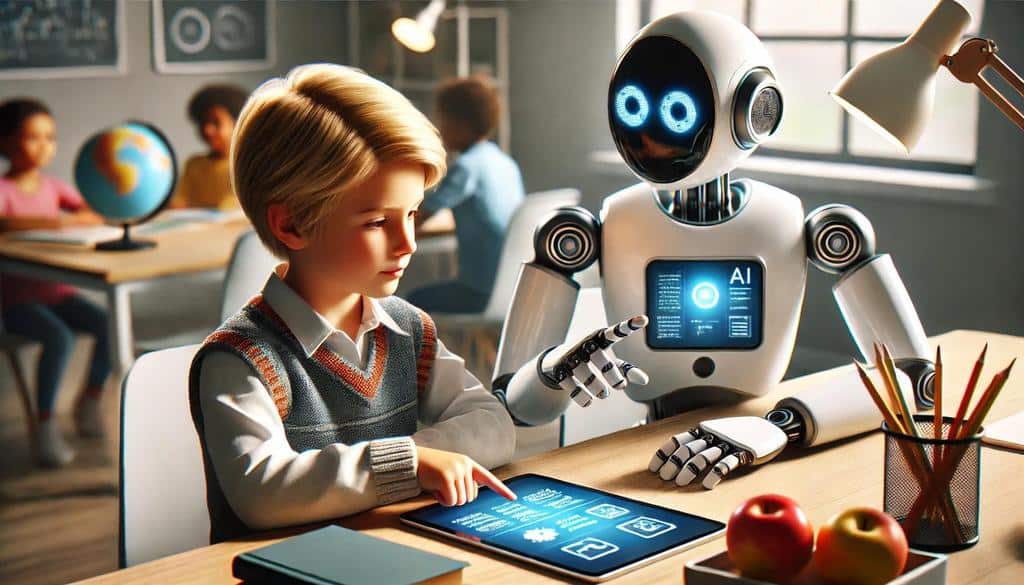
Picture this: a teacher and a robot working side by side to educate the next generation. That’s the possibility of AI in the classroom. With AI, teachers can now build customized lesson plans that cater to each student’s pace, closing knowledge gaps and firing up engagement. Math classes have traditionally been a one-way street, but AI learning methods are finally offering a way to drive education in the opposite direction, shaped around each individual student.
According to a 2023 report by EdTech Magazine, 60% of educators have already implemented AI technologies into their classrooms. This number is expected to grow as AI solutions become more sophisticated, helping students grasp complex concepts in mathematics through dynamic and interactive systems.
How AI Benefits Math Education
The advantages of using AI in math education are plentiful. Artificial intelligence for students is most effective for creating individualized learning paths, monitoring student progress in real time, and providing instant feedback. But let’s break this down further to see what that actually means in practice.
1. Personalized Learning Paths
Every student learns differently. Some excel in arithmetic but struggle with algebra, while others may grasp calculus but find geometry challenging. AI-based platforms like DreamBox and ALEKS use adaptive learning technologies to tailor math lessons to each student’s current ability level. These platforms analyze students’ responses, adjusting the difficulty and type of questions in real time.
2. Real-Time Feedback and Support
Math isn’t a subject that thrives on delayed feedback. Often, if a student doesn’t understand a concept, by the time they get help, it’s already too late to catch up. AI math education technologies are changing that. With real-time analysis, AI programs can spot mistakes the moment they happen and offer explanations or hints to help students understand why and how they went wrong.
For example, systems like Carnegie Learning’s MATHia software provide step-by-step explanations for students struggling with a problem. This ability to learn by doing—and being corrected in the moment—helps reinforce concepts. A 2024 report revealed that 75% of students felt more confident in math after using AI tutoring systems that offered instant feedback.
3. Automating Routine Tasks for Teachers
AI doesn’t just benefit students; it also makes life easier for teachers. Educators spend a considerable amount of time grading papers, assessing homework, and tracking student performance. These tasks are crucial but time-consuming. By using AI to automate administrative tasks like grading and attendance tracking, teachers can focus on more meaningful interactions with their students—such as providing personalized guidance, developing creative lesson plans, and offering emotional support.
According to a McKinsey report, between 20 and 40 percent of the hours teachers currently spend are devoted to tasks that could be automated with existing technology. This amounts to around 13 hours each week that educators could reallocate to activities that enhance student outcomes.
AI-Powered Tools Revolutionizing Math Education
1. Math Solver AI
Math AI is an AI-powered learning app that allows students to take a picture of a math problem and provides a detailed explanation of how to solve it. This math AI solver app doesn’t just give the answer; it teaches students how to arrive at the solution step by step. This encourages deep learning, making the application a powerful addition to any student’s toolbox.
2. Knewton’s Alta
Knewton’s Alta is an adaptive learning platform designed to provide personalized math instruction at the college level. It adjusts course materials in real time to focus on the topics that require more attention. This data-driven approach to education is making waves, particularly in higher education, where large class sizes can make individualized teaching difficult.
The Future of AI in Math Classrooms
Virtual reality (VR) and augmented reality (AR) are beginning to be combined with AI to create immersive learning environments where students can “visualize” complex math problems in three dimensions. Imagine learning geometry by actually “stepping into” the shapes or using AI avatars to guide you through abstract calculus problems.
Conclusion
As AI enters the math classroom, a silent revolution is underway. It’s changing the DNA of how students grasp complex ideas and how teachers guide them on that journey.
Students struggling with math can finally exhale – AI-driven learning platforms are here, complete with adapted lesson plans, feedback that’s both swift and spot-on, and behind-the-scenes support that steps in when needed.
For the education sector, the writing is on the wall – big changes are coming, and these will wield significant influence over the next chapter in educational history.


