
At Colegio Las Margaritas IED, a public school in one of Bogotá’s fastest-growing districts, the numbers tell a story most schools would consider impossible. According to the city’s Secretariat of Education, serious school coexistence incidents dropped 85 percent. Dropout fell below 1 percent. And reported bullying cases went to zero. The approach that delivered these results was not stricter discipline, more surveillance, or harsher penalties. It was a deliberate, school-wide pivot toward emotional well-being, peer-led conflict resolution, and dialogue as the default response to disagreement.
In July 2026, that work earned Las Margaritas a place among the World’s Best School Prizes top 10 finalists in the Supporting Healthy Lives category, run by the UK-based education organization T4 Education. It was the second Colombian school to be recognized in the prize within a year and the second in the Alianza Educativa network, a public-private partnership that has been quietly outperforming expectations in some of Bogotá’s most underserved neighborhoods since 2000.
This is the story of how a model developed inside a single classroom became a school-wide culture of well-being, what 25 years of research says about whether the approach actually works, and what it would take for any school in the world to try it.
A Bogotá School That Cut Bullying to Zero Without Punishment
Las Margaritas sits in the Bosa district of Bogotá, a sprawling southwestern neighborhood that has absorbed much of the capital’s population growth in recent decades. The school is part of Alianza Educativa, a nonprofit founded 25 years ago by the University of the Andes together with three of the city’s leading private schools. Alianza operates 11 public schools across Bogotá, serving more than 12,000 students, the majority in low-income districts where public education has historically struggled to retain students and contain conflict.
The numbers Las Margaritas reported in 2026 were not the result of a single initiative or a one-off campaign. They reflect the school’s Socio-Emotional Refuge model, a program built into daily classroom life, not layered on top of it. According to figures shared by the Bogota Secretariat of Education and reported by Colombia One:
- Serious school coexistence incidents fell by 85 percent after the model was implemented.
- Dropout remained below 1 percent, an extraordinary figure for a public school in a high-mobility district.
- Reported bullying cases were reduced to zero.
- More than 150 students have been trained as peer mediators through the Bogota Chamber of Commerce’s Hermes Program, giving classmates the skills to help resolve disputes before they escalate.
What is striking is the mechanism. Las Margaritas does not rely primarily on disciplinary sanctions, suspensions, or expulsions. Instead, it teaches students to recognize emotions, resolve disagreements through structured mediation, and build healthy relationships before conflicts become incidents. Teachers, counselors, and trained student mediators all play a role, and the program runs throughout the academic year, not as a one-off workshop.
As Diana Basto, executive director of Alianza Educativa, put it when the nomination was announced, the recognition shows that academic excellence and student well-being can advance together. Julia Rubiano, Bogotá’s Secretary of Education, framed it as evidence that strengthening students’ emotional development alongside classroom instruction is not a luxury but a foundation.
Inside the Socio-Emotional Refuge Model
The Socio-Emotional Refuge model is the operational heart of Las Margaritas’s approach. While the specific terminology is the school’s own, the framework maps directly onto the broader social and emotional learning (SEL) field, and most of its components have been studied independently for decades. In practice, the model rests on four interlocking practices.
1. Daily emotional vocabulary and recognition. Students are taught to identify what they are feeling and to name it, not as a clinical exercise, but as a routine part of classroom interaction. This corresponds to the self-awareness domain in the leading research frameworks, and it gives children the language they need to ask for help before a small frustration becomes an outburst.
2. Peer mediation in everyday disputes. Conflicts between classmates are not sent straight to the principal’s office.

Instead, trained student mediators (150 and counting at Las Margaritas, certified through the Bogota Chamber of Commerce) help their peers work through disagreements using a structured process. A 2016 study in the Spanish Journal of Psychology found that peer mediation programs significantly improved school climate and reduced negative peer roles, and a separate meta-analysis of school-based mediation programs reported a 93 percent agreement rate between mediated parties and 88 percent participant satisfaction.
3. A relationship-first response to conflict. When a serious incident does occur, the school leans on relationship repair rather than exclusion. This is similar to the “upstander” framework, where bystanders are trained to intervene, and to the broader restorative practices movement. At Chester A. Arthur School in Philadelphia, a 2023 World’s Best School Prizes finalist, a similar approach cut out-of-school suspensions from nearly 8 percent of students to almost zero.
4. Adult presence and continuity. Teachers and counselors are not absent during conflict. They are trained, supervised, and integrated into the model, so the school-wide system of support does not depend on a single charismatic administrator. Alianza Educativa’s broader network of 11 schools runs on the same logic: the model is institutional, not individual.
Alianza also reports that the approach has supported academic outcomes, placing Las Margaritas among Bogotá’s highest-performing public schools on standardized measures. That finding aligns with a large body of SEL research showing that students who participate in well-designed programs perform better academically, not worse.
The World’s Best School Prizes: What the Category Measures
The World’s Best School Prizes are run annually by T4 Education, a UK-based organization that works to elevate teaching and school leadership globally. The prizes recognize schools whose initiatives address major educational challenges while advancing the United Nations Sustainable Development Goals. There are five categories: Community Collaboration, Environmental Action, Innovation, Overcoming Adversity, and Supporting Healthy Lives. Ten schools are shortlisted in each category, and a Community Choice Award is decided by public vote.
Las Margaritas was one of 10 finalists in the 2026 Supporting Healthy Lives category. The other 2026 finalists in that category, drawn from thousands of applications worldwide, illustrate how broadly the prize defines “healthy lives” in a school setting:
- Government Girls Senior Secondary School NIT-5, Faridabad, India: a government school supporting at-risk girls through nutritional programs, physical and mental health services, and community engagement.
- Applied Technology School Sharjah, UAE: a public secondary school recognized for a student-designed smart food dispensing system that links student health records to healthier choices.
- Seth Anandram Jaipuria School, Lucknow, India: another Indian school in the top 10 for Supporting Healthy Lives, focused on student well-being initiatives.
- Avanti House Secondary School, London, UK: a state Hindu secondary school integrating yoga, meditation, ethics, and vegetarian nutrition into a values-based curriculum that achieved a 97.6 percent attendance rate.
These programs are not identical. The Indian schools are focused on nutrition, gender equity, and basic health access. The UAE school used emerging technology. The UK school used spiritual practice. Las Margaritas focused on emotional well-being and peer mediation. What unites them is the recognition that a school is not just a place to deliver academic content, but a system that shapes whether children are physically safe, emotionally supported, and able to learn.
Earlier in 2026, another Colombian school, Institución Educativa Jose Asuncion Silva in Medellín, was also recognized in the World’s Best School Prizes. Together, the two recognitions suggest Colombia is emerging as a hub for SEL-focused school innovation, an unusual development for a country more often associated with education-access challenges than with education-quality leadership.
The CASEL Framework: What 25 Years of Research Says About SEL
Las Margaritas’s model is one local expression of a global field. The most widely used framework in that field comes from the Collaborative for Academic, Social, and Emotional Learning (CASEL), a Chicago-based organization that has been defining and studying SEL since 1994.
CASEL’s framework organizes social and emotional learning around five core competencies, all of which can be traced in what Las Margaritas does:
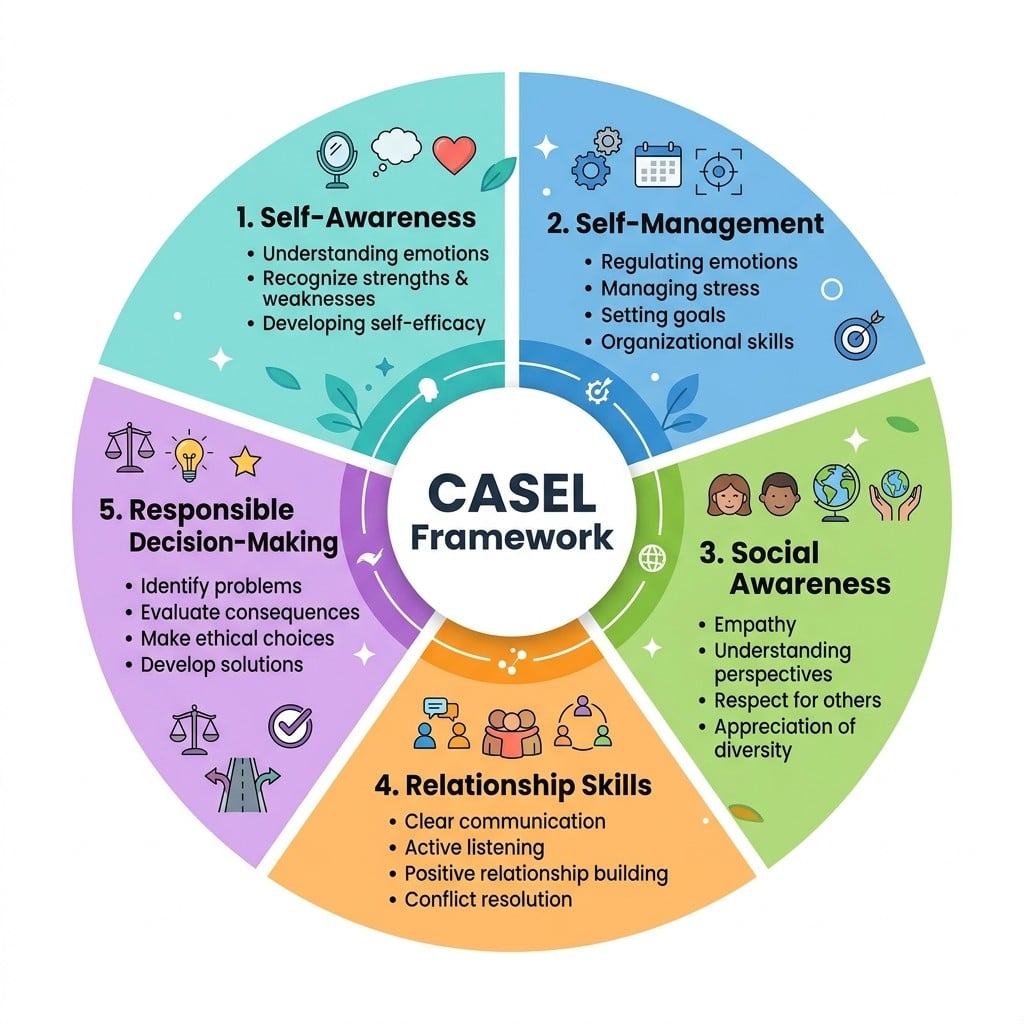
- Self-awareness: the ability to understand one’s own emotions, thoughts, and values, and how they influence behavior.
- Self-management: the ability to manage emotions, thoughts, and behaviors effectively in different situations.
- Social awareness: the ability to understand the perspectives of others and empathize across differences.
- Relationship skills: the ability to establish and maintain healthy, supportive relationships.
- Responsible decision-making: the ability to make caring and constructive choices about personal behavior and social interactions.
What does the research say about whether these competencies actually change outcomes? A great deal. A landmark 2011 meta-analysis by Durlak and colleagues, covering more than 270,000 students across 213 school-based SEL programs, found that participants showed significantly improved social and emotional skills, attitudes, behavior, and academic performance, with an average 11 percent gain in academic achievement. A separate CASEL review reported that students in SEL programs had better social skills than 76 percent of students in comparison groups, an average 23 percentage point gain in social-emotional skills.
The broader picture is consistent. A 2025 systematic review of SEL programs published in PMC found positive effects on overall academic achievement (effect size g = 0.08), with stronger effects in middle school (g = 0.122) and on grade point average (g = 0.33). A 2021 meta-analysis of school-based anti-bullying programs, also in PMC, found that effective programs reduced bullying perpetration by 18–19 percent and victimization by 15–16 percent.
These are not miracle numbers. They are modest, reliable gains across thousands of studies and millions of students. But modest, reliable gains, applied across an entire school system, can shift outcomes at a population scale. That is the case for SEL: not a silver bullet, but a foundation.
Critics of SEL, often organized around parental-rights concerns in the United States, argue that the field intrudes on family authority or pushes a particular political worldview. Those criticisms have surfaced in school board fights in multiple U.S. states and have led some districts to scale back SEL programming. The research evidence does not support the most extreme versions of those critiques, but it does suggest that SEL works best when it is implemented transparently, with parents and communities as partners, not as a covert curriculum.
The Alianza Educativa Model: How a Public-Private Partnership Runs 11 Bogotá Schools
What makes Las Margaritas especially worth studying is that it is not an isolated success story. It is part of a network. Alianza Educativa was founded in 2000 by four Bogotá institutions: the University of Los Andes, Colegio Los Nogales, Colegio San Carlos, and Gimnasio La Montaña. Its purpose was simple and ambitious: to demonstrate that a collaboration between elite private education and the public sector could deliver high-quality education to children in some of Bogotá’s most underserved neighborhoods.
Twenty-five years later, Alianza administers 11 public schools in Bogotá, serving more than 12,000 students, primarily in the districts of Kennedy, Bosa, Usme, and Las Cruces.

According to the organization’s own reporting and external profiles, its five oldest schools are all ranked among the top 20 public schools in Bogotá (out of approximately 400), and three of them are in the city’s top 10. The network has received the Orden de la Democracia Simón Bolívar from the Colombian Congress, one of the country’s highest civic honors.
But the most telling data point is this: in 2024, another Alianza Educativa school, Colegio La Giralda in the Las Cruces district, was named a Top 3 finalist in the World’s Best School Prizes Supporting Healthy Lives category. La Giralda’s Socio-Emotional Gymnasium model, built around integrating physical activity with socio-emotional learning, achieved a 67 percent reduction in school coexistence issues and kept dropout rates below 1 percent. Two Alianza schools, two different SEL models, both recognized internationally in consecutive years. That is not a coincidence. It is what a designed system produces.
The Alianza model rests on a few explicit principles, drawn from the organization’s own communications and from a 2026 retrospective published by the University of the Andes:
- Private-public complementarity. Top private institutions contribute pedagogical expertise, teacher training, and management know-how. The public sector provides the schools, the students, and the long-term contract.
- Constructivist, socio-emotional pedagogy. Alianza schools use a constructivist teaching model that explicitly develops both academic and socio-emotional competencies.
- Continuous teacher development. Teachers are not hired and left alone. They receive ongoing training in SEL methods, restorative practices, and the network’s specific frameworks.
- Long time horizons. Alianza has been at this for 25 years. Its leadership explicitly frames the work as building something durable, not running a pilot.
For an international audience, the most useful comparison is the British academy chain model, where groups of schools share governance, training, and curriculum across multiple sites. Alianza is similar in structure but operates in a public-private hybrid that most U.S., U.K., and European readers have not encountered. The lesson it offers is that SEL is not a soft add-on. It works best when it is built into a school’s operating system, with the institutional support to sustain it across staff turnover and political cycles.
For U.S. readers in particular, this matters because the country has been debating SEL aggressively. The collaborative work of teachers, counselors, and outside partners is part of why social workers and teachers working together tends to produce stronger student outcomes than either group working alone. A 2025–2026 wave of state legislation in places like Florida, Louisiana, and Texas has either restricted or required parental opt-in for SEL programming. The Alianza model suggests a different framing: SEL is not a curriculum imposed on children, but a way of running a school that produces measurable gains in attendance, behavior, and learning. That framing has not yet been tested in U.S. school choice debates.
Can the Las Margaritas Model Be Replicated?
The honest answer is yes, with effort, and with the right conditions. A school outside Bogotá that wanted to build something like Las Margaritas’s Socio-Emotional Refuge would need to do five things, each of which is hard but not impossible. Schools that want to do this kind of work typically benefit from having school psychologists embedded in the team from the start, since socio-emotional programming and mental health support are closely linked.
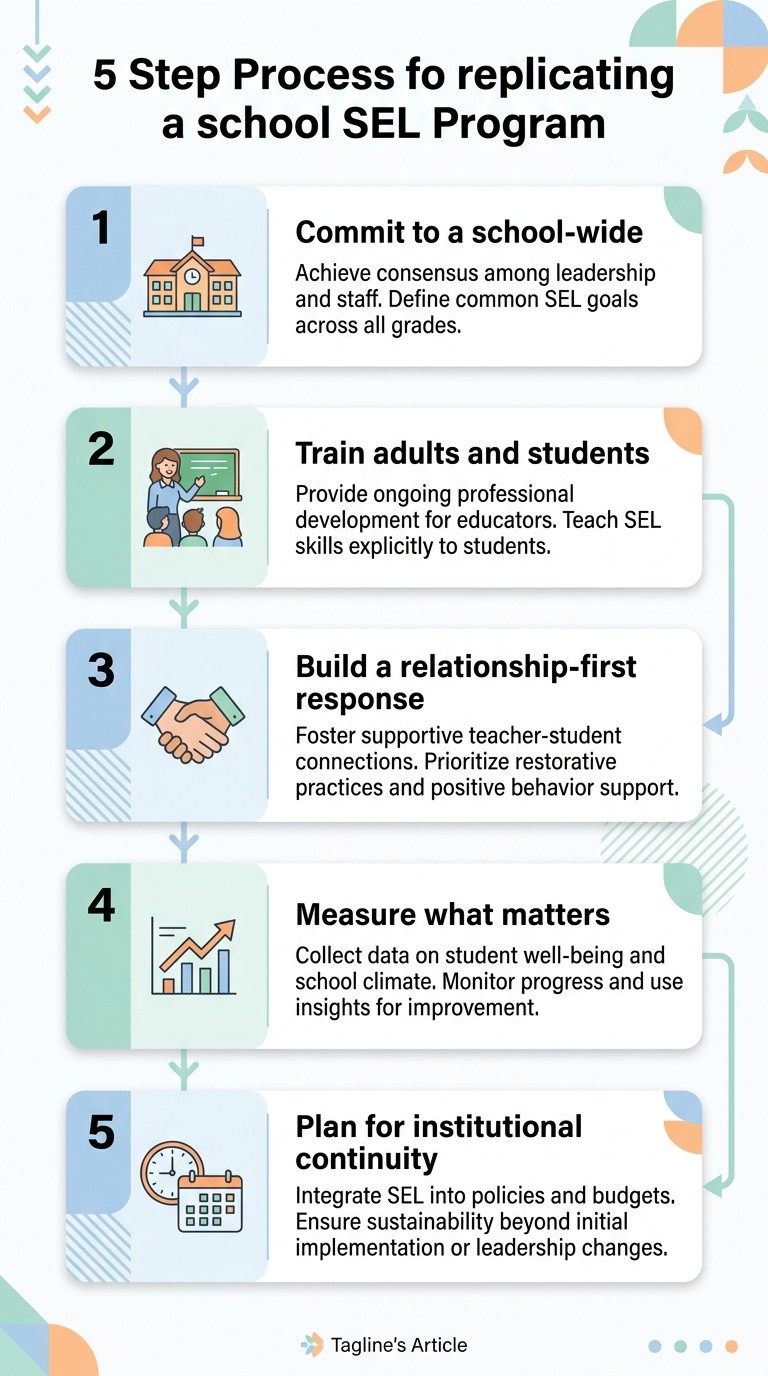
- Commit to a school-wide model, not a pilot. SEL works best when it is integrated into how the school operates, not run as a single class or a single semester. The Durlak meta-analysis found that successful programs used what researchers called SAFE practices: Sequenced, Active, Focused, and Explicit. A one-off anti-bullying assembly is not a SAFE program. A school-wide daily practice is.
- Train adults and students together. Peer mediation only works if the adults trust it and the students are competent at it. Las Margaritas’s 150+ trained student mediators came from a structured program with the Bogota Chamber of Commerce, not from a one-day workshop.
- Build in a relationship-first response to conflict. When something goes wrong, the school’s default move should be repair, not punishment. Chester A. Arthur School in Philadelphia cut suspensions from 8 percent to almost zero by doing exactly this. The principle is the same in Bogotá as in Philadelphia.
- Measure what matters. Las Margaritas’s case is powerful precisely because Alianza measured the outcomes: coexistence incidents, dropout, bullying reports. Without those numbers, the model would be a story; with them, it is evidence. Any school adopting this approach should commit to tracking both behavior and academic outcomes over multiple years.
- Plan for institutional continuity. Alianza has survived 25 years because it is institutionally embedded, not personality-dependent. Schools that try to replicate a model often lose it when the principal leaves. Alianza’s structure (a multi-stakeholder nonprofit with a long-term contract) protects against that. A replication effort should think about governance, not just classroom practice.
There are also three honest barriers. First, peer mediation requires a critical mass of trained students, which is hard in very small schools. Second, restorative practices can be misused as a soft option for serious behavior; effective programs distinguish clearly between low-level conflict (where mediation is appropriate) and harm (where adult intervention is required). Third, SEL programming is vulnerable to political backlash in places where “social and emotional learning” has become a culture-war flashpoint. Alianza’s success was made possible by a stable local political environment and a long-term contract; neither is guaranteed everywhere.
None of those barriers is fatal. They are the normal cost of doing serious work with children. And the cost of not doing it, measured in dropout rates, bullying incidents, and lost academic potential, is far higher.
Frequently Asked Questions
What is social emotional learning in schools?
Social and emotional learning (SEL) is the process through which children and adults acquire and apply the knowledge, skills, and attitudes needed to manage emotions, achieve goals, feel and show empathy, establish supportive relationships, and make responsible decisions. The most widely used framework is the CASEL model, which organizes SEL around five core competencies: self-awareness, self-management, social awareness, relationship skills, and responsible decision-making. SEL is typically delivered as part of the regular school day, integrated into classroom routines, school culture, and adult-student relationships, rather than as a standalone subject.
How do SEL schools differ from regular schools?
Schools that fully implement SEL do not look dramatically different from the outside. What changes is the daily operating logic. Discipline leans toward repair and mediation rather than punishment. Students are taught to name emotions as a normal part of classroom interaction. Adults are trained to respond to conflict as a teaching opportunity. Academic instruction continues, but it is supported by a layer of explicit work on the social and emotional skills that make learning possible. The result, in the research, is modest but reliable gains in academic performance, behavior, and attendance.
What are the criticisms of SEL?
Critics, particularly in the United States, argue that SEL encroaches on parental authority, introduces political or values-based content into public schools without adequate transparency, or is used to avoid addressing more concrete issues like school safety and academic rigor. Some have raised concerns about age-appropriate content and the training of teachers. Most of these critiques focus on how SEL is implemented, not on the underlying competencies themselves. The research consensus is that high-quality SEL programs are effective and do not harm academic outcomes, but that implementation quality, parent communication, and political context all matter.
What are some examples of SEL programs?
Real-world examples of effective SEL programs include the Socio-Emotional Refuge model at Colegio Las Margaritas IED in Bogotá (a peer mediation and emotional well-being program that helped eliminate reported bullying), the Socio-Emotional Gymnasium at Colegio La Giralda in Bogotá (which combined physical activity with socio-emotional learning and reduced coexistence incidents by 67 percent), the Mabasta student-led anti-bullying program at Istituto Galilei-Costa-Scarambone in Italy (which has reached 35,000 students), and the restorative practices program at Chester A. Arthur School in Philadelphia (which cut out-of-school suspensions from 8 percent to nearly zero). Internationally recognized frameworks like CASEL’s five-competency model are also widely adopted as the basis for both school-wide and classroom-level programs.
The Takeaway
Colegio Las Margaritas IED is not a miracle. It is a school that has done, systematically and for years, what decades of research says works: it has built a culture in which students are taught to understand themselves, to resolve conflict without violence, and to support one another. The fact that this work is now visible on a global stage, through the World’s Best School Prizes, matters because it puts a public, low-income, Latin American school in conversation with elite private institutions, with international NGO frameworks, and with the broader evidence base on what helps children learn.
The bigger story is not Las Margaritas alone. It is the Alianza Educativa network that produced it, and the broader question of whether the rest of the world’s school systems are willing to invest in the slow, unglamorous, evidence-based work of teaching children how to be human to one another. The research is clear. The model is replicable. The question is whether there is the patience to do it.


