
Within the streets of global metropolises, the climate transition has shifted from a distant policy goal into a tangible, local reality. It is unfolding at the scale of neighborhoods, buildings, and even individual heating systems. Utility providers globally now purchase flexibility from residential and commercial properties to reinforce and stabilize aging local power grids. Neighborhood microgrids are enabling residents to trade rooftop solar with each other. Large cities such as Tokyo and New York are placing firm carbon caps on buildings and attaching real financial consequences to emissions.
Taken separately, these developments look like technical reforms or policy tweaks. Taken together, they resemble the early blueprint of something larger: a local climate exchange. In such a system, buildings could trade not just electricity but also heating flexibility and verified carbon performance within city boundaries.
Local climate exchanges evolve naturally from existing clean energy market trends, mirroring infrastructure shifts that previously modernized global power systems. Market shifts driven by clean energy integration demonstrate how policy, finance, and technology interact to modernize grid infrastructure. Strategic urban renewable energy planning determines which municipal assets are eligible to participate in these emerging local exchanges.
Rather than inventing a new market from scratch, cities may simply need to connect the systems they already operate.
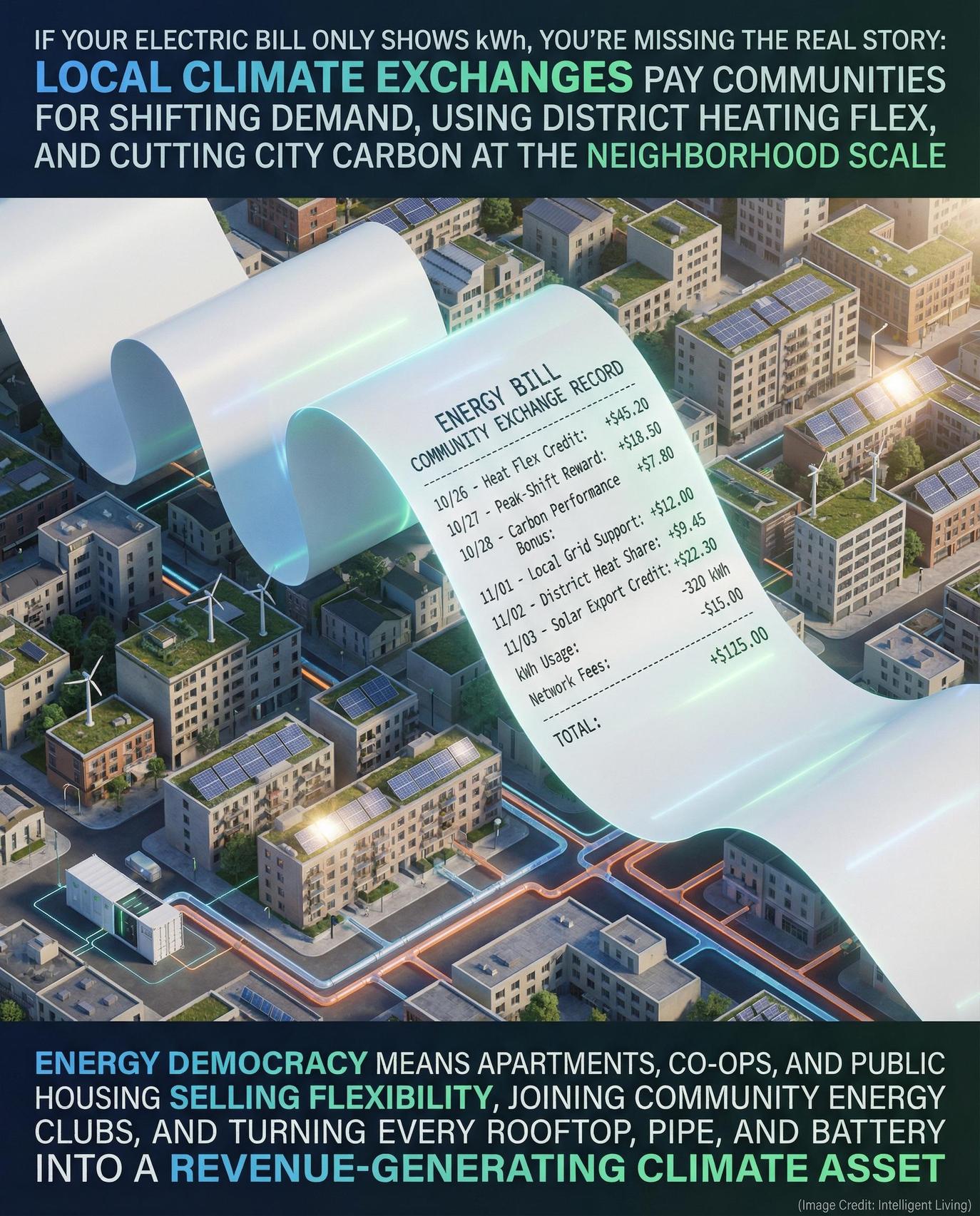
Fast Facts: Global Progress in Municipal Energy Flexibility
- Local flexibility markets in Europe allow distribution system operators to buy flexibility from buildings, advanced battery energy storage systems, electric heating systems, and electric vehicles to manage grid congestion and peak demand.
- Nordic countries have integrated large heat pumps and electric boilers into district heating systems, adding substantial flexible capacity that can respond to market signals.
- The Brooklyn Microgrid has demonstrated peer-to-peer energy trading within a neighborhood microgrid environment, mirroring the technical resilience of independent solar-powered highway stations that operate entirely off the main grid.
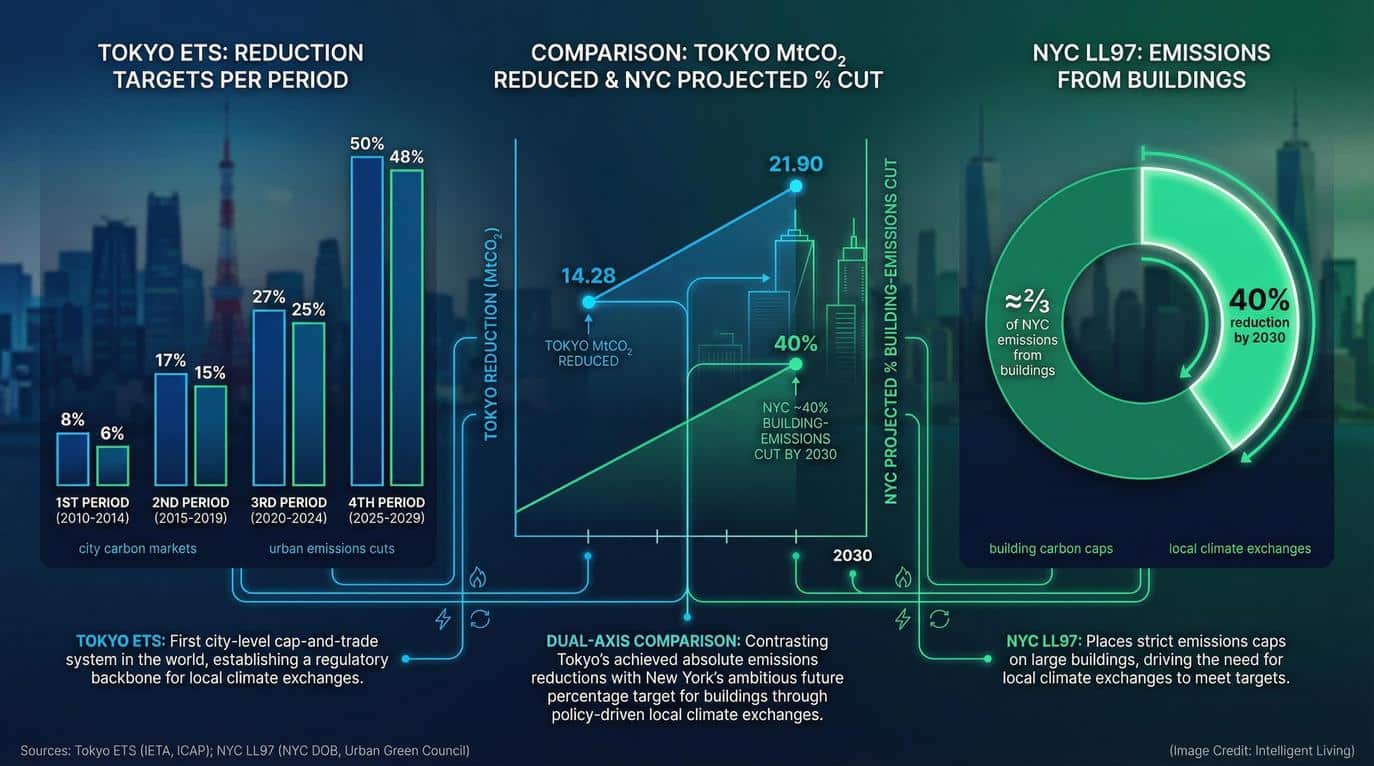
- Tokyo operates a city-level emissions trading system that covers large buildings and industrial facilities.
- New York City’s Local Law 97 places carbon caps on roughly 50,000 buildings and introduces financial penalties for exceeding emissions limits.
- Community-based models such as Energy Local clubs in the United Kingdom report electricity bill savings of up to 30 percent for participating members.
Building the Foundation: How Major Cities Pioneer Local Climate Markets
Across Europe, local flexibility markets have become an important tool for managing the rapid growth of distributed energy resources. Data regarding the role of local grid flexibility reveal how these mechanisms reduce the need for expensive infrastructure reinforcement.
At the community scale, peer-to-peer models such as Brooklyn Microgrid and similar pilots in Switzerland demonstrate that households can trade locally generated energy through transparent digital interfaces. While participation requires smart metering and regulatory approval, the core technology and settlement mechanisms are already operational.
Operational successes in Europe and North America prove that the core economic pillars of a municipal climate exchange are ready for integration today. These economic pillars currently exist in modular form across various global markets.

Thermal Innovation: Leveraging Heat Flexibility for Urban Decarbonization
Heat flexibility serves as the foundational pillar of any successful local climate exchange. In cold climates, winter heating drives peak electricity demand, especially as buildings transition from fossil fuel boilers to electric heat pumps.
Industrial-scale river-sourced heat pump projects anchor long-term urban decarbonization by replacing fossil fuel dependencies with sustainable thermal alternatives. These projects provide a model for cities looking to replace fossil fuel dependencies with sustainable thermal alternatives.
Integrating District Heating and Thermal Storage
Nordic experience shows how electrified district heating systems can function as flexible assets. Large heat pumps and electric boilers can shift operation to periods of lower electricity prices or higher renewable output, maximizing the use of electrified district heating assets to shift operation during periods of lower electricity prices.
Integrating long-duration sand battery storage into district heating networks allows cities to store surplus heat for use during periods of high demand. The Sthlmflex pilot in Stockholm integrates these resources into local flexibility markets, allowing district energy systems to respond dynamically to grid constraints.
For a local climate exchange, heat flexibility would be central. Buildings could earn compensation for verified shifts in heating or cooling demand during constrained periods, provided occupant comfort remains within acceptable bounds. This transforms heating systems from static loads into market participants.

Redefining Urban Energy: The Emergence of Local Climate Exchanges
Urban carbon policy has already created the regulatory backbone for local carbon trading. The Tokyo metropolitan emissions trading scheme requires large commercial buildings to meet rigorous reduction targets or acquire allowances. The program has operated for over a decade and is widely regarded as one of the first city-scale carbon markets.
New York City’s mandatory building carbon intensity limits introduce escalating standards that force property owners to prioritize emissions performance. For building owners, carbon performance is no longer symbolic. It has financial implications.
Verifying Building-Level Carbon Performance
Municipalities can move away from distant, unverified offsets by tying climate credits to measurable local actions. This strategy ensures that environmental and economic benefits remain within the community.
- Deep energy retrofits for aging building stock
- On-site renewable generation through residential and commercial solar
- Optimization of electrified district heating networks
- Restored urban forest ecosystems that naturally lower energy demand while storing city-generated carbon
Implementing these localized measures creates a transparent marketplace for verified emissions reductions. This approach keeps climate value inside the city walls while fostering local energy democracy.
Empowering Communities: Energy Democracy and Local Wealth Retention
Market architecture dictates the distribution of benefits, ensuring that local climate exchanges prioritize equitable wealth distribution. Community-oriented models offer important lessons. In the United Kingdom, Energy Local clubs connect residents to nearby renewable generation and encourage flexible energy use. Households participating in community-based energy cooperatives achieve electricity bill savings of up to 30 percent while supporting local renewable assets.
Prioritizing Environmental Justice in Local Markets
Neighborhood-focused energy systems keep financial value circulating within the local economy instead of funneling profits to outside intermediaries. Building public trust requires prioritizing inclusive sustainability policy frameworks that link aggressive climate action directly to environmental justice and local well-being.
Implementing carbon-aware digital coordination allows smart cities to use AI and IoT timing to slash emissions through automated demand response. The same types of coordination can support equitable participation in local climate exchanges, provided governance structures prioritize renters, small businesses, and public housing alongside large property owners.

Ensuring Integrity: Regulatory Guardrails against Urban Greenwashing
Any market that trades environmental value must confront the risk of greenwashing. Lessons from carbon markets highlight the importance of rigorous measurement, reporting, and verification, and the rise of companies falsely claiming to be eco-friendly under greenwashing scrutiny emphasizes that public trust evaporates when climate performance is not backed by evidence.
Safeguarding the integrity of a local climate exchange requires a series of uncompromising regulatory standards. These protocols ensure that environmental claims translate into tangible atmospheric benefits.
Operational Transparency and Verification Standards
- Strict baselines for all flexibility services provided by buildings
- Transparent digital settlement mechanisms for every transaction
- Firm caps on how much purchased credit can offset a building’s compliance obligation
These guardrails prevent the system from becoming a greenwashing engine. High-quality measurement and verification must underpin every trade to maintain public trust.
Implementation Strategies: Real-World Roadmaps for City-Scale Pilots
Municipalities can choose from several implementation models based on their existing infrastructure and climate goals.
- Heat-Flex Integration (Nordic Model): Cities with established district heating can layer exchanges onto markets like the Sthlmflex pilot in Stockholm to reward buildings for verified heat demand shifts and support city-level carbon compliance.
- Neighborhood Microgrid Resilience: A microgrid district modeled on Brooklyn Microgrid can expand beyond electricity trading to include resilient community-owned microgrids and small-scale, locally verified carbon reductions.
- Carbon-First Overlay: Cities with existing building carbon caps like Tokyo or New York can introduce a controlled trading layer where buildings exceeding standards sell limited performance credits to underperforming buildings, backed by verified local reductions.
These frameworks allow cities to pilot market mechanisms within defined boundaries before scaling to a city-wide level.

The Local Advantage: Long-Term Benefits for Renters and Property Owners
For renters, a local climate exchange could translate into buildings that actively manage heating and electricity use to reduce costs and emissions, potentially stabilizing long-term operating expenses.
Building owners who prioritize early investments in efficiency and electrification can unlock new revenue streams within city-managed markets, aligning with the transition toward green home building in New York City that treats carbon performance as a core part of real estate value, where building carbon performance is treated as a core component of asset value.
For city governments, connecting existing flexibility markets and carbon caps into structured exchanges could accelerate emissions reductions without waiting for national reforms and complement large-scale iron-air batteries built for grid-scale flexibility designed to provide grid-level flexibility and stabilize renewable power supplies.
Defined net-zero industrial transition pathways indicate that infrastructure transitions often unfold incrementally through municipal pilots before reaching mainstream policy status. Local climate exchanges may follow the same path, evolving from pilots to mainstream urban policy.
Pathways to Resilience: Scaling Integrated Municipal Climate Markets
Evolving from passive consumption to active market participation, city infrastructure is now entering the next frontier of urban climate policy. As cities refine their building carbon caps and expand local flexibility markets, the integration of these systems into a unified exchange becomes a logical necessity rather than a radical experiment.
Success in this arena requires more than just technical precision; it demands transparent governance and a commitment to keeping climate value circulating within the city walls. Metropolises embracing this model can accelerate their journey toward net-zero pathways while insulating residents from the volatility of global energy markets.
Local climate exchanges offer a scalable, replicable framework for urban decarbonization that turns every skyscraper and apartment block into a stakeholder in the planet’s future. The pieces of this puzzle are already on the table—the task now is for cities to connect them into a cohesive, resilient whole.

Essential Guide to Municipal Climate Market Participation
How can a building earn revenue through a local climate exchange?
Assets generate financial value through verified energy flexibility—shifting thermal or electrical demand during peak periods—and through the achievement of municipal carbon performance standards that allow for credit sales.
What role do building carbon caps play in this system?
Carbon intensity limits, like New York’s Local Law 97, provide the regulatory floor. The exchange layers a marketplace on top of these rules, rewarding buildings that cut emissions faster than required.
Will energy democracy lead to lower bills for residents?
Yes. Participating in neighborhood-scale flexibility markets allows residents to reduce peak demand costs and keep financial rewards within the community rather than paying distant utility providers.
How do cities verify that carbon reductions are real?
Verification depends on rigorous measurement, reporting, and verification (MRV) protocols, integrated with smart metering to ensure every credit mirrors a real atmospheric reduction.
Is my city ready to start a climate exchange pilot?
If your city already manages district heating systems, building emissions trading, or local grid flexibility programs, the foundational infrastructure is likely already in place to begin integration.


