
Harnessing the immense rotational kinetic energy of our planet has long been a pursuit relegated to the fringes of theoretical physics and speculative fiction. However, a provocative new study is challenging the established boundaries of classical electromagnetism by suggesting that Earth’s constant spin through its own global magnetic field can be converted into a measurable electrical current.
Fixing a specialized hollow cylinder to the ground allowed researchers to detect a subtle but steady direct current, sparking a heated debate over whether a long-overlooked loophole in physical law truly exists.
Experimental milestones of this nature do not promise to power global cities overnight, but they do invite us to rethink the reservoirs of ambient energy surrounding us. While the measured output remains in the microvolt range—far below the threshold of everyday utility—the implications for low-power physics and long-term scientific understanding are profound.
As the global shift toward diversified renewable sources accelerates, examining these subtle electromagnetic interactions offers a rare glimpse into the future of unconventional power generation and the diversified clean energy technologies currently reshaping the global energy landscape.
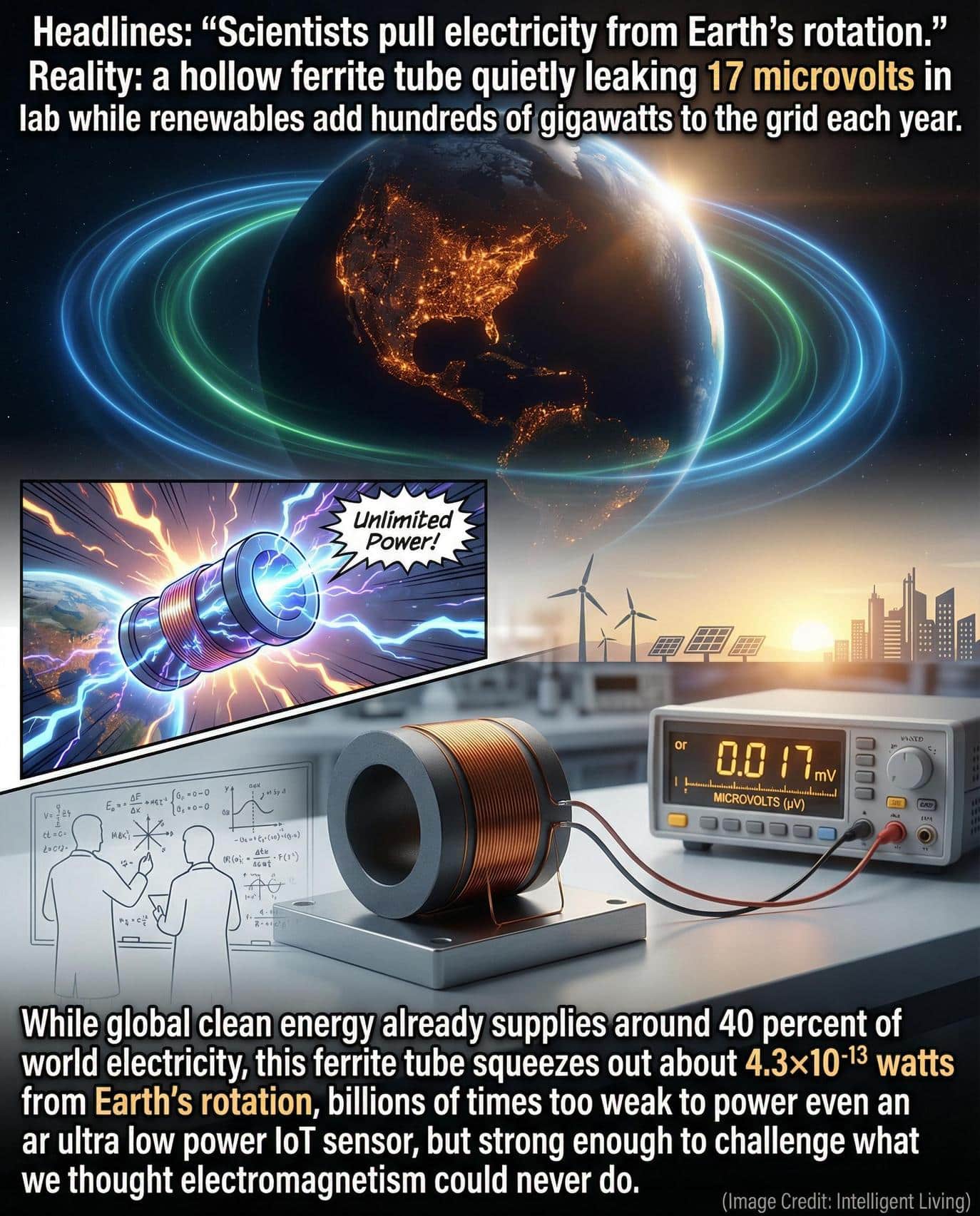
Harnessing Planetary Motion: The New Frontier of Earth Rotation Energy
Core Findings: The 17-Microvolt Earth Rotation Experiment at a Glance
- Christopher Chyba and Kevin Hand led the research team behind this experiment. Their findings were subsequently published in the journal Physical Review Research.
- The device was a hollow cylinder made of manganese zinc ferrite, a soft magnetic ceramic material.
- The team measured a continuous direct current voltage of roughly 17 to 18 microvolts.
- The signal depended on the device’s orientation relative to Earth’s magnetic field and reversed sign when rotated 180 degrees.
- Critics argue that the effect may still be explained by conventional electromagnetic processes and are calling for independent replication.
- Even if scaled dramatically, the estimated impact on Earth’s rotation would be about 7 milliseconds per century, comparable to natural tidal variations.
Analyzing the Hype: Does Earth’s Spin Really Generate Usable Electrical Power?
Headlines announcing that scientists have pulled electricity from Earth’s rotation spread quickly across science media. As analyzed in recent science news reports, the laboratory device appeared to generate power simply by remaining fixed on a spinning planet immersed in its own magnetic field.
To anyone following energy trends, the core concept seems revolutionary at first glance. Earth rotates once every 24 hours. Planetary rotation drives the churning molten iron deep within the core, sustaining a powerful global magnetic field that envelops the Earth.
In basic physics classes, students learn that moving a conductor through a magnetic field can induce a current. That principle powers traditional generators in coal plants, hydroelectric dams, and wind turbines.
The Fundamental Difference Between Turbines and Planetary Spin
Mechanical actions within a spinning turbine differ fundamentally from the steady, planetary rotation of Earth. Laboratory devices used in this study did not cut through magnetic field lines in the conventional sense. It was rigidly attached to Earth itself. For decades, physicists believed that any induced forces would be canceled internally by charge redistribution, preventing a steady flow of usable current.
Viral narratives often gloss over a pivotal nuance regarding the actual scale of the power produced. Voltage levels measured during the experiment hovered around 17 microvolts. That is millions of times smaller than the voltage required to power household electronics. Scientific implications focus less on free energy for cities and more on whether a subtle theoretical loophole may exist in classical electromagnetic reasoning.
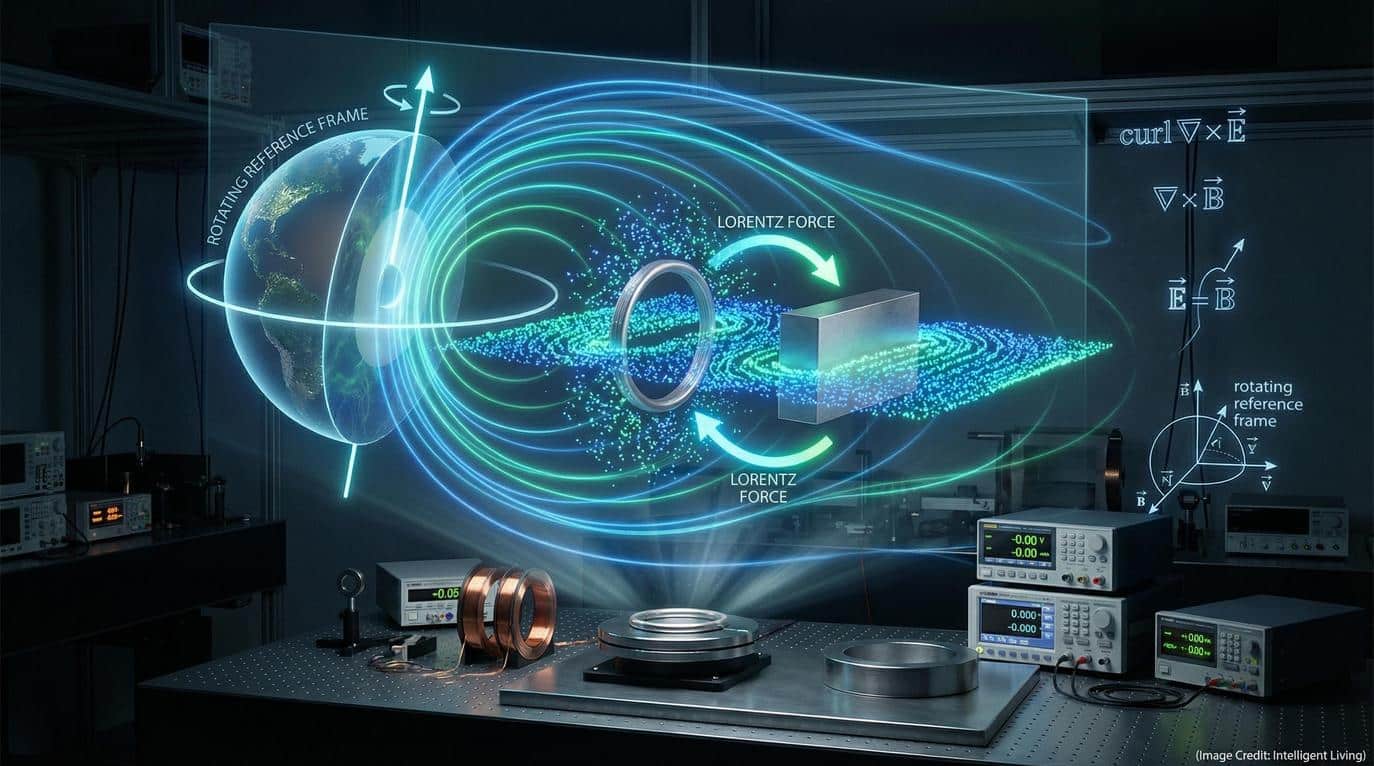
Electromagnetic Theory: Why Static Devices Typically Fail to Harvest Earth’s Spin
Grasping the nature of this dispute involves revisiting the core mechanics of electromagnetic induction.
When a metal wire moves through a magnetic field, electric charges inside it experience a force known as the Lorentz force. This force pushes electrons in one direction to create a voltage difference, a process driven by mechanical motion in a typical generator.
Challenging the Lorentz Force Cancellation
When a complete conducting system rotates in tandem with the planet, the physics of charge redistribution come into play. Rearranging these charges creates an internal electric field that cancels the original force, leading to no continuous power output. For more than a century, this reasoning was treated as effectively settled.
Researchers conducting a theoretical analysis of rotation-based power in 2016 suggested that standard cancellation might not apply under certain conditions. The research proposed that specific hardware configurations could bypass traditional electromagnetic limits:
- Specific geometries that prevent full charge redistribution.
- The use of soft magnetic ceramic materials like ferrite.
- Hollow shell architectures that interact uniquely with the field.
Theoretical models provided by the team suggest that a hollow shell interacts with Earth’s magnetic field quite differently than a solid block. Academic resistance to the proposal was immediate. Issuing a formal physics refutation, Jean Jeener insisted that fundamental symmetry arguments still rule out continuous power generation.
The debate continued in the pages of peer-reviewed journals. The central question became simple and sharp: Does Earth’s rotation through its own magnetic field allow a static device to generate steady electrical power, or do established electromagnetic principles forbid it entirely?
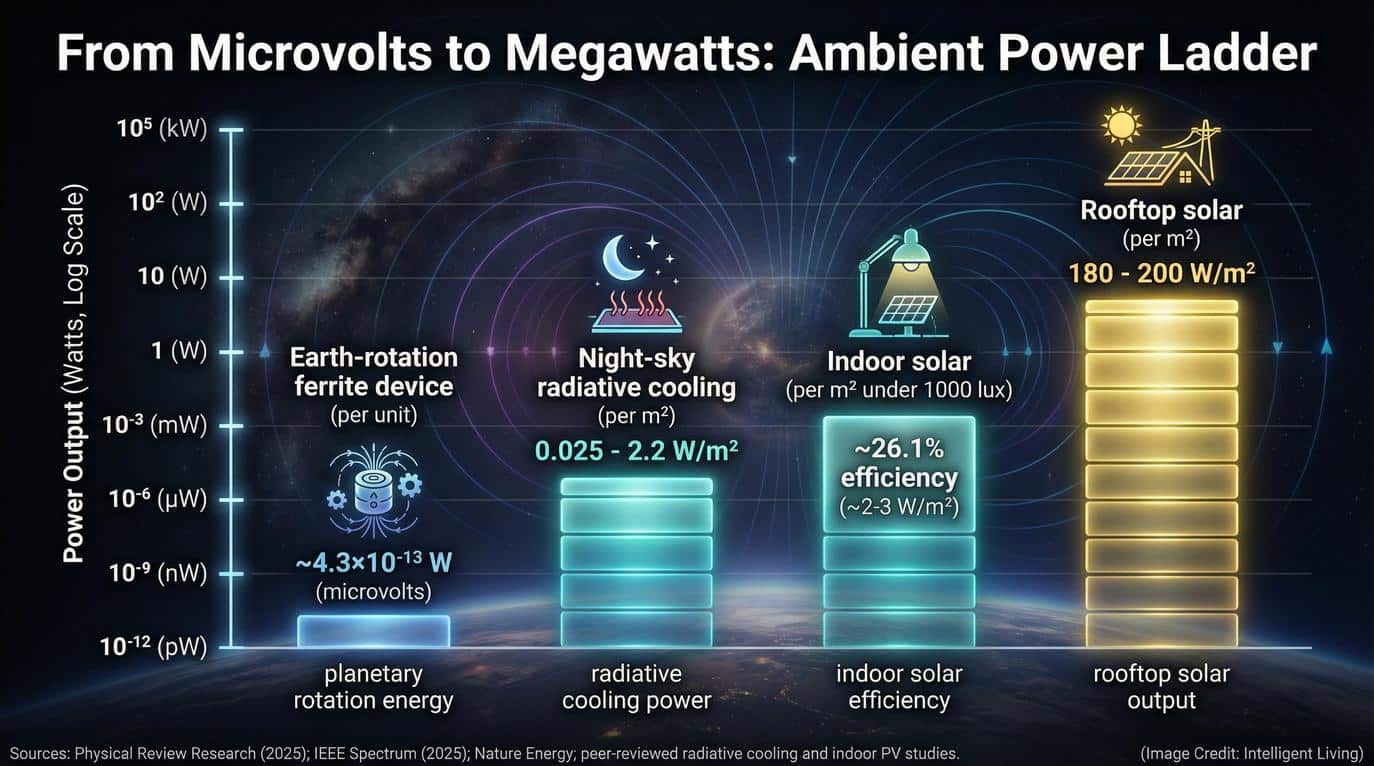
Ferrite Cylinder Design: Testing Ambient Energy Extraction in the Laboratory
Seeking empirical evidence, the research team constructed a specialized device to stress-test their claims under strict laboratory controls.
Building a Hollow Ferrite Cylinder
The device was a hollow cylinder made of manganese zinc ferrite, a soft magnetic ceramic commonly used in transformer cores and electromagnetic shielding.
Soft magnetic materials are easily magnetized and demagnetized, which allows them to guide magnetic field lines effectively. Measuring nearly a foot long, the cylinder utilized a hollow geometry that researchers deemed critical to the success of the test. The team’s theoretical model suggests that a hollow shell interacts with Earth’s magnetic field quite differently than a solid block when interacting with Earth’s magnetic field, especially when magnetic diffusion inside the material becomes significant.
Orientation and Measurement
Positioning the cylinder was a delicate process; the team aligned the long axis perpendicular to both the planet’s spin and the local magnetic field. Under that configuration, they measured a continuous direct current voltage of roughly 17 to 18 microvolts.
When the device was rotated 180 degrees, the voltage reversed sign, as predicted. When oriented at right angles to the optimal position, the signal dropped close to zero. These directional dependencies were central to the team’s claim that the effect was not random electrical noise.
Experimental details of the phenomenon were eventually featured in a Scientific American study that analyzed the researchers’ findings.
Rigorous control tests were conducted to verify the source of the 17-microvolt signal. The following configurations failed to show the same electrical output:
- A solid ferrite cylinder of identical material composition.
- Device designs utilizing different magnetic properties.
- Orientations positioned at right angles to the optimal axis.
These results strengthened the claim that the signal was specific to the hollow ferrite cylinder. Such negative controls are essential for validating a narrow theoretical prediction.
How Small Is 17 Microvolts?
Seventeen microvolts is 0.000017 volts. For comparison, a standard AA battery produces 1.5 volts. Detection of this tiny voltage reveals a scale smaller than many biological electrical signals observed in advanced quantum materials where topological properties dictate electrical behavior. It cannot power everyday devices.
Its significance lies in whether it validates a narrow theoretical prediction. If the effect is real and not an artifact of measurement, it suggests that the interplay between rotation, magnetic fields, and material geometry is more subtle than once believed.

Scientific Debate: Why Physicists Dispute the Validity of the Rotation Signal
Reactions across the scientific community remain cautious and deeply divided.
Some researchers view the experiment as carefully executed and intriguing. Proponents note that the signal reversed as expected when the device orientation changed. Simultaneously, control configurations consistently failed to produce similar voltages, a pattern that supports the team’s interpretation.
Evaluating Experimental Precision and Potential Artifacts
Others remain unconvinced. Critics point out that measuring microvolt-scale signals is notoriously difficult. Tiny temperature differences can generate thermoelectric voltages, while stray magnetic fluctuations or instrumentation artifacts often produce misleading readings.
Expert commentary featured in Scientific American emphasized that independent replication at varied latitudes is essential for validation. Cycles of bold claims followed by meticulous scrutiny define the inherent rigor of modern physics.
A recent reevaluation of the theoretical framework revisits whether the proposed loophole truly escapes classical symmetry arguments. In other words, the debate is still active.
This cycle of bold claims followed by meticulous scrutiny defines the rigor of modern physics. Bold theoretical claims provoke criticism. Experiments attempt to settle the question. Additional scrutiny follows. Over time, consensus forms through replication and refinement.
Ambient Energy Harvesting: Comparing Earth’s Rotation to Anti-Solar and Vibration Tech
Ambient energy harvesting is an expanding discipline, and this rotation-based experiment fits squarely within its exotic boundaries. These innovative technologies aim to capture low-power signals from the environment:
- Harvesting electricity from the night sky via anti-solar panels that exploit thermal differences.
- Utilizing specialized indoor solar cells to capture energy from ambient room lighting for smart sensors.
- Leveraging shadow-effect generators to convert light contrast into usable electricity in dim environments.
- Designing battery-free industrial sensors that run entirely on vibrational sound energy.
These systems do not compete with utility-scale solar farms. Instead, they provide sustainable solutions for niche, low-power electronic applications, aiming for niche applications rather than the distributed renewable power currently being unleashed within urban infrastructure.
In that context, harvesting a tiny electrical signal from Earth’s rotation becomes less about powering cities and more about exploring new corners of low-power physics.

Scaling Planetary Power: Can Earth’s Rotation Compete with Solar and Wind Grids?
Can this micro-scale effect actually transform into a significant contributor to the global energy supply as renewable energy market trends continue to redefine how global supplies are managed?
Global electricity demand is on the order of 11 trillion watts.
According to analysis discussed in Scientific American, even if a hypothetical Earth rotation technology somehow provided all that power, it would lengthen the day by roughly 7 milliseconds per century. That change is comparable to natural variations caused by tidal forces and shifts in Earth’s interior.
Material Science Bottlenecks in Terawatt-Scale Power Generation
In practical terms, however, scaling from microvolts in a laboratory cylinder to terawatts on the grid would require enormous advances in materials science and device architecture, along with the advanced energy storage solutions that electrical engineers now use to maintain grid stability. Power density per device remains extremely low, falling far short of the levels achieved through vehicle-to-grid power sharing, where electric cars act as mobile energy assets.
The Dominance of Solar and Wind in the Global Energy Transition
By contrast, existing renewable technologies are already scaling rapidly. Current global renewable power consumption trends show that solar and wind now deliver meaningful fractions of national electricity.
Deploying solar battery backup systems in homes and businesses helps address the ongoing challenges of intermittency. Recent projections showing that renewable sources drive new generation emphasize how quickly clean technologies are capturing market growth. Recent data showing renewables overtaking fossil fuels across the European Union illustrates the massive scale of this transition. Long-term projections for renewable growth suggest that storage will keep reshaping the grid far more than niche experimental tech.
From today’s vantage point, Earth rotation power is not a viable competitor to the gigawatt-scale storage projects currently moving clean power across the globe. It is a scientific curiosity with potential niche applications at best.
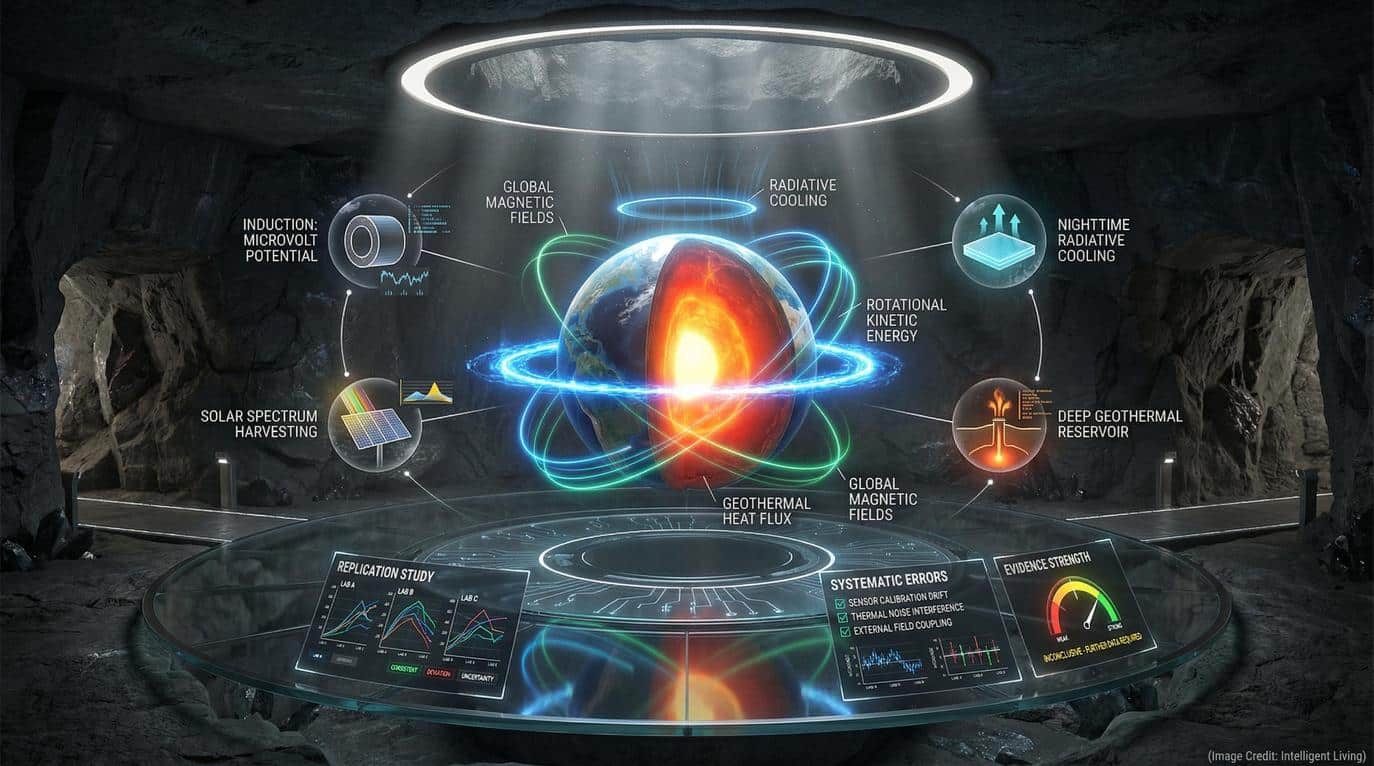
Future Implications: Scientific Skepticism and the Search for New Clean Energy Reservoirs
Experiments of this nature do not rewrite the energy transition, nor do they provide a shortcut around the hard work of building solar farms and storage systems.
Redefining the Energy Transition Through Scientific Scrutiny
Together with disruptive infrastructure technologies currently reshaping the global energy landscape, the path forward remains clear. Research into Earth’s spin underscores the reality that our planet is home to multiple, largely untapped energy reservoirs. Current scientific understanding recognizes that our planet houses several major energy reservoirs:
- Rotational kinetic energy from the Earth’s spin.
- Global magnetic fields generated by the core.
- Thermal gradients found between the surface and deep interior.
Tapping these effectively requires both imagination and rigorous testing, utilizing intelligent AI tools to reduce waste and balance energy loads across smart grids.
Scientific skepticism remains a cornerstone of this narrative, ensuring that theoretical claims are challenged and results are questioned. Replication is demanded. That friction strengthens scientific understanding.
In recent years, researchers have pushed the limits of magnetic field manipulation and precision measurement, as seen in the production of the most powerful steady magnetic fields ever recorded in a laboratory environment and advances in quantum sensing technology that allow for the detection of extremely subtle magnetic shifts. Earth rotation experiments sit within a broader global effort to probe subtle electromagnetic effects and precision measurements.
Should future experiments confirm these findings, it could inspire a new generation of maintenance-free electronic devices. If replication fails, the result will still have sharpened our understanding of electromagnetic theory in rotating systems.
Either outcome adds to scientific knowledge.

A Provocative Milestone in Planetary Energy Research
The detection of a 17-microvolt signal linked to the planet’s rotation marks a significant, albeit quiet, shift in how we approach ambient energy. While the immediate results are far from providing a grid-scale solution, the experiment serves as a vital stress test for our understanding of electromagnetic theory in rotating systems. It reminds us that even “settled” science contains subtle nuances that can be probed with modern materials like manganese zinc ferrite, potentially leading to specialized, maintenance-free sensors or niche electronic applications that draw power from the very ground they sit on.
Moving forward, the success of this research line depends on rigorous replication and the continued integration of advanced materials science. This discovery should be viewed as a single thread in the larger tapestry of a sustainable transition, existing alongside utility-scale solar, wind, and sophisticated storage networks. Regardless of potential scalability, the study reminds us that the energetic pulse of our world is still yielding its secrets.
FAQ: Grasping the Science of Energy from Earth’s Spin
Can Earth’s rotation provide a limitless supply of electricity?
Current evidence suggests the output is extremely limited. While the planet’s kinetic energy is immense, the mechanism for converting it into electricity remains inefficient and produces only microwatts of power in laboratory settings.
Does extracting energy from rotation slow down the Earth?
Yes, but the effect is negligible. Even if the entire global energy demand were met by this method, the length of a day would only increase by a few milliseconds over a century, which is comparable to natural tidal variations.
How does the 17-microvolt experiment differ from a standard generator?
Traditional generators require mechanical motion—like a spinning turbine—to cut through magnetic field lines. This experiment uses a static device that interacts with Earth’s field simply by remaining fixed on the rotating planet.
Is this technology ready for consumer use?
No. The technology is in the early experimental phase. Output levels remain far below the threshold required to power conventional electronic devices, serving instead as a proof of concept for theoretical physics.
Are there any other ways to harvest ambient energy?
Absolutely. Technologies like anti-solar panels, shadow-effect generators, and indoor solar cells are already being developed to capture energy from darkness, light contrast, and room lighting for low-power electronics.


