
The renewable energy market is always changing and growing.
As the world looks for cleaner energy sources, new trends are constantly being developed to improve the industry—from EV charging infrastructures to green hydrogen production. These changes help reduce our dependence on fossil fuels and fight climate change.
Let’s check out the top four future trends in the renewable energy market, how the industry evolves, and what we can expect in the coming years.

1. Advancements in Solar and Wind Technology
The renewable energy market is witnessing significant advancements in solar and wind technologies. The improvements make these energy sources more efficient, affordable, and accessible. Enhanced solar panels and wind turbines are at the forefront of this transformation, leading the global shift towards cleaner energy.
Check out the benefits of solar and wind technology:
- Reduced Costs: Advances in materials and manufacturing processes have made solar and wind technologies more affordable, resulting in significant cost reductions.
- Higher Efficiency: Innovations have led to more efficient solar panels and wind turbines, enabling them to generate more electricity from the same amount of sunlight or wind.
- Versatile Applications: Solar and wind technologies can be deployed in various settings and scales, from residential rooftops and small wind turbines to large solar and wind farms, providing flexibility in meeting different energy demands.
- Low Maintenance: Both technologies generally have low maintenance requirements. Solar panels have no moving parts, and modern wind turbines are designed for durability and easy maintenance, resulting in lower long-term operational costs.
- Environmental Impact: Solar and wind energy stand as clean, renewable resources that generate no greenhouse gas emissions while operating. Utilizing these energy sources helps decrease dependence on fossil fuels. Furthermore, they play a critical role in mitigating the impacts of climate change.

2. Energy Storage Solutions
Energy storage solutions enable the capture and retention of energy generated by solar panels, wind turbines, and other renewable sources. This capability ensures a reliable and consistent electricity supply, even during periods when the sun is not shining or the wind is not blowing.
These are our top three most efficient energy storage solutions:
- Lithium-Ion Batteries: Lithium-ion batteries are the most popular and widely utilized energy storage solution today. They provide high energy density and boast a long cycle life. Their fast charging capabilities make them suitable for a range of applications. From small-scale residential systems to large-scale grid storage, lithium-ion batteries are proving to be ideal.
- Pumped Hydro Storage: Pumped hydro storage is one of the oldest and most efficient large-scale energy storage methods. The process involves pumping water to a higher elevation when energy demand is low. When energy demand increases, the water is then released to generate electricity.
- Flow Batteries: Flow batteries, such as vanadium redox flow batteries, offer a scalable and flexible energy storage solution. They separate energy storage from power generation, allowing for easy scalability and longer cycle life.

3. Smart Grids
Smart grid technology represents a transformative approach to managing and distributing electricity. Here are the three main benefits of smart grids:
First, they integrate advanced digital communication systems. Second, they utilize automation to enhance operational efficiency. Third, they employ control systems to create a more reliable and resilient power grid.
- Enhanced Reliability and Resilience: Smart grids have the ability to rapidly detect power outages or disruptions. They can respond quickly to these issues, thereby minimizing downtime. This enhances the overall reliability of the electricity supply.
- Efficient Energy Management: Smart grid technology allows for better energy consumption management through real-time data collection and analysis.
- Integration of Renewable Energy: Smart grids enable the smooth incorporation of renewable energy sources into the power grid. By accommodating the intermittent nature of solar and wind energy, smart grids ensure a stable and balanced supply of electricity, promoting the use of cleaner energy and reducing reliance on fossil fuels.
4. Green Hydrogen Production
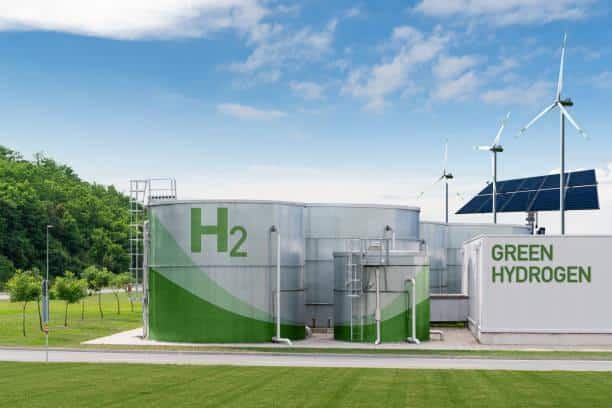
Green hydrogen is created by splitting water into hydrogen and oxygen. This process utilizes renewable energy sources like solar or wind power. The process results in hydrogen that is entirely free of carbon emissions, making it a clean and sustainable alternative to traditional fossil fuels. Green hydrogen has a wide range of applications. It can be used in transportation, industrial processes, and energy storage. Its use contributes significantly to the decarbonization of multiple sectors.
Here’s how it works:
- Renewable Energy Source: The first step is harnessing renewable energy, such as solar or wind power, to generate electricity, which will power the electrolyzer.
- Electrolyzer Operation: When electricity from a renewable source is applied to the electrolyzer, water molecules at the anode are split into oxygen, protons, and electrons.
- Water Splitting Reaction: The chemical reaction at the anode produces oxygen gas (O₂) and positively charged hydrogen ions (protons). The reaction is as follows:
- Hydrogen Formation: The protons move through the electrolyte towards the cathode, where they combine with electrons (which travel through an external circuit) to form hydrogen gas (H₂). The reaction at the cathode is:
- Gas Collection: The resulting hydrogen gas is collected and can be stored or transported for various uses. The oxygen gas produced can also be captured and utilized in industrial processes or released into the atmosphere as a harmless byproduct.

Renewable Energy Market Trends: A Bright Future
The renewable energy market is nearing a transformative era, driven by technological breakthroughs, innovative storage solutions, and intelligent grid systems. The emergence of green hydrogen also plays a crucial role. These advancements far exceed incremental progress. They signify a substantial leap towards sustainable energy independence.
As these trends gain traction, they are set to reshape the global energy landscape. The vision of clean, reliable power will soon become an everyday reality. With ongoing innovation and commitment, a future powered entirely by renewable energy is not just possible—it is imminent.


