
A singular floating platform from NoviOcean harvests wave, wind, and solar energy within a compact offshore footprint. This “ocean power stack” includes a tidal configuration specifically for sites where deep currents outpace surface swells. Resource layering mitigates the volatility inherent in single-source renewables. Resource layering stabilizes output for coastal grids.
Research investigating synergistic offshore wind and wave energy clarifies why multi-resource platforms remain a persistent focus in marine engineering. Integrated systems provide essential solutions in regions prioritizing sea-space efficiency and grid stability. Rather than competing for seabed real estate, these hybrid generators share a unified foundation, streamlining the logistical burden of offshore development.
While the concept is straightforward to articulate, its true durability must be forged and proven in the unpredictable environment of the open sea. This architecture earns its credibility only after long-term performance data withstands punishing weather cycles and rigorous operating expenses. The promise lies in a “shared infrastructure” model that could finally shift the economics of marine energy from experimental to industrial scale.

The Hybrid Offshore Shift: What’s Verified and Why it Matters
Verified Tech Specs and Key NOVIOCEAN Project Milestones
Progress tracking in hybrid systems relies on specific, verified project milestones rather than just conceptual designs. The transition from a render to a functioning platform is marked by official documentation and public funding records. These early indicators help separate long-term industry shifts from experimental curiosities.
- Hybrid System Architecture: NoviOcean’s wave wind solar hybrid platform design pairs wave conversion with wind and deck-level solar, with an optional tidal pathway intended for current-heavy sites.
- Demonstration Timeline: A Swedish LIFE programme overview listing the NOVIOCEAN project places the demonstration on an official timeline and helps anchor the project as more than a concept pitch.
- Operational Performance Benchmarks: The University of Surrey’s hybrid offshore findings summary reports that reviewed hybrid cases can lower estimated costs versus standalone offshore wind in some scenarios.
- Sector-Wide Transparency: A DOE-backed marine energy cost and performance report explains why long-duration operations data and consistent O&M reporting remain scarce across much of wave and tidal.
Stakeholder evaluation depends on understanding these milestones. By reviewing third-party data, the industry can better predict how these platforms will behave in varied sea states. This documentation serves as a prerequisite for any commercial-scale deployment.
The Ocean Power Stack: Industrial Logic and Cost Efficiency
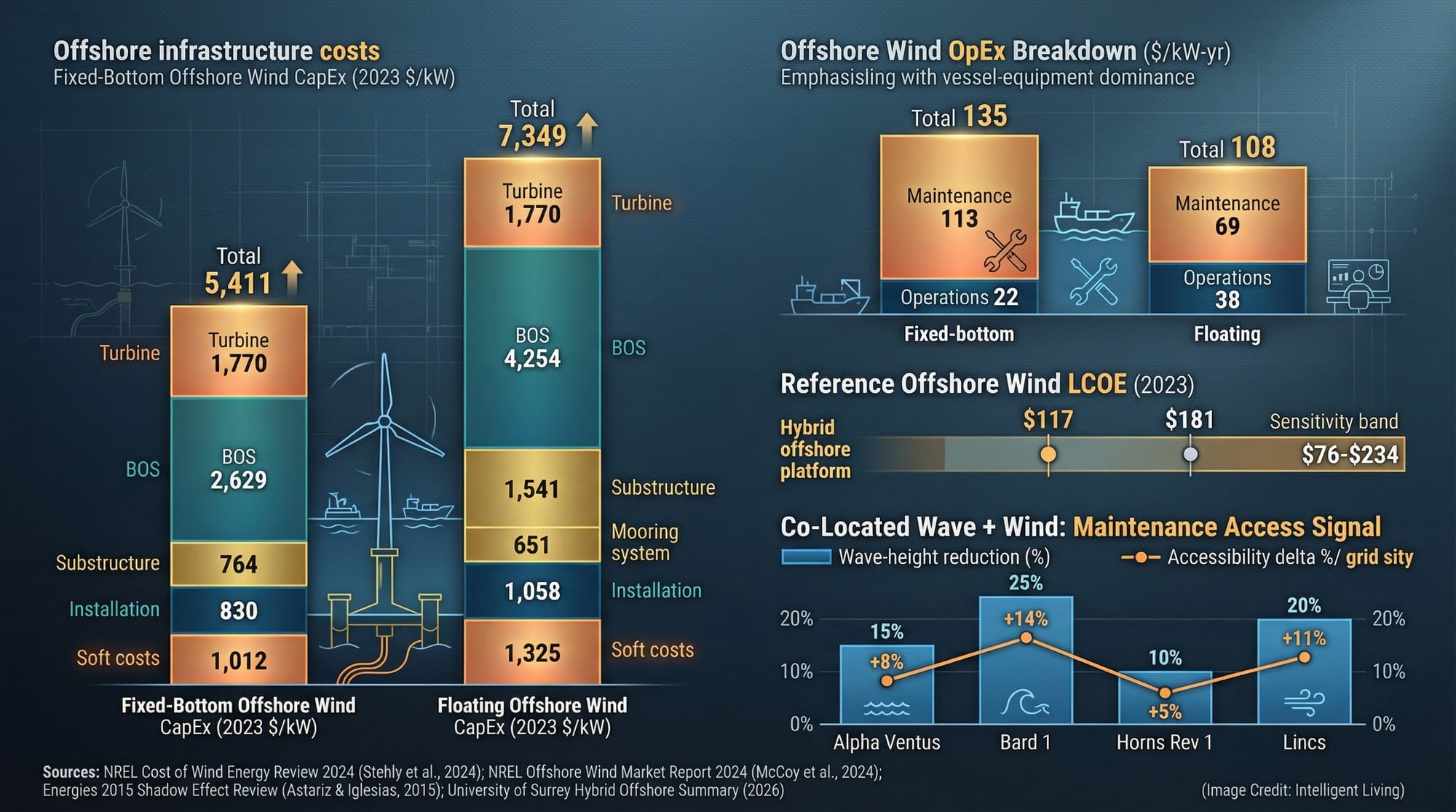
Offshore power generation demands high capital for construction and grid integration. Most expenses do not originate from the generators themselves. Instead, the primary financial burden lies in the essential infrastructure needed for utility-scale operations.
Essential components include high-strength foundations, advanced moorings, and subsea cables. Specialized support vessels also contribute heavily to the budget. Project reports on the expansion of modern U.S. offshore wind projects highlight these infrastructure costs within modern technical models.
Cost Curve Impacts of Shared Infrastructure
Peer-reviewed research on multi-resource platforms details how shared infrastructure and smoothed power output can shift project economics. Structural synergies explain why multi-harvester concepts frequently accompany floating wind innovations. Integrated designs enable high-output floating wind arrays to extract significantly more power from a single offshore installation.
Diversifying energy sources enables operators to stabilize generation. Diversification minimizes expensive, last-minute adjustments during grid fluctuations.
The Limits of a Shared Real Estate Argument
Shared infrastructure does not guarantee a simple victory. Stacking multiple machines on one platform introduces severe engineering hurdles. These include managing combined mooring loads and meeting tighter tolerances for structural fatigue.
Maintenance scheduling grows increasingly complex. However, wave height reduction in co-located layouts provides operational benefits beyond power production, specifically in improving maintenance access. Global ocean energy innovation trends emphasize that survivability and maintenance costs remain the primary barriers to commercial scale.

From Funding to Function: The NOVIOCEAN Demo and the Machine
Scaling the LIFE NOVIOCEAN Pilot from Concept to Sea Validation
NoviOcean’s concept has moved beyond concept-stage storytelling into formal demonstration funding. The EU-backed scale-up pilot listing provides a concrete reference point for the scope and validation of the pilot.
Demonstration programmes prioritize long-term proof of concept. Seasonal energy capture matters, but so do availability, survivability through heavy weather, and the unglamorous details of maintenance windows. A strategic marine energy innovation roadmap identifies these gaps as the primary reason for the industry’s focus on demonstration.
In plain terms, a demonstration is not a marketing milestone. It is the stage where promises have to show up as meter readings, maintenance records, and repeatable procedures that another operator could realistically follow.
Key Performance Benchmarks for Marine Energy Verification
Judging the success of any offshore pilot requires looking past the initial launch. The real value is found in how the system handles the daily grind of salt and storm. These metrics are the true indicators of industrial readiness.
- Performance Precision: Pilot installation with instrumented monitoring designed to capture performance across changing sea states.
- Energy Reliability: Third-party verification of generated energy and platform availability.
- Fiscal Transparency: O&M cost reporting that includes vessel-days, parts replacement, and unscheduled repair events.
- Diagnostic Depth: Evidence that downtime causes are understood, logged, and reduced over time.
Quality data provides the foundation for scaling. Without it, securing the confidence of long-term investors remains difficult. Validated offshore performance milestones help track the timeline and scope of the testing campaign without assuming a guaranteed end state.
How NoviOcean Works and Where Optional Tidal Actually Fits
At its core, the wave component is a heave-based point absorber designed to convert vertical motion into electrical power through a power take-off system. Documentation in the WEC profile in the PRIMRE database identifies the converter as a buoyant system designed to extract energy across diverse sea conditions.
Prerequisite knowledge includes the meaning of power take-off. In ocean energy, the power take-off is the mechanism that turns motion into electricity, often through hydraulics, mechanical linkages, or direct-drive approaches. Power take-off reliability dictates long-term costs as heavily as raw energy capture.
Wind and solar add familiar generators to the same offshore footprint. Solar panels can be integrated on platform surfaces, while wind hardware typically requires careful placement and structural separation to avoid interfering loads. In sites with strong, predictable currents, the tidal pathway acts as a different resource layer. Planning improves significantly with the predictable nature of marine energy cycles, even during slack-water periods.
Plain-English Mechanic Notes
Operational awareness of these platforms involves understanding the core mechanics of the ocean power stack. Design choices often balance peak efficiency with long-term durability. Here is a breakdown of how the hardware actually handles the environment:
- Heave Extraction Mechanics: The float moves up and down with waves, driving the internal power take-off system.
- Broad-Band Energy Capture: The goal is consistent power across many wave periods, avoiding the fragility of narrow resonant designs.
- Tidal Resource Integration: Optional tidal pathways provide highly predictable generation, though they alter subsea layouts and maintenance requirements.
Mechanical choices dictate technician visit frequency. A robust design minimizes these visits, keeping lifecycle costs low. Every engineering decision is a bet on the platform’s survival in open water. Safe lifting windows depend on sea state, not the calendar.

Real-World Fit: Where Hybrid Ocean Power Could Land First
Targeted Early Markets and Operational Survivability Constraints
Hybrid platforms are most effective where local power carries a high premium. Regional economics favor hybrid platforms where expensive fuel imports create constant strain. Consistency often outweighs pure peak capacity, a priority evident in resilience initiatives like the D.C. microgrid reliability pilot.
Ports and coastal load centers are another logical fit, especially when planners want more stable clean electricity near industrial demand. Tidal predictability is proven by grid-integrated floating tidal systems that provide steady benchmarks for energy export. Reliability is evidenced by utility-scale UK tidal benchmarks demonstrating the capacity to power thousands of homes.
Volatile planning forces communities to pay twice: once through higher backup costs, and again through time spent managing unpredictability.
Engineering Challenges: Structural Fatigue and Marine O&M Windows
Ocean platforms live in a world of dynamic loads. Waves, wind, and currents repeatedly stress every joint, cable, and mooring connection, and millions of cycles turn small weaknesses into failures. Structural design hurdles for ocean converters capture why the integration of multiple resources into a single platform remains a significant engineering challenge.
Offshore solar engineering offers a parallel lesson in survivability. Large-scale offshore solar expansion demonstrates the growth potential of sea-space renewables when structures are engineered for long-term durability. Hurricane-resistant floating solar platform designs underscore the necessity of dynamic-load planning in open water.
Cost realism also matters, especially when early claims get ahead of field data. Levelized cost projections for wave magnet technology serve as a reminder to separate early-stage claims from verified operating results.
Regulatory Compliance and Environmental Monitoring Requirements
Mechanical integrity is only half the battle. Ocean hardware must also secure social and environmental permission to operate in public waters. This involves rigorous monitoring plans, including acoustic studies and seasonal surveys to protect local fisheries.
Regulatory constraints protect marine mammals and ecosystems from negative impacts. Ocean ecosystem health considerations remind stakeholders that ocean energy operates within sensitive living environments rather than empty space.
Key Performance Benchmarks for Marine Energy Verification
- Multi-season energy production data verified by independent monitoring
- Availability and uptime metrics that reflect real maintenance schedules
- O&M cost reporting with vessel-days, spare parts, and unplanned interventions
- Environmental monitoring results that address marine life and acoustic impacts
- Scalability signals such as repeatable installation templates and supply-chain readiness
- Evidence that output variability is understood and managed across the combined resource mix
Comparative international cost metrics for ocean power explain why transparent boundaries are essential for credible technology comparisons.
Conclusion: Ocean Energy is Getting Modular, but Proof Still Has to Live at Sea
Hybrid platforms like NoviOcean’s ocean power stack reflect a practical shift in marine engineering: ocean space is finite, offshore infrastructure is expensive, and combining resources makes clean power steadier. The logic is clear—if you’ve already invested in a subsea cable and a mooring system, you should maximize the electrons flowing through them.
The decisive factor is empirical performance over multiple seasons, audited by independent parties, and supported by transparent O&M reporting. Until those signals appear, hybrid platforms remain promising prototypes rather than turnkey infrastructure. We are moving toward a modular ocean, where the “stack” approach allows developers to tailor generation to the specific energy profile of a coastline.
Success for multi-resource systems hinges on surviving the relentless stresses of salt, silt, and storm. If the engineering holds up, the ocean power stack could become a cornerstone of coastal resilience. It isn’t just about the peak capacity; it’s about the reliability of the energy we harvest from our most energetic environments.
FAQ: Hybrid Offshore Renewable Energy Platforms
What is a hybrid offshore renewable energy platform?
It is a singular structure—either floating or fixed—that integrates two or more generation technologies like wave, wind, and solar to maximize energy yield and share expensive infrastructure.
How does NoviOcean’s point absorber generate power?
The system utilizes a heave-based float that moves vertically with wave motion, driving a power take-off mechanism that converts that mechanical energy into usable electricity.
Is tidal energy more reliable than offshore wind?
Yes. Tidal currents are driven by astronomical cycles, making them highly predictable for grid planning, whereas wind and solar rely on more volatile weather patterns.
What must the EU LIFE NOVIOCEAN demo prove?
The pilot is designed to validate seasonal energy capture, structural survivability in heavy weather, and the long-term reliability of shared maintenance procedures.
Why are hybrid platforms better for the environment?
By stacking multiple generators on one footprint, they reduce the total amount of seabed disruption and subsea cabling required compared to building separate wind and wave farms. Integrated offshore wind and wave systems define how designers classify the co-generation technologies used in hybrid platforms. Consistency of tidal energy resources does not eliminate cyclic variation, so pairing generation with storage remains critical. Oscillating-water-column wave conversion demonstrates how surging air pressure can be effectively turned into electricity. Predictability is essential for coastal industrial energy applications, where steady power output often matters as much as peak capacity.


