
Dutch startup SolarDuck has developed an offshore floating PV platform that can withstand hurricane-force weather. The triangular structure that resembles an offshore oil platform is advancing the way we can use renewable energy. They’re calling it the “Demonstrator.”
SolarDuck recently conducted a test in the Netherlands in which they towed the Demonstrator upriver to simulate some of the water stresses and winds of being out at open sea. They dragged the platform 31 miles (50 kilometers) while moving at 7 knots, experiencing forces of 17.6 tons (16 metric tons). It passed with flying colors.
Now, the company is going to test the system in the North Sea, where waves can be much higher. Then, its next Demonstrator will be 13 times bigger to withstand even heavier forces.
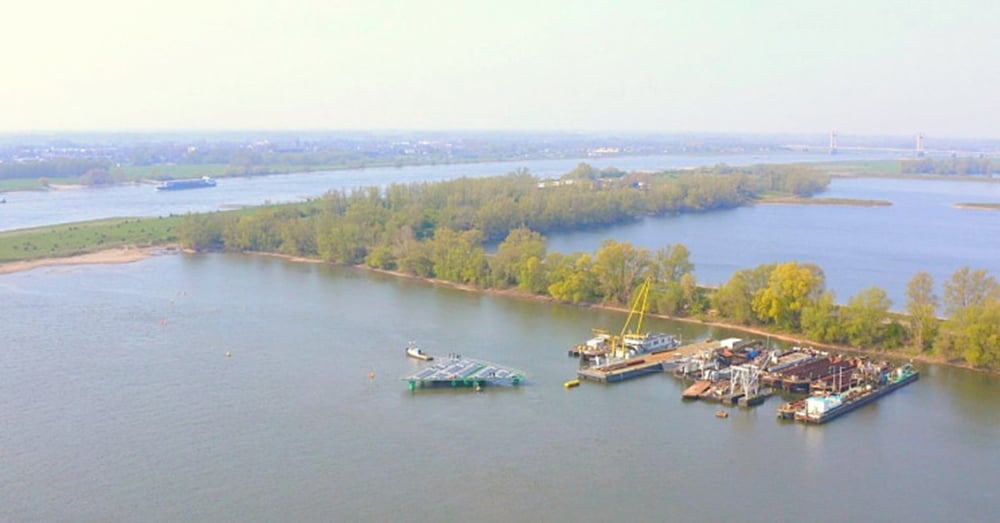
According to CEO Koen Burgers, the Demonstrator is unique in form and function – it keeps solar panels over three meters above the water surface. This feature helps prolong the lifetime of the electronics and other materials of the array, which can be seriously damaged by seawater contact. And it can handle coastal sea conditions like big waves (over 10 feet (3 meters) high) and dynamic loads.
The company has also optimized the platform for estuaries, natural harbors, and other near-shore regions. It envisions the platform being used at islands and cities in the sunbelt – places that lack land space but need renewable power.
Burgers told PV Magazine:
We have developed a near-shore concept, which can cope with waves that can be more than 3 meters high and hurricane winds. We are targeting megacities and large companies in the Mediterranean, the Caribbean, South East Asia, and in general markets with high solar radiation in the global Sun Belt.

The Demonstrator comes at just the right time, considering the rapid acceleration of climate change in recent years. Crowded coastal cities like New York and Tokyo are looking for ways to pivot away from fossil fuels to meet their Paris Accord targets.
CTO Don Hoogendoorn of SolarDuck, said:
Cities like Hong Kong, SINGAPORE, and other islands are out of land space. For example, in Hong Kong, putting solar panels on top of skyscrapers would only generate 10% or 11% of the city’s energy needs. And the land is costly, with many new houses in the city now built as floating structures.
These platforms would be suitable for communities around the global Sun Belt (the global ring near the equator), where the wind is scarce, but the sun is constant.

Price is another reason many global leaders prefer solar over wind power. It’s now the cheapest electricity in history and according to an AltEnergy Mag report:
Solar is by far the cheapest method to produce renewable energy in the sunbelt.
Each platform is raised on floating pillars. Several can connect, forming large power plants.
Burgers said:
It is more or less a semi-sub structure that is used in offshore floating wind projects. What we did was connecting these platforms in a smart way, and by elevating the platforms, you get much less wave resistance.
Hoogendoorn added:
Our structure elevates all PV and electrical parts above the waves. This avoids those waves will impact the panels, which causes micro-cracks.
The upward and downward direction of lift is significant — you don’t want the floating solar panel assemblies to fly away. You want them to be stiff enough to remain sturdy but also resistant to fouling and algae growth. The shape of the platform, too, is crucial for an offshore floating platform. Squares, for example, are not ideal. When you have a torsional wave — a wave coming toward the square at 45 degrees — one side of the platform will move upward, but the other will move downward.
Unlike other offshore solar platform companies, we turned down the square design to favor something more elegant. If you look at lightweight structures, like cranes, oil rigs, the Eiffel Tower, they are all triangles. Very light, stiff, strong, the triangular design can warp with additional loads. And triangles slide right into each other.
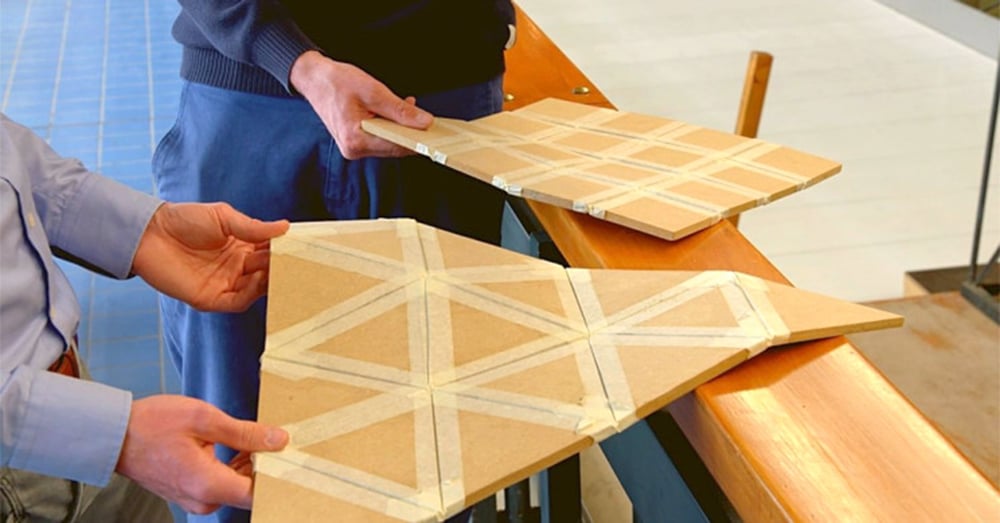
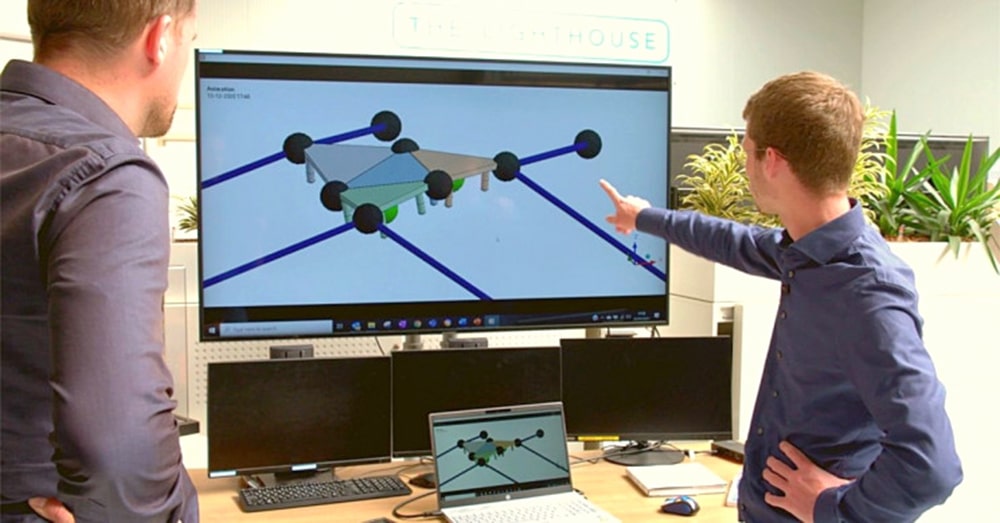
SolarDuck plans to scale up the Demonstrator, aiming for a setup of ten-by-ten platforms that outputs 10MW of clean energy.
Hoogendoorn continued:
We want to go for 10-MW plants — about 240 m by 240 m (roughly 790 ft by 790 ft), which is roughly ten by ten platforms. So that’s approximately 100 platforms connected. This will give you a 10-MW peak, which is equal to a new offshore fixed wind turbine. So then you can build a farm with a 500-MW peak power output with 50 of those ten by ten assemblies — equivalent to an offshore wind farm.
Last but not least, the triangular shape and larger platform area make for a stable and safe environment for operation and maintenance services at sea. SolarDuck’s technology is, therefore, more reliable and maintenance-friendly.


