
When we talk about the future of energy, the tokamak fusion reactor is often the star of the show, but keeping these machines running means solving a massive heat flux handling puzzle. Science teams recently tweaked tokamak edge modeling to include measured toroidal rotation, finally explaining why exhaust particles hit the machine’s divertor so unevenly. This breakthrough helps us answer a big question for the grid: how do tokamaks handle extreme heat? Linking the plasma’s center to its edge exhaust lets experts build better protection for parts that must survive constant punishment.
Real fusion progress is shifting from just making hot plasmas to actually predicting fusion reactor component life under intense plasma-wall interaction stress. This is where we see how exhaust slowly wears down metal surfaces, a process that determines divertor durability over time.
Once the math starts matching reality, building these reactors gets much safer. An error that makes it much harder to guess how long these parts will actually last is no longer a surprise.

Breakthrough Results in Plasma Exhaust Modeling and Core Data
Recent Findings in Plasma Exhaust Modeling: Why Engineers are Watching
Researchers at the Princeton Plasma Physics Laboratory recently tested ways to help fusion reactors survive decades of use by running edge simulations aimed at a stubborn tokamak exhaust puzzle: far more particles appear to strike the inner divertor target than the outer one.
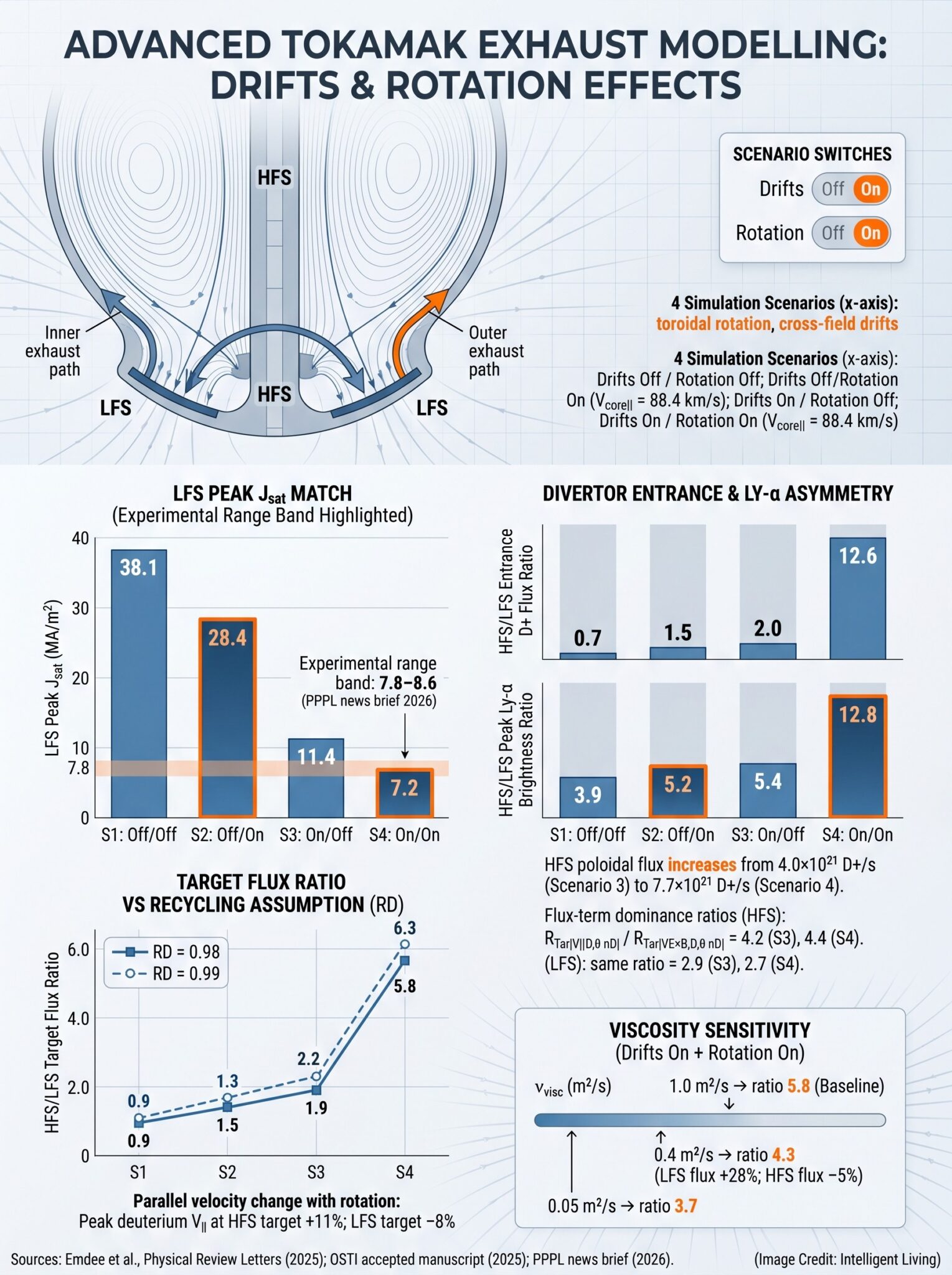
The team used the SOLPS-ITER edge modeling suite to compare four different scenarios by switching cross-field drifts and measured core toroidal rotation on and off. By isolating which physics inputs actually move the needle, the team could prove that core spin is the missing link.
The test case drew on measurements from the DIII-D National Fusion Facility, a U.S. tokamak whose diagnostics help trace how heat, particles, and momentum travel from the plasma edge toward the wall. Simulations only matched real-world data when the model included the measured rotation, which fixed a mismatch that causes big errors in how we predict tokamak edge physics and component life.
Quick Facts: Divertor Heat, Rotation, and Key Numbers
These quick points are the fastest way to orient to the physics and the engineering stakes without getting buried in code names. These facts highlight the main numbers and terms that show up repeatedly when researchers describe tokamak divertor durability.
- Setting: A DIII-D tokamak scenario modeled with SOLPS-ITER, using an updated SOLPS-ITER software version to test how edge physics changes divertor exhaust patterns.
- The recurring observation: the inner divertor target shows stronger recycling and particle arrivals than the outer target.
- The missing ingredient in the tested case: measured core toroidal rotation, set at 88.4 kilometers per second in the Physical Review Letters DOI record.
- The physics takeaway: rotation-driven parallel flow and cross-field drifts together produce a stronger inboard-outboard asymmetry than either effect alone.
- The engineering stakes: divertor targets are built to absorb extreme heat and particle flux, so hotspot predictability directly affects lifetime and service planning.
- Why it Matters: Think of it this way: what “recycling” means in plain language: atoms hit a wall, cool, bounce off as neutrals, and then re-enter the edge plasma as fuel. When that cycle concentrates on one side, wear and heat handling do too.
How Toroidal Rotation Solves the Heat Load Mystery
The Mystery of Tokamak Edge Physics Explained Simply
A tokamak confines a superhot plasma in a donut-shaped magnetic bottle. Even when most of the plasma stays trapped, a thin boundary region, the scrape-off layer, still leaks heat and particles, and that exhaust has to go somewhere.
Tracking the Plasma Exhaust Path
In large machines such as the ITER “sun machine” project, the exhaust path ends at the fusion reactor divertor, a set of targets designed to take the hit so the rest of the vessel does not. The divertor is not a side detail. It is the planned landing zone for heat and ash, and it is often where real-world durability gets decided.
Causes of Uneven Heat Flux Handling on Divertor Surfaces
Operators have noticed a lopsided pattern for years: more particles recycle and return on the inner divertor target than on the outer one. Simulations that leaned on cross-field drifts alone struggled to reproduce how strong the imbalance looks in real measurements.
- The Analogy: Think of it like a ventilation duct that only gets dirty on one side.
- The Bias: The problem isn’t the dirt; it’s a bias in the airflow.
- The Reality: In a tokamak, that ‘bias’ comes from charged particles following a magnetic path, determining exactly where tokamak fusion reactor hotspots form.
How Toroidal Rotation Fixed the Exhaust Simulation Gap
Think of it this way: the center of the plasma is constantly moving. This rotating plasma can shape edge flow in ways that determine where exhaust and recycled neutrals concentrate.
In the peer-reviewed rotation and scrape-off layer analysis, the authors show that plasma rotation, when combined with drift effects near the edge, can reproduce the strong inboard outboard recycling asymmetry measured in a DIII-D high-confinement discharge. A full-text modeling paper lays out the simulation setup and the test matrix that produced the match.
Limits of Traditional Cross-Field Drift Modeling
Cross-field drifts describe how charged particles slide sideways across magnetic field lines in the scrape-off layer. While experts once thought these drifts were the main cause of uneven wear, testing showed that switching drifts on and off didn’t create a perfect match. Getting only half the story is dangerous when building these reactors, as it misplaces the wear budget.
Linking Core Spin and Parallel Flow for Accuracy
The tokamak fusion reactor donut spins in what we call toroidal rotation. This spin creates a parallel flow along magnetic lines, pushing particles toward the divertor in a specific pattern.
Imagine magnetic field lines act like rails to visualize ‘parallel’ flow. Cross-field effects push particles sideways between rails, while parallel flow moves them quickly along the rails toward a target. Both motions work together in the final combined model.
Matching Lab Data with SOLPS-ITER Simulations
The simulation that best matched the experiment used a measured core rotation speed of 88.4 kilometers per second. This finding proves the link between the core and the edge: getting exhaust predictions right means we have to look at how a rotating core influences edge flows, because the edge is not isolated from what the plasma is doing deeper inside.

Why Divertor Durability is Essential for Fusion Reactor Life
Impact on Large-Scale Tokamak Fusion Reactor Projects Like ITER
Large machines like ITER use the divertor as an ‘exhaust pipe’ for heat and by-products, and the extreme heat flux sustained by divertor targets can turn even tiny mistakes into expensive repairs.
Converting Heat Flux Data into Fusion Reactor Maintenance Plans
ITER design work puts divertor heat flux at a 10 to 20 megawatt per square meter design basis at target surfaces. When models underestimate where loads concentrate, designers might build cooling systems that are too small or fail to see how fast parts will wear out.
Here is a simple example. Imagine a kitchen pan. If the heat is even, it works fine. But a single ‘blistering’ hotspot will warp and crack the pan quickly. Hotspots in a reactor work just like that, but with enough power to melt metal in seconds.
Forecasting Hardware Lifetime for Stable Grid Operations
Managers planning maintenance will find this data vital. Better exhaust prediction helps planners align spare-part inventories and run plans with where the wall is most likely to take damage, instead of finding out where the damage is after a part already breaks.
6 Breakthroughs in Divertor Durability and Reactor Engineering
- Predicted Hotspots: Factoring in rotation shows us which tiles wear out first so maintenance is planned rather than reactive.
- More Reliable Design Inputs: Cross-checking against state-of-the-art edge plasma codes helps engineers select materials with better justification.
- Integrated Core-Edge Modeling: The result reinforces that core behavior and edge exhaust are coupled systems.
- Smarter Operational Monitoring: Rotation and edge flows become valuable diagnostics for anticipating shifting load patterns.
- Lower Costs: Accurate math stops surprise wear and tear from driving up bills.
- Clearer Scale-Up Roadmaps: Model credibility improves trade-off analysis for larger devices where downtime is expensive.
Nuclear Fusion Energy Momentum and Global Grid Demands
Fusion Performance and the Global Race for Nuclear Fusion Energy
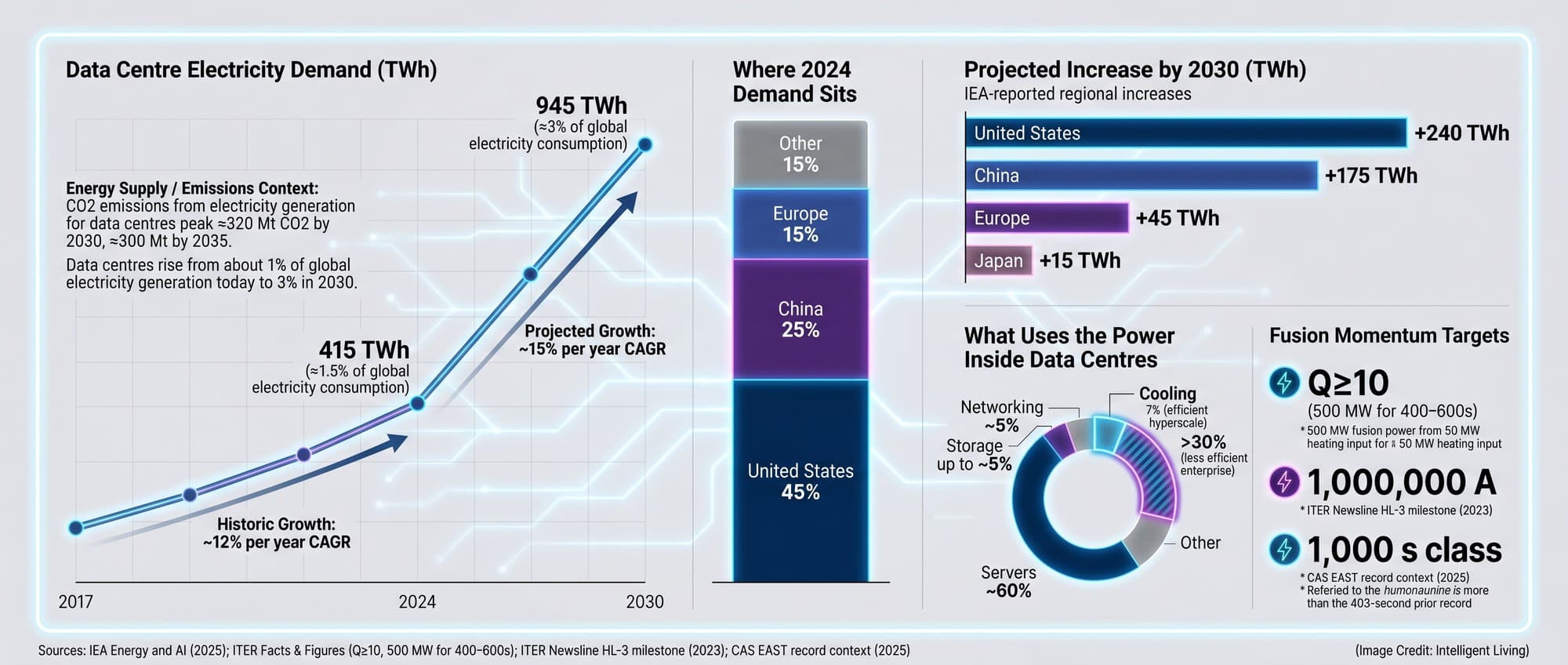
Fusion programs in multiple countries operate at different scales, but they meet the same edge-physics constraints. Tokamaks also depend on magnetic-field strength, and steady magnetic field records show how enabling hardware keeps advancing alongside plasma performance. Recent HL-3 tokamak milestones in China show that handling exhaust heat remains a major design hurdle.
Growing power demand is another major pressure point. The rise of AI infrastructure as a grid problem keeps pushing energy planners to ask what “reliable baseload” means in the AI era.
Fusion energy for AI electricity demand only makes sense if long-run operation is paired with predictable maintenance and controllable wear. Validated models also give everyone a better way to talk about risk. This pattern is familiar to anyone managing large projects: complex infrastructure lives or dies on whether failure modes can be modeled before they show up.
Final Takeaway: Why Divertor Durability is the Key to Reliable Fusion Power
Better math won’t solve every hurdle, but it gives us a massive advantage in fusion reactor maintenance by showing exactly where exhaust punishment lands. This matters right now as teams build next-generation prototypes, and it will matter even more later when we need systems that are easy to certify and operate. Reliable plasma exhaust modeling ensures that we aren’t just guessing about how long our equipment will last.
Managing heat isn’t just a story for fusion scientists; it’s a massive challenge for all modern infrastructure. From reactors to the massive server farms powering our world, data-center cooling tradeoffs often decide if performance gains actually lead to stable operations. As we look at fusion as a candidate for AI-era electricity demand, we have to ensure the machines can handle the load without breaking down.
Progress in this field looks less like a single ‘magic’ moment and more like a growing stack of verified fixes:
- Lowered Technical Risk: Moving from optimism to engineering plans.
- Improved Magnetic Confinement: Better control over core spin and edge flows.
- Validated Engineering: Creating a practical, everyday reality for global power.

Common Questions: Predicting Fusion Reactor Component Life and Heat Handling
What is a Divertor and Why Does it Matter?
A divertor is the ‘exhaust pipe’ of a tokamak; its durability determines how long a reactor can run before needing repairs.
Why Did Simulations Miss the Imbalance Before
Previous models missed a major physical driver—toroidal rotation—which caused them to underestimate where the heat was actually landing.
What is Toroidal Rotation in Simple Terms?
Think of it as the ‘spin’ of the plasma donut; this spin pushes exhaust toward specific areas of the wall.
What is the Scrape-Off Layer?
This is the thin ‘outer skin’ of the plasma where heat and particles start their final trip toward the machine’s wall components.
Does this Mean Fusion is Solved?
No, but it makes fusion power much more predictable and cost-effective by improving our fusion reactor maintenance schedules.


