
Believe it or not, wind power goes as far back as the 9th century BC (at least) when sails were erected on the windy Sistan plains in Persia. The power of these wind turbines was used to grind grain and draw up water. Of course, today’s wind harvesting doesn’t use a cloth to catch the wind; it uses gigantic turbine blades built from composite materials—newer ones from carbon fiber and the older ones from glass fiber. Such materials are used because they are light and robust. Unfortunately, they are also complicated to recycle.
So, what happens to all wind turbines that reach the end of their life? Most of them just get buried.
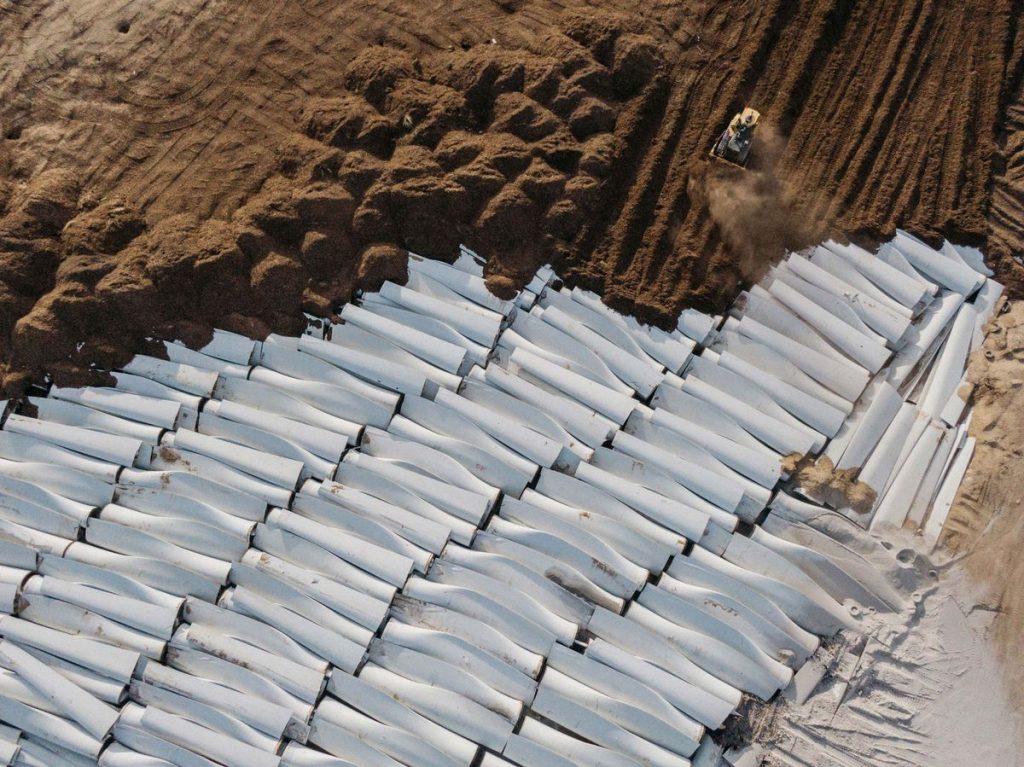
A wind turbine comes to the end of its lifecycle after about 20-25 years. Over that operating lifespan, it repays the carbon cost of building it many times over, as our analysis of how quickly wind turbines repay their carbon footprint shows. It is estimated that in the USA there will be more than 720,000 tons of blade material to get rid of over the next two decades. This amount is roughly 8,000 blades a year over the next four years. In Europe there will be around 3,800 blades coming down annually through 2022. The problem is only going to get worse, and the issue is of great concern. While 99% of a turbine’s parts can be re-sold and recycled, the majority of turbine blades are a challenge, so much so that they end up just being buried in a giant ‘graveyard of blades’ landfill.
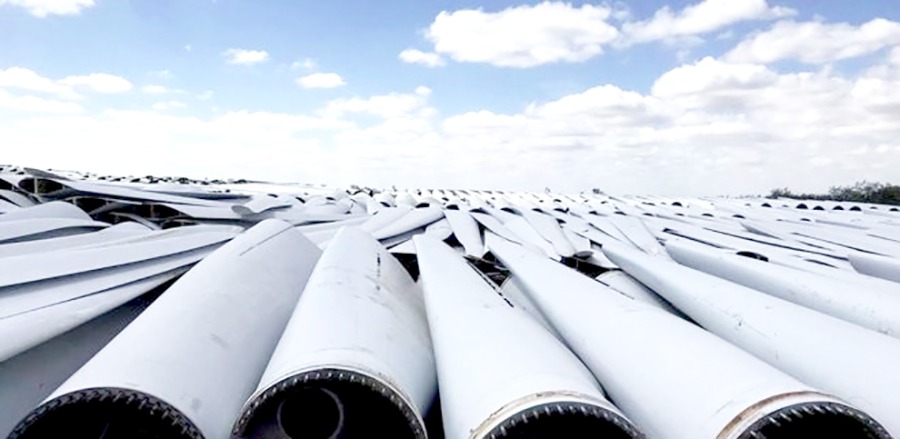
The growing waste problem of decommissioning old wind turbines (and blade replacements) due to wear or aging is contradictory to what the wind industry is supposed to be—a perfect solution to combat climate change. And while much thought was put into their creation, not much was put into figuring out what to do with them when they’re no longer useful.
Furthermore, these blades are hundreds of feet long and super durable. They can’t be easily crushed or repurposed. Most of them have to be cut on-site into at least three parts, and even then, they are a hassle to transport.

There is one company in America that was founded in 2009 called Global Fiberglass Solutions (GFS) that has been breaking down old blades and turning them into pellets and fiberboards to be used for walls and flooring.
Don Lilly, Chief Executive Officer of GFS, said, “We can process 99.9 percent of a blade and handle about 6,000 to 7,000 blades a year per plant. When we start to sell to more builders, we can take in a lot more of them. We’re just gearing up. We use the waste we recycle as manufacturing material and we enable other businesses to do the same. Together with our clients we create a circular, zero-waste solution to bypass land-filling of fiberglass waste and to reduce the world’s carbon footprint.”

There’s also a collaborative research project in the works, by the European Chemical Industry Council, the European Composites Industry Association, and WindEurope, to develop a method of recycling composite materials through cement co-processing. The procedure first separates the glass fibers from the fillers and organic fraction in the composite material. It then replaces parts of cement raw materials with glass fibers and fillers and uses the organic fraction as a replacement for coal as a fuel.
Giles Dickson, the WindEurope CEO, said, “The first generation of wind turbines are now starting to come to the end of their operational life and be replaced by modern turbines. Recycling the old blades is a top priority for us, and teaming up with the chemical and compositors’ industries will enable us to do it the most effective way.”

Meanwhile, in some places around the world, designers are finding creative ways to upcycle turbine blades in a fun and useful manner. For example, in Rotterdam, there’s a 1,200 sq m children’s playground called Wikado, with tunnels, slides, ramps, and even a slide tower, all made from five discarded wind turbine blades.

There’s also a Polish firm called AIRchitecture turning blades into funky urban furniture.

Aside from all that goodness, there’s still much work to be done in finding ways to recycle old turbines. It would be helpful if the problem were thought through during the design process of the blades. They could be planned in such a manner that the method of decommissioning is known, rather than trying to figure out how to deal with them afterwards.


