
Imagine a battery made entirely of solid carbon, heated to temperatures hotter than molten lava, that can store renewable electricity and release it around the clock as industrial heat or grid power. That is exactly what California-based Antora Energy has built, and a new partnership with graphite manufacturer GrafTech International is now scaling the technology using American-made materials.
The collaboration, announced in September 2026, marks a significant step toward making carbon thermal batteries a mainstream energy storage solution for factories, data centers, and the grid. Here is how the technology works, why it costs a fraction of lithium-ion storage, and what it means for the future of industrial energy.
How Carbon Thermal Batteries Work
A carbon thermal battery operates on a deceptively simple principle: convert cheap electricity into heat, store that heat in blocks of solid carbon, and release it on demand. The process has three stages.
Charging: During periods when electricity is abundant and inexpensive, such as midday when solar generation peaks or overnight when wind farms produce surplus power, the system runs electricity through the carbon blocks via resistive heating. Carbon’s exceptional thermal conductivity allows it to absorb energy rapidly, enabling ultra-fast charging that captures the cheapest hours of electricity generation.
Storage: The carbon blocks reach temperatures up to 2,400 degrees Celsius, roughly 40 percent of the surface temperature of the sun. At these extremes, the blocks glow white-hot and emit intense light radiation. A heavily insulated enclosure wraps the blocks to minimize heat loss, allowing energy to be stored for days with minimal degradation.
Discharge: When a factory or grid operator needs energy, insulating shutters open and the glowing carbon radiates thermal energy. This heat can be delivered directly to industrial processes, or it can be converted back into electricity using thermophotovoltaic cells, a technology we will explore in detail below.
The elegance of the system lies in what it does not require. There are no moving parts in the storage module itself, no water or steam systems for basic heat delivery, and no reliance on rare earth elements or supply-constrained critical minerals. Carbon is the fourth-most-produced industrial material on Earth, and the blocks used in Antora’s systems are derived from petroleum coke and coal tar pitch, byproducts of existing industrial processes.
Why Carbon Beats Lithium: The Cost and Density Advantage
The economic case for carbon thermal batteries rests on a striking comparison with lithium-ion technology.
Carbon’s material cost is as low as $1 per kilowatt-hour of storage capacity, according to Antora. Lithium-ion cells, by contrast, cost roughly $55 to $60 per kWh at the cell level for LFP chemistry and $150 to $350 per kWh at the fully installed system level, depending on region and scale. That makes carbon-based thermal storage about 50 times cheaper as a storage medium.
Energy density tells a similar story. Antora’s thermal batteries store roughly three to four times more energy per unit volume than lithium-ion systems, according to data from ARPA-E, the U.S. Department of Energy’s advanced research agency. This compact footprint matters for industrial sites where space is at a premium.
Because the carbon storage medium is so inexpensive and the system sidesteps critical mineral supply chains, the total installed cost of a carbon thermal battery can be well below the $200 to $500 per kWh typical of fully installed lithium-ion electrical storage. When the goal is delivering heat to an industrial process, the economics become even more favorable, since converting electricity to heat through a conventional system wastes energy at every step.
| Feature | Carbon Thermal Battery | Lithium-Ion Battery |
|---|---|---|
| Storage medium cost | ~1/kWh (company figure) | ~55 to $60/kWh (LFP cells) |
| Installed system cost | Not publicly disclosed | $150 to $350/kWh electric (regional range) |
| Energy density | 3 to 4x lithium-ion per volume | Baseline |
| Max operating temperature | 2,400 degrees Celsius | Typically 40 to 60 degrees Celsius |
| Critical minerals required | None | Lithium, cobalt, nickel, manganese |
| Moving parts | None (heat delivery mode) | Battery management system, cooling |
| Duration | Multi-day | Typically 2 to 4 hours |
| Cycle life | Virtually unlimited (no degradation mechanism) | Degrades over 3,000 to 5,000 cycles |
For applications that need electricity rather than heat, lithium-ion still holds advantages in round-trip efficiency and response speed for short-duration storage. But for industrial heat, which accounts for roughly 74 percent of all industrial energy use in the United States, carbon thermal batteries offer a fundamentally different value proposition.
The Thermophotovoltaic Breakthrough: Turning Heat Into Electricity
One of the most technically impressive aspects of Antora’s system is its ability to convert stored heat back into electricity without turbines, generators, or any moving mechanical components. The key is thermophotovoltaic (TPV) technology.
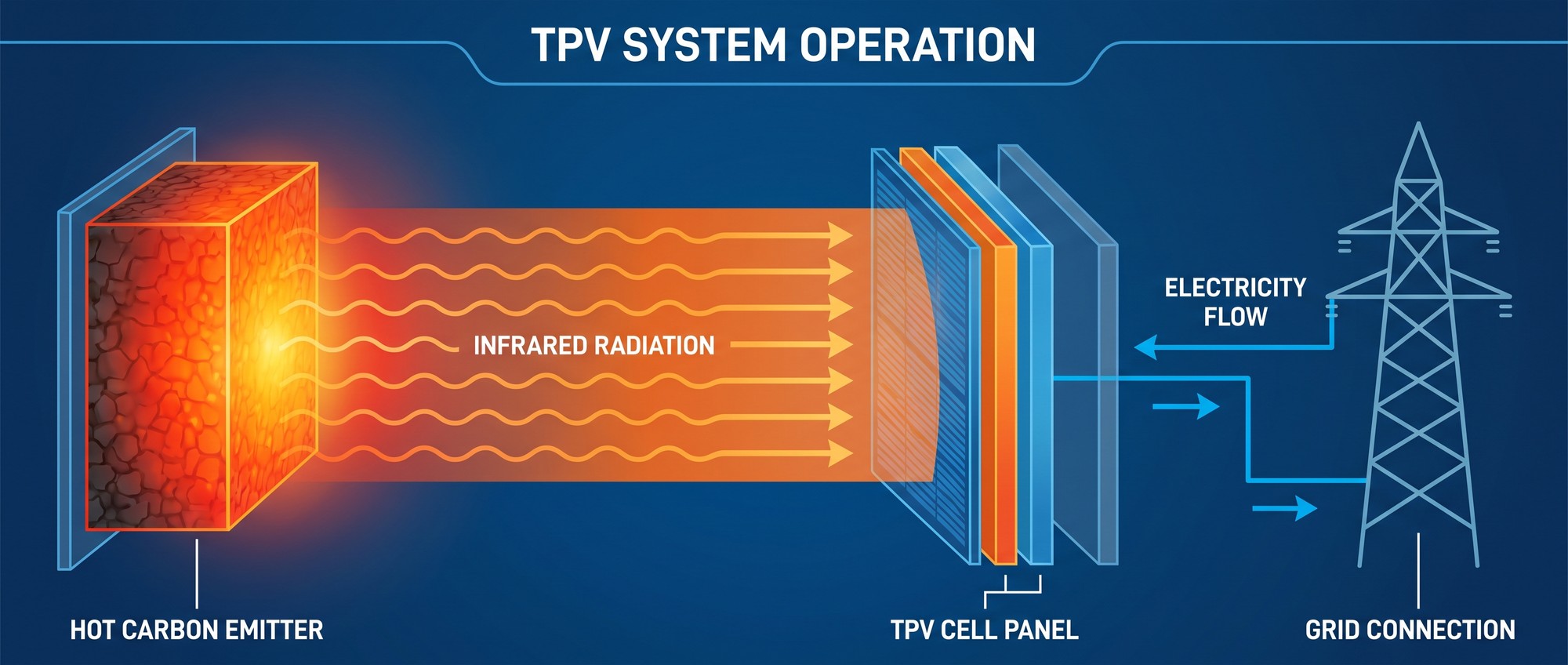
At 2,400 degrees Celsius, Antora’s carbon blocks glow with light intensity roughly 500 times that of sunlight. TPV cells, which are solid-state semiconductor devices similar in concept to solar panels, capture this thermal radiation and convert it directly into electricity.
The critical efficiency breakthrough came in 2022, when researchers at MIT and the National Renewable Energy Laboratory published a landmark paper in the journal Nature documenting a TPV cell that achieved 41.1 percent conversion efficiency at source temperatures around 2,400 degrees Celsius. That figure surpassed the efficiency of a typical steam turbine, which averages around 33 percent, and did so with no moving parts, no water, and no steam cycle.
Antora, co-founded by Stanford alumni Andrew Ponec and Justin Briggs alongside David Bierman, whose work on thermal battery technology has been compared to a revolution in heat energy storage, has built on this research to develop manufacturing-scale TPV cells. The company demonstrated greater than 40 percent efficiency at its dedicated TPV cell production line in California, which opened in January 2023.
When delivering heat directly to an industrial process rather than converting it to electricity, the system achieves round-trip efficiency above 90 percent, since there is no conversion step. This dual-output capability, producing either heat or electricity from the same module, is what makes the technology versatile enough to serve chemical plants, food processors, steelmakers, data centers, and the electrical grid from a single design.
From Lab to Grid: Project Big Stone Proves the Concept
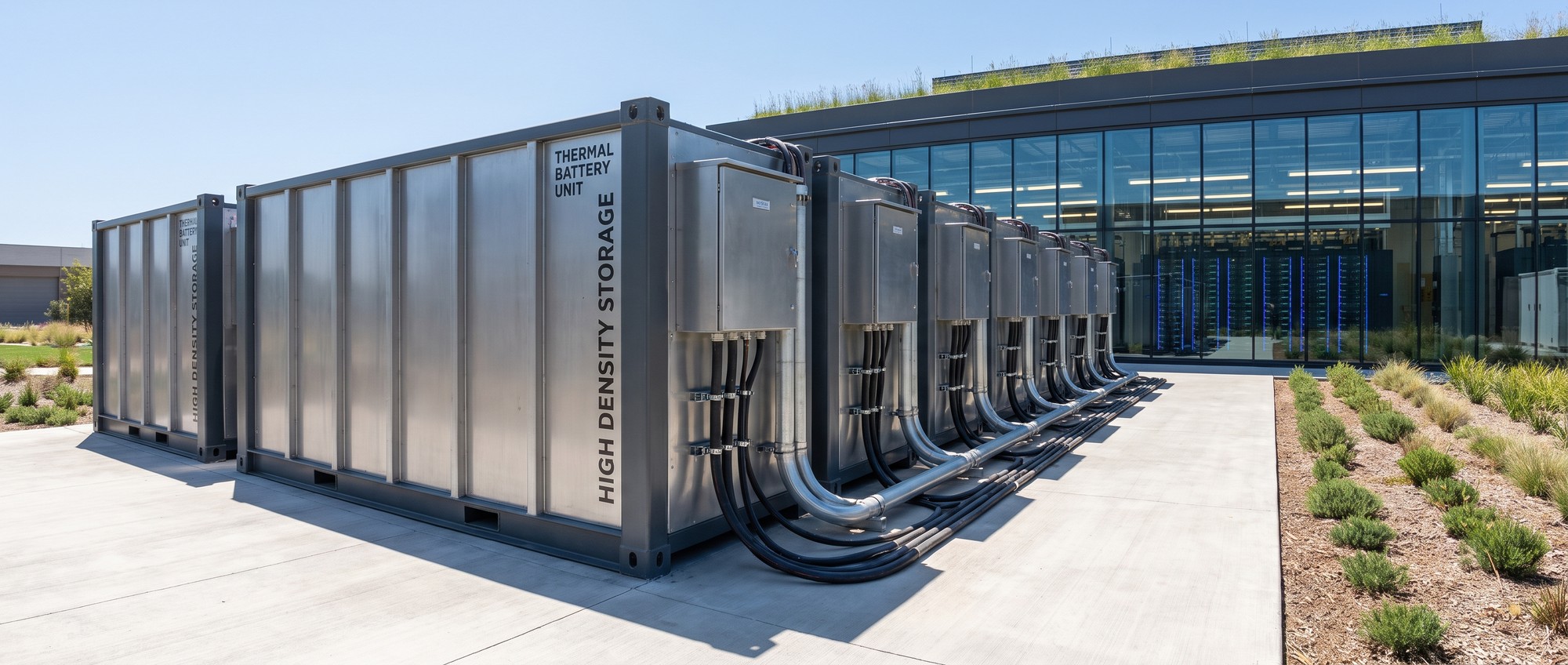
Theoretical advantages matter little without real-world deployment. In May 2026, Antora and POET, the world’s largest biofuel producer, commissioned Project Big Stone in Big Stone City, South Dakota. The system is a 5 gigawatt-hour, multi-day thermal energy storage installation that deployed more than 200 of Antora’s thermal battery modules.
What makes the project remarkable is its speed. From initial construction to delivering energy, the entire system came online in under 12 months, a timeline that stands in stark contrast to the multi-year construction schedules typical of large energy infrastructure projects.
Upon full completion, Project Big Stone will rank among the world’s largest energy storage installations by capacity. It currently delivers round-the-clock energy to POET’s bioprocessing facility, replacing what would otherwise be fossil fuel consumption for industrial heat.
Antora’s stated goal is to beat natural gas on cost alone, even without a carbon price, which would represent a tipping point for industrial decarbonization.
The GrafTech Partnership: Building a Domestic Supply Chain
The September 2026 announcement that GrafTech International and Antora Energy are partnering to develop carbon-based materials for thermal batteries signals the beginning of a domestic manufacturing supply chain for this technology.
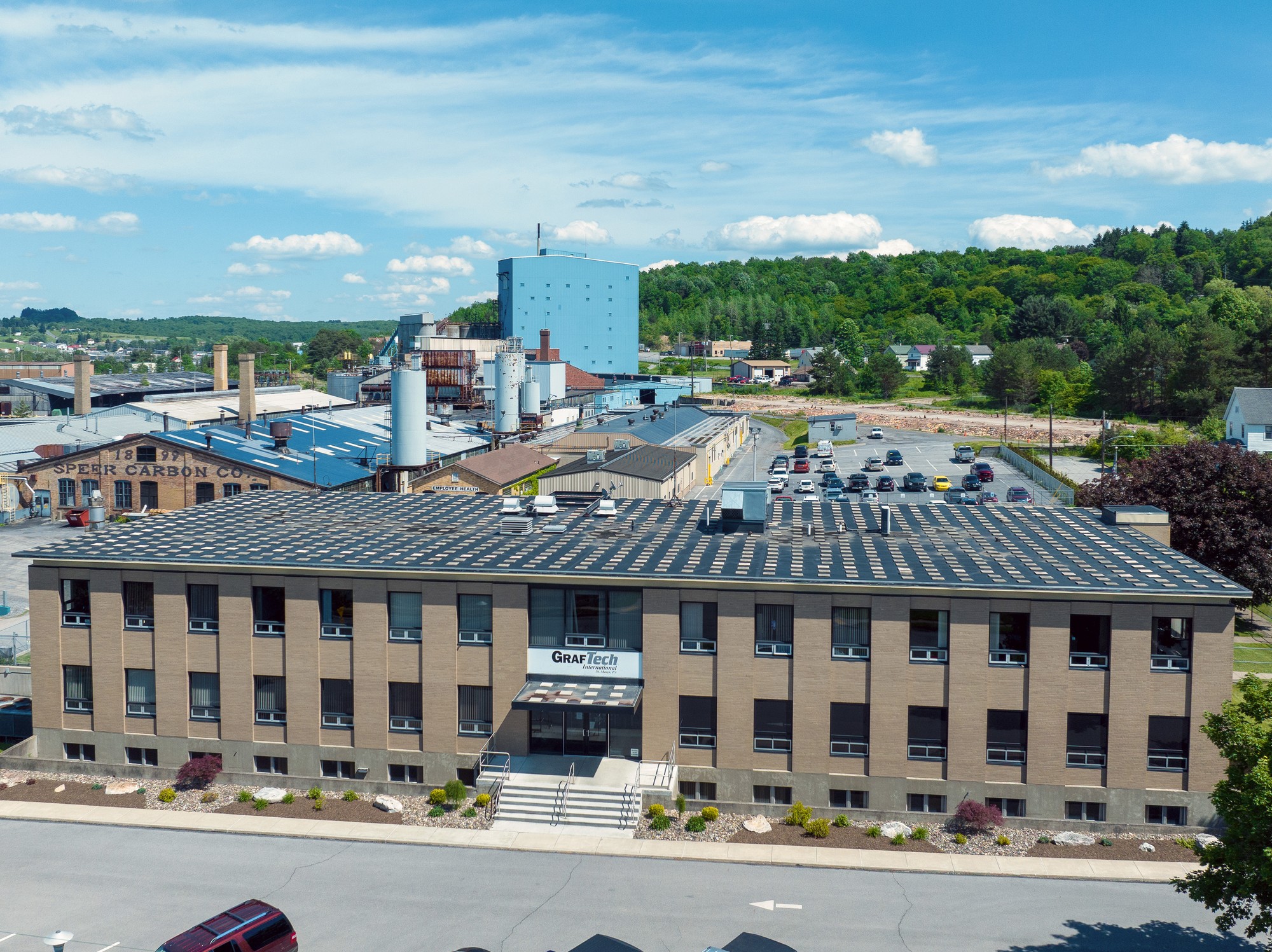
GrafTech, which has manufactured carbon and graphite products for nearly 140 years, will produce the carbon blocks and insulation materials at its St. Marys facility in Pennsylvania. Eight bake furnaces at the plant have already been restarted, and the companies are hiring approximately a dozen additional workers across plant operations, machining, and maintenance.
“St. Marys has been an important part of GrafTech’s manufacturing footprint since we acquired the facility in 2010, and we are proud to partner with Antora to leverage the facility and our nearly 140 years of experience in carbon and synthetic graphite-based solutions,” said Timothy Flanagan, CEO and president of GrafTech International.
For Antora, the partnership secures a domestic source of the core storage material as the company scales from individual projects to factory-level production. The carbon blocks used in thermal batteries are made by heating petroleum coke and coal tar pitch in high-temperature furnaces, a process that GrafTech has perfected over more than a century.
“By partnering with GrafTech to source carbon-based materials from their St. Marys facility, Antora is strengthening our domestic supply chain,” said Andrew Ponec, co-founder and CEO of Antora Energy. The two companies have signed a memorandum of understanding and are negotiating definitive agreements for the collaboration.
The partnership also opens a new market for American carbon materials. Petroleum coke and coal tar pitch are industrial byproducts that currently have limited high-value applications, and repurposing them for energy storage creates economic value from what would otherwise be lower-grade feedstocks.
A $53 Billion Market Opportunity
The GrafTech-Antora partnership arrives as the global thermal energy storage market is entering a period of rapid growth. Market analysts project the TES market will reach $53.4 billion by 2030, with industrial process heat emerging as the fastest-growing application segment.
Several forces are converging to drive this expansion:
- Industrial decarbonization mandates: Tightening emissions regulations across the United States, Europe, and Asia are pushing manufacturers to find alternatives to natural gas for process heat.
- Renewable energy surplus: As wind and solar capacity expands, there are increasing periods of excess generation that need storage solutions to avoid curtailment.
- Data center demand: The explosive growth of AI infrastructure is creating enormous electricity needs that require reliable, around-the-clock power, a use case where thermal batteries with dual heat-and-power output are particularly well suited.
- Energy security: Domestic production of storage materials reduces dependence on imported lithium and cobalt supply chains, strengthening U.S. energy independence.
- Grid flexibility: Long-duration energy storage that can discharge for days rather than hours is increasingly recognized as essential for grid reliability.
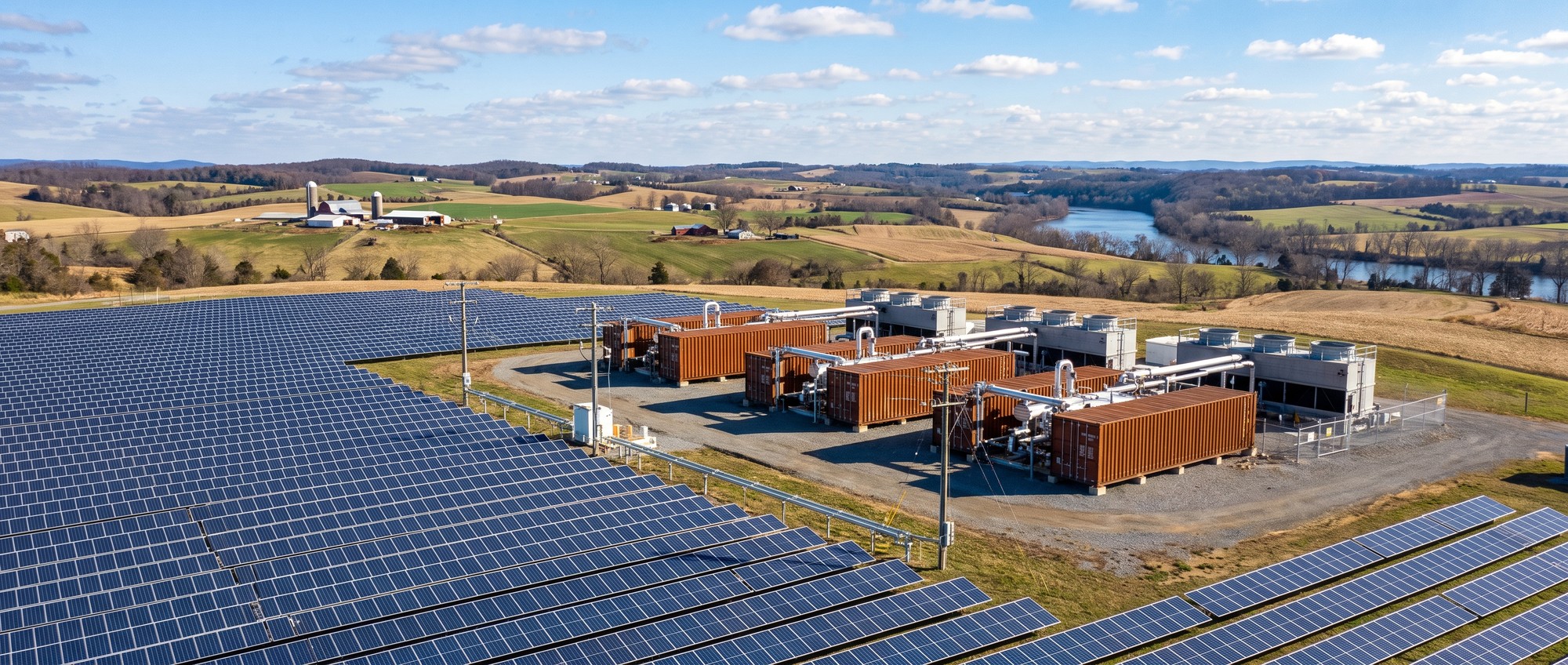
Antora’s $550 million Series C funding round, announced in July 2026, reflects this market confidence. The oversubscribed round was co-led by G2 Venture Partners and Eclipse, with participation from Salesforce Ventures, Breakthrough Energy Ventures (Bill Gates’ climate fund), and other major investors. The raise pushed Antora’s total funding past $1 billion.
The company is using the capital to establish a second U.S. manufacturing hub and expand production capacity. Its San Jose, California, factory doubled its output in spring 2026, and a growing pipeline of signed agreements with hyperscalers and industrial manufacturers is driving demand for modules.
For data centers in particular, the dual-output capability is a differentiator. A single Antora module can deliver both the process heat needed for on-site operations and the firm electricity required to maintain uptime, eliminating the need for separate diesel backup generators and separate heat systems.
How Carbon Thermal Batteries Compare to Other Storage Technologies
Carbon thermal batteries are not the only approach to industrial heat storage. Several competing technologies are also vying for market share, each with distinct trade-offs. Thermal energy storage as a field is rapidly expanding beyond traditional battery approaches.
| Technology | Max Temperature | Storage Medium | Key Advantage | Key Limitation |
|---|---|---|---|---|
| Carbon thermal (Antora) | 2,400 degrees Celsius | Solid carbon blocks | Highest temperature, dual heat/power output, no critical minerals | Heat-to-electricity round-trip efficiency ~40 to 50% |
| Brick thermal (Rondo) | 1,500 degrees Celsius | Ceramic bricks | 97 to 98% round-trip efficiency (heat-to-heat), very low capex | Lower max temperature limits some industrial applications |
| Molten salt | 565 degrees Celsius (current) | Nitrate or chloride salts | Proven at utility scale (concentrated solar power) | Freezing risk, corrosion, lower temperature ceiling |
| Phase-change materials | 100 to 400 degrees Celsius | Various salts and metals | High energy density at specific temperature ranges | Narrow temperature band, early-stage for industrial use |
| Lithium-ion (for comparison) | 40 to 60 degrees Celsius (operating) | Lithium compounds | High round-trip electrical efficiency (90 to 95%) | Critical minerals, degradation, high cost, short duration |
Rondo Energy’s brick-based thermal batteries, which heat ceramic bricks to 1,500 degrees Celsius, achieve impressive round-trip efficiency of 97 to 98 percent for heat-to-heat applications and operate at lower capital costs of $20 to $40 per kWh thermal. However, they cannot reach the ultra-high temperatures that Antora’s carbon blocks achieve, which limits their suitability for certain industrial processes like steelmaking or chemical production.
Finland’s commercial sand battery uses a similar thermal storage principle with crushed rock. Molten salt storage, proven at utility scale through concentrated solar power plants, tops out at around 565 degrees Celsius with current nitrate salts. That temperature covers many industrial applications but falls short of the needs of heavy industry.
The key differentiator for carbon thermal batteries is the combination of extreme temperature capability, dual-output versatility, and the absence of critical mineral dependencies. For the hardest-to-decarbonize industrial sectors, that combination may prove decisive.
Frequently Asked Questions
What does a thermal battery do?
A thermal battery stores energy as heat in a medium such as solid carbon, ceramic bricks, or molten salt. When electricity is cheap, the system heats the storage medium. When energy is needed, the stored heat is released either directly as industrial process heat or converted back into electricity. This approach bypasses the need for expensive electrochemical batteries in applications that need heat or long-duration storage.
How much does a carbon thermal battery cost?
The carbon storage medium itself costs approximately $1 per kilowatt-hour of capacity, about 50 times cheaper than lithium-ion battery materials. Antora does not publicly disclose system-level capital costs or a specific levelized cost of storage, but the inexpensive storage medium and the elimination of critical mineral supply chains are expected to keep total costs below those of comparable lithium-ion installations, which currently run $150 to $350 per kWh depending on region.
What is the largest thermal battery project in the world?
As of 2026, Antora Energy’s Project Big Stone in South Dakota is among the world’s largest energy storage installations by capacity at 5 gigawatt-hours. The system, which uses more than 200 thermal battery modules, was commissioned in May 2026 and delivers round-the-clock energy to POET’s biofuel processing facility. The project advanced from construction to delivering energy in under 12 months.
Can thermal batteries replace lithium-ion for grid storage?
Thermal batteries and lithium-ion serve different roles. Lithium-ion excels at short-duration, high-efficiency electrical storage (2 to 4 hours). Thermal batteries are designed for long-duration storage (days), industrial heat delivery, and applications where critical mineral supply chains are a concern. For data centers and heavy industry that need both heat and power around the clock, thermal batteries offer advantages that lithium-ion cannot match.
Conclusion
The GrafTech-Antora partnership represents more than a single business deal. It signals the emergence of a domestic supply chain for a technology that could reshape how American industry stores and uses energy. Carbon thermal batteries combine an ancient material with cutting-edge thermophotovoltaic conversion to deliver a storage solution that is cheaper, longer-lasting, and free of the critical mineral dependencies that constrain lithium-ion technology.
With Project Big Stone proving the concept at grid scale, $1 billion in funding backing the company’s expansion, and a $53 billion market opportunity opening worldwide, carbon thermal batteries are moving from laboratory curiosity to industrial reality. The question is no longer whether the technology works, but how fast it can scale. As alternative battery chemistries like iron-air also challenge lithium-ion’s dominance, the energy storage landscape is diversifying rapidly, with each technology carving out its own niche.


