
On a remote stretch of Oman’s southern coastline overlooking the Arabian Sea, archaeologists have uncovered a 6,000-year-old stepped pyramid that is reshaping our understanding of prehistoric trade between Arabia and Mesopotamia. The discovery, published just days ago, reveals that long-distance exchange networks connected the two regions as far back as the fourth millennium BCE, centuries earlier than many scholars had assumed.
A Neolithic Pyramid on the Arabian Sea
The structure stands at Khawr Kharfut, a site in Oman’s Dhofar region that has been under excavation since 2014. Led by the Archaeological Research Institute in Indiana and funded by the Khor Kharfut Foundation, the research team exposed a carefully constructed northern wall during the 2023 and 2024 excavation seasons. The wall features vertical and stepped masonry built from partially dressed limestone blocks, set in a coursed pattern and bound with mud mortar and smaller filler stones.
Though time and erosion have worn down much of the original structure, the elevated mound remains a prominent landmark on its coastal terrace. Its commanding position has led researchers to suggest it served ceremonial, administrative, or otherwise important communal functions: a place where people gathered for ritual, governance, and exchange. “The discovery points to a long-term, organised, symbolically charged settlement utilising far-reaching trade networks into Mesopotamia and probably elsewhere.”
The researchers published their findings in Athar, the bulletin of archaeological research in Oman.
The Ziggurat Connection: Stone Vessels That Crossed a Sea
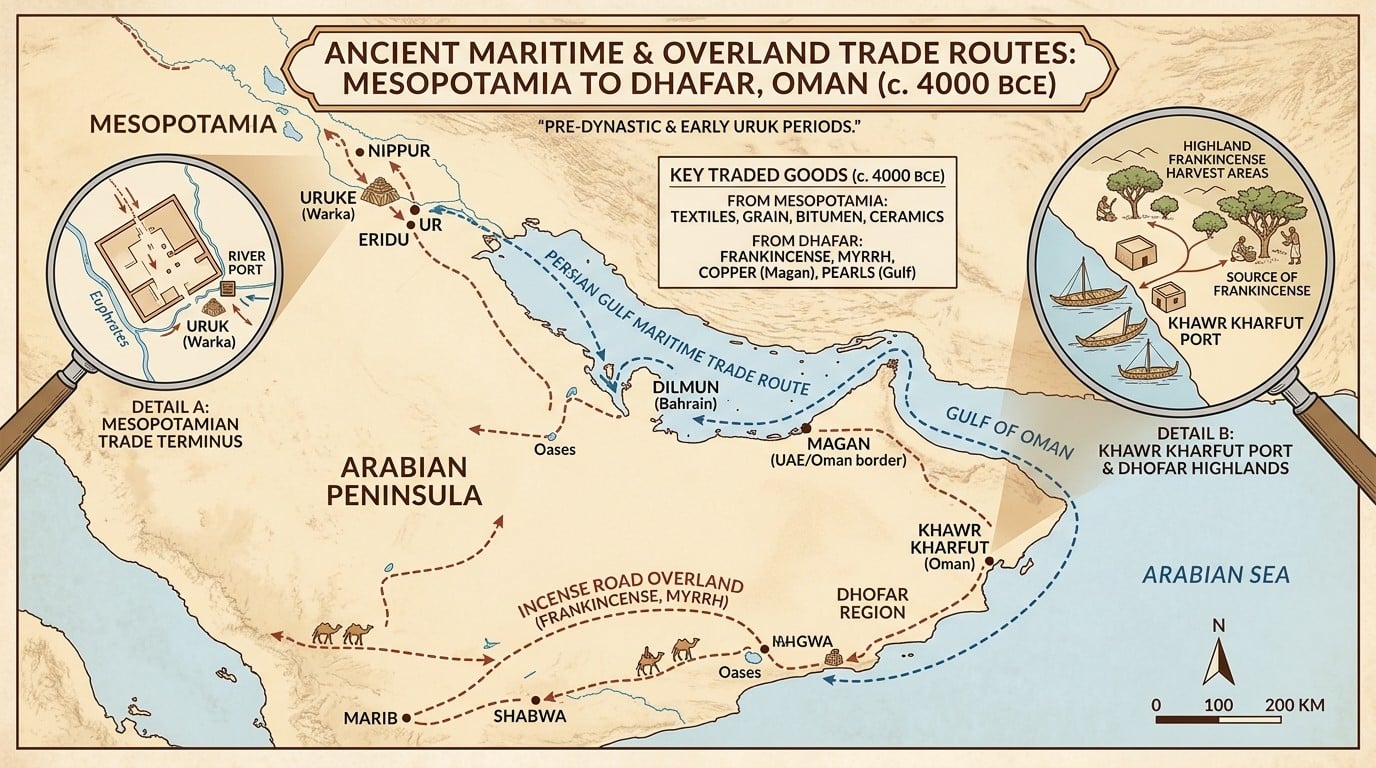
What makes the Khawr Kharfut discovery especially significant is not just the pyramid itself, but the artifacts found within and around it. Among the most telling finds are stone vessels that closely resemble examples associated with the Anu ziggurat in Mesopotamia during the Warka period, dated between roughly 3800 and 3400 BCE.
The Anu ziggurat, located at Uruk in modern-day Iraq, is the oldest known ziggurat in the world. Dedicated to Anu, the Sumerian sky god, its construction began around 4000 BCE and proceeded through fourteen distinct building phases. At its peak, the White Temple was built atop it sometime between 3500 and 3000 BCE, crowning what was already one of the ancient world’s most significant sacred structures.
A basal fragment of a stone vessel found eroding from the Khawr Kharfut pyramid’s northern slope may provide a direct chronological link between the Omani monument and the Warka phase.
If confirmed through planned radiocarbon dating, this would place the stepped pyramid firmly within the same cultural horizon as Mesopotamia’s earliest temple towers.
Decorative motifs on pottery recovered from the site further reinforce the connection, echoing traditions from both inland South Arabia and southern Mesopotamia. The ceramics include plain red and brown wares, vessels decorated with fingernail impressions, and occasional fragments of imported glazed ware, a material profile that speaks to a community engaged in both local craftsmanship and participation in much wider exchange networks.
Life at Khawr Kharfut: A Hub Between Two Worlds
The natural setting of Khawr Kharfut made it unusually well-suited for sustained human occupation. Sheltered waters, freshwater springs, nearby lagoons, and plentiful woodland created one of the most favorable environments along this stretch of the Arabian Sea coast. These resources likely supported repeated seasonal visits, maritime activity, and human settlement over many centuries.
Researchers now believe the site functioned as a nodal settlement, a ceremonial and strategic contact point that mediated between Dhofar’s highland incense-producing communities and coastal maritime networks reaching as far as Mesopotamia. The settlement appears to have connected the frankincense-rich interior of southern Oman with trading routes extending across the Arabian Sea, through the Persian Gulf, and into the heart of the Sumerian world.
This is a significant revision to the established picture of fourth-millennium BCE trade. While archaeologists have long known that Mesopotamia imported goods from the Arabian Peninsula, including copper from Oman and incense from Dhofar, the Khawr Kharfut discovery suggests that these networks were not merely extractive. They were anchored by permanent, architecturally sophisticated settlements that served as cultural and commercial bridges between inland and maritime worlds.
What Are Ziggurats? A Brief Primer
For readers encountering the term for the first time, ziggurats were massive stepped temple towers built across ancient Mesopotamia, roughly the area of modern-day Iraq and parts of Syria, Iran, and Turkey, between the fourth and first millennia BCE. The word derives from the Akkadian zaqārum, meaning “to build high,” and these structures were designed quite literally as mountains of the gods, bridging the earthly and divine realms.
Built from mud-brick cores and fired-brick exteriors, ziggurats typically rose in receding tiers with a shrine at the summit. Each major city had its own, dedicated to its patron deity:
- Anu ziggurat at Uruk: dedicated to Anu, the sky god; the oldest known, begun around 4000 BCE
- Great Ziggurat of Ur: dedicated to Nanna, the moon god; built circa 2100 BCE and the best-preserved today
- Ziggurat of Kish: dedicated to Zababa, the warrior god, and Ishtar; restored by Nebuchadnezzar II
- Etemenanki in Babylon: dedicated to Marduk; widely believed to have inspired the biblical Tower of Babel
One of the most common questions about ziggurats is how they compare to the pyramids of Egypt, and the answer often surprises people. The oldest known ziggurat, the Anu ziggurat, began construction around 4000 BCE, predating Egypt’s Step Pyramid of Djoser (circa 2630 BCE) by roughly 1,400 years.
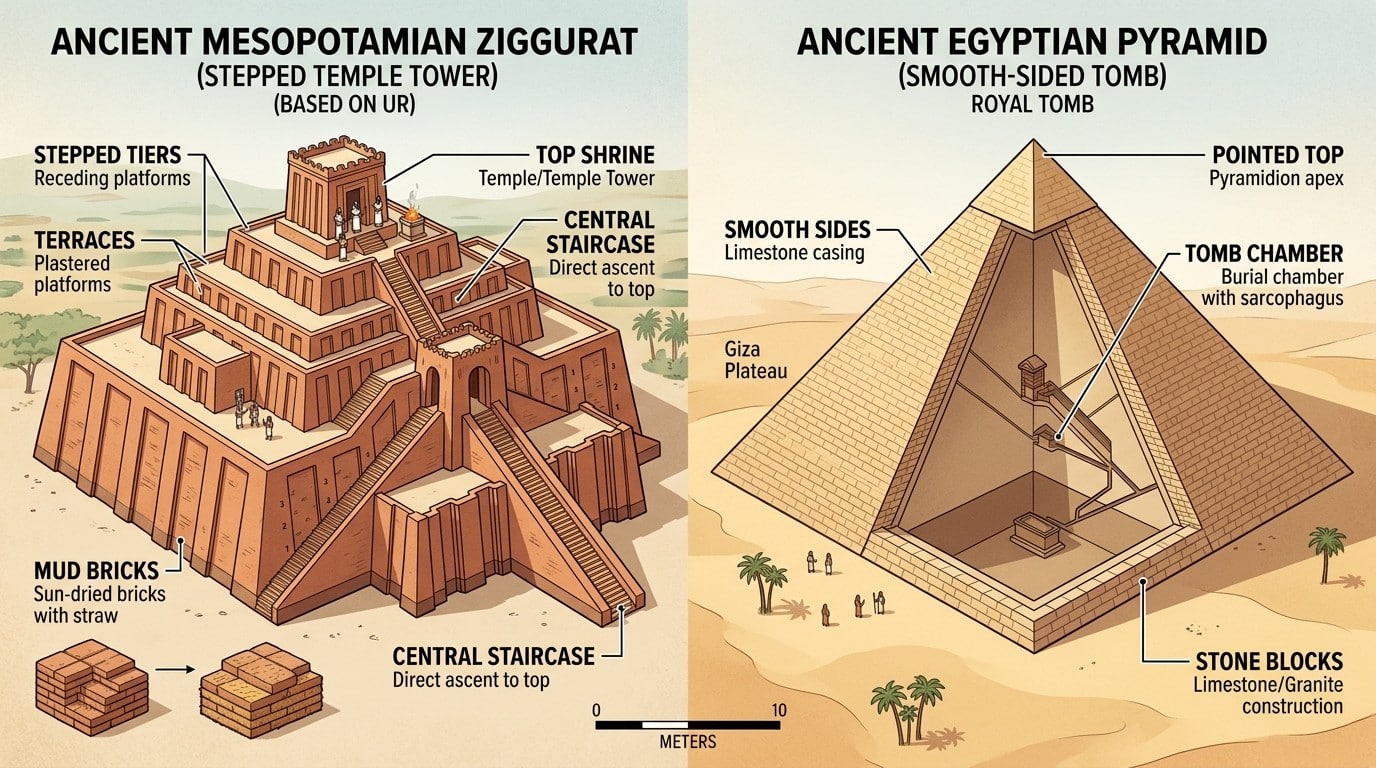
While Egyptian pyramids served as tombs, ziggurats functioned as living temples, places where priests performed daily rituals and where the patron deity was believed to dwell.
2026’s Other Ziggurat Milestones
The Oman discovery is not the only reason ziggurats have made headlines this year. Two other major developments, one archaeological and one conservational, have kept these ancient monuments in the spotlight.
The Kish Cylinders: Nebuchadnezzar Speaks
In January 2026, researchers published the first complete translation of two fired clay cylinders discovered at Tell Al-Uhaimir, the site of the ancient city of Kish in central Iraq. Handed over to Iraqi authorities by local residents in December 2013, the barrel-shaped cylinders, each roughly the size of a soda can, bear cuneiform inscriptions documenting the restoration of the ziggurat of Kish by King Nebuchadnezzar II (604–562 BCE).
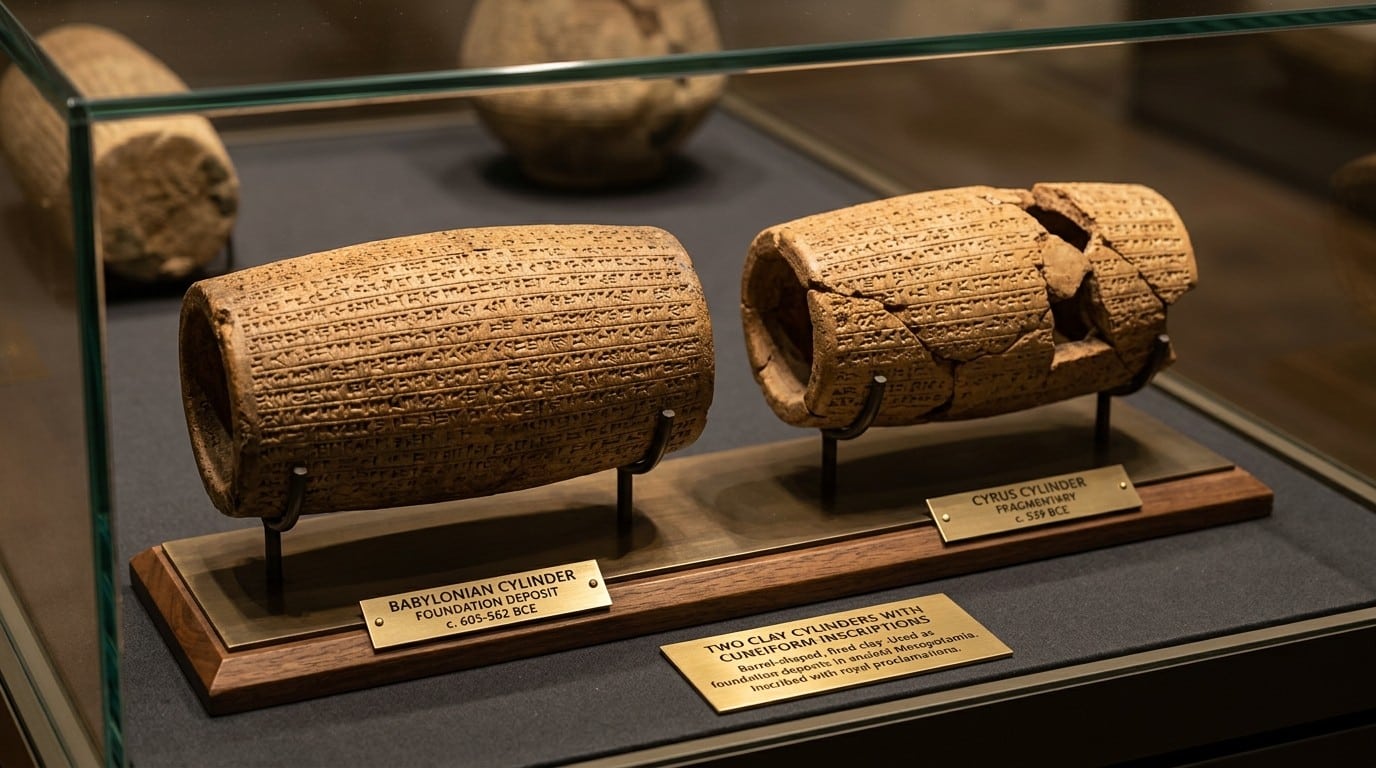
The text, published in the Cambridge University journal Iraq, is the first foundation inscription to explicitly detail Nebuchadnezzar’s work on this particular temple-tower. Previous knowledge of his involvement came only from scattered bricks stamped with his name. In his own words, the king describes how the ziggurat, originally built by a “king of the past,” had deteriorated: “its walls had bulged… and rain showers carried away its brickwork.” Claiming divine urging from the gods Zababa and Ishtar, Nebuchadnezzar recounts how he reorganized the brickwork, rebuilt collapsed sections, completed the structure, and raised its superstructure until it shone “like the light of day.”
The ziggurat’s Sumerian name, the cylinders reveal, was É.U6.NIR.KI.TUŠ.MAH, “House, Tower-Temple, Exalted Dwelling.” The discovery confirms what had long been suspected: that Nebuchadnezzar II, famous for the Hanging Gardens of Babylon, was also a dedicated restorer of the older sacred monuments of Mesopotamia, using royal building projects to legitimize his rule by presenting himself as a pious continuator of ancient traditions.
The Great Ziggurat of Ur: A Race Against Time and Climate
While scholars work to decipher the past, another team in southern Iraq has been racing to preserve one of its most iconic monuments for the future. The Great Ziggurat of Ur, located near Nasiriyah in Dhi Qar province, has been undergoing its seventh major restoration and the first truly comprehensive one in more than a quarter century.
Built around 2100 BCE by King Ur-Nammu of the Third Dynasty of Ur, the ziggurat was dedicated to the moon god Nanna and remains one of the best-preserved examples of its kind. It has also endured extraordinary hardship: during the 1991 Gulf War, the structure sustained more than 400 bullet holes, and nearby bomb craters left visible scars on its walls. The last restoration, carried out in 1999, was limited to four small patches: three on the second tier and a section of lime replacement on the first tier measuring less than one square meter.
The current project, led by Iraqi experts with a budget of approximately $382,000, takes a fundamentally different approach.
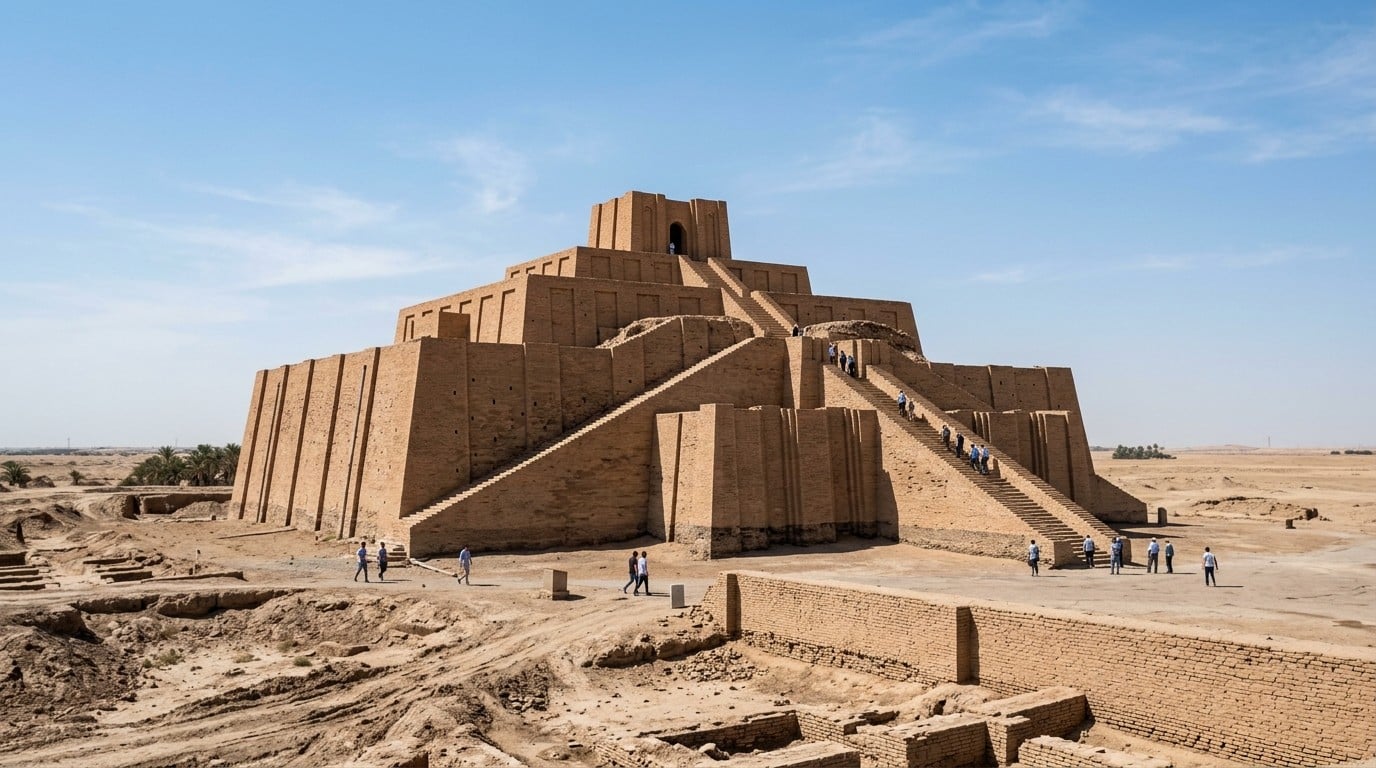
Workers are producing bricks locally, chemically matching them to the original materials, and applying traditional construction methods to maintain authenticity. Mud is handmade on site using clay sourced from an environment similar to that of the ancient city. Restoration covers the entire first-tier façade with its three main staircases, emergency repairs on the second tier and its stairs, and a redesign of the third tier based on archaeological data and scientific sources.
The work was expected to reach completion by early July 2026. However, as one project supervisor noted, the site now faces a threat its original builders never imagined: without the natural and man-made barriers that once shielded it, the full force of weather, intensified by climate change, means regular maintenance will likely be necessary for the foreseeable future.
Frequently Asked Questions
What is a ziggurat, and what was it used for?
A ziggurat is a massive stepped temple tower built in ancient Mesopotamia, constructed with a mud-brick core and a fired-brick exterior. Each major Sumerian, Babylonian, and Assyrian city had its own ziggurat, dedicated to the city’s patron deity. At the summit sat a shrine where priests performed daily rituals. Unlike Egyptian pyramids, ziggurats were not tombs; they were living religious centers, believed to be the literal dwelling places of the gods on earth.
Are ziggurats older than pyramids?
Yes. The oldest known ziggurat, the Anu ziggurat at Uruk, began construction around 4000 BCE. This predates Egypt’s oldest pyramid, the Step Pyramid of Djoser at Saqqara (circa 2630 BCE), by approximately 1,400 years. The newly discovered stepped pyramid at Khawr Kharfut in Oman, dated to the fourth millennium BCE, may add yet another chapter to this timeline.
Do ziggurats still exist today?
Yes, though none remain fully intact. The best-preserved is the Great Ziggurat of Ur in southern Iraq, which still stands approximately 21 meters (69 feet) tall despite being over 4,000 years old. Other notable remnants include the ziggurat at Chogha Zanbil in Iran and the eroded ruins of the ziggurat of Kish. The ongoing restoration at Ur aims to preserve it for future generations.
What are the three most famous ziggurats?
The three most historically significant ziggurats include: the Great Ziggurat of Ur (dedicated to the moon god Nanna, built circa 2100 BCE), the Anu ziggurat at Uruk (the oldest known, begun around 4000 BCE and dedicated to the sky god Anu), and the ziggurat of Etemenanki in Babylon, widely believed by scholars to have inspired the biblical story of the Tower of Babel. The ziggurat of Kish, the subject of the recently published Nebuchadnezzar cylinders, adds a fourth contender to that list.
What were ziggurats typically made from?
Ziggurats were constructed primarily from sun-dried mud bricks for the core and fired (kiln-baked) bricks for the exterior facing. Bitumen, a naturally occurring tar-like substance, was often used as mortar. The exteriors were sometimes glazed in different colors; the ziggurat of Etemenanki in Babylon is believed to have had blue-glazed upper tiers. The stepped pyramid at Khawr Kharfut in Oman, by contrast, used partially dressed limestone blocks with mud mortar, reflecting the different available building materials of the Arabian Peninsula.
What Comes Next
The next phase of research at Khawr Kharfut will prioritize radiocarbon dating of organic materials and broader ceramic comparisons with neighboring regions. These efforts should refine the site’s chronology and confirm, or complicate, its relationship to the Mesopotamian ziggurat tradition.
Together, the three stories of 2026 sketch a remarkable arc: from the very origins of the stepped temple form in the fourth millennium BCE to the royal inscriptions that documented their renewal two and a half millennia later to the modern hands now working to preserve what remains. The ziggurat, it turns out, is not merely an artifact of the distant past. It is a living thread connecting ancient Sumer to the present day, and, as the discovery in Oman suggests, its story may stretch farther across geography and time than anyone had imagined.

