
Robotics tend to favor plastic and metal because of their durability and strength, but a team of scientists from the United States has chosen to use cells from biological tissues to make living robots instead. Their robots are the world’s first living machines, assembled from African clawed frog cells into tiny living robots that can move around like a little creature blob. The way they see it, the material isn’t as durable, but it’s better in other ways. For example, when it is damaged, it can heal itself, and when the robot has completed its task, it simply falls apart and decomposes in the same way a natural organism decays when it dies.
The director of Tufts University’s Allen Discovery Center, Michael Levin, said:
These are entirely new lifeforms. They have never before existed on Earth. They are living, programmable organisms.

For now, the robots are less than 1mm long, but they envision making them life-size eventually. They are designed using a program that generates random 3D configurations and tests them in a virtual environment. These “evolutionary algorithms” are run on a supercomputer and successful versions then selected for their viability. Two kinds of cells are used: skin and heart cells. The skin cells make up the “body,” and the heart cells are like the muscles because they naturally contract and release. Depending on where the heart cells are, and which ones beat when the robot can move in any direction.
How a robot is born:
- 500-1,000 skin and heart cells are put into a solution in a dish connected to the supercomputer.
- The program then generates random 3D configurations of these cells.
- Each design completed is tested in a virtual environment. They check how far the robot can move when the heart cells beat.
- The best performers are used to spawn the next designs, and the cycle continues.
- When the energy reserve in the cells run out, the robot dies. The cells have enough power in them to survive for seven to ten days before that happens.
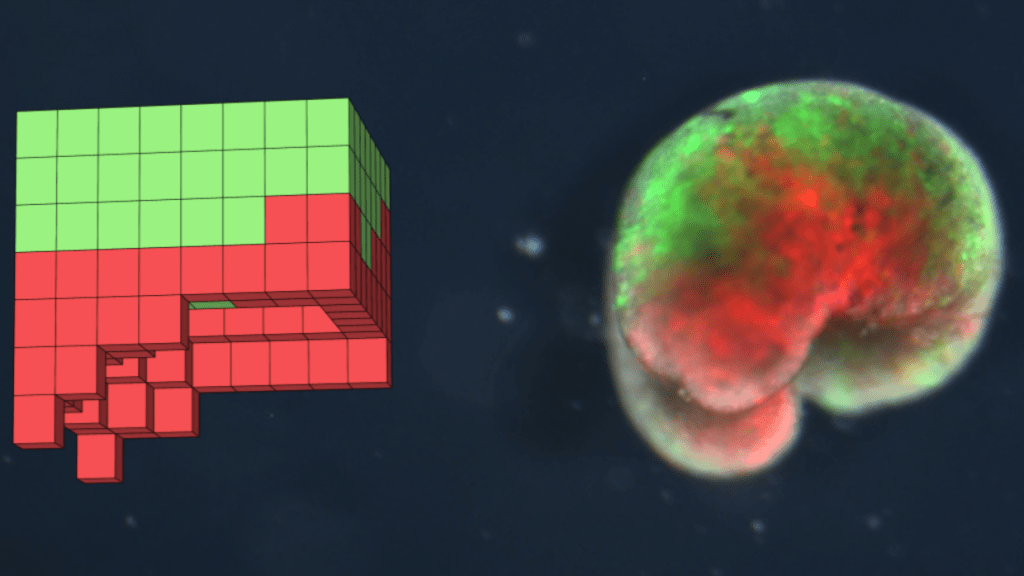
The most successful creations so far were:
- A blob that had two stumpy legs made of heart cells that propelled it along its “chest.”
- A blob with a hole in the middle that could shimmy around with miniature payloads.

The team had the computer pump out 100 generations before they selected a few of the best designs to build in the lab with real cells. For the early stages of the robot’s development, the scientists had to use tweezers and cauterizing tools to help it along.
The skin and heart cells used were scraped from the embryos of African clawed frogs, Zenopus laevis, which influenced naming their living machines “xenobots.” The study has been published in the journal Proceedings of the National Academy of Sciences (PNAS).

The ultimate plan is to make them with built-in nervous systems, sensory cells, and blood vessels so the robots could form rudimentary eyes. The researchers also speculated that if built with using mammalian cells they could even live on dry land.
What could these robots be used for? They could be deployed to clean up microplastic pollution in the oceans and waterways or locate and digest toxic materials from the environment. They could deliver drugs within the body, with accuracy, to where they need to go or remove plaque from artery walls to reduce the risk of heart failure. There are so many potential applications for living robots.


