
For years, “solid state battery” has been the most loosely used phrase in the electric vehicle industry. Automakers have used it to describe cells that still contain a surprising amount of liquid electrolyte. Buyers have read it as a promise of 500 miles of range and a battery that cannot catch fire. In the meantime, the phrase has become nearly impossible to evaluate, because two companies can use the same words to mean very different things.
China has now attempted to fix that. In August 2026, the country’s State Administration for Market Regulation announced that a Chinese proposal for the world’s first international standard on solid-state EV batteries had been approved for development at the International Electrotechnical Commission. Alongside it sits a Chinese national standard that gives the term a quantitative definition for the first time anywhere in the world.
Both documents point at the same threshold: a battery can only be called all-solid-state if it loses no more than 0.5% of its mass after six hours in a 120-degree vacuum oven. It sounds like a technicality. It is anything but, because a widely circulated claim about when this standard actually takes effect turns out to be wrong.
What China Actually Approved, and When
The international news is narrower than many headlines imply. The proposal is titled “Secondary lithium-ion cells for the propulsion of electric road vehicles: Application guide, test items, and conditions for solid-state batteries.” It covers how solid-state traction batteries should be tested and applied, and it was approved for development by the IEC, with China leading and experts from France, Japan, and South Korea participating.
Approving a proposal is not the same as publishing a standard. International standard drafting typically runs 24 to 36 months from approval to publication, and that process is specifically designed to be hard. Every participating country gets to propose changes, and the text only moves forward when the committee reaches consensus. Japan and South Korea have both invested heavily in solid-state chemistry, and both have commercial roadmaps of their own that they will have no interest in reshaping to suit a Chinese proposal.
So the accurate framing is this: the first international standard for solid-state EV batteries has entered the drafting process, led by China, and it has not yet been agreed.
The Number Everyone Got Wrong
Here is the part worth slowing down for. Almost every English-language report on this story, and a great deal of the Chinese-language commentary, identifies China’s national solid-state standard as GB/T 43568-2026 and states that it came into force on 1 July 2026. Both claims are wrong.
The official national standards database maintained by China’s regulator lists GB/T 43568-2023 as the “Specification of insurance consumer complaints handling,” a financial services standard published in December 2023 and in force since April 2024. That number belongs to insurance paperwork, not batteries, and it remains current.
The real standard is GB/T 48093.1-2026, “Solid-state battery for electric vehicle, Part 1: Terms and classification.” It was officially published on 28 August 2026, and it does not take effect until 1 January 2028.
Both documents are listed in China’s official national standards database, run by the State Administration for Market Regulation, and the solid-state standard is catalogued under national standard plan 20250835-T-339, overseen by the national automotive standardization technical committee.
Chinese financial media that checked the number rather than repeating it caught this, and at least one outlet published a piece specifically warning that the circulating story had been used to move share prices.
There is a second correction worth making while we are here. GB/T 48093.1-2026 is a recommended standard, not a mandatory one. It carries the “GB/T” prefix rather than “GB,” which is how China distinguishes voluntary guidance from binding regulation. The two mandatory battery safety standards that did come into force on 1 July 2026, GB 38031-2025 and GB 18384-2025, are separate documents about thermal runaway and vehicle safety. They do not define what counts as solid state.
The Three Categories and the Line Between Them
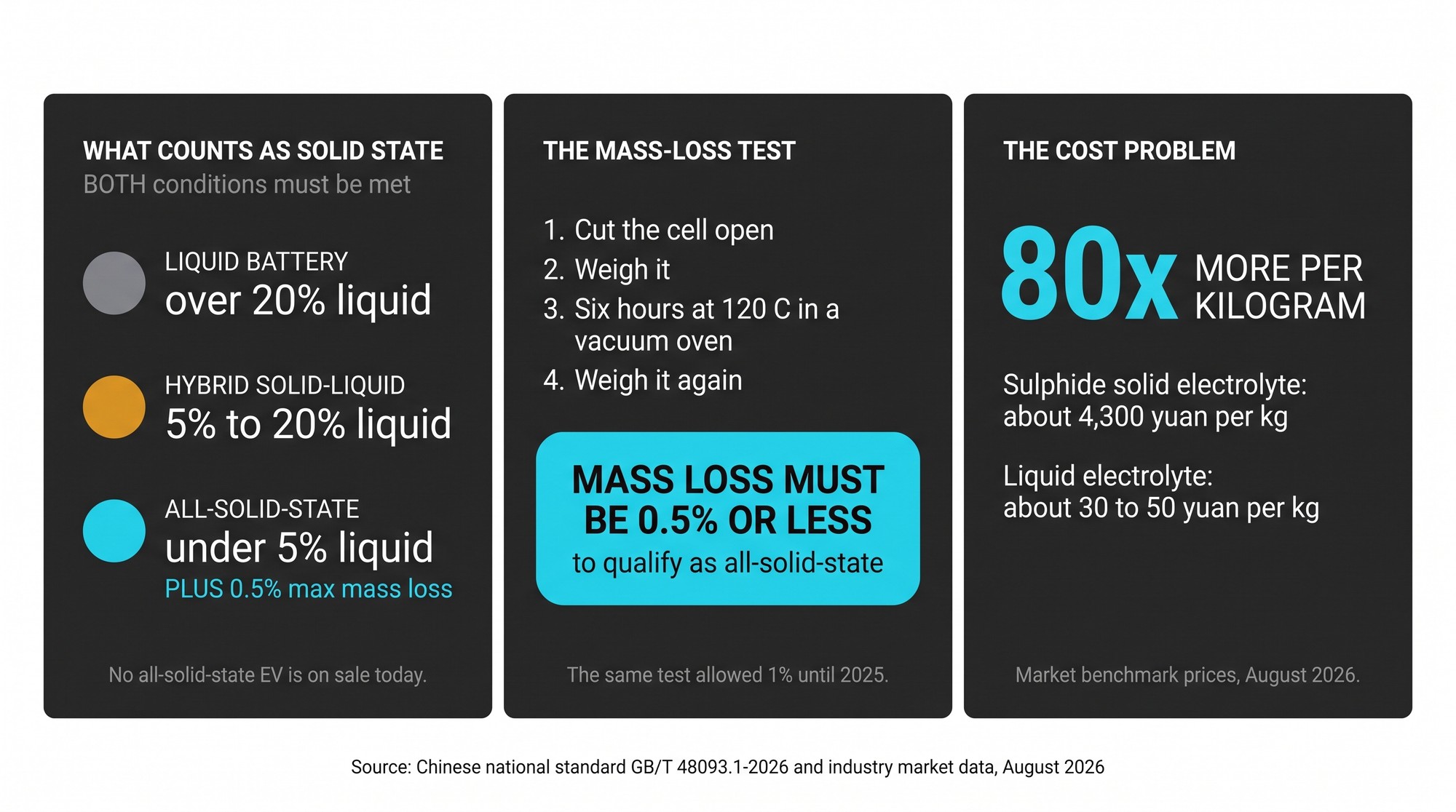
So what does the standard actually say? It classifies traction batteries by a single core metric, the mass fraction of liquid electrolyte, which makes it unusually easy to test and unusually difficult to argue with.
| Category | Liquid electrolyte by mass | Additional test | Status |
|---|---|---|---|
| Liquid battery | More than 20% | None | Fully mature, mass produced |
| Hybrid solid-liquid battery | 5% to 20% | None | Small-scale vehicle deployment |
| All-solid-state battery | Below 5% | Mass loss of 0.5% or less after 6 hours at 120°C in a vacuum | Laboratory and pilot stage only |
The second element of the standard is a marketing ban. Terms such as “semi-solid,” “quasi-solid” and “pseudo-solid” are prohibited in product promotion, replaced by the single official term “hybrid solid-liquid battery.” Companies already using the banned language were given a six-month transition period to comply once the standard takes effect.
It is worth reading alongside our solid state versus lithium-ion comparison, which explains the underlying chemistry and what genuinely separates the two chemistries.
This is the practical consequence for buyers, and it is not small. Batteries currently marketed as solid state in vehicles, including the Nio ET9 and the IM L6 use cells supplied by WeLion and QingTao, respectively, and both are semi-solid designs that contain meaningful liquid electrolyte. Under this framework they are hybrid solid-liquid batteries, not all-solid-state cells. That is not a criticism of those products, which are legitimate and in some cases excellent. It is an acknowledgement that the label they carried was not accurate.
How the 0.5% Test Actually Works
The mass-loss test is the mechanism that makes the definition enforceable, and it is reassuringly simple. Nothing sophisticated is required, which is precisely why it works as an industry-wide reference method.
A cell sample is cut open and visually inspected. If liquid visibly seeps out, it fails immediately. If it does not, the cell is weighed to record its initial mass, then placed in a vacuum oven at 120 degrees Celsius for six hours. Volatile material boils off. The cell is removed and weighed again, and the percentage of mass lost is calculated against the original figure.
There is a pleasing bluntness to it. Heat the cell until everything that can evaporate has evaporated, then put it on a scale. A cell that meets the all-solid-state threshold loses 0.5% of its mass or less.
The test breaks down into four movements:
- Cut open. The sample is opened and inspected for visible liquid. Any seeping means immediate failure.
- Weigh. Initial mass in grams is recorded precisely.
- Vacuum bake. Six hours at 120 degrees Celsius, evaporating everything volatile.
- Weigh again. Mass loss is calculated against the original. At or below 0.5%, the cell qualifies.

Why the Threshold Tightened From 1% to 0.5%
This method is not new. The China Society of Automotive Engineers published a group standard, T/CSAE 434-2025, in May 2025, that used the same 120-degree, six-hour vacuum test alongside the same no-visible-leakage check.
The earlier standard, T/CSAE 434-2025, was published by the China Society of Automotive Engineers on 22 May 2025 and was, at the time, the first document anywhere to define the term quantitatively. The crucial difference is the threshold: the 2025 group standard accepted a mass loss below 1%, while the national standard halves that to 0.5%.
The drafting group behind the 2025 standard, which involved more than 50 organizations, including CATL, BYD, the China Automotive Technology and Research Center, and Gotion, ran over a thousand tests across sulphide, oxide, and polymer routes. Their working conclusion was that a 1% threshold would capture about 95% of genuine all-solid-state cells. Tightening the number to 0.5% deliberately raises the bar, tightening the net so that cells sitting in the ambiguous middle cannot pass.
That matters commercially. The 5% threshold for liquid content, combined with a 0.5% volatility test, is a considerably harder gate than the 1% figure most of the industry’s hybrid products would clear. Several cells previously promoted as quasi-solid have reportedly measured mass losses in the 1.2% to 3% range, which places them not just outside the all-solid-state category but uncomfortably near the hybrid ceiling.
Why the Physics Is Still Genuinely Difficult
Setting marketing language straight is comparatively easy. Building a solid-state cell that works at scale is not, and the reason is worth understanding, because it explains why every automaker roadmap keeps moving.
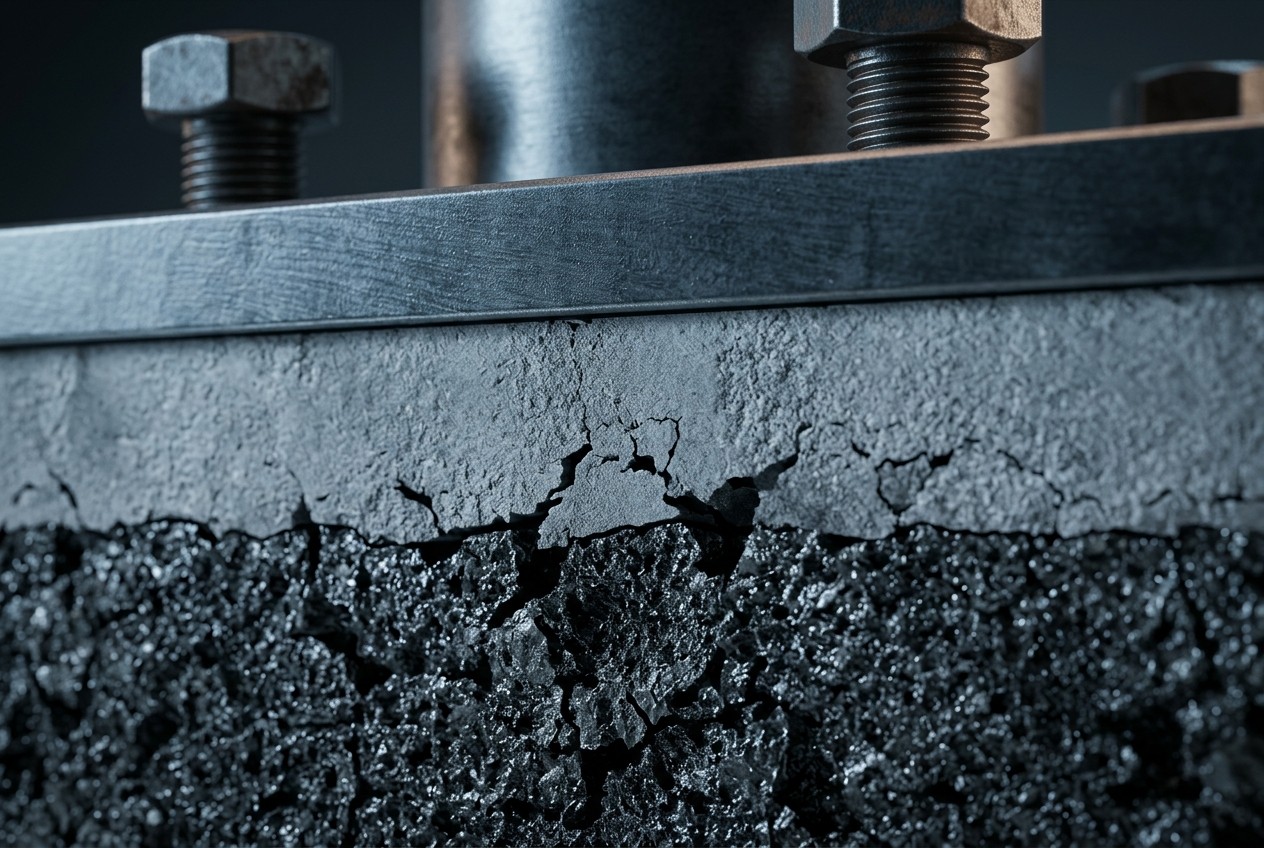
A conventional lithium-ion cell uses liquid electrolyte to wet the surface of the electrodes, creating intimate contact throughout. A solid-state cell replaces that liquid with a solid ceramic or polymer. Two solids pressed together do not bond the way a liquid does. They touch at microscopic points, and as electrodes expand and contract through thousands of charge cycles, contact gaps open up. Those gaps raise internal resistance and accelerate cell degradation.
The industry’s answer has been to simply press harder. EVE Energy has specified that its 60 Ah EV cell operates at stack pressures up to 5 megapascals, which is roughly 500 times atmospheric pressure, and requires external hardware to maintain. Some designs are pursuing a low-pressure route instead, and the Tsinghua group that published a 604 Wh/kg pouch cell in Nature in September reported its result under 1 megapascal of external pressure. Both approaches carry trade-offs.
Costs remain stark. Industry benchmark data put the sulfide electrolyte Li6PS5Cl at around 4,300 yuan per kilogram in August 2026, against liquid electrolyte prices of roughly 30 to 50 yuan per kilogram. That is more than eighty times the cost, per kilogram, of the material it is intended to replace. Cell-level costs are estimated at 1.6 to 2.2 yuan per watt-hour for solid state against 0.39 to 0.5 for lithium iron phosphate. Manufacturing yield is around 60 to 70% for solid state, versus above 94% for liquid cells.
The Timeline the Industry Would Rather You Missed
In June 2026, at the Dalian Summer World Economic Forum, CATL chairman Zeng Yuqun gave the technology a blunt score. On the standard nine-level technology readiness scale, he said, the industry’s most advanced solid-state work had reached level 4, meaning laboratory proof of principle. He was explicit that this referred to the technical route alone, before questions of mass production, supply chain or whether consumers would pay.
His assessment was that all-solid-state batteries reaching deployment on a million-vehicle scale before 2030 was very unlikely.
Current timelines, stated openly by the companies involved, look like this:
- CATL: small-batch sulphide production targeted for 2027, with million-vehicle scale judged very unlikely before 2030.
- Toyota and Idemitsu Kosan: commercialisation of all-solid-state cells in 2027 to 2028, with full-scale mass production to follow.
- Chinese industry consensus: wider automotive deployment around 2030 or later.
- Sunwoda: a 0.2 GWh solid-state sample line, targeting 400 Wh/kg with vehicle trials in late 2026 and 2027.
That caution is worth weighing against the pace of charging breakthroughs, such as the CATL cell claiming 621 miles of range with seven-minute charging, which reaches for very different chemistry.
There is also a tax dimension that shapes the incentives. China introduced consumption tax changes in September 2026, applying 2% to lithium-ion battery products and raising it to 4% from September 2027. Solid-state batteries, sodium-ion batteries and fuel cells are exempt through the end of 2028. This rewards the industry for developing cells that do not yet exist commercially, which is a coherent industrial policy even if it does not accelerate the timeline by much.
What This Means for Buyers Right Now
If you are shopping for an electric vehicle today, the practical conclusion is clarifying. No mass-market all-solid-state battery is on sale anywhere in the world. Any vehicle described as having a solid-state battery currently has a hybrid solid-liquid cell, and the standard’s authors are the first to say so.
That is not bad news. Hybrid cells with reduced liquid content are a genuine engineering step, and several of them deliver real benefits. But they are an incremental improvement on lithium-ion chemistry, not a different technology, and they should be priced and compared accordingly.
What the standard delivers is not a new battery. It is an end to a two-year period in which a marketing word meant whatever the speaker wanted it to mean. Once GB/T 48093.1-2026 takes effect in January 2028, and once its IEC counterpart is eventually agreed, “solid state” will become a measurable claim with a number attached to it. For an industry built on a reputation for safety, that is arguably more valuable than another incremental gain in energy density.
Frequently Asked Questions
What is the first international standard for solid-state batteries?
It is the Chinese-led IEC proposal “Secondary lithium-ion cells for the propulsion of electric road vehicles, Application guide, test items, and conditions for solid-state batteries,” approved for development in August 2026. France, Japan and South Korea are participating. It is expected to take 24 to 36 months to reach publication, so it is not yet a completed standard.
Is there such a thing as a solid-state battery today?
Not in the all-solid-state sense. Cells marketed as solid state in vehicles on sale now, including in the Nio ET9 and IM L6, contain both solid and liquid electrolyte and are classified as hybrid solid-liquid batteries.
What does 0.5% mass loss mean?
It is the result of a specific test. A cell is cut open and checked for visible liquid, weighed, then held at 120 degrees Celsius in a vacuum for six hours. Whatever mass is lost to evaporation, as a percentage of the original, must come to 0.5% or below for the cell to qualify as all-solid-state.
Which cars have solid-state batteries?
Under the definitions being formalised, none have all-solid-state batteries. Semi-solid and hybrid designs are already fitted to several Chinese EVs, and these retain 5% to 20% liquid electrolyte by mass.
When does the Chinese standard take effect?
GB/T 48093.1-2026 was published on 28 August 2026 and takes effect on 1 January 2028. Reports claiming it came into force in July 2026, under the number GB/T 43568-2026, are incorrect on both counts.
Will solid-state batteries arrive before 2030?
Some will, in small volumes. CATL’s chairman said in June 2026 that million-vehicle deployment before 2030 is very unlikely, and rated the industry’s most advanced work at level 4 of 9 on the standard readiness scale. Toyota and Idemitsu Kosan are targeting 2027 to 2028 for commercialisation, with wider deployment expected later.


