
Researchers from Pennsylvania State University evaluated and compared the ability of biochar to absorb contaminants in wastewater. Biochar is a charcoal-like substance made primarily from agricultural waste products. The results revealed that biochar could potentially be used to remove emerging contaminants, like pharmaceuticals, from wastewater.

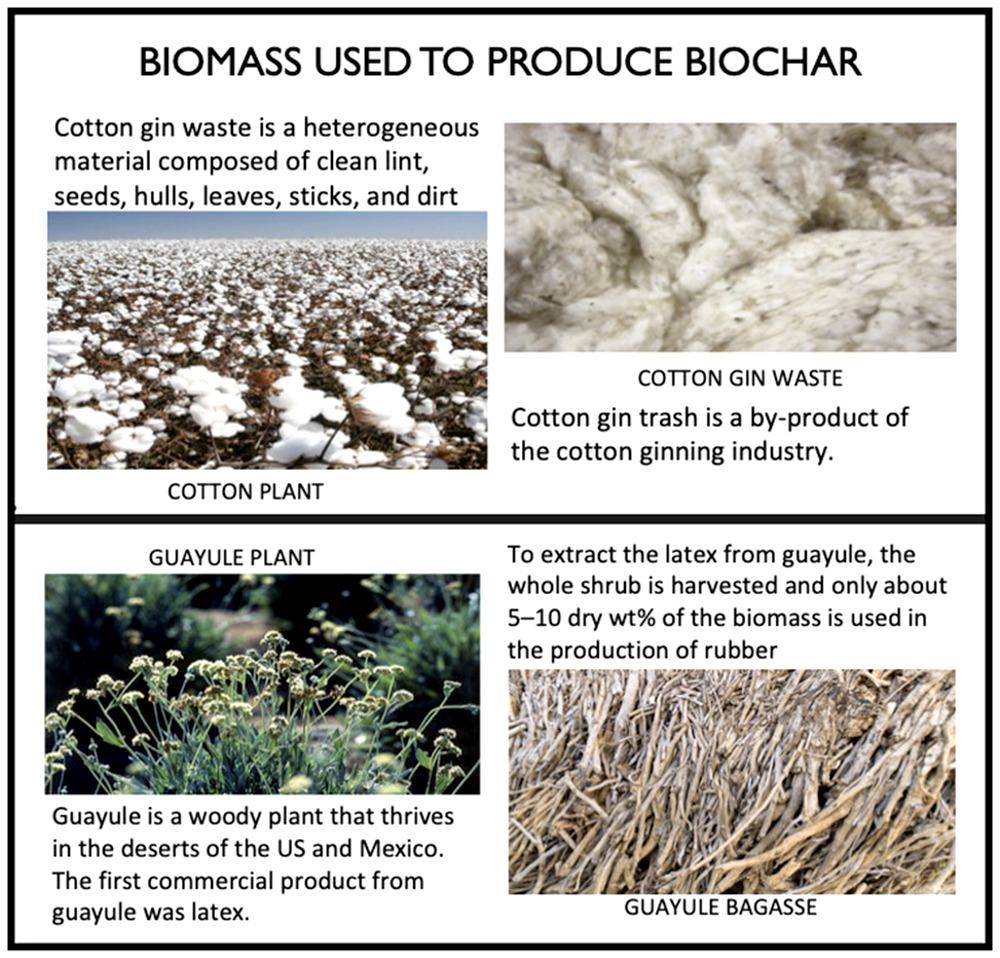
This study made two versions of biochar – one made with cotton gin waste and the other guayule bagasse – both being common leftover agricultural materials. The team tested the materials’ effectiveness at absorbing three common pharmaceutical compounds (docusate, erythromycin, and sulfapyridine) from water.
There are two ways absorption works. One is when a material is taken internally into another, like a sponge absorbs liquids. The other is when a compound sticks to another’s surface, like a pharmaceutical molecule attaching to a solid biochar particle.
Guayule, more appropriately known as Parthenium argentatum, is a shrub that grows in the arid Southwest. It is cultivated as a source of latex and rubber. To extract the ingredient, the plant must be cut down and its branches mashed up. What remains is a dry, pulpy, fibrous residue called bagasse. The team used this leftover to make guayule bagasse biochar. The cotton gin biochar was made from the scraps of the cotton extraction process.
The opportunity to use plentiful agricultural waste that would otherwise be disposed of is fantastic. It could be a low-cost additional treatment for reducing contaminants in treated wastewater used for irrigation while recycling at the same time with effective wastewater solutions.
Researcher Herschel Elliott, a Penn State professor of agricultural and biological engineering, said:
“Most sewage treatment plants are currently not equipped to remove emerging contaminants such as pharmaceuticals, and if biochars can remove those toxic compounds, then wastewater can be recycled in irrigation systems. That beneficial reuse is critical in regions such as the U.S. Southwest, where a lack of water hinders crop production.”
The study found that the cotton gin waste biochar was much more efficient than the guayule bagasse biochar. It absorbed 70% of the sulfapyridine, 74% of the erythromycin, and 98% of the docusate in aqueous solution, while the bagasse only absorbed 5% of the sulfapyridine, 50% of the erythromycin, and 50% of the docusate.
The study also found that a temperature increase in the oxygen-free pyrolysis process used to transform the agricultural waste materials to biochar (from approximately 650 to 1,300 degrees F) significantly enhanced the biochar’s capacity to adsorb pharmaceutical compounds.

Lead researcher Marlene Ndoun, a Penn State doctoral student, said:
“The most innovative part about the research was the use of the guayule bagasse because there have been no previous studies on using that material to produce biochar for the removal of emerging contaminants. Same for cotton gin waste—research has been done on potential ways to remove other contaminants, but this is the first study to use cotton gin waste specifically to remove pharmaceuticals from water.”
Ndoun wants to scale up the technology and use it to make a difference in the world. Particularly in poor regions where cotton gin waste is widely available and can be used to decontaminate water.
She added:
“I am originally from Cameroon, and the reason I’m even here is that I’m looking for ways to filter water in resource-limited communities, such as where I grew up. We think if this could be scaled up, it would be ideal for use in countries in sub-Saharan Africa, where people don’t have access to sophisticated equipment to purify their water.
Beyond removing emerging contaminants such as pharmaceuticals, I am interested in blending biochar materials so that we have low-cost filters able to remove the typical contaminants we find in the water, such as bacteria and organic matter.”
The project’s next phase involves testing different biochar mixtures and developing a mix of materials capable of absorbing a wide range of contaminants from water.


