
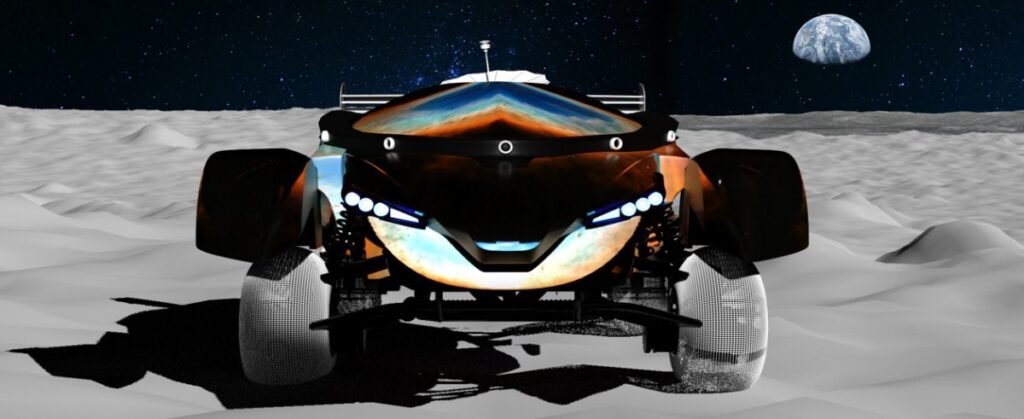
A multi-media entertainment and education content company called Moon Mark is working with Houston-based, private aerospace company Intuitive Machines on a very bizarre project: the first-ever competition to race vehicles on the surface of the Moon. The racecars are to be designed by high school students with the help of McLaren P1 designer Frank Stephenson. The anticipated launch and race date is October 2021.
Mary L. Hagy, Moon Mark Founder, and CEO said:
We are thrilled to partner with Intuitive Machines in our mission to reach and engage global audiences with the stories of young explorers living their dreams to be the first to race on the Moon.
These Moon Mark racecars will be traveling in a Nova-C lander made by Intuitive Machines, atop a SpaceX Falcon 9 rocket. The Nova-C will touch down close to the Grand Canyon-sized Schröter’s Valley, in the Oceanus Procellarum. Aside from dropping off the racecars, its chief task is to conduct an initial survey of the area for future lunar missions. It will contain a 100kg payload, and around 8kg of that will be the racecars.
A press release by Moon Mark about the race reads:
Moon Mark’s Mission 1 competition will include six diverse teams of high school students selected from across the United States, who will compete in a series of qualifying challenges that include unique demands, such as drone and autonomous vehicle racing, e-gaming, and a space commercialization entrepreneurship contest. The two top teams from the qualifying rounds will win a once-in-a-lifetime opportunity to build and race two vehicles on the Moon. The vehicles will be loaded onto Intuitive Machines’ Nova-C Lunar Lander, launched from Earth on SpaceX’s Falcon 9 rocket, and land in 2021. Competitors will then race their rovers remotely, navigating through harsh terrain, racing around a sphere of cameras, which will capture every aspect.
New Atlas asked the Moon Marks team what the control and vision latency will be like for humans driving the remote-controlled race cars from Earth and how the signal will be sent.
Todd Wallach, Moon Mark CTO, answered:
We do not expect significant communications delay as impacting the race or drivability of the vehicles. We will have near real-time visuals, telemetry, and command and control via our partnership with Intuitive Machines. The racers built by Lunar Outpost will connect with the Intuitive Machines Lander via WiFi, and the Lander will send and receive telemetry, commands, and controls to and from the Earth to drive the racers.
However, even if the communications connection occurs at the speed of light between the Moon and Earth, it would take 1.3 seconds each way to cover the approximately 384,000-kilometer (238,600 miles) gap. That means it would take 2.6 seconds from when a student pushes a thumbstick to when they see that command executed on the video feed they’re watching.
Hermann Tilke, the designer of all the recent Formula One tracks worldwide, will be designing the lunar racetrack. Stephenson said:
They know the lunar surface; it’s been scanned to the point where he has enough information to develop this track.
When questioned about vehicle speed, Hagy told New Atlas:
Our racers will be designed to test the limits of speed on the lunar surface. The checkered flag remains the deciding factor upon which the final winner will be determined.

As far as aesthetics go, that’s Stephenson’s domain. He said:
There’s a lot of things they have to consider. Obviously, it’s not downforce! It’s more about, say, dust filtration, traction, weight, materials, endurance, stability … Then there’s the center of gravity and protection – if these things flip over at speed, you have to make sure none of the parts are damaged. You have to be able to upright it in some way. But everything you do to these things adds weight; everything you do to correct something else is another part added. So, there’s got to be an incredible simplicity to the design and incredible reliability. There’s a pretty big team working on it, a huge engineering team, and there are some huge names attached that will be announced in early 2021.
These things can look really cool. If you look at the lunar rovers, they never look really cool. It might look cool from an engineer’s point of view, but from a designer’s point of view, you’re always questioning why they haven’t done this or that to give a little bit more of an edge to it. Obviously, the body surfacing of these cars will be minimal; it’s all weight. But you want the surfacing to work with the engineering, not just add pieces on to make it look cool. Smart engineering and smart design should go hand in hand, so the ambition is to make it look great and work well. This is a way to get the young generation involved in discovering new technology and stretching their minds in a way that’s never been done before in history.
And of course, the million-dollar question (quite literally) is how Moon Marks expects to get its money’s worth for the millions of dollars it will cost to send the race cars to the Moon?
Hagy said:
Moon Mark is an entertainment and education company that will create and distribute content globally. We will capture and share the next generation’s adventures as they compete to become the first students whose work lands on the Moon.
Together Moon Mark and Intuitive Machines will create a global multi-media campaign that will feature authentic stories of each team on this journey, create traditional and non-traditional educational experiences, providing accessible content for students, teachers, and the public, and will brand STEAM education as a fun and inspirational choice for youth across the globe.
There will also be various opportunities for custom sponsorships, brand integrations, and licensing for associated products. Following the race itself, the vehicles will move into their scientific mission, remaining on the lunar surface indefinitely.
Since the 1970s, there have only been five attempts to land spacecraft on the Moon, and two of those were failed missions last year. But 2021 is set to be a much more eventful year with six lunar landing attempts planned. This Intuitive Machines and Moon Marks mission is one of them. How crazy is it that perhaps the fourth lander to touch down on the Moon in over four decades will contain a pair of remote-controlled race cars as 10% of its cargo!


