
A short piece of music can be exactly right and still end too soon. Imagine a film editor with a 45-second cue for a scene that now runs 70 seconds. The music already has the right restrained piano, low electronic pulse, and late string lift. Replacing it would mean losing a sound that works. Duplicating eight bars would preserve the palette, but the repeated rise might draw attention to the edit just as the dialogue reaches its most important line.
This is the difference between looping and extending. A loop sends the listener back to material they have already heard. A continuation keeps enough of the music’s identity to feel related while allowing its timing, intensity, or direction to change. The extra 25 seconds must do a job inside the scene, not merely occupy space.
Generative tools can propose continuations, but they do not remove the central creative decisions. Someone still has to decide where the original cue should hand off, what the new passage should accomplish, and whether the complete 70-second arc feels intentional.
A Loop Preserves a Pattern; a Continuation Preserves an Idea
Repetition is fundamental to music. A beat may recur every bar, a melodic figure may return every few measures, and a chorus may come back later in a song. Yet meaningful repetition usually contains consequence: harmony shifts, an instrument enters, a phrase changes its ending, or energy moves toward a release.
The research behind Music Transformer discusses musical structure across multiple timescales. That helps explain why copying a locally convincing pattern does not necessarily create a coherent longer passage. Four more bars can match the rhythm and timbre of a cue while ignoring the larger dramatic shape.
For the film cue, the difference is practical. If a four-bar piano pattern simply repeats, its small crescendo may also repeat. The audience hears a new peak every few seconds, even though the scene is holding back. A continuation could retain the pulse and piano motif while postponing the string lift until the final reveal.
Motifs, phrases, and sections are useful terms, but an editor does not need a conservatory analysis. A motif is a recognizable small idea. A phrase has a sense of departure and arrival. A section performs a larger role, such as an intro, buildup, or outro. The important question is which level must remain recognizable and which level is allowed to change.
Start With the New Timing Map
Before choosing a tool or writing a prompt, map the music against the revised picture.
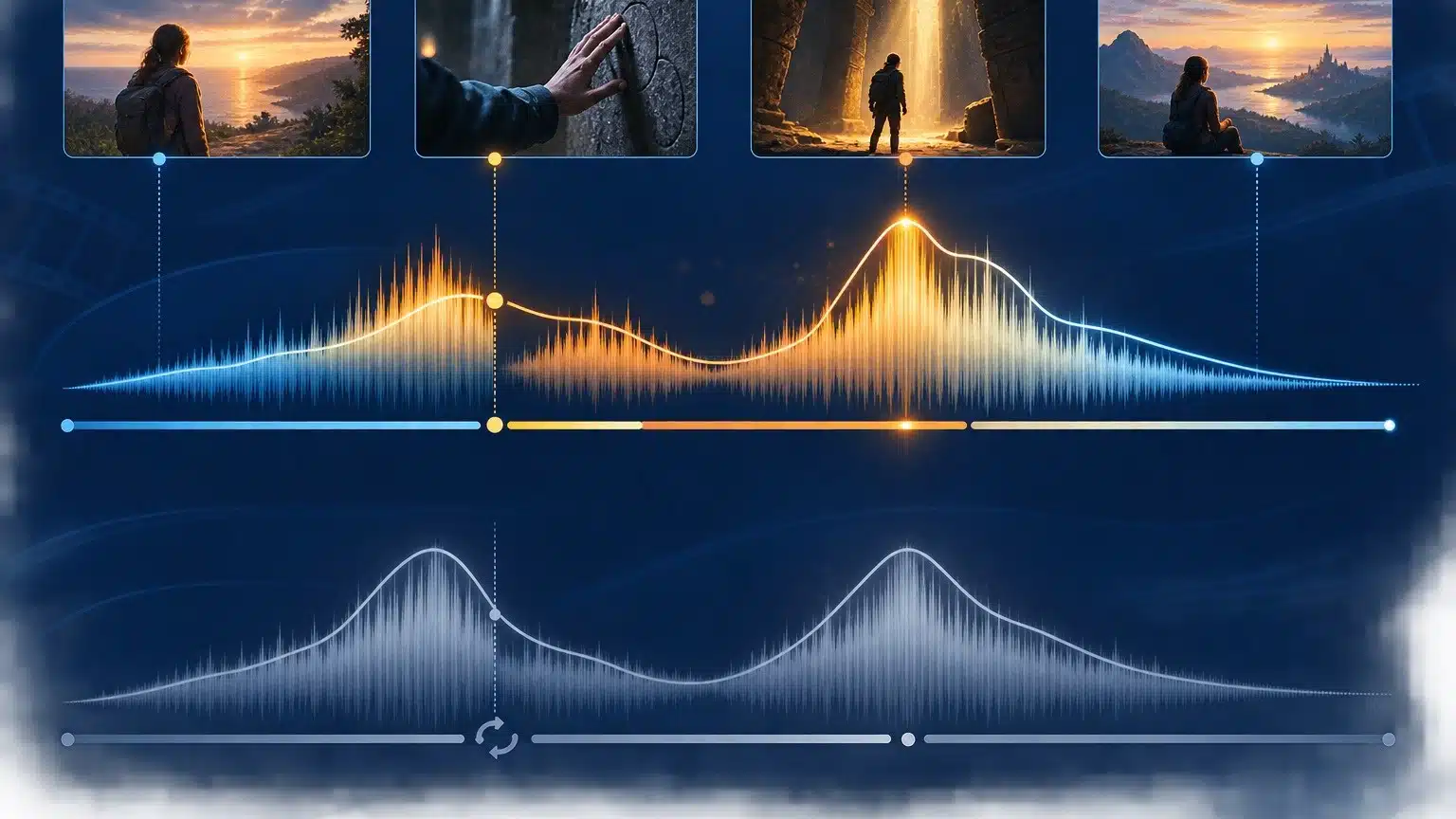
In the 70-second scene, suppose dialogue continues until 60 seconds and the visual reveal lands at 64. The final six seconds cover a reaction and cut to black. The cue therefore needs to stay restrained for roughly 15 seconds longer than before, begin lifting around 60 seconds, and resolve close to 68 seconds so its decay can carry through the cut.
That map is more useful than the instruction “add 25 seconds.” It defines three musical functions:
- maintain a quiet bed beneath dialogue;
- build without introducing a distracting new lead idea; and
- create one controlled resolution for the reveal.
It also exposes when a loop may be the better choice. If the scene contains an intentionally static menu, installation, or waiting period, a well-made loop can be efficient and appropriate. Continuation becomes valuable when the added time needs direction.
Choose the Continuation Boundary by Ear
The endpoint of a file is not always the best point from which to continue. A cue cut to exactly 45 seconds may end during a cymbal decay, after the start of a pickup, or halfway through a harmonic resolution. Generating from that point can preserve the duration while inheriting an awkward musical premise.
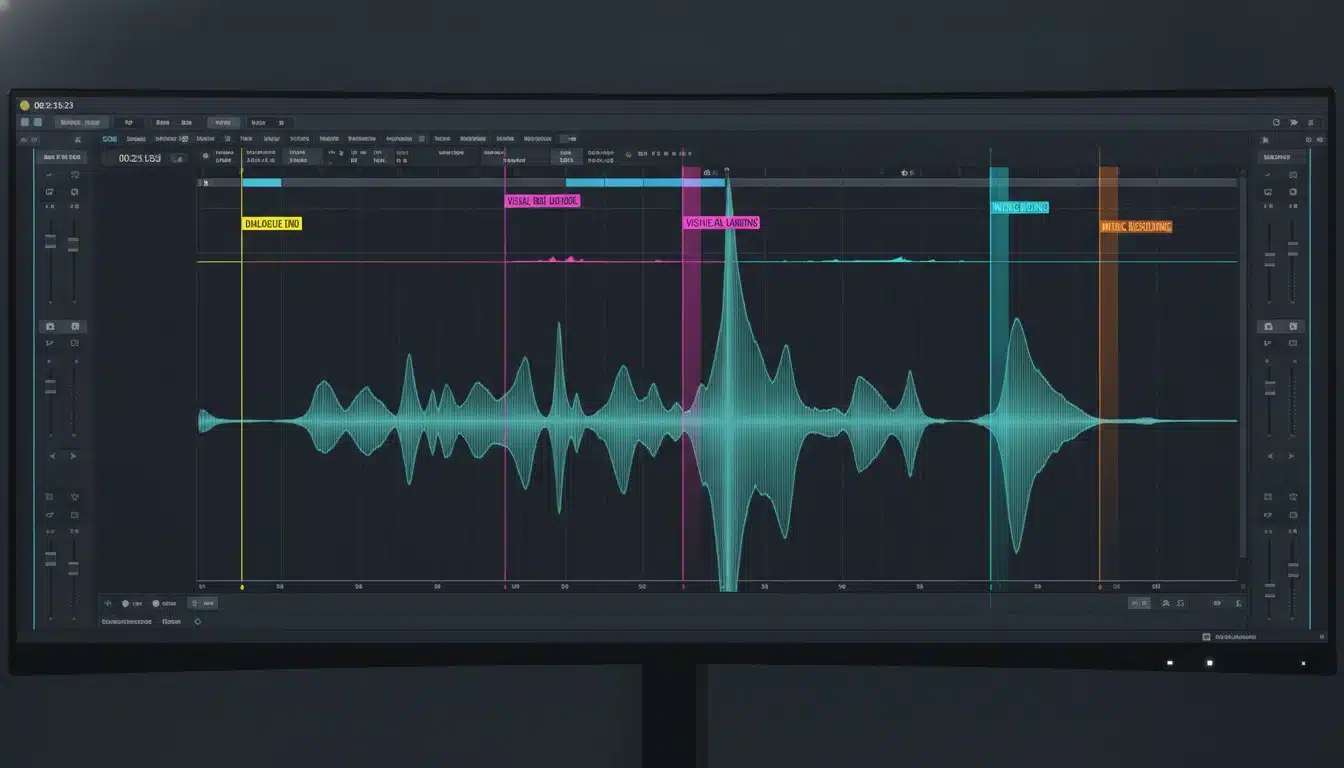
Listen several seconds before the end and look for a boundary that supports the new timing map. Useful clues include a downbeat, the end of a phrase, a stable chord, a brief thinning of texture, or a transition that deliberately leaves tension unresolved. Count beats rather than trusting a quiet-looking place in the waveform; silence can be easy to cut but musically wrong.
For the example cue, imagine that the strings begin their original final rise at 41.5 seconds. Keeping that rise and then asking for another 25 seconds would create two endings. A better choice may be to branch just before it, at the last stable piano phrase. A purpose-built interface such as the Creatune AI Music Extender is most useful at this decision point: as a way to explore what could follow a musically meaningful boundary, not as a guarantee that any endpoint will produce an invisible join.
Preserve enough preceding audio to establish tempo, tonal center, instrumentation, and recent phrase direction. At the same time, do not assume that more context automatically communicates the intended future. The existing cue shows what has happened; the timing map explains what now needs to happen.
Prompt for Motion, Not Just Style
“Cinematic ambient music” describes a category. It does not describe the development required between seconds 42 and 70. An extension brief should state what remains stable, what changes, and where the passage should arrive.
For this cue, a working brief might read:
Preserve the restrained piano motif and low electronic pulse. Continue at low intensity beneath dialogue, with no new lead melody. Begin a gradual string rise after about 16 seconds, then resolve with one soft final chord and a natural decay.
The timing does not need to be obeyed with frame-level precision to be useful. It gives the generation a dramatic shape. Alternatives can then vary one decision at a time: a shorter buildup, less percussion, a warmer ending, or a version that omits the strings.
Generating several candidates is often more productive than trying to perfect one densely specified prompt. One result may preserve the piano tone best, another may develop the harmony more convincingly, and a third may land its final cadence at the useful moment. The editor’s task is to choose the continuation that serves the scene, not the one that merely sounds polished in isolation.
Inspect the Seam, Then Forget About It
The first quality-control pass should focus tightly on the handoff. Listen for timing shifts, doubled attacks, truncated reverberation, a sudden change in stereo width, altered room tone, or low-frequency energy that jumps at the boundary. Headphones can reveal small artifacts; speakers and the intended playback system reveal whether those artifacts matter.
For the 45-to-70-second cue, loop only the area around 40 to 45 seconds during this inspection. If the piano attack flams or the ambience changes, a short crossfade, level adjustment, or slightly different boundary may help. If pitch or pulse drifts immediately, another generated candidate is usually a stronger starting point than heavy repair.
Then stop looping the seam and watch the complete scene. A technically smooth join can still create a weak result if the music peaks beneath dialogue, delays the reveal, or seems to end twice. Conversely, a continuation with a small editable transition may deliver the right emotional arc. Musical fit and signal continuity are related, but they are not the same test.
Export the cue at its actual delivery length and review it with dialogue, effects, and picture. The final chord should arrive because the scene calls for it, not because the generator happened to produce one after a convenient number of seconds.
What the System Can Infer and What It Cannot
In generative research, conditioning means supplying information that guides an output. The MusicGen paper describes generation conditioned by text or melodic features, while Google’s MusicLM research explored generation from text and from combinations of text and melody. An extension also has preceding audio as context: tempo, timbre, rhythm, density, harmony, and recent melodic events all narrow the possibilities.
They do not determine one correct future. The same piano phrase could plausibly lead to a climax, a quieter reprise, a new section, or an ending. Music structure itself can be ambiguous; a peer-reviewed overview of audio-based music structure analysis notes that segmentation is hierarchical and partly subjective.
That uncertainty is why output should be treated as a proposal. Research examples also are not universal performance guarantees for consumer tools, which may use different models, controls, or post-processing. Dense mixes, rubato performances, sustained vocals, and unstable live tempo can all make continuation harder.
The Same Method Applies Beyond Film
The timing-map approach transfers to podcasts, games, dance, and branded video. A podcast bed may need to remain harmonically quiet for another paragraph before closing. Choreography may require an extra eight-count before a breakdown. A game cue may need variation that avoids the fatigue of an obvious short loop.
The evaluation criteria change with the use. Under speech, restraint and intelligibility matter more than melodic novelty. For dance, beat alignment and predictable phrase length become central. In an interactive environment, several compatible continuations may be more useful than one fixed extended file.
When comparing another environment such as LumiMusic, use the same source boundary, duration target, and creative brief. Then compare phrase direction, tonal continuity, transition behavior, and how easily each result can be revised. Changing the source and prompt at the same time produces a showcase, not a controlled comparison.
Rights remain part of the workflow. Creators should extend only music they own or are authorized to modify and confirm the permitted use of generated output. A new continuation does not erase rights in the underlying composition, performance, or recording.
Added Time Must Earn Its Place
Extending a song is not difficult because every join must be mathematically perfect. It is difficult because listeners remember what they have heard and expect later events to mean something in relation to it.
In the film example, success means protecting the dialogue, delaying the lift, supporting the reveal, and resolving once across the full 70 seconds. The boundary, prompt, alternatives, and seam check all serve that larger decision.
A loop asks, “How can this pattern recur?” A continuation asks, “Given what the music has already said, what should it say next?” Generative systems make that second question faster to explore. The editor still decides when the additional time has become musically necessary, and when the piece has said enough.


