
Researchers from Washington State University (WSU) and Pacific Northwest National Laboratory (PNNL) have developed a sodium-ion battery that works as well and holds as much energy as some commercial lithium-ion batteries. Additionally, the battery technology is made with inexpensive and abundant materials.
The team claims their sodium-ion battery can deliver a capacity similar to lithium-ion batteries and can recharge successfully while maintaining over 80% of its charge after 1,000 cycles.
Dr. Imre Gyuk, who supported this research at PNNL, said, “This is a major development for sodium-ion batteries. There is great interest around the potential for replacing Li-ion batteries with Na-ion in many applications.”
The downfall of lithium-ion batteries is that the materials used to manufacture them, including lithium and cobalt, are rare and expensive. As electric energy storage and electric vehicles increase in demand, these materials will become harder to find and more costly than they already are.
Sodium, on the other hand, is abundant, sustainable, and inexpensive. The development of sodium-ion batteries is an excellent candidate for large-scale energy storage. BYD has since pushed the technology further with a third-generation sodium-ion platform targeting 10,000 charge cycles, as detailed in our latest coverage of BYD’s solid-state and sodium-ion battery roadmap. The only problem with existing sodium-ion batteries is they don’t hold as much energy as lithium batteries, and sometimes they have trouble being recharged.
WSU explains that the main issue with some cathode materials is that a layer of inactive sodium crystals accumulates at the surface of the cathode, blocking the flow of sodium ions and eventually degrading the battery. “The key challenge is for the battery to have both high energy density and good cycle life,” added Junhua Song, the study’s lead author.
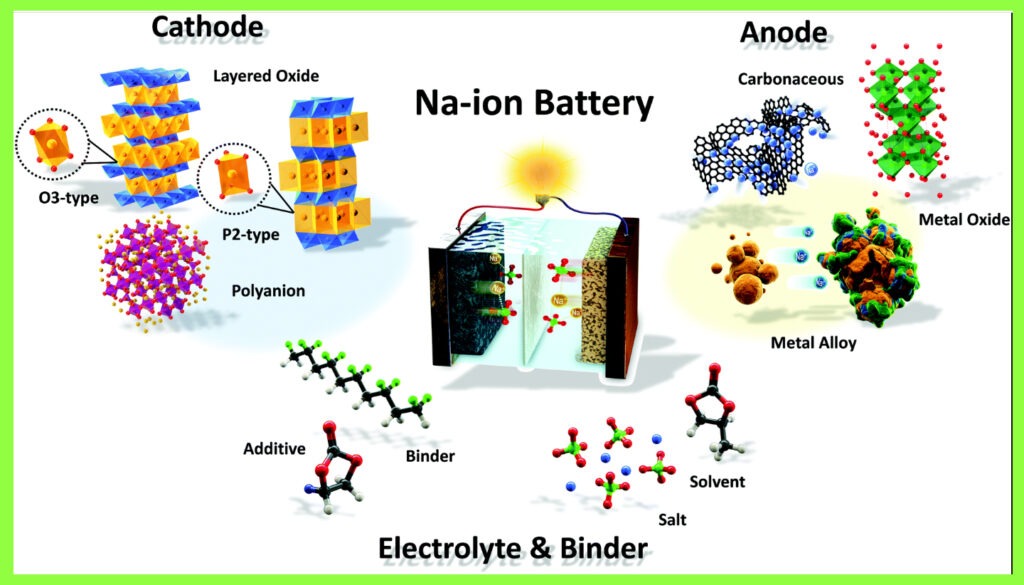
The team found a solution to these problems. They combined a layered metal oxide cathode and a liquid electrolyte that contained extra sodium ions, resulting in a saltier solution that interacted much better with their cathode. This cathode design and electrolyte system prevent inactive surface crystal build-up, allowing a continuous movement of sodium ions and unimpeded electricity generation.
Yuehe Lin, a lead researcher of the study, concluded, “Our research revealed the essential correlation between cathode structure evolution and surface interaction with the electrolyte. These are the best results ever reported for a sodium-ion battery with a layered cathode, showing that this is a viable technology that can be comparable to lithium-ion batteries.”
The research carried out by Xiaolin Li, a senior research scientist at PNNL, and Yuehe Lin, a professor in WSU’s School of Mechanical & Materials Engineering, is published in the journal ACS Energy Letters.


