
Jack is nine. Every Tuesday afternoon, right around the time the after-school pickup line gets loud and the fluorescent lights in the gym flicker on, he throws himself on the ground and screams. His parents used to think he was overtired, or testing limits, or just being nine. Then someone finally mapped out what actually happens in that ten-minute window, and it turned out Jack wasn’t testing anything. He was drowning in noise and light; he had no way to filter, and the floor was the only place left to go.
That’s the thing about behaviour most people never get around to asking. It looks like defiance from three metres away. Up close, with the actual sequence of events laid out, it almost always turns out to be something else entirely.
What “behaviours of concern” actually means
The term covers aggression, self-harm, property damage, and intense withdrawal, anything that puts the person or the people around them at risk. It’s deliberately clinical language, because the alternative, judging the person before anyone’s worked out what’s driving them, tends to make things worse rather than better.
Decades of behavioural science rest on one fairly simple claim: behaviour serves a function. Nothing about it is random, even when it looks that way in the moment. Something, sensory input, an unmet need, fear, a mismatch between what’s being asked and what someone can currently manage, has pushed a person past what they can handle, and the behaviour is what comes out the other side. Track it for long enough and a pattern almost always shows up. With Jack it was Tuesdays, the gym, the flickering lights. For someone else it might be a different trigger entirely, but there’s usually a trigger.
Sensory overload is the one people miss most
Sensory overload is a big part of what happened to Jack, and it’s one of the most misread drivers out there. It happens when more information is coming in through the senses than the brain can sort through and process, competing noise, harsh or flickering light, a crowded room, or a fabric that feels wrong against skin. For a nervous system that’s more sensitive to that kind of input, which shows up often in autism, ADHD, and PTSD, the brain can genuinely get stuck. Too much coming in, no clear way to decide what to prioritise.
From the outside this can look like agitation or restlessness building toward a full meltdown. Some people cope by stimming, rocking or hand-flapping or repeating a phrase. Others shut down entirely and go looking for somewhere quiet. Neither response is defiance. It’s closer to a system that’s genuinely maxed out.
Punishing that response doesn’t touch the actual cause. It adds pressure to a system that was already overloaded, which usually means the same trigger produces a worse reaction the next time around.

It’s rarely only sensory
Sensory overload gets most of the attention, but it isn’t the only thing hiding underneath a behaviour. Communication difficulty is another big one. Someone who can’t say “this hurts” or “I don’t understand what you want” still has that need. It just comes out as behaviour instead of words, and anyone who’s ever struggled to explain themselves mid-crisis knows how fast that pressure builds.
Unmet needs matter too, and they’re often unglamorous. Hunger. Fatigue. Discomfort from something as small as an itchy tag. A need for some sense of control in a situation that currently feels like it’s happening to someone rather than with them.
Anxiety works differently again. It can build for hours before anything visible actually happens, dread about what’s coming, long before the moment itself arrives. And sometimes the cause is simpler than any of this: the task on the table is genuinely beyond what the person can manage right now, with the skills and support they currently have, even if it looks small from where you’re standing.
Whatever the cause, ignoring it produces the same outcome. The behaviour comes back. Maybe an hour later, maybe the following week in an entirely different setting, because whatever actually caused it was never addressed in the first place.
Where Positive Behaviour Support comes in
This is the gap Positive Behaviour Support exists to close. A PBS practitioner doesn’t start with the behaviour. They start earlier than that, observing the person, talking with them and the people around them, and sometimes tracking patterns over days or weeks to build a real picture of what’s actually driving things. The strategy only gets built once that picture exists, not before it.
That ordering matters more than it sounds like it should. A plan built without understanding the cause is a guess, and guesses tend to fail quietly, resurfacing as “the same problem” a few weeks later under a slightly different name. A plan built from an actual assessment can be tested, adjusted, and improved, because there’s something real underneath it to work from.
What it looks like day to day
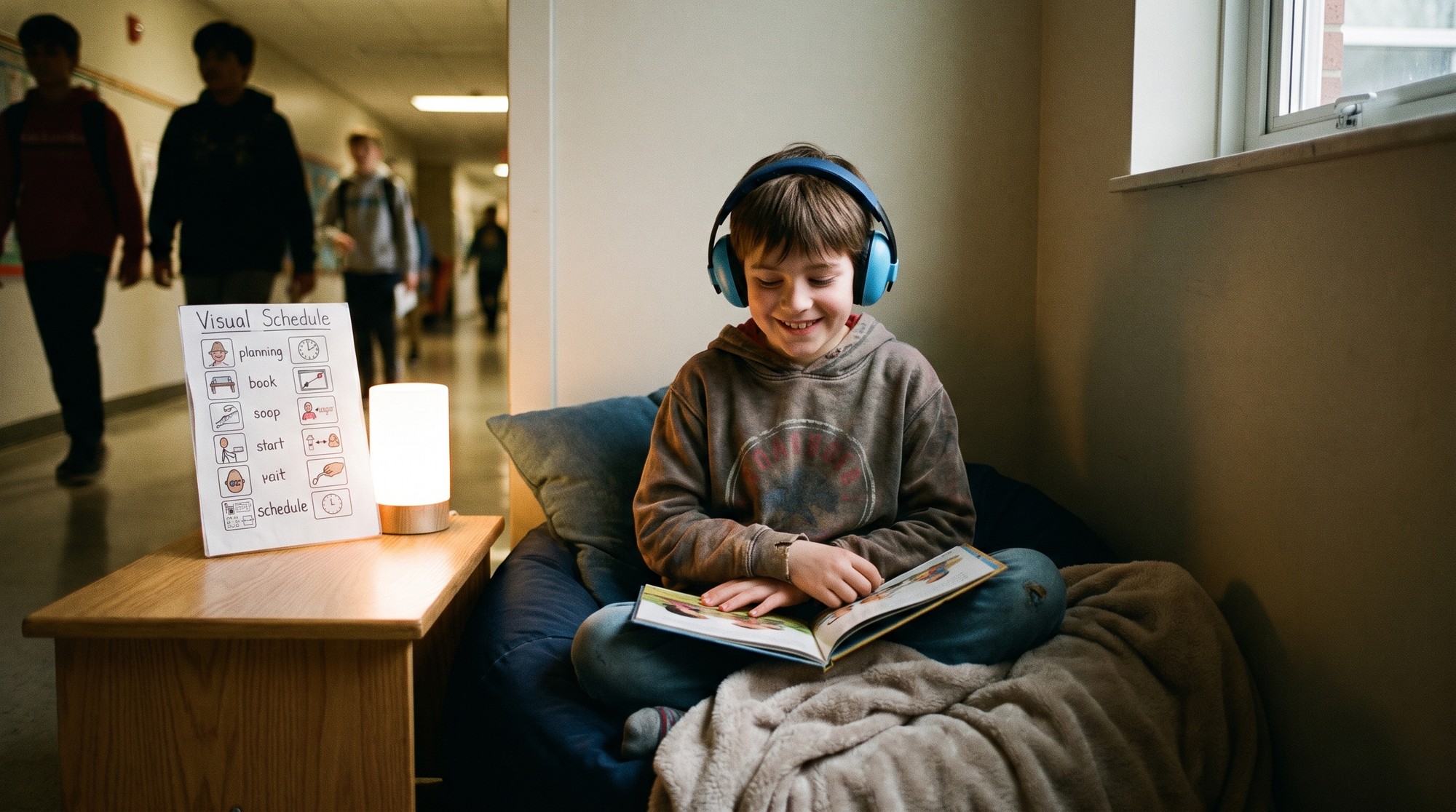
For Jack, the fix wasn’t complicated once someone understood the trigger. Noise-cancelling headphones for pickup time, a heads-up about which days the gym lights would be on, and a quiet spot he could go to before he hit his limit rather than after. None of that would have occurred to anyone treating the floor-throwing as the problem to solve.
More broadly, this usually involves predictable routines, since a lot of anxiety comes from simply not knowing what’s coming next. It involves communication support, whether that’s a visual schedule, simplified language, or another way to get a need across before it turns into a crisis. It often means adjusting the environment itself: dimmer lighting, a quieter corner, and fewer competing demands at once. And it involves reinforcing the behaviour you actually want to see, rather than only stepping in once something’s already gone wrong.
None of this is about suppressing behaviour through punishment or restriction. It’s about reducing the load on a system that’s already carrying too much and giving someone other ways to get what they need before they hit the point Jack hit on the gym floor.
The behaviour is telling you something
Next time this happens with someone you support, the more useful question probably isn’t how to make it stop. It’s what the behaviour is actually communicating. A gap in communication, an unmet need, sensory overload, and anxiety that’s been quietly building for hours, all of these show up far more often than plain defiance, and each one calls for a genuinely different response.
That’s the underlying idea behind Positive Behaviour Support: treat behaviour as information rather than a problem to shut down. It changes the response, but it also changes something harder to measure, whether the person feels understood in that moment rather than managed. Jack’s parents will tell you that part mattered more than the strategy itself.


