
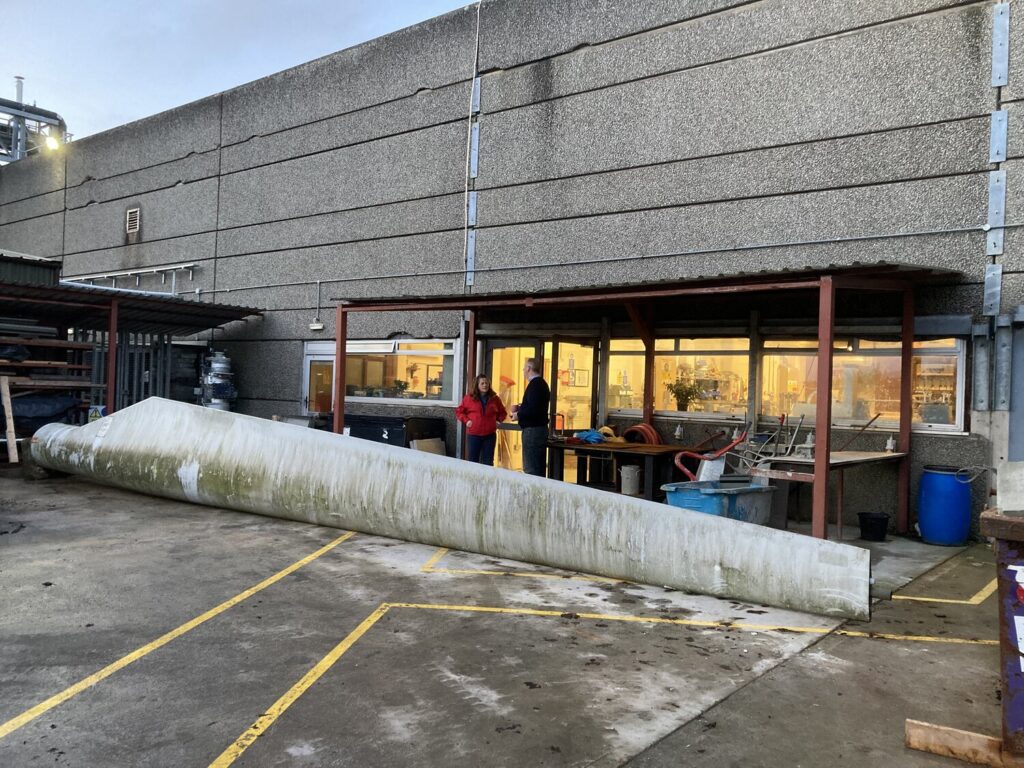
Last month, three 40-foot-long wind turbine blades were delivered from a Belfast wind farm to southern Ireland’s Cork Institute of Technology (now Munster Technological University). The institute’s civil engineers will expose the blades to a battery of tests as they create a pedestrian bridge that will use parts of the blade as a replacement for traditional steel girders.
Construction of the blade bridge is expected to be finished by April this year. Once complete, the Cork County Council will pick it up and install it on a major bicycle route connecting Middletown and Youghal. If this experimental blade bridge is a success, it could be the first of many worldwide.
Civil engineering Ph.D. student Angela Nagle, of the University College Cork, envisions dozens of these bridges connecting towns in the Irish countryside in the future. “What I’d love to do is turn it into a blade waste brokerage business,” said Nagle. Since 11,000 tons of blades are projected to be decommissioned across Ireland by 2025, there should be plenty of material to work with.
Nagle’s blades-to-bridges vision is part of an emerging and fast-growing effort to find innovative solutions to blade waste. Nagle and the Re-Wind project members are confident that wind turbine blades can be repurposed for bridges, electrical transmission towers, and other significant structures since the blades are huge and sturdy.
Meanwhile, General Electric (GE) has a different approach to dealing with blade waste. The multinational conglomerate recently announced it has begun converting retired wind turbine blades into cement, while engineers at the National Renewable Energy Laboratory are creating new materials that could make the blades far more recyclable than existing blades.
These innovations could help fend off a looming wind turbine blade waste crisis, which Re-Wind team leader Larry Bank describes as a “potential black eye” for the wind power industry. “If you are talking about a sustainable, renewable fuel source, it’s not appropriate to then pollute the environment with materials that are decommissioned,” Bank added.
Wind turbines are made to last about 20 years, and most of the turbines in existence haven’t reached the end of their lifespans yet. Even so, they earn back their manufacturing carbon well before retirement, as our wind turbine carbon payback data shows. However, blades often get removed sooner as companies replace them with larger ones to produce more energy. Blade sizes have “increased dramatically” over the past few years, according to the Electric Power Research Institute (EPRI)—from an average diameter of 145 feet in 1997 to 367 feet in 2017.

Once retired blades are no longer catching the wind, they are tossed in the landfill, where they take up massive (and growing) amounts of space. Unfortunately, many countries, including the U.S., lack blade waste regulations. “They are very difficult to move around, and they are not biodegradable. It’s like a big, hollow tube that takes up a tremendous amount of space,” Bank explained.
According to the AWEA (American Wind Energy Association), several million tons of blades are expected to enter the growing U.S. waste stream in the coming years. It would be better for the climate and the environment to put these structures to another use.
Since 2016, Re-Wind has been investigating the possibility of repurposing blades for numerous civil engineering projects. This year, the team expects to kick off its first two large-scale demonstrations.
These include:
- The pedestrian blade bridge in County Cork.
- “Blade Pole,” a joint effort with an electric power company to repurpose wind blades as high-voltage electrical transmission towers.
Before they begin construction on the Blade Pole, they will test the idea to make sure it’s sound. To do so, three decommissioned blades will be installed as power towers on a Kansas wind farm next summer. These towers won’t be connected to the grid, as it’s only a trial run to study the structure’s durability. “We’ve got all the theory and calculations, but of course, as engineers, we also want to make sure that this works before putting live wires on it,” Bank noted.

The Re-Wind team has several other ideas it plans to test, including:
- Laying blades horizontally along coastlines to act as wake brakes and help prevent erosion
- Installing old blades underwater to serve as artificial reef scaffolds
- Using blades to build better noise barriers for highways
- Separating the blade’s curved surfaces to use in skate parks, archways, or art installations
- Using old blades to construct affordable housing
Bank explained, “One of the first things we looked at was cutting up these blades into pieces that could be given for free or for very low cost to individuals in economically deprived neighborhoods that could be using them for construction.”
In December 2020, GE’s renewable energy division announced it had begun contracting recycling company Veolia North America to collect old turbine blades from U.S. wind farms to repower them, shred them up, and use them as feedstock in cement kilns.
Using shredded blade waste to create cement, a co-processing method was first deployed commercially in Europe around ten years ago. Advocates say this technique could help solve one of the most considerable environmental impacts: cement-making, which involves heating limestone to over 2,700°F in a kiln, fuelled by coal.
Independent research led by Nagle has confirmed that co-processing is more eco-friendly than landfilling. The only downfall is co-processing still produces emissions and destroys high-quality construction materials. Bank and Nagle both agree that repurposing is currently the best option.
Nagle said, “Co-processing is the best thing that can be done with blade waste right now that’s viable. But it is definitely better to build bridges out of the blades.”
Once significant numbers of blades have deteriorated to the point that they cannot be repurposed, there could be another option: to recover the materials wind turbine blades are made of to manufacture new ones.

The only problem with that is that wind turbine blades are currently made using a “thermoset resin,” an ultra-sturdy plastic cured at high heat in a chemical process that can’t be reversed. “The typical thermoset materials don’t melt down. Therefore, our options for recycling are limited, less cost-effective, and produce recycled material that is less useful in terms of material properties,” said senior wind technology engineer Derek Berry of the National Renewable Energy Laboratory.
Over the past five years, Berry and his team have investigated whether thermoplastics can replace thermoset resins. They constructed a 42-foot blade from thermoplastic resin, a polymer that can be melted down and reused. Then, they exposed it to a battery of tests along with a traditional thermoset blade. The results, detailed in the journal Renewable Energy, were promising: Both blades have very similar mechanical properties.


