
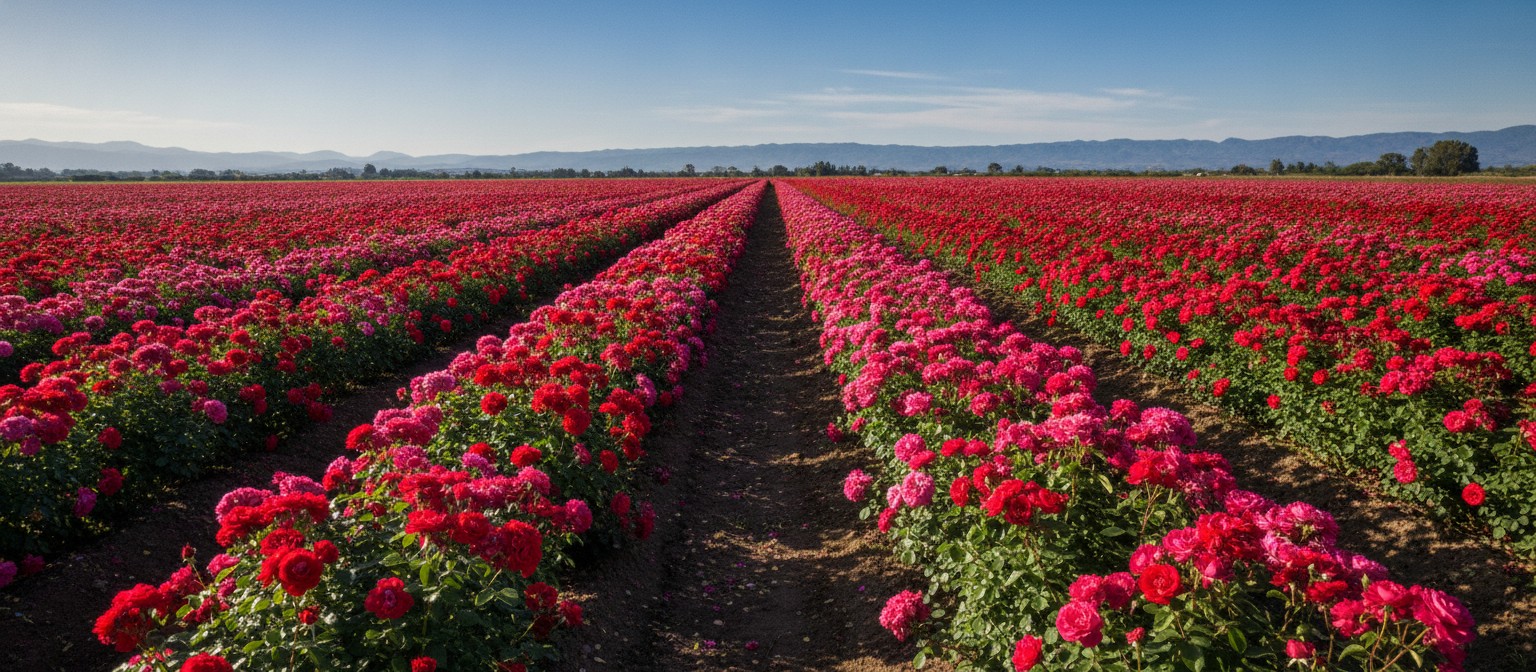
A dozen roses bought in Chicago in February have almost certainly flown in from the Andes. The United States grows flowers, but nowhere near as many as it buys. An analysis of 2024 trade data by agricultural economists at the University of Illinois found that more than 60 percent of U.S. cut-flower imports, worth $1.24 billion, came from Colombia. A further 25 percent came from Ecuador, and Latin America as a whole supplied 92 percent.
Flowers are light, fragile and short-lived, so most of that volume moves by air. That gives a bouquet a larger carbon footprint than its weight suggests. It does not make the answer as simple as “buy local.” The research on flower footprints holds a few surprises, and they point to choices an ordinary buyer can act on.
What the Flight Costs
The clearest estimate comes from the International Council on Clean Transportation. Its researcher Brandon Graver calculated in 2018 that the flowers Colombia sends north each year weigh about 200,000 metric tons. Flying them to the United States burns roughly 114 million liters of jet fuel and releases about 360,000 metric tons of carbon dioxide. That figure covers the flowers alone. It leaves out the cartons, the refrigerated trucks at both ends and the cold rooms in between.
Trade groups argue that some widely quoted totals are out of date, and per-stem estimates swing widely with the method used. The direction is not in dispute. A stem that flies costs more carbon than a stem that rides a truck.
Why “Local” Is Not Automatically Greener
In 2007 researchers at Cranfield University in England compared roses grown in Kenya and flown to Europe with roses grown in heated Dutch greenhouses. The result ran against intuition. As Scientific American summarized it, growing and delivering 12,000 Kenyan roses released about 13,200 pounds of carbon dioxide. The same number from a Dutch hothouse accounted for 77,160 pounds, nearly six times as much.
The Dutch roses needed artificial light, heating and cooling for the eight to twelve weeks they took to grow. The Kenyan roses grew under the sun. Lighting and heating a glasshouse cost more carbon than the long-haul flight did.
The lesson reaches beyond roses. Distance is one part of a flower’s footprint. How the flower was grown is the other, and in cold months it can be the larger part. A field-grown stem in season will usually beat a hothouse stem out of season, wherever each one starts.
The Second Journey Most Buyers Forget
Every imported flower makes one long trip. Some make two. A boxed bouquet ordered from a national shipper travels by overnight courier from a warehouse or a farm to the recipient’s door, and over any real distance that means another flight. The box carries insulation and cold packs to keep the stems alive, and most of that goes in the bin within the hour.
The alternative is older and simpler. A florist in the recipient’s own city buys flowers that have already reached the regional wholesale market, arranges them and drives them across town. Nothing is boxed for the mail, and nothing flies again.
Two very different West Coast markets show how this works. Same-day flower delivery in San Francisco from Pink Clover starts at the shop’s studio on Ellis Street, where each order is arranged by hand and sent out by car the same day. On an island the logic is stricter still, because a boxed bouquet sent to Hawaii can only arrive by plane. Pink Clover, a florist in Honolulu, builds its arrangements at a studio in Aiea, near Pearl Harbor, and delivers across Oahu by road. In both places the last leg is a short drive.
Four Questions Worth Asking a Florist
- What is in season? Seasonal stems are more likely to be field-grown and less likely to have needed a heated greenhouse. Give the florist a color range and let them use what is good that week.
- Where will the arrangement be made? A shop with a street address in the recipient’s city fills its own orders. A website without one will pass the order to someone else or ship a box.
- Is there floral foam in it? Many designs no longer need it, for reasons explained below.
- What is it wrapped in? Paper and a vase or box that can be used again are easy to keep out of the trash. Cellophane sleeves and plastic picks are not.
The Green Brick at the Bottom of the Vase
Floral foam, the green block that holds stems in place, is a plastic. It crumbles into fine particles when it is cut or soaked, and those particles wash down the sink. A 2020 study at RMIT University in Melbourne, led by Charlene Trestrail, exposed a range of freshwater and marine invertebrates to them. Every species ate the particles. The chemicals that leached from the foam were also more toxic to the animals than leachate from other families of plastic.
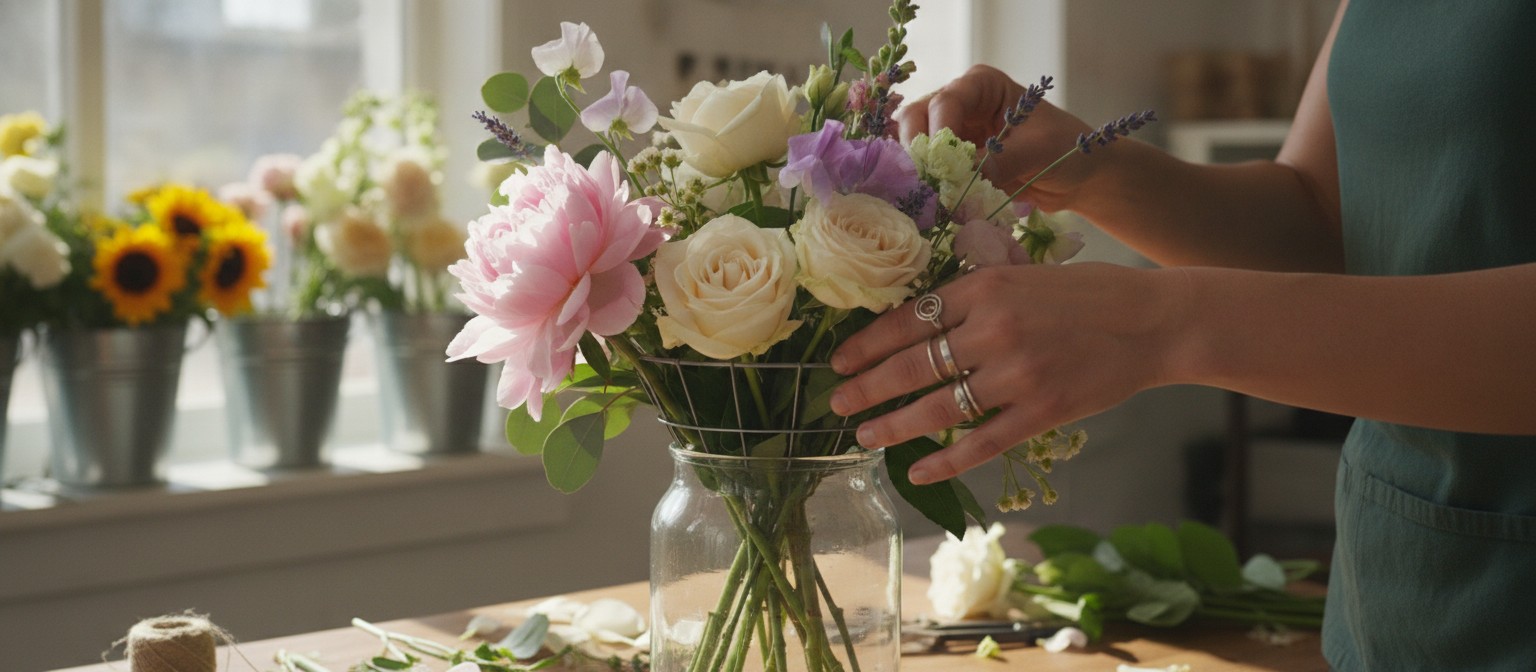
The Royal Horticultural Society has since dropped floral foam from its shows, Chelsea included. Many florists now build arrangements on chicken wire or reusable pin holders, or simply in water. A buyer only has to ask.
Making a Bouquet Last
The lowest-impact flower is the one still alive ten days later, because it does not need replacing. Recut the stems at an angle, change the water every second day and keep the vase out of direct sun. Keep it away from the fruit bowl as well. Ripening fruit gives off ethylene, the plant hormone that softens bananas, and cut flowers exposed to it age faster.
When the flowers are finished, the stems go in the compost or the green bin and the vase goes back in the cupboard.
Key Takeaways
- Most cut flowers sold in the United States are imported, mainly from Colombia and Ecuador, and most arrive by air.
- Growing method matters as much as distance. A heated greenhouse can outweigh a flight.
- Ordering from a florist in the recipient’s city avoids a second shipment and the mail-order packaging.
- Ask for seasonal stems and no floral foam, then look after the bouquet so that it lasts.
Frequently Asked Questions
Are imported flowers always worse for the climate than domestic ones?
No. The Cranfield comparison found that roses flown in from Kenya had a far smaller footprint than roses raised in heated Dutch greenhouses. The energy used to grow a flower can outweigh the energy used to move it. Season and growing method are better guides than country of origin.
Is it better to order from a florist in the recipient’s city?
In most cases, yes. A local shop arranges flowers that are already in the region and delivers them by road, so there is no second shipment and no insulated box. Look for a street address in the city and a stated same-day deadline.
What do florists use instead of floral foam?
Chicken wire, reusable pin holders known as kenzan, or simply a container with a narrow neck. Wire and pin holders can be used for years, and neither sheds plastic into the drain.


