
Molten salt reactors were first invented back in the 1950s at the Oak Ridge National Laboratory in Tennessee. However, they never made it far because the Atomic Energy Commission (the Department of Energy’s predecessor) was committed to light water reactors. A variant was already finding success in the electric power industry and another powering the nuclear navy.
Like with many new prominent technologies, utility demand, industry money, and political influence decide. As such, light water reactors dominated and pushed molten salt reactors out of the picture.
However, a few engineers and scientists continued to focus on developing molten salt reactors, despite their unpopularity. From this small collective emerged a pair of entrepreneurs – Carl Perez and Ed Pheil, the owners of Elysium Technologies USA – with an updated design for a Molten Chloride Salt Fast Reactor (MCSFR).
The principal selling points and benefits of their MCSFR include:
- No downtime to fuel
- On-line fueling
- Fueled with nuclear waste from other reactors and weapons
- Full fuel utilization
- Air cooling
- Process heat
- Doesn’t require proximity to a large water source
- The lower reactor, fuel, and balance of plant costs
- Lower electricity generation cost
- A potential source of hydrogen generation at a reasonable cost
- Flexible power capacity (low or high)
- Higher efficiency
- Low Maintenance
- Safe and reliable energy
- No operator intervention needed for reactor shutdowns
As you can see, the list of pluses is very long. And while Elysium isn’t the only molten salt reactor manufacturer in the game, its reactor has some features the others’ don’t.
It requires less safety infrastructure due to low operational pressure requirements, and its components have high technical readiness today, reducing time for development and costs.
It’s a fast reactor with molten fuel, so it can use spent nuclear fuel from water reactors and weapons waste, burning it up over time. It transforms nuclear waste into useful energy. The reactor uses up 95% of the fuel, and the 5% that’s left is toxic for a much shorter period. Fission products usually decay to background levels in approximately 300 years, versus 10,000 years for conventional solid-fuel reactors waste.
And, it can provide clean power and base-load.
Overall, the MCSFR is ideal because it’s a simple design. It possesses passive safety features, uses liquid fuels, and it’s a low-pressure system – all factors that enable significant safety, economic, and environmental benefits.
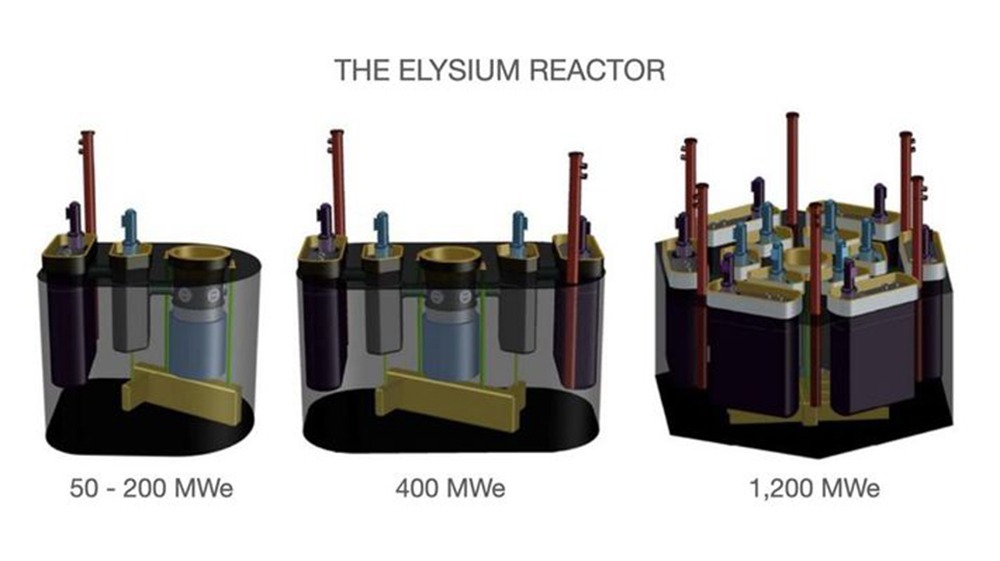
Elysium’s MCSFR can scale from tiny to huge – from 50 Megawatts electric (MWe) to 1,200 MWe. However, the company’s first reactor plant will be a small 10 MWe demonstration, the size determined by Nuclear Regulatory Commission rules.
Many believe the world won’t reduce carbon emissions to meet climate goals without nuclear power. The MCSFR appears to be a great choice. It solves two problems at once – providing energy and eliminating waste – and it’s cheap compared to other options.


