
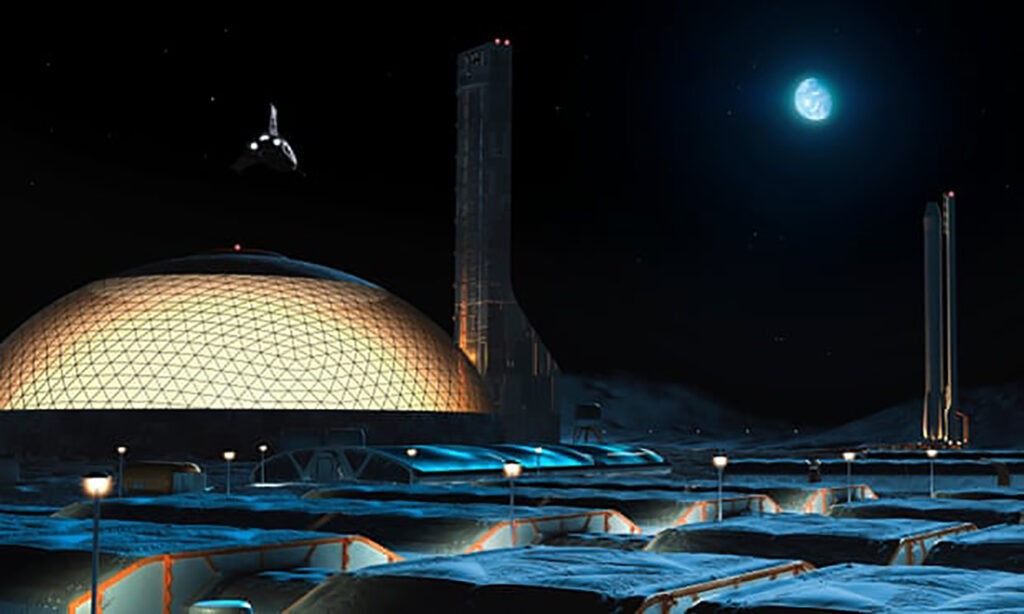
When humans return to the moon in the next decade, they will do more than stick a flag in the ground and collect rock samples. NASA alongside other space agencies are preparing to return to the moon, but this time to create a permanent lunar base, also called “moon village,” where countries and private companies will work together on vital technologies including life support, energy generation, habitat construction, and materials and food production.
UK-based firm Metalysis, which extracts metals from metal oxides trapped within minerals for the electronics, aviation & automotive industries, has won a European Space Agency (ESA) contract to apply its technique to moon rocks. If the process works, it will turn moon dust and rocks into oxygen, leaving behind iron, aluminum, and other metal powders that lunar construction workers could then use as building materials.
The technology could pave the way for lunar extraction facilities that make valuable materials and oxygen on the moon’s surface, rather than having to carry them into space at tremendous cost.
Ian Mellor, the managing director of Metalysis, explained:
Anything you take from Earth to the moon is an added weight that you don’t want to carry, so if you can make these materials in situ, it saves you a lot of time, effort, and money.
Lunar rock examinations revealed that oxygen makes up approximately 45% of the material by weight, with the remainder mainly aluminum, silicon, and iron. In a study published in January 2020, scientists at Metalysis and the University of Glasgow extracted 96% of the oxygen from replicated lunar soil while leaving behind beneficial metal alloy powder.
The ESA contract, worth around $329,460 (£250,000), will fund Metalysis for nine months to perfect the electrochemical method that releases oxygen from lunar rocks and dust by transmitting an electrical current through the material. The technique is already used on Earth; however, the oxygen released is an undesirable byproduct of mineral extraction. On the other hand, Lunar explorers will need oxygen; therefore, it will be captured and stored.
Metalysis will improve the yield and purity of oxygen and metals from lunar rocks while minimizing the amount of energy the process consumes. If the technology proves promising, the next step will be to test out the oxygen extraction method on the moon.

The oxygen extracted from the lunar surface can produce breathable air when mixed with other gases. Simultaneously, oxygen is a vital element of rocket propellant that could be manufactured on the moon and used to refuel spacecraft destined for deep space missions. “If you want to go further out into space, it’s a gas station on the moon essentially, to get into deeper space,” added Mellor.
Symes explained:
Oxygen is useful not only for astronauts to breathe but also as an oxidizer in rocket propulsion systems. There is no free oxygen on the moon, so astronauts would have to take all their own oxygen with them to the moon for life support and to enable their return journey, and this adds considerably to the weight and hence the expense of rocket launches bound for the moon.
For over forty years, human space exploration missions have been limited to the international space station, an orbiting outpost roughly 220 miles above the Earth. Over the coming years, constructing a new station in orbit around the moon will be the focus. Once complete, it will act as a post for astronauts to establish a presence on the moon and eventually as a base from which to launch onward to Mars.
Sue Horne, the UK Space Agency’s head of space exploration, said:
In the future, if we want to travel extensively in space and set up bases on the moon and Mars, then we will need to make or find the things required to support life: food, water, and breathable air.
In 2024, the Lunar Gateway program is expected to send humans back to the Moon aboard NASA’s Orion spacecraft for the first time since 1972. ESA has developed the power and propulsion components for the initial Orion flight and has agreed to build the lunar station’s central crew unit. Meanwhile, the rocket’s first un-crewed flight is expected to launch in 2021.


