
Sharks are covered in a tough protective layer of denticles – tiny, tooth-like scales. New research found that consistent exposure to a low pH (more acidic water) can degrade the denticles. Meanwhile, all the carbon dioxide building up in the atmosphere is slowly being absorbed by the oceans turning the water more acidic every day.
Luntz Auerswald, a fisheries biologist at Stellenbosch University in South Africa, led a team of researchers on an investigation to discover what effects long-term exposure to acidified water has on sharks.
Auerswald said:
Shark denticles are made from dentin, which we know from human dentistry is susceptible to degradation from carbonic acid. That could make [sharks] especially vulnerable.
The researchers’ aim was to find out what would happen to the sharks and other marine life if climate change continues, and the ocean keeps absorbing more and more carbon dioxide. When the CO2 is absorbed, the seawater converts it into carbonic acid – which is how the oceans acidify. If people keep burning fossil fuels at the current rate, the average pH of oceans will drop from 8.1 today to 7.3 by 2300.
As you can imagine, ocean acidification is not suitable for marine life. Scientists have already shown that it can weaken the calcium carbonate shells of bivalves (such as clams), cause some creatures to behave erratically, and make corals more brittle. Now, they’ve shown it negatively affects sharks as well by essentially stripping them of their scales. If the sharks lose their scales, it could lead to problems with their swimming capabilities and they could lose their ability to catch prey. The research has been published in Scientific Reports.
Jean-Luc Solandt, Principal Specialist in Marine Protected Areas at the Marine Conservation Society, U.K., told Newsweek:
This study pertinently shows a case of another marine animal being threatened by ocean acidification. But more widely, it is likely to have a greater impact on ocean system processes leading to less productive seas. If this is happening to the skin of a shark, think of the massive impact on plankton, the base of the food web, and a massive absorbing agent of CO2.
The Study
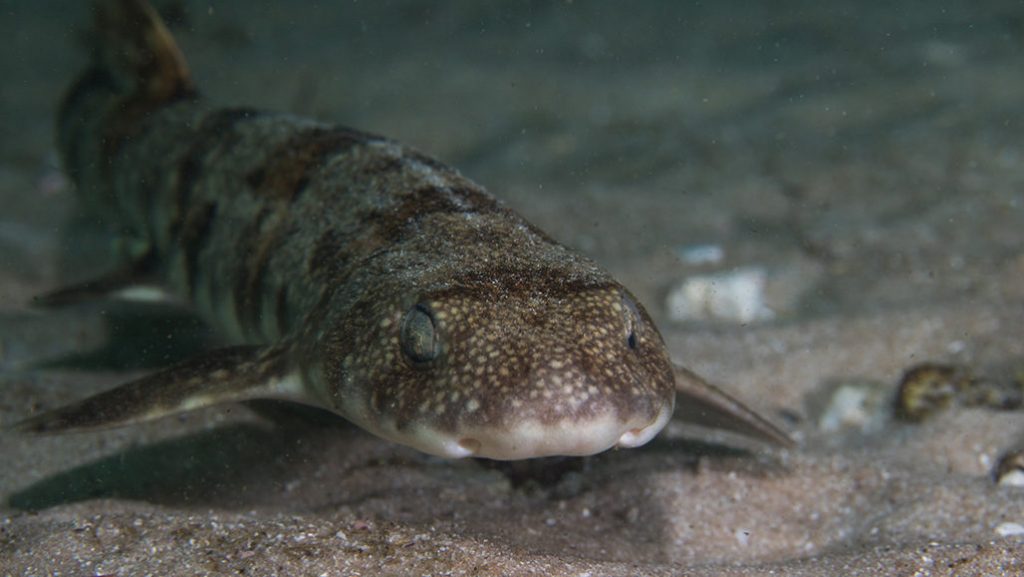
- A puffadder shyshark (catshark) was chosen as the species to represent sharks. They swim just above the ocean floor and are native to the South African coast.
- Three sharks were housed in 1,000-liter tanks for nine weeks. The water was set to simulate pH 7.3 ocean water the entire time to test chronic exposure.
- Other sharks (the control group) were kept in different tanks for nine weeks with waters at current pH levels.
The Results
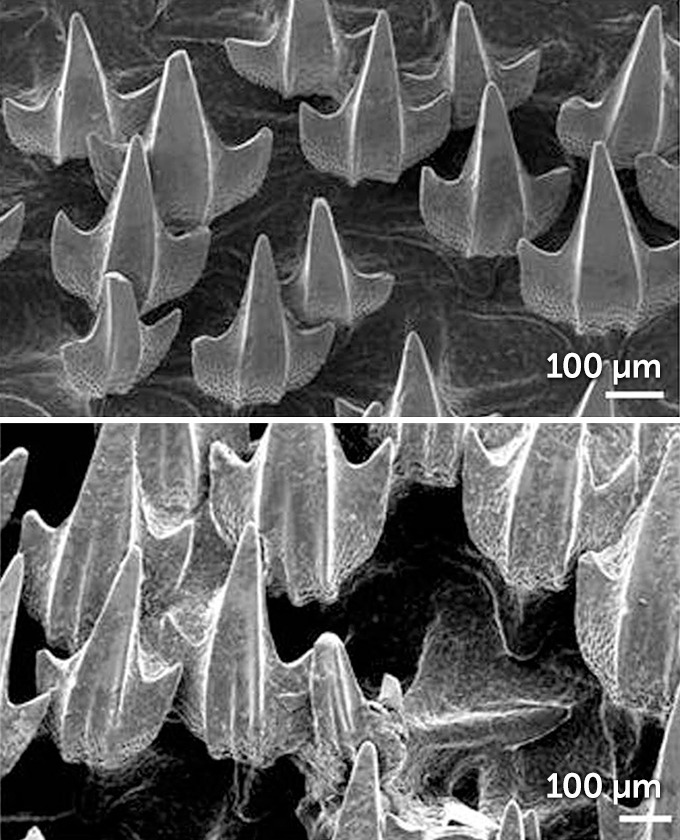
- Exposure of acidic seawater after only nine weeks had caused corrosion that frayed the edges of many denticles of the sharks in tanks doctored to mimic projected acidity levels.
- Of the sharks in the acidic tanks, 25% of the denticles were damaged.
- Of the control group sharks in normal water, only 9.2% of the denticles were damaged.
- All the sharks were able to adapt physiologically to lower pH by pumping bicarbonate into their bloodstream. This built-in mechanism keeps the internal pH steady. (Bicarbonate stops blood from becoming too acidic.)
Auerswald told Newsweek:
From the changeable environment the shysharks come from (in terms of pH), we expected that they would be able to regulate their acid-base balance in the short term as a response to a lowered pH. We were unsure, but not surprised that they can keep this regulation up for extended periods. The corrosion of the denticles, however, came as a surprise. We did not expect this.
Damaged denticles could increase the drag on the animals’ skin, causing them to become slower swimmers. It could also cause them to become more susceptible to injury or infection. The researchers suspect that similar levels of corrosion could also damage the sharks’ teeth and make it harder for them to feed. They plan to continue experimenting on shark denticles and teeth into 2020 to back up their recent findings and suspicions.
Auerswald added:
There are, of course, many other processes that could be compromised, such as reproduction. However, we can only speculate about this at the moment.
The team is currently investigating the effects of acidic seawater on other marine organisms as well, such as rock lobster, sea urchins, and abalone.
Auerswald said:
We hope that people realize what impact ocean acidification has on marine organisms. The focus is mostly on ocean warming, whereas acidification is hardly in the mind of the public but also decision-makers.
So not only is the increasing carbon dioxide in the atmosphere causing global warming, but it’s also causing ocean acidification. Global emissions are destroying all the air and water on the planet, causing catastrophic weather above land and weakening marine life below water.


