
Economic stress turns ordinary months into a tactical challenge when debt dominates your monthly cash flow. This guide transforms the debt snowball vs. avalanche debate into a repeatable operating system that functions even when financial life feels unpredictable.
Developing a complete debt inventory enables the selection of a payoff strategy aligned with your interest-minimizing baseline and psychological motivation. Prioritize interest drag reduction and Regulation F protections to safeguard progress during collection activity.
Maintaining this baseline facilitates tactical pivots between mathematical efficiency and motivation-focused milestones without sacrificing momentum. Technical frameworks ensure the protection of your credit utilization ratio while ensuring every surplus dollar directly attacks outstanding balances. Individuals managing high-interest retail cards or navigating the complexities of Regulation F with collectors will find that these steps lock in a path to total financial clarity.

Start Here: Snowball vs. Avalanche Basics and the Rules that Protect You
Tactical Overview: Snowball vs. Avalanche Metrics, Credit Reports, and Collection Timelines
Before you pick a debt payoff strategy, it helps to lock in a few facts that keep the plan grounded. These quick points explain why some approaches feel faster, why some cost less, and why credit reports and collection rules matter in the same workflow.
- Debt Avalanche sends extra dollars to the highest APR first after minimums, which is why an interest-minimizing baseline for debt repayment prioritizes the avalanche method when comparing payoff strategies.
- Debt Snowball clears the smallest balances first to create momentum, and focusing on repayment concentration and consumer motivation explains why visible progress can increase follow-through even when the math is not perfectly optimal.
- Free Credit Reports are easiest to pull by obtaining your free annual credit reports to surface forgotten accounts before they quietly derail a payoff plan.
- Collections Timelines are anchored in rules that require a written notice and a dispute window, and utilizing a formal debt validation request ensures you know exactly what to ask for when a collector contacts you.
- Minimum Payments Stay Nonnegotiable because one missed due date can trigger late fees, penalty APR, and a credit score hit that makes future borrowing more expensive.
- One “Extra Payment” Line Item Matters because every small surplus you find is multiplied by time once you start rolling freed minimum payments into the next target balance.
- Paper Trails Beat Phone-Call Memory because a short log of dates, amounts, and letters is often what keeps a collections situation from turning into an argument.
Prioritize building your complete debt list before selecting a specific payoff method. If you are getting collection calls, use the Safety Lane section before you send money to a debt you have not verified.

Structural Comparison: Mathematical Interest Avalanche vs. Psychological Snowball Motivation
What the Avalanche Method Is
The avalanche method directs every extra dollar toward the highest annual percentage rate balance after meeting minimum payments on all other accounts. Logic dictates that because interest accrues based on balance and APR over time, targeting the highest rate remains your fastest interest-minimizing baseline to stop financial bleeding.
What the Snowball Method Is
Prioritizing the smallest balances first allows the snowball method to create immediate financial wins. Eliminating a single account enables you to roll its freed minimum payment into the next target, generating a compounding effect that provides visible traction for your debt payoff plan.
The Hybrid Rule for Real Life
Practical blends work effectively for individuals who require both motivation and mathematical efficiency. Follow these steps to execute a hybrid strategy:
- Initiate your plan with the snowball method to secure one or two quick balance eliminations.
- Pivot your focus to the avalanche method once psychological momentum is established.
- Reorder your remaining debts by APR to maximize long-term interest savings.
Stable monthly payment rhythms allow for these tactical shifts without disrupting your overall debt inventory management.
In real life, this can be as plain as wiping out a small retail card in two paychecks, then using that freed minimum payment to hit the highest APR credit card without hesitation.

Build Your Debt Payoff System: The Three Core Steps
Phase 1: Establishing a Comprehensive Debt Inventory and Verifying Account Accuracy
Pull Your Reports the Safe Way
Start by pulling your credit reports using the official process for free credit reports guidance, then reconcile that list against your statements and any collection letters you have received. Credit reports catch accounts you forgot. Statements catch balances that changed since the report updated. For a full debt inventory, include medical bills, personal loans, credit cards, and any collections accounts so you are not surprised mid-plan.
Expect to find forgotten store cards or minor collection entries, as collector names frequently differ from original creditors.
Build the Master Table: Fields You Must Include
Constructing an effective operating ledger requires tracking specific account details. Ensure your master table includes these essential fields:
- Creditor name and current outstanding balance
- Annual Percentage Rate (APR) and variable rate indicators
- Minimum monthly payment and exact due dates
- Account status (original creditor vs. third-party collector)
- Promotional expiration dates and active payment-plan terms
Monthly updates to this ledger ensure your debt payoff plan remains grounded in real-time data.
Maintaining a visible schedule column prevents late fees from inflating balances as due dates drift throughout the month.
If You Find Errors: Dispute Basics and Timelines
Identify reporting discrepancies, initiate formal disputes, and retain digital or physical copies of all correspondence. The credit bureau generally has 30 days to investigate, and you should receive written results when the credit report dispute resolution window concludes. Some disputes can take longer in specific situations, and the CFPB provides notifications regarding expected timelines for credit report accuracy and notification.
A quick practical habit is to attach one piece of supporting documentation to every dispute and keep a simple dispute log so you can track dates without having to replay the details in your head.
Phase 2: Strategy Selection for Sustainable Progress and Long-Term Commitment
A Simple Decision Tree: Snowball, Avalanche, or Hybrid
Effective strategy selection begins with three critical questions:
- Does commitment waver when visible progress feels slow?
- Is interest the primary drain on your available monthly surplus?
- Do you possess small balances ready for immediate elimination?
Affirmative responses to the first query suggest a snowball approach, while a focus on the second indicates an avalanche priority. Hybridizing these methods facilitates high-impact wins followed by aggressive APR targeting.
An Illustrative Payoff Example
Consider a scenario with three balances: $1,200 at 26% APR, $4,500 at 18% APR, and $700 at 12% APR, paired with a $350 monthly surplus. Under avalanche math, the highest APR card receives the extra payment, and total interest is usually lower. Under snowball, the smallest balances are eliminated first, and the feeling of closure can keep someone on plan. The calendar difference can be modest, but the psychological difference often is not, which is why many people finish faster with the method they can stick to.
Sustainable payoff plans outlast initial enthusiasm by accounting for life’s inevitable friction. Individuals who secure an early, small balance elimination—such as a gig worker clearing a minor retail card—foster the necessary commitment to execute long-term APR targeting.
Phase 3: Aggressive Interest Mitigation and Annual Percentage Rate Optimization
The Free Move: Call the Creditor Before Collections
Requesting hardship adjustments or temporary rate reductions from creditors remains the most cost-effective initial step. Capture the agent’s name, the date, and all promised terms in your records.
Short-term rate reductions prevent interest from consuming your monthly surplus. Implementing a coping with debt checklist while remaining vigilant against relief scams ensures long-term system stability.
Focus your negotiations on single changes, including lower APRs, fee waivers, or adjusted minimum payments to avoid late penalties.
Balance Transfers and Fees: What to Calculate
Leveraging 0% balance transfers serves as a powerful interest-minimizing baseline, though you must account for transfer fees that apply regardless of the zero-percent rate. Carefully evaluating the impact of balance transfer fees clarifies what to check before you move debt. The practical math is simple: if the fee plus any remaining interest is less than the interest you would pay by staying put, the transfer can speed up payoff.
Consolidation Loans and Credit Score Considerations
A debt consolidation loan converts multiple balances into one installment loan with a fixed schedule. That can reduce chaos, but it can also change your credit profile in ways that matter if a mortgage is on the horizon. A plain reality check is that the relationship between personal loans and credit utilization is tied to payment history and account timing, so consolidation should match your timeline instead of a one-week urge for simplicity. Critical failure occurs when individuals use consolidation loans to clear revolving balances only to re-accumulate debt on the original accounts, compounding their financial obligations.

Debt Crisis Management: Navigating Collections, Validation, and Accredited Resources
If You’re Getting Collection Calls: The Safety Lane (Validation, Dispute, and Call Limits)
What a Validation Notice is and What it Should Contain
Debt collection rules mandate a written notice detailing account specifics and consumer dispute rights. Regulation F governs the mandatory content of a debt validation notice so you know what should be in that first written notice. Clear instructions for initiating a dispute or requesting verification must also be present in this first communication.
Request all documentation in writing upon receiving a call regarding unfamiliar debt. Retaining every correspondence in a dedicated folder ensures your debt inventory remains accurate and verifiable.
The 30-Day Dispute Window and Why Written Disputes Matter
Initiating a written dispute within the validation window forces collectors to cease recovery efforts until verification is provided. Exercising your rights to debt verification under the FDCPA establishes a formal structure for these requests. Utilizing written correspondence prevents payment errors to unauthorized collectors and preserves the integrity of your debt records.
Call-Frequency Presumptions and What to Document
Regulation F also includes presumptions tied to call frequency, including the widely cited seven calls in seven consecutive days measure for a particular debt. Identifying telephone call frequency presumptions is essential if repeated calls are becoming disruptive. A simple call log with dates, times, and what was said is often enough to keep the situation orderly.
How to Stop Contact and What May Happen Next
A written request can require a collector to stop contacting you, with limited exceptions, and guides answering the question of “how to stop a debt collector from contacting me?” clarify what that letter does and does not change. Stopping contact does not erase the debt, so pair the letter with verification and a plan for what happens next.
When you want language that matches the rule structure, accessing standardized debt collection validation forms includes a model validation notice and samples that mirror the regulation.
Accredited Counseling Evaluation: Identifying Professional Support for Debt Management
What Nonprofit Credit Counseling Does and What it Doesn’t
Professional credit counseling and budget planning establishes structured repayment plans for unsecured obligations within your monthly means.
Evaluating the risks of debt settlement versus credit counseling is critical, as settlement firms frequently encourage payment cessation, which compounds fees and collection risks. Productive counseling sessions yield realistic budgets, sustainable payment terms, and transparent fee documentation.
When a Debt Management Plan Makes Sense
Debt management plans offer significant relief when unsecured obligations are concentrated in high-interest revolving credit. A structured repayment plan through a debt management program typically routes one payment through a counselor who distributes it to creditors under negotiated terms. Success depends on realistic monthly payments that effectively eliminate the cycle of compounding late fees.
Participating in these plans often necessitates closing specific credit lines to prevent further debt accumulation. While restricting access to credit may feel inconvenient, it serves as a critical safeguard against temptation during your payoff journey. Finding an NFCC nonprofit agency directory allows you to compare providers using consistent standards.
Red Flags and How to Check Legitimacy
High upfront fees, guaranteed outcomes, and pressure to stop paying creditors are warning signs. If a provider refuses to put terms in writing, treats questions as a hassle, or cannot explain how fees work, that is a reason to walk away.
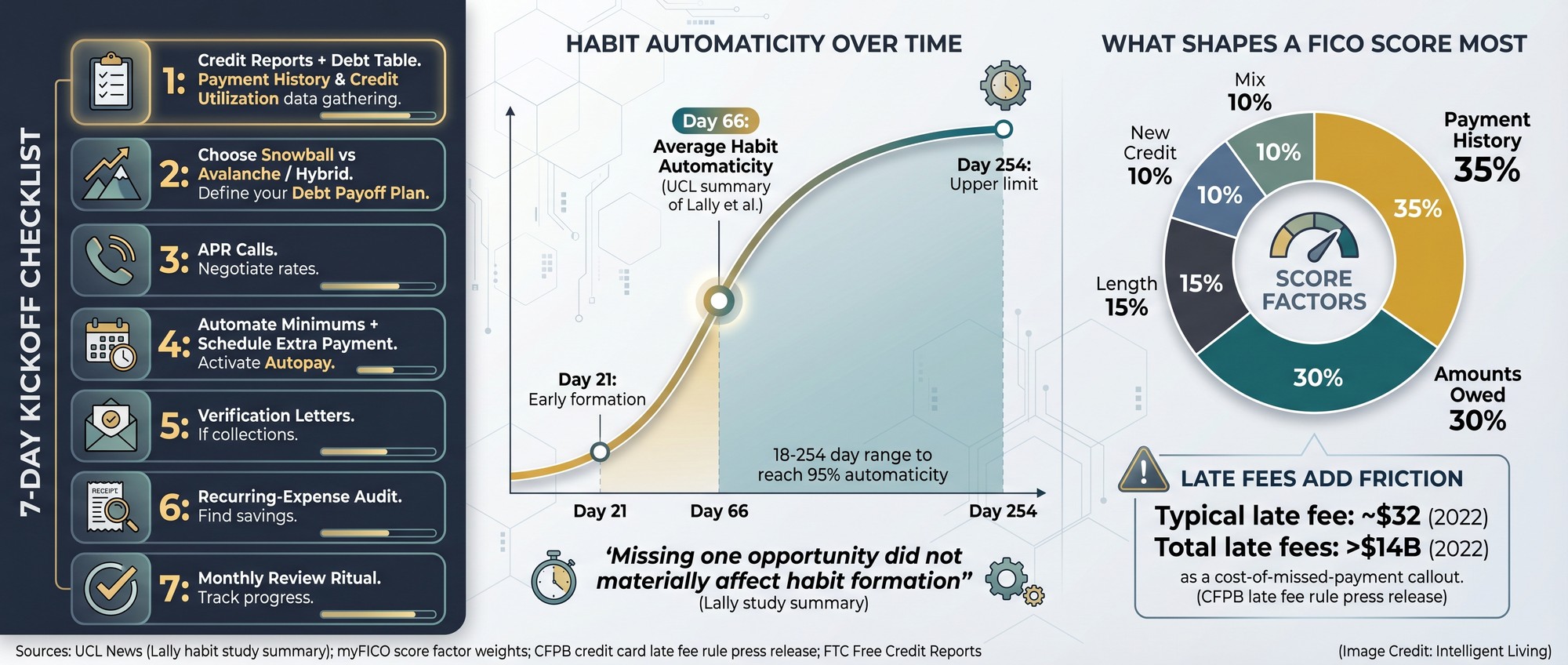
Make it Stick: Habits, Relapse Protection, and a 7-Day Kickoff
Standard Operating Procedures: Twelve Essential Habits for Continuous Payoff Momentum
- Automate minimum payments so you never miss them.
- Schedule a monthly 20-minute review against your master table.
- Build one small weekly check-in that confirms balances and due dates.
- Reconcile statements to your master table as soon as accounts update.
- Direct windfalls to the top-priority payoff instead of spreading them thin.
- Freeze new credit applications for the payoff period to avoid churn.
- Build a small emergency buffer so a surprise bill does not restart borrowing.
- Keep one page that explains your current payoff order and why.
- Pair payment day with a simple routine cue, because mastering behavioral habit formation often comes down to a trigger, a tiny action, and a reward that feels real.
- If calls arrive, pause the plan and follow the Safety Lane checklist.
- Recalculate the plan after any major life change such as income shifts or medical events.
- At month end, move any newly freed cash to the top-priority line in the table.
A small change that sticks is often the one that is easy to measure. Canceling one unused subscription and sending that exact amount to debt payoff can turn vague intention into a repeatable monthly habit.
When there truly is no slack at all, an understanding of how to manage a tight budget as a student still maps well to adult cash flow because envelope categories are the same levers under a different label.
Structural Safeguards: Emergency Buffers and Credit Profile Preservation
Emergency Buffer Basics
An emergency buffer preserves progress. A few hundred dollars in a separate account can keep an unexpected expense from landing on a high-APR card again, especially when the emergency is medical. A small buffer that covers urgent bills, including building an emergency fund for medical expenses, is less about being prepared for everything and more about avoiding backwards progress.
Credit Score Levers that Matter During Debt Payoff
Paying down debt can change credit utilization, payment history, and your overall credit profile. Understanding vital things to know about credit scores includes utilization, payment history, and account age, which is why payoff order matters. If you close accounts or open new credit, expect your score to move in ways that are not always intuitive.
If Homebuying is the Next Milestone
If homebuying is next, improving mortgage readiness through credit scoring often starts with report accuracy, lower utilization, and automatic payments. The payoff plan should protect those fundamentals while you reduce balances.
Initial Deployment: A Seven-Day Strategic Roadmap for System Activation
Day 1: Pull your credit reports and build the master table.
Day 2: Flag accounts by APR and balance, then choose snowball, avalanche, or hybrid.
Day 3: Call top creditors to ask about hardship options or lower rates.
Day 4: Automate minimums and schedule the extra payment.
Day 5: If collectors called, request verification in writing and document every contact.
Day 6: Audit recurring expenses to find a small surplus, since managing recurring expenses, subscriptions, and seasonal bills often reveals small leaks that add up.
Day 7: Do the first monthly review and lock the plan into a calendar habit.

Strategic Synthesis: Achieving Long-Term Sustainability in Your Debt Payoff Journey
Sustainable progress relies on maintaining a transparent debt inventory that accounts for life’s inevitable volatility. While rigid spreadsheets often fail during high-stress weeks, a flexible operating system allows you to prioritize high-interest balances while keeping your monthly rhythm intact. Focus on the habits that protect your surplus, such as reconciling statements early and automating nonnegotiable minimum payments to safeguard your credit profile.
Executing the fastest debt payoff strategy for high interest is a marathon of consistency rather than a sprint of intensity. Integrating these technical safeguards with human-centered motivation ensures that the system keeps running even when initial enthusiasm fades. Reclaim your financial agency by sticking to the verification protocols and tactical shifts that turn a daunting balance into a series of achievable, completed milestones.
Common Questions Regarding Debt Snowball and Avalanche Methods
Is debt snowball or avalanche better for me?
Avalanche saves the most on interest costs, but the snowball method is superior if you need quick psychological wins to stay committed to the plan.
What is the fastest way to pay off credit card debt?
Target the highest APR balances first while maintaining minimums on all other accounts to reduce the total interest drag on your monthly surplus.
How do I dispute an error on my credit report?
Initiate a formal dispute through the credit bureau’s portal, provide supporting documentation for the discrepancy, and retain copies of all correspondence.
When should I consider a debt management plan?
Targeted debt management plans provide relief when widespread high-interest obligations threaten to compound through late fees and missed payments.
What should I say to a debt collector on the phone?
State clearly that you want all communication in writing, ask for a formal validation notice, and avoid confirming any details until the debt is verified.


