
Intel’s neural texture compression (TSNC) represents a strategic shift in managing the escalating GPU memory footprint of modern high-fidelity gaming. By utilizing latent representation to shrink texture sets, TSNC ensures that visual quality remains uncompromised even when hardware faces severe VRAM pressure. This methodology employs a sophisticated two-path runtime: a high-throughput XMX-accelerated route for flagship hardware and a critical fallback mode for legacy systems without dedicated matrix engines.
Modern rendering environments often hit a memory wall where bandwidth bottlenecks and VRAM residency dictate performance more than raw compute power. A title running smoothly in optimized corridors can experience sudden stuttering during asset-heavy transitions, as texture streaming pipelines fail to saturate high-resolution throughput requirements. TSNC addresses this by compressing full texture sets into compact formats, allowing engines to maintain higher fidelity without exceeding the local memory budget or inducing frame-time spikes.
The integration of DirectX Cooperative Vectors and Shader Model 6.9 provides the standardized framework necessary for this neural reconstruction to thrive. By exposing ML-style math primitives directly to the graphics pipeline, developers can implement resident data compression that scales across various GPU architectures. This ecosystem shift moves beyond simple block compression, enabling a future where high-density materials are reconstructed on demand to preserve hardware longevity and enhance player immersion.
Runtime performance bottlenecks often manifest as disruptive GPU stalls during intensive gameplay. A game that runs smoothly in an empty corridor can suddenly hitch the moment a dense city scene loads, not because the GPU forgot how to render, but because texture streaming and VRAM residency turn into the real bottleneck.

Technical Overview: Intel TSNC, DirectX Cooperative Vectors, and VRAM Efficiency
This story sits at the intersection of neural rendering and the ongoing VRAM squeeze in modern PC gaming. Microsoft recently confirmed that DirectX is incorporating ML-style math primitives within its retail release notes, making neural texture compression more accessible. These additions make techniques like neural texture compression easier to express and accelerate across various hardware.
For players, the impact is direct: compact texture sets alleviate VRAM pressure, reduce installation sizes, and ensure smoother asset streaming. However, the technical benefits depend heavily on decode mode and hardware acceleration. Consequently, early implementations will likely ship as cautious, opt-in paths for enthusiast users.
- Intel frames TSNC through a DirectX 12 hardware acceleration demo, leveraging neural texture compression to optimize the tradeoff between bandwidth consumption and storage footprints using lightweight math.
- Intel released an open-source TSNC implementation sample that includes runtime toggles for comparing neural modes against uncompressed textures.
- Intel’s performance benchmarks highlight a substantial reduction to 28MB of VRAM for 4K texture sets, which significantly alleviates memory residency pressure.
- Microsoft’s shader-level linear algebra framework allows drivers to map matrix workloads onto hardware acceleration where available.
- The DirectX roadmap for linear algebra capabilities explains why these features are expanding within the internal graphics pipeline architecture.
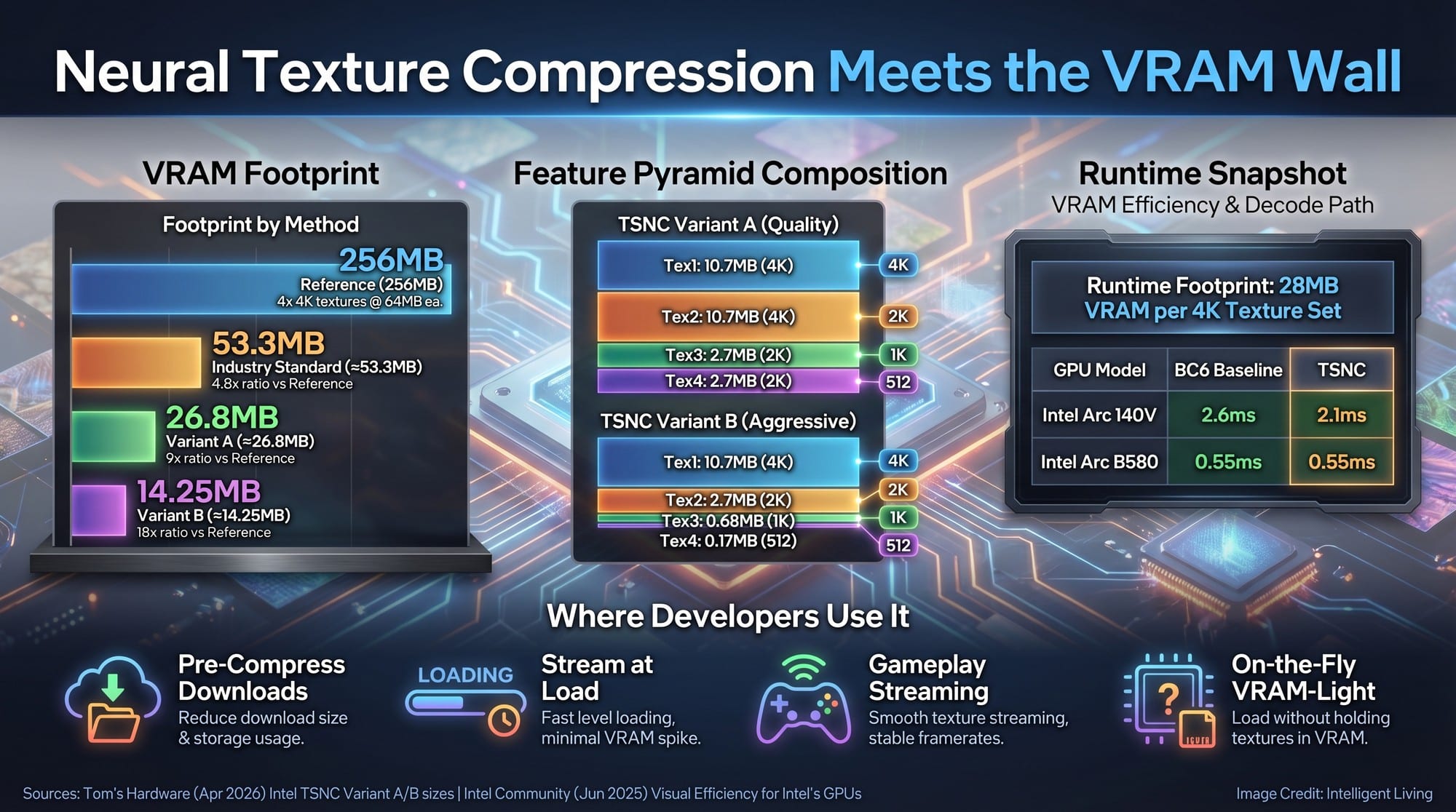
Intel TSNC Arrives as VRAM and Game Assets Hit a Wall
Standardizing TSNC: Industry Adoption and DirectX Integration Timelines
Intel prioritizes hardware accessibility by standardizing matrix acceleration alongside a universal fallback path. Neural texture compression has been explored for years, but Intel is prioritizing hardware accessibility by standardizing matrix acceleration alongside a universal fallback path.
Early technical analysis comparing Intel’s neural compression performance to Nvidia NTC describes two variants with distinct memory optimization goals.
Modern gaming assets increasingly rely on massive texture payloads, which creates significant residency overhead. Even on a system that can push high frame rates, a large open world can feel unstable when the GPU memory budget is tight and the engine is forced to juggle what stays resident. It shows up fast in the settings menu: a player bumps textures one notch higher, the scene looks sharper, and then the next fast travel introduces pop-in because the memory footprint quietly crossed the safe line.
Neural Architecture: How Latent Mapping and Decoding Logic Work
Traditional textures store surface information using block-compressed formats like BCn. While these apply fixed transforms to small pixel blocks, they hit significant efficiency limits as assets grow in complexity and detail.
Neural texture compression employs a strategy that departs from traditional pixel storage. Instead of retaining every texel, it utilizes a compact learned representation:
- Latent Mapping: Stores a high-density “blueprint” rather than raw data.
- Neural Decoding: Uses a small runtime decoder to reconstruct texture values on demand.
- VRAM Efficiency: Minimizes the data resident in VRAM and reduces storage travel.
- Compute Tradeoff: Shifts the resource cost toward GPU compute during the reconstruction phase.
This architectural shift enables superior compression ratios while maintaining visual fidelity parity with raw assets. The reason “texture set” matters is that modern materials are not one map; they are bundles. A single surface might combine albedo, normals, roughness, metallic, and ambient occlusion, optimizing compression throughput by capturing shared structural data across multiple material channels.
The research lineage behind this idea is laid out in random-access neural compression of material textures, which focuses on reconstructing texels on demand without turning textures into a full-screen decode job.

How TSNC Decodes Textures and Where it Could Show Up First
How it Works: TSNC, Cooperative Vectors, and the Two Decode Paths
The Neural Reconstruction Step, Explained
The stored latent function serves as a high-density material blueprint, which a compact decoder expands into active texture channels during on-demand sampling. Games can choose to do more of that work during loading, which can avoid extra per-frame cost, or to do it closer to sampling time, which can save more VRAM but demand more compute.
A practical detail is mip levels. If the pipeline is designed well, it can reconstruct only the resolution needed for the current view, rather than rebuilding full-resolution texture data that will never be sampled at distance.
Fast Path Versus Fallback Path
Intel’s fast path leans on matrix acceleration, specifically using XMX units to make reconstruction cheap enough for real-time use.
The fallback path performs the same class of operations using conventional instructions. This ensures that hardware without dedicated AI cores can still participate in the neural ecosystem.
Decode Modes: On-Load, On-Sample, and Feedback
The key decision is where the work happens. If decoding is done on load, runtime cost stays low, but VRAM savings can be smaller. If decoding is done on the sample, VRAM savings can be larger, but frame time becomes the constraint. RTX Neural Texture Compression SDK defines these mode choices, highlighting feedback-style strategies that balance memory residency against reconstruction overhead.
Use Case Scenarios: Optimizing the Graphics Pipeline for TSNC
- Reduced installation footprints and optimized patch payloads, as compressed texture sets minimize data distribution requirements.
- Faster loads in texture-heavy titles when decode work is concentrated during loading instead of during active gameplay.
- Texture streaming with less stutter, because smaller texture representations can be moved and staged more smoothly.
- Low-VRAM modes for laptops and budget GPUs, where a smaller resident footprint can preserve higher visual settings.
- Cloud gaming pipelines, where moving fewer bytes can reduce transit overhead and cache pressure.
- Mod texture packs that weigh less, which lowers friction for players who avoid giant add-ons.
- Handheld devices that still want premium visuals, especially where memory limits are tight and thermals are unforgiving.
- Optional ultra HD texture layers that do not explode VRAM, because the highest-detail maps can be staged and reconstructed more surgically.
- Asset archives and content delivery systems, where storage churn is reduced when texture payloads are smaller.
These diverse implementation pathways demonstrate how TSNC adapts to specific hardware constraints. Each of these use cases depends on a developer selecting a decode mode tailored to the specific title’s requirements.
The same compression concept behaves differently depending on its design. Load-time decoding prioritizes VRAM savings, while continuous reconstruction during motion requires optimized frame-time management.

Strategic Implications: Resident Data Compression in Modern Graphics
Systemic Scalability: Neural Compression as a Solution for Bandwidth Bottlenecks
Memory Residency is the Quiet Budget
TSNC exemplifies a critical industry shift: as bandwidth and high-speed memory become bottlenecks, engineering focus pivots to compressing resident data.
Technical constraints are now intersecting with economic realities. The global supply chain shift toward HBM makes bandwidth and memory capacity strategic constraints across all computing platforms.
The Same Constraint Shows Up in AI and Gaming
The same intuition appears when examining VRAM residency limits in AI supercomputer hardware, where practical throughput is often gated by memory capacity.
A parallel exists on the AI side, where compressing the expensive resident state helps maintain stability in long-context systems instead of letting memory growth erode performance.
Performance Tradeoffs: Toolchain Maturity and Implementation Challenges
Decode Mode Decides Where the Cost Lands
Not all neural compression savings arrive the same way. Load-time decoding offers minimal footprint reduction but preserves a low runtime compute profile. If it decodes on sample, VRAM can fall dramatically, but the renderer pays a frame time bill. Tom’s Hardware benchmarking on Nvidia’s side captures this tradeoff, and the RTX Neural Texture Compression mode tests show how on-sample strategies can shift costs into frame time.
Standards and Drivers Decide What Ships
Toolchain maturity is the second constraint. Cooperative Vectors and related linear algebra features are still evolving inside DirectX, and the HLSL Shader Model 6.9 specification makes it clear that this is part of a broader push to represent machine learning-style operations directly in shader code.
Similar bandwidth limits appear in other GPU workloads, where scaling raw compute faster than data movement causes bottlenecks to migrate directly into memory traffic.
Market Integration: The Future Roadmap for Neural Texture Adoption
Signals that TSNC is Moving into Real Games
The primary validation metric is the seamless normalization of TSNC-style pipelines across major engines and toolchains. Telling signs include widespread exporter support and build steps that generate neural texture assets alongside legacy BCn versions.
On the industry strategy side, this also fits a recurring Intel theme: efficiency as a competitive lever. The logic behind Intel’s low-bit efficiency strategy remains a recurring theme for Intel, focusing on smaller representations to maintain efficiency.
Tangible User Experience Benefits and Gameplay Stability
The primary advantage for users is a more stable visual experience rather than a superficial setting adjustment. For players, the first obvious win will not be a new slider label. It will look like fewer texture stalls, less sudden pop-in during fast travel, and a system that holds visual quality more consistently as scenes get crowded.

Conclusion: Neural Texture Compression Efficiency for Breaking the Memory Wall
The arrival of TSNC is a clear signal that neural rendering is transitioning from a research curiosity into a production necessity. The strongest promise is straightforward: compact latent representations can reduce VRAM pressure, mitigate bandwidth bottlenecks, and make premium visuals feel less fragile on mainstream GPUs. By leveraging a neural fallback mode, Intel ensures that these advancements are not locked behind high-end matrix hardware, fostering a more inclusive graphics ecosystem.
As we move toward a future where resident data compression becomes the norm, Intel’s efficiency-first strategy could be the key to breaking the memory wall. Success hinges on specific pipeline requirements and whether the industry adopts these ML-style math primitives as standard. If the developer toolchain matures as expected, neural texture compression could redefine the balance between visual fidelity and memory residency, providing a sustainable path for the next generation of immersive experiences.
FAQ: Intel TSNC, Neural Texture Compression, and Cooperative Vectors
How does Intel TSNC reduce the GPU memory footprint?
It stores textures as compact latent representations rather than raw pixels, significantly lowering the data resident in VRAM and optimizing the overall texture set footprint.
What is the benefit of the TSNC fallback mode?
It allows systems without XMX units or dedicated matrix acceleration to still benefit from neural reconstruction using conventional GPU or CPU cores, maintaining the technical viability of legacy hardware platforms.
Does DirectX Shader Model 6.9 improve VRAM management?
Yes, by introducing Cooperative Vectors and ML math primitives, it allows the graphics pipeline to handle neural texture compression and resident data more efficiently across different hardware tiers.
Will TSNC help fix game stuttering and texture pop-in?
By reducing VRAM bloat and optimizing texture streaming, it minimizes the hitching caused when the GPU memory budget is exceeded, ensuring smoother asset staging during gameplay.
Is neural texture compression better than traditional BCn?
While BCn is reliable, neural methods capture shared structure across texture sets—including albedo and normals—much more efficiently, delivering superior visual fidelity with substantial memory savings.


