
The Florida Keys coral reef tourism economy serves as the regional lifeblood, powering every sector from hospitality to commercial fishing through the invisible strength of its biological architecture. Beyond simple aesthetics, these living coral structures provide essential marine ecosystem services that sustain fleets and anchor local commerce.
Strategic Florida coral reef restoration funding has evolved from isolated grants into comprehensive coastal resilience Florida planning, a shift designed to ensure ecosystems remain functional against intensifying storm cycles.
Current efforts in bleaching-resistant coral restoration are shaping the future of these habitats. By corals that can retain heat tolerance, researchers aim to ensure these coral reef infrastructure projects survive the next hot summer to protect the coastline.

Why Florida’s Reef Grants Act as Tourism Insurance in the Florida Keys
Essential Facts: Florida Keys Tourism and Reef-Based Coastal Resilience
- Florida’s reef restoration funding includes recurring $9.5 million award cycles. These funds support the state coral protection and restoration program and its FCR3 initiative, emphasizing propagation scale and recovery capacity.
- The FY 2025–26 project list emphasizes land-based coral grow-out, workforce training, rescue capacity, and digital systems.
- Florida’s Coral Reef tourism value is commonly cited at around $6 billion. This economic impact is reflected in Florida’s U.S. Coral Reef Task Force jurisdiction profile alongside state program messaging.
- Local economic activity relies heavily on recreation, and sanctuary research tracks how reef use connects to the visitor economy in NOAA’s Florida Keys socioeconomic recreation and tourism monitoring.
- A 2026 milestone moved thousands of juvenile corals to restoration partners, showing the pipeline is producing at volume.
- Florida Keys water quality projects are being funded in parallel because corals cannot recover in polluted, nutrient-heavy water.
Infrastructure Planning: Treating Florida’s Coral Reefs as Critical Assets
Florida now treats its reefs as coral reef infrastructure, moving beyond niche scientific experiments toward systematic planning. This approach targets the practical logistics required for repeatable restoration: grow-out capacity and a specialized workforce.
Operational scale now takes precedence over planting individual fragments, as evidenced by a funding package that set aside $9.5 million for 11 reef restoration projects that establishes reefs as vital components of a broader resilience strategy.
A simple dive shop orientation safeguards the region’s future by transforming curious tourists into educated observers, preventing accidental damage and stabilizing local jobs during volatile seasons.
Modern coastal engineering is adopting ecological design principles. Many projects now utilize marine infrastructure designed for ecosystem support rather than sterile concrete surfaces.
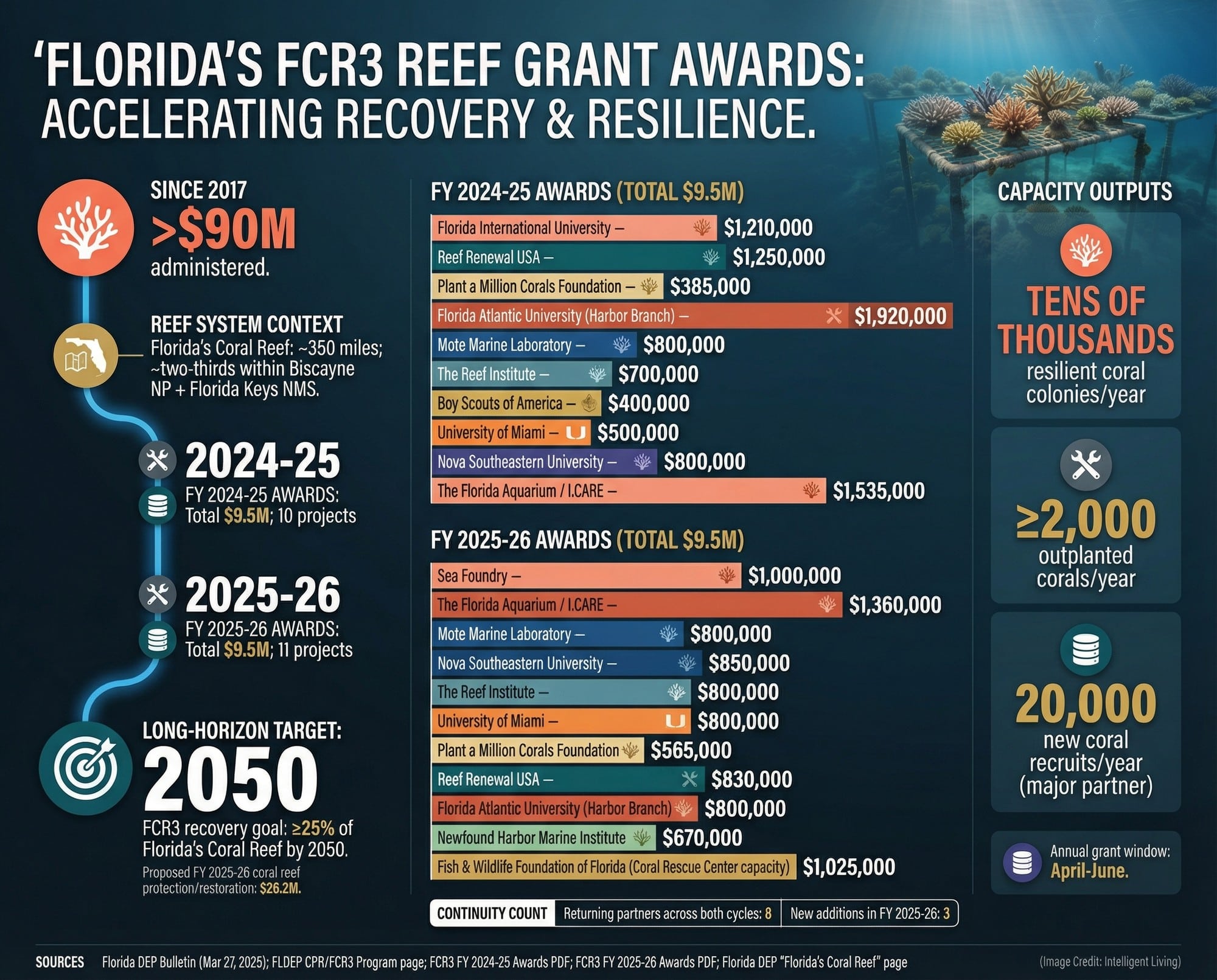
Strategic Restoration: Inside Florida’s Reef Infrastructure Funding Playbook
Economic Impact: Quantifying Florida’s Investment in Reef Restoration
State officials explicitly linked the reef system to the visitor economy in a March 2025 bulletin. By valuing the reef at roughly $6 billion, official state economic bulletins establish a clear mandate for sustained restoration.
Tourism pressure remains measurable. Hundreds of thousands of sanctuary visitors enter Keys waters annually, presenting a risk to fragile habitats. However, these visitors also represent a massive monitoring workforce when trained and guided effectively.
Operational Priorities: Key Projects Funded for the FY 2025–26 Cycle
FY 2025–26 investments fortify the industrial-scale capacity required for ecosystem survival, ensuring transparency through the FCR3 restoration awards list across four critical domains:
- Advanced tracking and monitoring systems for reef health.
- Land-based coral propagation and grow-out facilities.
- Workforce training for restoration technicians.
- Infrastructure to safeguard coral stock during environmental disruptions.
Effective allocation ensures the Florida coral reef restoration pipeline remains resilient.
Scaling Restoration: Enhancing Propagation Capacity, Training, and Data Infrastructure
Funding itemization reveals the true scale of these efforts, such as the $1,000,000 allocation for Sea Foundry’s digital infrastructure. Another $1,360,000 supports the Florida Aquarium and I.CARE in expanding land-based propagation and technician training. Additionally, $1,025,000 strengthens the Florida Coral Rescue Center, as detailed in the FY 2025–26 FCR3 awards list.
This approach builds a sophisticated supply chain for living organisms, often integrating advanced coral aquaculture techniques into restoration planning.
Measurable Progress: Moving 9,000 Juvenile Corals into the Restoration Pipeline
A funding strategy becomes real when the pipeline moves volume. In January 2026, the Florida Aquarium described a transfer of 9,000 juvenile corals to restoration partners across Florida, a milestone that signals steady production rather than one-time experimentation.
Watching technicians handle trays of tiny corals redefines ‘reef protection’ for many snorkelers. At this scale, conservation stops being abstract and becomes a precise form of farming essential to the destination’s survival.
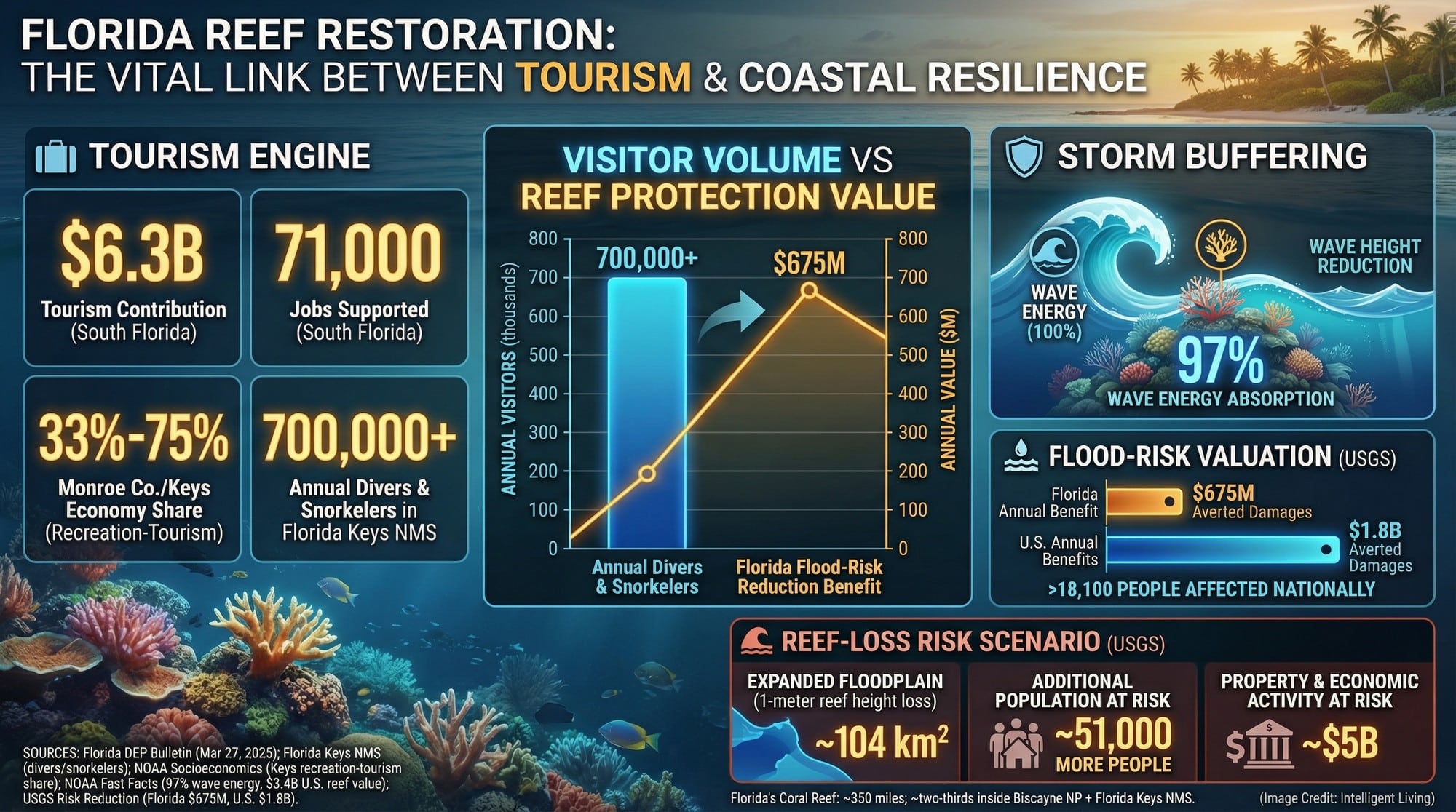
Marine Ecosystem Services: Linking Reef Restoration to Tourism and Storm Protection
Purposeful Travel: Integrating Recreational Diving into Reef Recovery Efforts
Tourism functions as a dynamic delivery channel for reef recovery, allowing successful programs to transform recreational interest into high-quality monitoring data.
Citizen Science at Scale: The Impact of the Iconic Reef Guardians Program
The Iconic Reef Guardians training model empowers recreational divers and snorkelers to contribute to science at scale. This program standardizes observation protocols, transforming casual visitors into a proficient monitoring force. The reporting pipeline is designed to move quickly, with observations feeding into Florida’s Southeast Florida Action Network system for reef condition reporting, which helps restoration teams see issues earlier.
Prepare for your first marine conservation diving trip by focusing on skills that exceed basic equipment checks. Practical preparation ensures your presence supports the reef rather than disturbing it.
Sustainable Choices: Reducing Environmental Pressure through Blue Star Operators
Booking choices directly influence the health of heavily visited reef sites. Essential briefings on buoyancy and wildlife etiquette significantly reduce accidental damage.
Blue Star diving and fishing operators lead this effort by integrating customer education into every excursion to ensure the reefs are not over-exploited.
Nature-Based Defense: Understanding Reef-Driven Storm Buffering
Reefs are fundamentally ecological, yet they also serve as massive breakwaters that absorb destructive wave energy long before it threatens the coastline.
Wave Energy Dissipation: Why Healthy Reefs are Essential for Beach Protection
Wave energy reduction studies confirm that healthy reef crests function as living breakwaters, dissipating nearly all incoming surge. This natural buffering determines whether a coastline recovers rapidly or loses critical beach width and visitor access following a storm.
Nature-based storm protection is not limited to reefs. Coastal planners increasingly treat ecosystems as fiscal assets, including mangrove forests framed as living flood defense rather than scenery.
Fiscal Risk Assessment: The Economic Consequences of Coral Reef Degradation
Economic protection from reefs is a concrete fiscal asset, with flood-risk valuations estimating that these systems prevent $1.8 billion in annual storm damages while safeguarding thousands of residents. Furthermore, healthy reefs safeguard approximately 18,100 people every year by absorbing surge energy. In a tourism-driven place, fewer flood disruptions can translate into shorter downtime for hotels, marinas, restaurants, and the local workforce that depends on them.
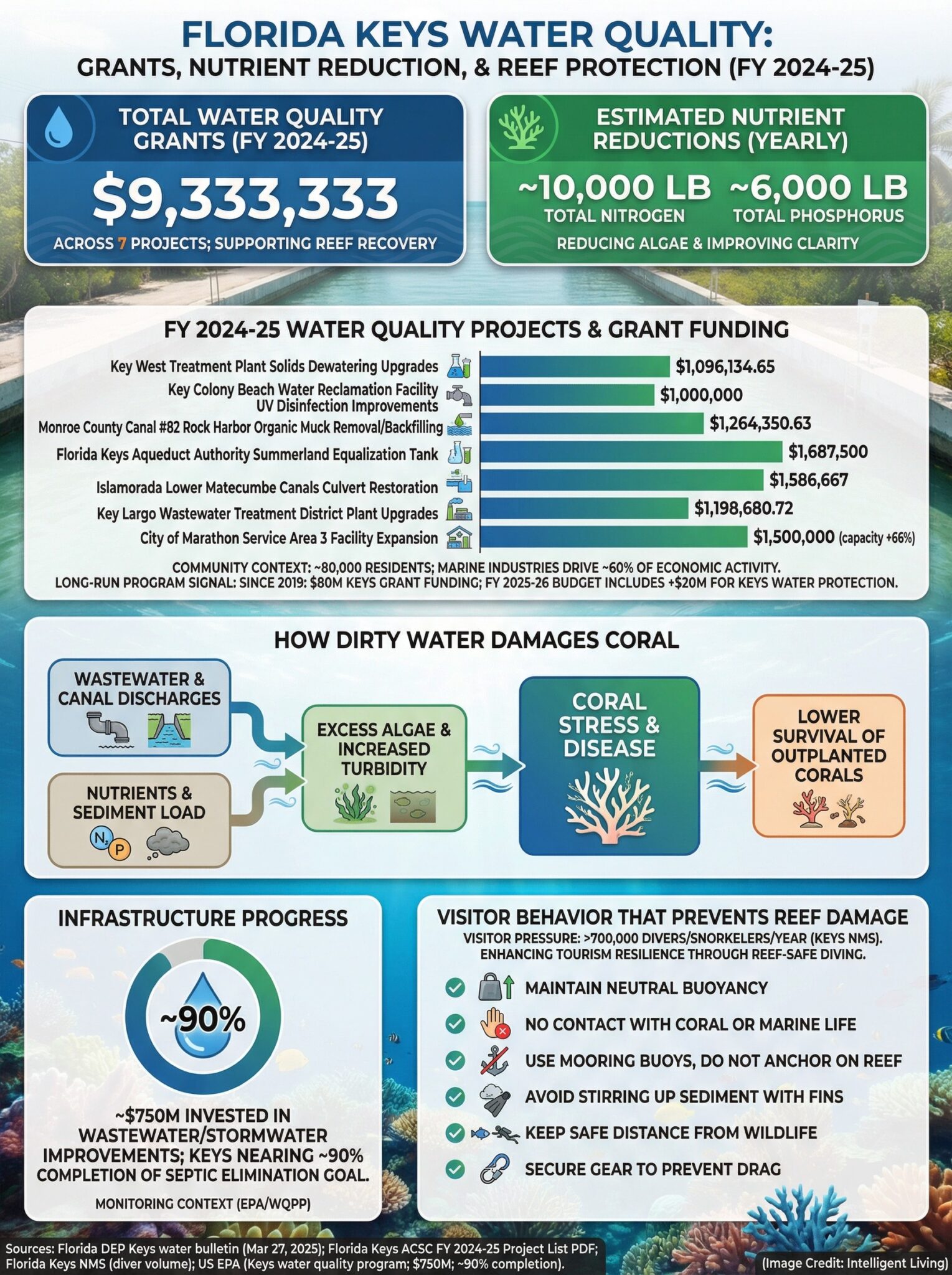
Ensuring Long-Term Recovery: The Impact of Water Quality and Visitor Behavior
Water Quality Management: Addressing the Hidden Drivers of Reef Health
Coral restoration is fragile if the surrounding water stays unhealthy. Restoration must also restore ecological functions such as grazing, and researchers are testing Caribbean king crab restoration to reduce macroalgae and create better conditions for coral growth. Nutrient pollution and sediment can stress corals, fuel harmful algae growth, and make it harder for outplanted colonies to survive long enough to rebuild reef structure.
Parallel state investments reinforce the vital link between nearshore clarity and successful restoration. A $9.3 million allocation for Keys wastewater and canal projects ensures that outplanted corals grow in the nutrient-poor, clean water required for long-term health.
Visitors immediately notice cloudier water, even without knowing the technical cause; this perception directly influences future booking decisions and long-term tourism stability.
Urban and coastal planners increasingly treat wetlands and water systems as core assets, and that same infrastructure mindset shows up in biosolar wetland designs that treat natural systems as core urban assets.
Responsible Visitation: Minimizing Human Impact on Fragile Coral Ecosystems
Most reef damage from visitors is unintentional. The fix is mostly behavioral and surprisingly learnable.
Adhering to sanctuary diving guidelines ensures that visitors leave no trace, focusing on several critical behavioral shifts:
- Mastering neutral buoyancy to avoid substrate contact.
- Maintaining a respectful distance from marine wildlife.
- Utilizing mooring buoys exclusively to prevent anchor damage.
Safe interactions preserve the very destination visitors come to enjoy.
Everyday travel habits matter too. Sustainable underwater etiquette includes simple choices like reef-safe sun protection and better fin awareness, which aligns with sustainable snorkeling and diving habits that preserve underwater biodiversity even at high-traffic destinations.
Outside the water, beach behavior shapes what flows into the ocean. Many people start with small routines, like carrying a trash bag or avoiding microplastic-heavy packaging, which is the kind of practical mindset described in eco-conscious beach habits that reduce what washes into nearshore water.
For visitors building a full trip plan, it helps to think of the Keys as an ecotourism destination with real limits, which is the premise behind responsible traveler principles for ecotourism that keep nature tourism from degrading the asset it depends on.
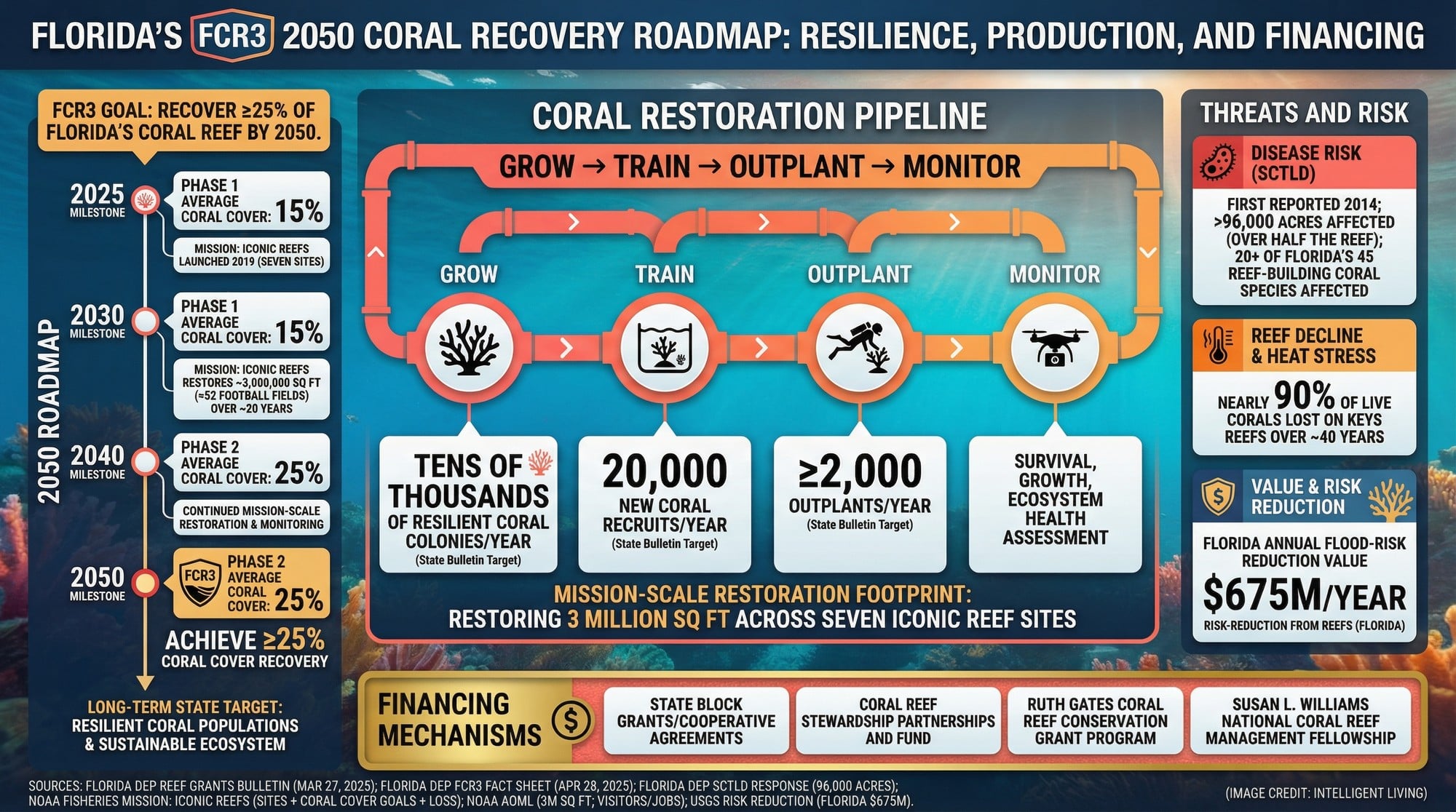
Scaling the Pipeline: The Future of Florida’s Coral Reef Infrastructure Funding
Forward-Looking Strategy: The Next Evolution of Reef Infrastructure Funding
Future progress depends on sophisticated feedback loops rather than mere budget increases. Identifying which interventions survive extreme heat and storm surges allows managers to fund restoration as ongoing maintenance.
Florida’s program documents already hint at this direction. The state’s FCR3 fact sheet outlines how reef restoration strengthens coastal economies and flood protection while pointing to new federal mechanisms under the reauthorized Coral Reef Conservation Act.
Evaluation is becoming more technical as scientists employ omics-based monitoring to verify restoration outcomes across the Keys.
Scientific monitoring is only half the battle; travelers influence this trajectory by booking reef-aware operators and adhering to etiquette standards that maximize the impact of restoration dollars.
Sustainable travel beyond the Keys involves minimizing travel weight and choosing low-impact ground transportation to reduce overall environmental footprints.
Maximizing Coastal Resilience: The Future of Florida’s Reef Infrastructure
While often labeled environmental spending, these grants function primarily as reef restoration funding for critical asset maintenance. Reefs serve as a working component of the local economy and a physical buffer that reduces storm risk, making the logic of reinvestment a matter of fiscal necessity rather than sentiment. NOAA’s review of the total economic value of U.S. coral reefs reinforces this by treating these habitats as measurable assets bundled with fisheries and coastal protection.
Success in this field requires addressing trade-offs between restoration and environmental stressors like heat and pollution. By prioritizing nature-based storm protection and building a robust supply chain for living coral, Florida can maintain a resilient destination. Training visitors to become careful observers ensures the Keys remain a sustainable treasure rather than an exhausted resource.

Common Questions About Florida’s Reef Restoration and Tourism
How does reef restoration act as Florida Keys tourism insurance?
Restoration maintains the physical reef structure that protects the Florida Keys coral reef tourism economy by sustaining biodiversity and preventing beach erosion.
What are Florida’s reef grants actually funding?
The funds support coral reef infrastructure, including land-based propagation and workforce training as outlined in the state coral protection and restoration strategic plan.
What is the goal of Mission: Iconic Reefs?
This NOAA-led effort focuses on restoring coastal resilience in Florida by rebuilding seven diverse reef sites to their functional and ecological glory.
How does the Blue Star program help the reefs?
It promotes sustainable diving in the Florida Keys by certifying operators who educate visitors on reducing their environmental footprint.
Can tourists participate in coral restoration?
Yes, visitors can support recovery by choosing Blue Star operators and following responsible diving practices that prevent accidental damage.


