
Coral reef restoration is not always as simple as planting more corals. On many degraded Caribbean reefs, the immediate obstacle is macroalgae: fast-growing brown and green seaweeds that cover the reef, shade corals, occupy settlement space, and can release chemical compounds that interfere with coral larvae.
A native Caribbean crab may help clear that bottleneck. Scientists are studying the Caribbean king crab (Maguimithrax spinosissimus) as a reef grazer, an animal that eats macroalgae and may create better conditions for corals to settle and grow. Restoration programs are also beginning to test hatchery and semi-wild production so that enough crabs can be raised for future releases.
The idea is not that crabs can rebuild a reef on their own. Instead, researchers see them as one part of a restoration toolbox. By restoring a missing grazing function, Caribbean king crabs could help coral transplants and naturally recruited corals face a cleaner, less competitive reef surface.
Why Algae Becomes the Restoration Bottleneck
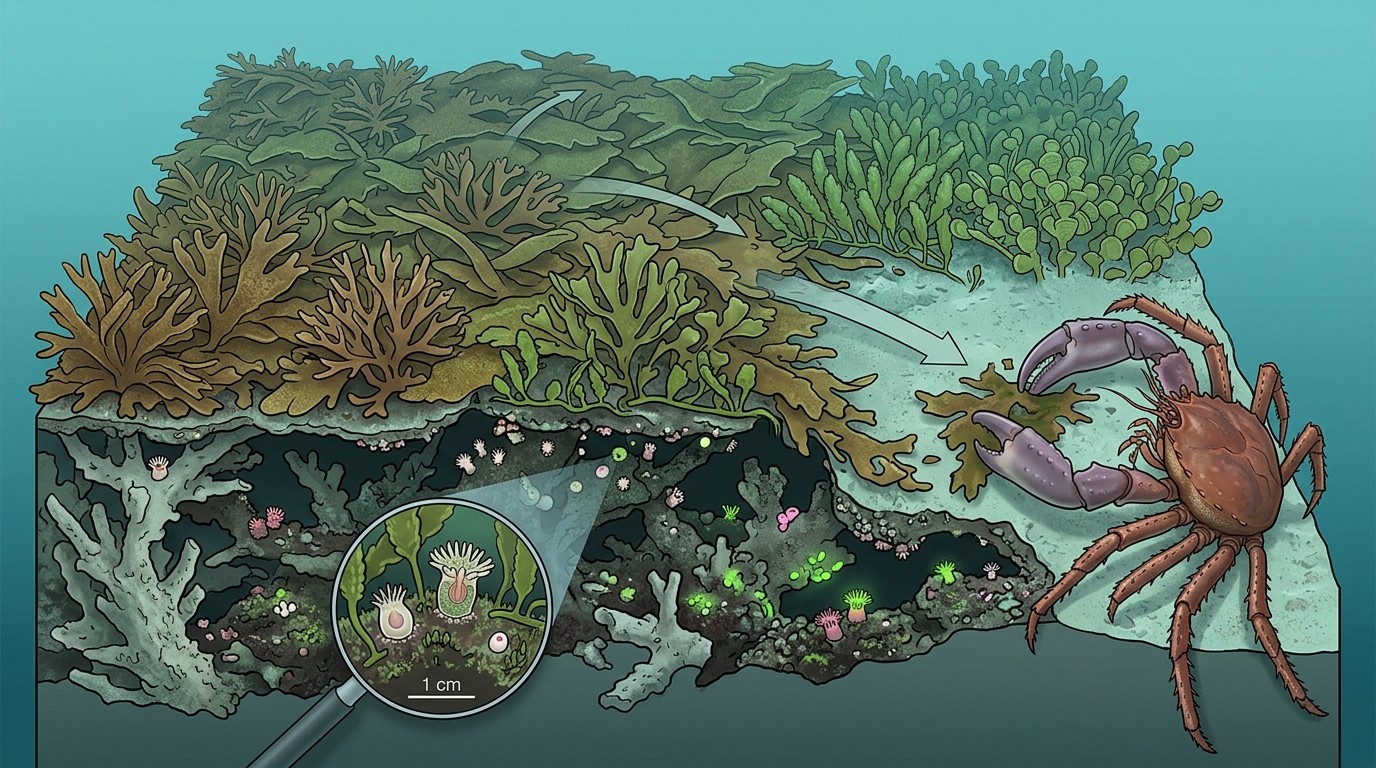
Macroalgae are a normal part of healthy marine ecosystems. The problem begins when coral cover declines and grazing animals are lost. Algae can then spread across the reef faster than corals can recover, creating an alternative ecosystem state in which seaweed is the dominant bottom cover.
Dense algae can compete with corals for space, reduce the amount of light reaching coral tissue, inhibit larval settlement, and lower the survival and growth of newly established corals. A 2024 review of Caribbean reef restoration explains that transplanting coral fragments alone may not be enough when macroalgae remain abundant. The review identifies herbivore recovery, including the use of native crabs, as a complementary strategy.
This matters because restoration is not only about adding corals. A coral fragment placed onto a reef smothered by algae may have to compete for space, light, and chemical space at the same time. Clearing that competition gives restored corals a better chance to settle, survive, and eventually rebuild a more complex reef community.
The strategy is especially relevant in places such as the Florida Keys. As Florida Keys reef restoration projects work to protect a vulnerable barrier reef, managers are looking for ways to address both coral loss and the algal overgrowth that can follow it.
What Is the Caribbean King Crab?
A large, mostly algae-eating native grazer
The Caribbean king crab is a large spider crab native to the Caribbean Sea, the Gulf of Mexico, and the tropical and subtropical western Atlantic. It lives in crevice-rich habitats, including coral reefs from shallow water to more than 200 meters deep. Older scientific sources may list it under the name Mithrax spinosissimus, while Maguimithrax spinosissimus is the currently used name.
It is the largest brachyuran crab in the western Atlantic. Large males can exceed 3 kilograms and have carapace widths greater than 190 millimeters, although more typical adults are considerably smaller. Its broad, spiny shell and powerful claws help it move through reef crevices where it shelters during the day and forage more actively at night.
Although Caribbean king crabs are omnivores, macroalgae and algal turf make up most of their diet. They consume a range of seaweeds, including some physically and chemically defended forms that many fish grazers avoid. They also eat small benthic animals, which can provide additional nutrients and support growth.
The important distinction is between eating capacity and ecosystem-scale effect. Research cited in a 2024 review found that Caribbean king crabs consume more algae per gram of body mass than nearly all Caribbean parrotfishes and can graze faster than sea urchins. Yet their natural densities are very low, often estimated at only 0.005 to 0.01 crabs per square meter. In other words, a few crabs can do a great deal of local work, but a healthy reef needs enough of them to make a broader difference.
What the Florida Field Experiments Found
The strongest evidence so far comes from experiments in the Florida Keys published by Angelo Spadaro and Mark Butler in Current Biology in 2021. The researchers transplanted Caribbean king crabs onto patch reefs and monitored the results for a year. The experiments included 24 reefs, each measuring about 10 to 20 square meters, at two locations roughly 15 kilometers apart.
The study by Spadaro and Butler reported several striking outcomes:
| What researchers measured | Observed result after crab stocking |
|---|---|
| Macroalgae cover | Crabs reduced seaweed cover by 50% to 80%. |
| Coral recruitment | Recruitment increased threefold to fivefold. |
| Reef-fish community | Fish abundance and diversity increased. |
| Manual algae removal | Hand scrubbing helped temporarily, but the effect faded unless grazers maintained the cleared area. |
These results suggest that restoration is not simply a contest between a coral transplant and a weed. A persistent grazer may help keep the cleared space from returning immediately to an algae-dominated state. The fish response is also significant because reef fishes and crabs are part of the same food web: changing the abundance of one group can alter how the rest of the ecosystem functions.
The results are promising, but they are not a universal guarantee. The experiments were small, focused on patch reefs, and followed for one year. They do not mean that every reef will experience a 50% to 80% reduction in algae or a fivefold increase in coral recruitment. They show that, under the conditions tested, the crabs can help reverse a key part of reef degradation.
How Restoration Programs Are Raising and Stocking Crabs
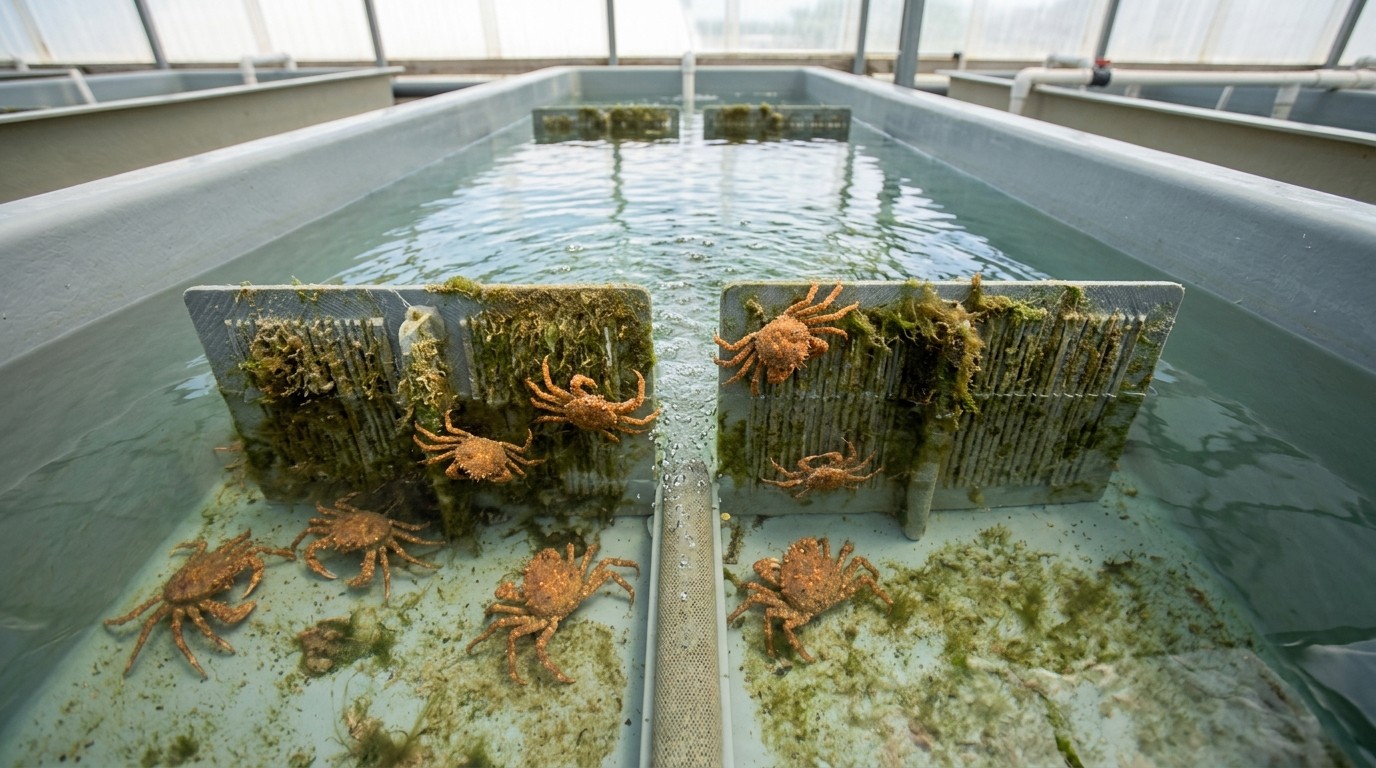
The next challenge is supply. A restoration program cannot protect large reefs if it depends on removing large numbers of wild crabs from already stressed habitats. That is why researchers are studying mariculture, or controlled production, for the species.
Caribbean king crabs have several biological features that make them plausible candidates for this work. Their larval period is short and non-feeding, they grow quickly on a mostly herbivorous diet, and juveniles stocked at more than about 30 millimeters of carapace width can show relatively high survival in experimental conditions. A review of the restoration literature reports one post-stocking survival estimate of around 25% after a year. That figure is a study-specific estimate rather than a promise, but it illustrates why survival, size, timing, and habitat all matter.
Florida’s mariculture support project is exploring the use of saltwater quarries as semi-wild production areas. The idea is to raise or maintain crabs in a controlled coastal system, then periodically move them to nearby reefs. Researchers are also studying population genetics to determine whether quarry animals are suitable sources for wild releases.
This is early-stage restoration science, not a settled commercial industry. The review of Caribbean reef herbivores describes the scaling of crab and urchin mariculture as one of the largest unresolved logistical challenges. Better production methods are only useful if the animals survive, reproduce, fit the local ecosystem, and provide the grazing pressure the reef needs.
What the Crab Cannot Solve Alone
Caribbean king crabs address a specific part of reef decline: excessive algal competition. They do not remove the underlying causes of coral stress, such as ocean warming, disease, pollution, nutrient runoff, or habitat damage. A reef can be full of grazing crabs and still fail if water temperatures remain too high or coral recruits cannot establish.
That is why coral aquaculture programs remain an important part of restoration. Coral nurseries can provide new colonies, genetic diversity, and carefully selected material for transplantation. Crab grazing can potentially improve the conditions those corals face when they return to the reef.
The most promising approach is therefore a combined one:
- Protect or restore important grazing species such as parrotfish and sea urchins.
- Reduce pollution, sediment, and nutrient inputs that encourage excessive algae growth.
- Use coral transplantation and natural recruitment to rebuild coral populations.
- Add native invertebrate grazers where algal competition is limiting recovery.
- Monitor survival, reproduction, coral recruitment, and ecosystem function over many years.
In practical terms, a crab is not a replacement for coral. It is closer to a maintenance worker: useful because it performs an ecological function that can determine whether other restoration efforts have time to succeed.
Climate Change Adds a Complication
Some early-life tolerance, not climate-proofing
An earlier laboratory study on larvae and young Caribbean king crabs found evidence of tolerance to some conditions associated with climate change. Researchers compared 28°C and 31°C temperatures and tested normal and reduced seawater pH. When the two stressors were combined, larval survival to the megalopa stage was 13.5% lower than in the control treatment. The independent temperature and pH treatments did not produce a statistically significant reduction in larval survival, and juvenile morphology did not differ among treatments.
The authors of an earlier study on early-life tolerance concluded that juvenile crabs showed some physiological tolerance. That is encouraging for restoration planning, but it is not evidence that the species is immune to a warming ocean. The experiment was short, used laboratory conditions, and did not measure every aspect of long-term fitness.
A newer study raises a warning about larval dispersal
More recent results show why researchers are not treating the crabs as a simple solution. In a 2026 experiment, a study of larval swimming behavior compared crabs raised at 28°C with those raised at 32°C. Larvae in the 32°C treatment were nearly three times more likely to die, moved more lethargically, and showed a changed vertical-swimming response. They also swam downward faster, which could alter how currents carry them and reduce their chances of reaching suitable settlement habitat.
That does not prove that every released crab population will fail. It does show that adults clearing algae are only one part of the task. If stocked crabs cannot survive their larval phase, disperse, and produce offspring, the restoration benefit may not persist.
Genetic Safeguards Will Matter
Moving native animals between habitats can help conservation, but only if managers understand how populations are connected. A 2026 genomic analysis used 3,677 genetic markers from 82 Caribbean king crabs sampled from wild and quarry populations. The researchers found that quarry populations retained genomic diversity comparable to wild populations and detected no clear overall genomic structure among the sampled sites. They also found signals of movement between locations, although one quarry showed a pattern that could indicate local adaptation.
The findings from the 2026 genomic analysis support the possibility of quarry-based mariculture, but they do not justify unrestricted movement of crabs. Managers still need to consider the source population, local adaptation, genetic diversity, disease risk, and the ecological role of the release site.
Ecological models also projected the Florida Keys as potentially suitable habitat for the species through 2100 under several climate scenarios. That is useful for long-term planning, but it is a model projection, not a guarantee. Warming patterns, local currents, habitat change, and the success of restoration releases could all alter the outcome.
A cautious restoration program would therefore use genetically appropriate local sources where possible, monitor released crabs and their offspring, and measure whether the population contributes to reef recovery rather than simply surviving in the short term.
What to Watch Next
Several questions will determine whether Caribbean king crabs become a dependable reef-restoration tool. Researchers need longer field trials that follow crabs, corals, fish, and algae through marine heatwaves and multiple spawning seasons. They also need to learn whether hatchery-reared crabs can reproduce successfully in the wild, whether they can be produced at a scale large enough to matter, and whether different reef habitats require different stocking densities.
The work also needs to measure more than the number of crabs released. The most important outcomes are whether macroalgae remain under control, whether coral recruitment and outplant survival rise, whether reef-fish communities recover, and whether the intervention remains stable without constant human intervention.
If those outcomes hold up, the “reef gardener” description may be more than a catchy nickname. Caribbean king crabs may become a useful tool for restoring an ecological process that many degraded reefs have lost: the steady control of algae by native grazers.
The Bottom Line
Caribbean king crabs are not an all-purpose answer to coral decline. They are promising native grazers that can reduce macroalgae, create space for coral recruitment, and support a more complete restoration strategy. The best evidence so far comes from controlled Florida experiments, while newer research highlights the need to protect genetic diversity and account for heat-stressed larvae.
For coral restoration to work, reefs may need more than coral fragments. They may also need the missing workers that keep algae from taking over the surface. If future trials show that these crabs can be produced responsibly, released selectively, and sustained over time, their role as reef “gardeners” could become part of a more effective restoration toolkit.


