
Scaling an artificial intelligence model usually presents a stark hardware trade-off: making a neural network deeper requires stacking more physical layers, which multiplies parameter counts, memory bandwidth demands, and serving costs. With the release of the GLM-5.4 Loop Transformer, Z.ai takes a different engineering path. Instead of adding hundreds of billions of new weights, the architecture takes a 28-layer block from its existing ~750B scale model and runs data through those shared layers twice during every forward pass.
According to Z.ai, this recurrent passes approach allows a ~750B scale foundation to reach intelligence levels comparable to 2T-3T parameter models while actually shrinking average chain-of-thought output lengths by 10% to 14%. The announcement builds on the company’s recent focus on architectural efficiency following GLM-5.3’s post-training gains, shifting the bottleneck from raw parameter bloat to how effectively a network reuses the weights it already has.
What Z.ai Actually Released on November 23
Released on November 23, 2026, GLM-5.4 is Z.ai’s newest flagship system and the company’s first commercial deployment built on a Loop Transformer architecture. The engineering team adapted an existing ~750B-scale base model through continued training, looping 28 shared layers across two iterations.
Per the GLM-5.4 developer documentation, the model handles a 1M context window and generates up to 128K output tokens in a single run. It accepts multimodal inputs across video, images, text, and files, while returning text outputs tailored for complex software engineering, mathematical problem solving, and long-horizon agent workflows. Production capabilities include native thinking mode, function calling, context caching, and structured JSON output.
| Specification | GLM-5.4 Details |
|---|---|
| Base Scale | ~750B parameter scale (per Z.ai) |
| Loop Architecture | 28 shared layers executed across 2 iterations |
| Performance Tier Claim | Comparable to 2T-3T parameter models (Z.ai claim) |
| Context Window | 1M tokens |
| Maximum Output | 128K tokens |
| Supported Inputs | Video, Image, Text, File |
| Supported Output | Text (with structured JSON and function calling) |
| Streaming Throughput | Up to 200 tokens/s off-peak (70-80 tokens/s at peak) |
| Current Availability | Live for GLM Coding Plan users (1.5x GLM-5.3 weekly quota) |
| General Model API | Pending completion of security assessment |
Access is currently split. The model is live today for all subscribers on the GLM Coding Plan, where users on weekly quota tiers receive 1.5 times the quota previously allocated for GLM-5.3. For teams looking to integrate the system via standard endpoints, Z.ai notes that the general Model API will become available once the model completes its required security assessment.
Loop Transformer vs Standard Transformer
To understand why looping changes the economics of large language models, look at how a standard Transformer processes information. In a conventional feed-forward stack, each token passes through Layer 1, then Layer 2, and continues sequentially until the final output layer. Because each layer runs exactly once per forward pass, computational depth is strictly tied to physical parameter count. If engineers want a 100-layer network to perform deeper multi-step composition, they must store and load 100 distinct sets of layer weights in high-bandwidth GPU memory.
The idea of sharing weights across depth is not brand new. As Z.ai notes in its technical announcement blog, the 2018 Universal Transformer paper originally proposed weight-shared depth as a way to give networks recurrent computational steps. However, in modern large-scale evaluations, a looped model trained from scratch still lags behind an unshared model when both are given the exact same pre-training compute budget. Unique weights simply capture more diverse representations during initial training.
Z.ai bypassed that historical trap by separating knowledge acquisition from iterative depth. Instead of training a small looped network from zero, the team started with the massive GLM-5 base model (~750B scale) that had already absorbed broad world knowledge during standard pre-training. They then took a 28-layer block of that foundation and adapted it via continued training to run two consecutive iterations, allowing the network to refine its internal hidden states before emitting a token.
| Architectural Dimension | Standard Transformer | GLM-5.4 Loop Transformer |
|---|---|---|
| Layer Execution | Each layer runs once per forward pass | Shared 28-layer block runs across 2 iterations, refining hidden states |
| Scaling Mechanism | Deeper compute requires adding more physical parameters | Increases effective computational depth without adding new parameters |
| KV Cache Footprint | Full Key-Value cache stored independently for every executed layer | Hybrid KV cache (second pass reuses sparse KV from pass one plus sliding window) |
| Reasoning Allocation | Multi-step thinking relies heavily on explicit output tokens | Shifts part of reasoning into implicit loop depth inside hidden states |
| Output Token Volume | Baseline chain-of-thought length | 10% to 14% shorter average outputs on GPQA-Diamond and MMLU-Pro |
Before scaling this design to ~750B parameters, Z.ai validated the mechanism across 1B, 4B, 30B, and 750B base models. In a controlled 30B iso-parameter test, where the looped model kept identical parameter counts and used only about 10% more training compute via continued training, the looped architecture delivered clear gains over its unlooped baseline. Secondary writeups of Z.ai’s ablation report AIME25 rising from 19.17 to 30.42, GPQA-Diamond from 47.58 to 56.26, and AA-LCR from 40.33 to 47.67. According to Z.ai, the largest improvements emerged in mathematics, scientific reasoning, and long-context tracking, domains where iterative state refinement directly helps resolve multi-hop dependencies.
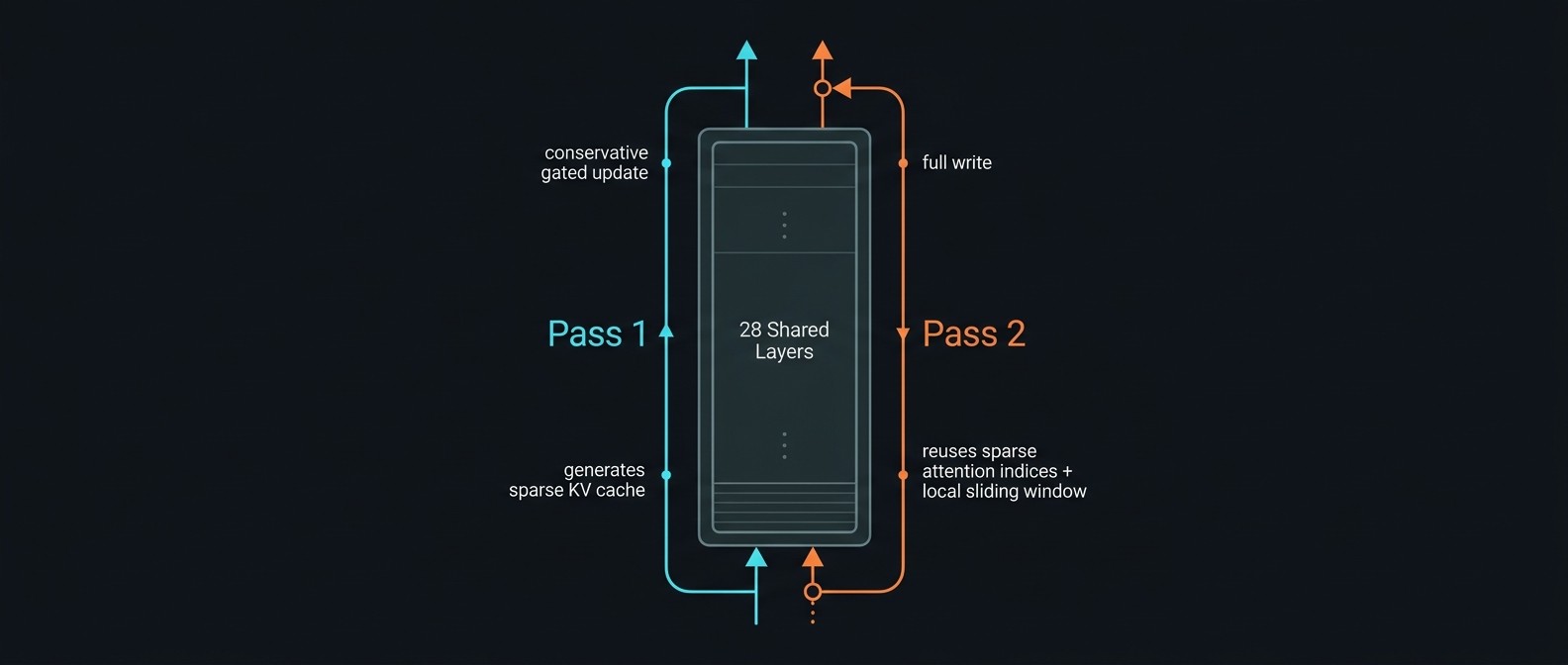
The Three Tricks That Make 28 Layers Looped Twice Work at 750B Scale
Naively looping a 28-layer block twice inside a ~750B scale model creates immediate systems bottlenecks. First, feeding an intermediate output back into layers configured for earlier representations can overwrite useful features or destabilize gradients. Second, running those layers a second time across a 1M token context window normally doubles the Key-Value (KV) memory cache and doubles the cost of attention indexing. Z.ai solved these constraints with three specific architectural modifications.
- Gated Progressive Updates: When the 28-layer block executes twice, the network cannot treat both passes identically. Z.ai implemented independent per-token gates for each iteration to throttle how strongly new computations overwrite the existing residual stream. During the first pass, the model applies conservative, small gates that make tentative adjustments to the hidden states, though the dynamic routing allows harder tokens to write more aggressively right away. On the second pass, the gates open for full writes, committing the refined representation once context has stabilized.
- Hybrid KV Cache: In long-context serving, memory capacity is dominated by the KV cache, which stores past token representations so the model does not have to recalculate them. If two loop iterations stored two complete 1M-token KV caches across 28 layers, deployment memory costs would surge. GLM-5.4 uses a Hybrid KV Cache where the second loop reuses the sparse KV cache generated during the first pass and combines it with its own compact local sliding window. Consequently, the extra loop costs only one additional sliding window of memory, keeping deployment cost increases over GLM-5.3 under control even at the full 1M context limit.
- Sparse Attention Index Reuse: Modern long-context models rely on sparse attention indexers to identify which distant tokens actually matter for the current calculation. Searching across a million tokens twice per step would bottleneck latency. In GLM-5.4, the second loop directly reuses the indexer attention indices calculated during the first pass. Z.ai reports that this introduces zero indexing overhead on the second iteration while maintaining accuracy nearly identical to recomputing the indices from scratch.
Together, these three mechanisms decouple effective computational depth from memory footprint. The GPU cluster keeps the same 28-layer weights resident in fast memory and reuses the heavy long-range attention lookups, paying primarily for the arithmetic of the second forward pass and a tiny sliding-window cache.
Why Fewer Thinking Tokens Means Lower Cost
Since the arrival of reasoning-focused models, the hidden tax on developers has been chain-of-thought bloat. Standard reasoning models essentially think out loud: to solve a hard logic or coding challenge, they emit thousands of intermediate thinking tokens before producing a final answer. Because every generated token requires a full autoregressive step limited by memory bandwidth, long chains of thought drive up both wall-clock latency and API bills.
The GLM-5.4 Loop Transformer alters where that intermediate reasoning happens. By cycling representations through the 28-layer block twice before emitting a single word, the model shifts multi-step deduction from explicit output tokens into implicit loop depth.
According to Z.ai’s internal evaluations on the GPQA-Diamond and MMLU-Pro benchmarks, this implicit depth reduces average output length by 10% to 14% due to shorter chains of thought, even as accuracy rises. For engineering teams running high-volume agent loops, generating 10% to 14% fewer tokens directly compounds with raw generation speed.
On the serving side, Z.ai paired the Hybrid KV Cache and index reuse with custom fused kernels optimized for the dual-pass execution graph. As a result, GLM-5.4 delivers streaming throughput of up to 200 tokens per second during off-peak hours, settling to 70 to 80 tokens per second during peak traffic. For developers who routinely balance heavy reasoning models against lighter, high-speed options like GLM-5.3-Flash, trimming token volume while holding off-peak speeds near 200 tokens per second makes flagship-tier thinking far more practical for interactive coding tools.
Generalized Coding: When Code Becomes Video, Games, and Machines
Alongside the architectural shift, Z.ai uses the GLM-5.4 release to push a paradigm it calls Generalized Coding. The core premise is that software code is no longer just an end product for building web apps or backend scripts. Instead, code acts as a universal deterministic intermediate language for synthesizing video, physical hardware designs, and interactive 3D worlds.

In Z.ai’s release demonstrations, GLM-5.4 shows how deeper implicit reasoning helps keep complex, multi-file structural geometry and timing logic coherent across three distinct domains:
- Self-Narrated Music Video Generation: Rather than relying on diffusion pixel guessing, the model generated a complete, self-narrated music video titled Hello World entirely through code. By programming the audio synchronization, visual transitions, typography, and narrative timing programmatically, every frame remains deterministic and editable.
- 6-Axis Robotic Arm CAD Modeling: Moving into physical manufacturing, GLM-5.4 wrote parametric Python scripts to construct a functional 6-axis robotic arm inside FreeCAD. Programming mechanical computer-aided design (CAD) without visual feedback requires a model to hold three-dimensional coordinate transforms, joint tolerances, and part hierarchies in working memory across thousands of lines of script.
- Interactive 3D Macro Bird-Watching: The model built an interactive 3D macro bird-watching experience from scratch without importing pre-made 3D studio assets. It synthesized the birds, feathers, lighting, and movement using pure mathematical geometry and custom OpenGL Shading Language (GLSL) shaders.
These demonstrations highlight why long-context stability and multi-step spatial reasoning matter for coding agents. Z.ai also lists complete game builds among the Generalized Coding demos. Writing a custom GLSL shader or a multi-joint FreeCAD assembly requires solving nested math equations before outputting syntax, a workflow well suited to an architecture that refines its internal state twice per token.
Limits and Honest Caveats
While the engineering behind the Loop Transformer is substantive, developers evaluating GLM-5.4 should keep several practical caveats and unverified claims in mind.
First, the headline assertion that a ~750B scale model reaches intelligence comparable to 2T-3T parameter models comes directly from Z.ai’s release documentation. Because GLM-5.4 launched on November 23, 2026, independent third-party evaluations, blind arena leaderboards, and external enterprise audits have not yet verified where the model lands relative to competing frontier systems. Similarly, Z.ai describes the base as operating at the ~750B scale rather than publishing an audited layer-by-layer parameter manifest.
Second, the model has a documented behavioral quirk known as marathon thinking. In its official documentation, Z.ai candidly notes that GLM-5.4 tends to get caught in overly long marathon thinking loops on certain open-ended or deceptive prompts. Although the company points out that extended self-reflection pushes final accuracy well beyond what a standard parameter count would suggest, runaway reasoning chains can unexpectedly consume token quotas and increase latency when an agent gets stuck verifying edge cases.
Finally, deployment readiness is not yet uniform. While individual developers and teams on the GLM Coding Plan can test the model immediately with a 1.5x quota boost over GLM-5.3, production application builders waiting on the general Model API must wait until the pending security assessment concludes. Z.ai has not yet announced per-token API pricing or an open-weights release schedule for GLM-5.4. Trackers including BenchLM and CometAPI confirmed no Hugging Face repository, model card, or official pay-as-you-go pricing existed as of late November 2026.
Early independent testing adds practical context. Reviewer AICodeKing ran the KingBench 4 suite, as aggregated in a November 24 Codebumble analysis, and reported GLM-5.4 scoring 33.2 out of 60, ranking 7th overall and 1st among open-style models in that harness, compared with a 27.5 partial score for GLM-5.3. The same run took 431 minutes with 1,128 reasoning steps and roughly 1.04M tokens, versus 109 minutes and about 70,000 tokens for Gemini 4 Neon. Across effort settings the tester reported Low at 25.2, Medium at 24.1, High at 28.8, and Max at 31.8 (33.2 with a rerun), with High and Max timing out at 180 seconds on small tasks while still reasoning. These are single-tester findings from one harness, not official benchmarks, but they reinforce the marathon-thinking warning.
Quota math carries the same caution. The 1.5x boost comes from lower Coding Plan credit multipliers, reported as 4.6 input, 1.1 cached, and 16 output per 10k units versus 6.9, 1.7, and 24 on GLM-5.3. Because output tokens carry the highest multiplier, a Max-effort session generating 200K output tokens instead of 100K can cost more than GLM-5.3 in the worked example (447.5 versus 436 credits). For routine edits, testers recommend setting reasoning effort explicitly rather than leaving the default Max, which risks timeouts and wasted output credits.
What Comes Next
GLM-5.4 serves as a live production proving ground for recurrent depth at frontier scale, and Z.ai indicates that two-pass looping is only the starting point. Right now, every token passes through the 28-layer loop twice, regardless of whether the model is predicting a simple punctuation mark or resolving a complex differential equation.
Looking ahead, Z.ai says its research team is actively exploring adaptive compute, a mechanism that dynamically assigns more loop iterations to harder tokens while letting easy tokens exit early, alongside scaling both the loop count and the underlying base model size. According to the company’s roadmap notes, lessons from GLM-5.4 are already feeding into a next, significantly larger flagship model that is coming soon.
Frequently Asked Questions
What is GLM-5.4?
GLM-5.4 is Z.ai’s flagship multimodal reasoning and coding model, released on November 23, 2026. It is the company’s first system built on a Loop Transformer architecture, adapting a ~750B scale base model to support a 1M token context window, 128K max output, and up to 200 tokens per second off-peak streaming.
How does a Loop Transformer differ from a standard Transformer?
In a standard Transformer, each network layer executes only once per forward pass, meaning deeper reasoning requires adding more physical parameters. In the GLM-5.4 Loop Transformer, a 28-layer block runs across two consecutive iterations using Gated Progressive Updates, a Hybrid KV Cache, and Sparse Attention Index Reuse. This refines internal representations twice per token and cuts average chain-of-thought output length by 10% to 14% on benchmarks like GPQA-Diamond and MMLU-Pro.
How can developers use GLM-5.4 today?
GLM-5.4 is available immediately to subscribers of the GLM Coding Plan, where weekly quota tiers receive 1.5 times the quota of GLM-5.3. General Model API access is not yet live and will launch once the system completes its required security assessment.
Is the 2T-3T parameter performance claim independently verified?
No. The statement that GLM-5.4 reaches intelligence levels comparable to 2T-3T parameter models is a vendor claim from Z.ai based on its internal benchmarks and iso-parameter scaling tests. Independent third-party benchmark verification is not yet available.


