
Adding solar panels to an electric car sounds simple until you look at the small surface area of a standard roof. Most vehicle roofs cannot hold enough cells to move a heavy battery more than a couple of miles a day. The DartSolar solar roof rack takes a practical mechanical approach to that limitation by sliding extra panels out while you park and tucking them flat before you drive away.
With orders now open at $1,350 per 500-watt unit, everyday EV drivers have a real aftermarket option to weigh against rival rooftop chargers and purpose-built solar cars. Whether the investment pays off depends on your daily mileage, where you park during daylight hours, and how much energy actually survives the transfer from roof panels to a portable battery and finally into your car.
What DartSolar Just Put on Sale
Los Angeles-based DartSolar is now taking orders for its expandable 500-watt solar roof rack designed for electric cars, trucks, vans, and RVs. According to the official DartSolar order page, each 500-watt unit costs $1,350 upfront, with a listed $113 per month payment option. Shipping is free within the United States and roughly $120 per unit internationally.
Units ordered today are scheduled to ship in mid-January, after the December 2026 pre-order batch, backed by a 30-day return window and a limited warranty. Early coverage in a November 2026 New Atlas report highlighted how the production design stepped up to a 500-watt modular rating that clamps directly onto existing crossbars without drilling.
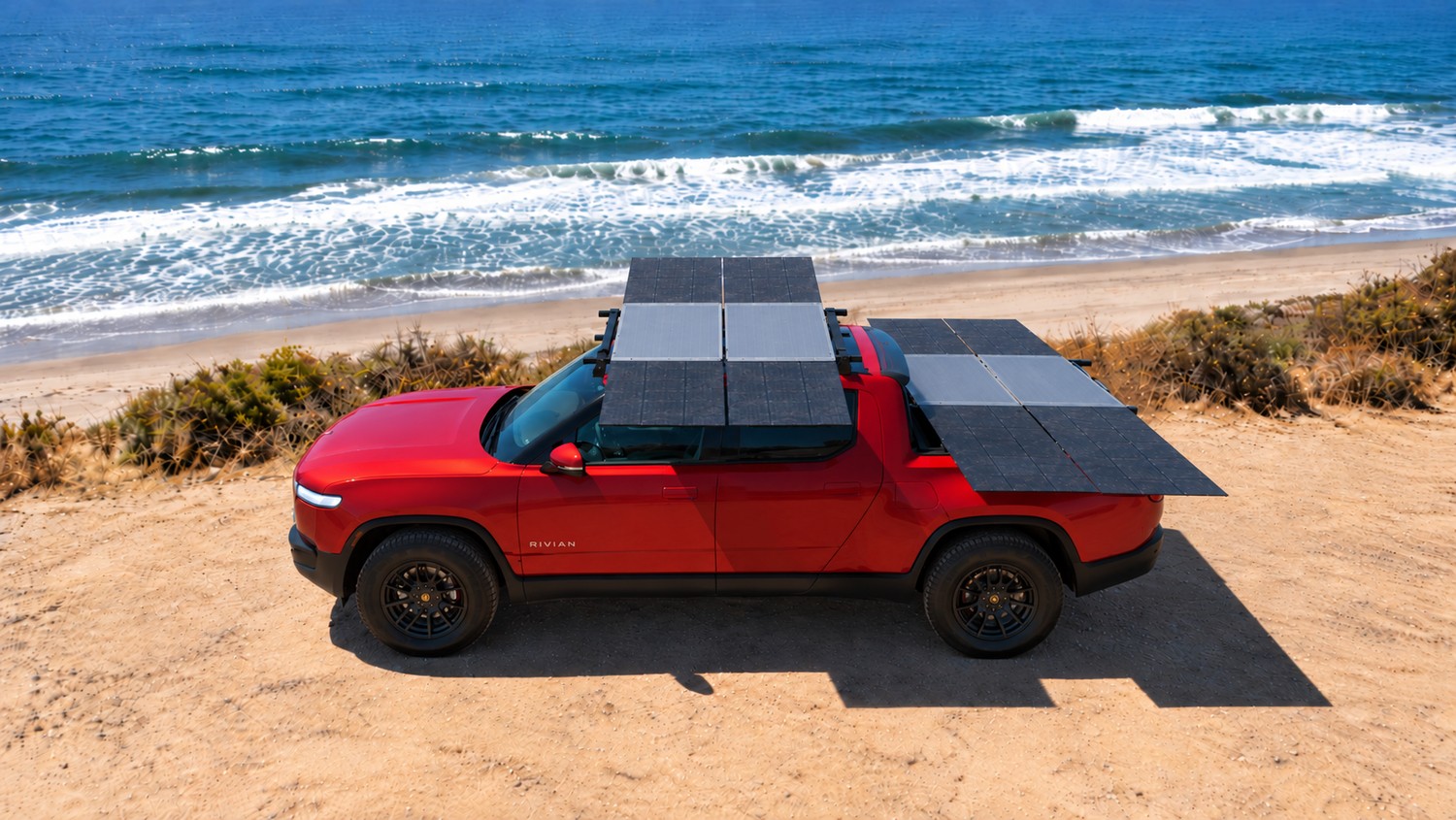
Two people can install the rack in minutes, and because the system is modular, owners can mount a single 500-watt unit on a compact sedan or link two to four units together for 1,000 to 2,000 watts on larger roofs. The whole assembly also detaches so you can set it on the ground at a campsite while keeping your vehicle parked in the shade.
How the Expandable Roof Rack Works
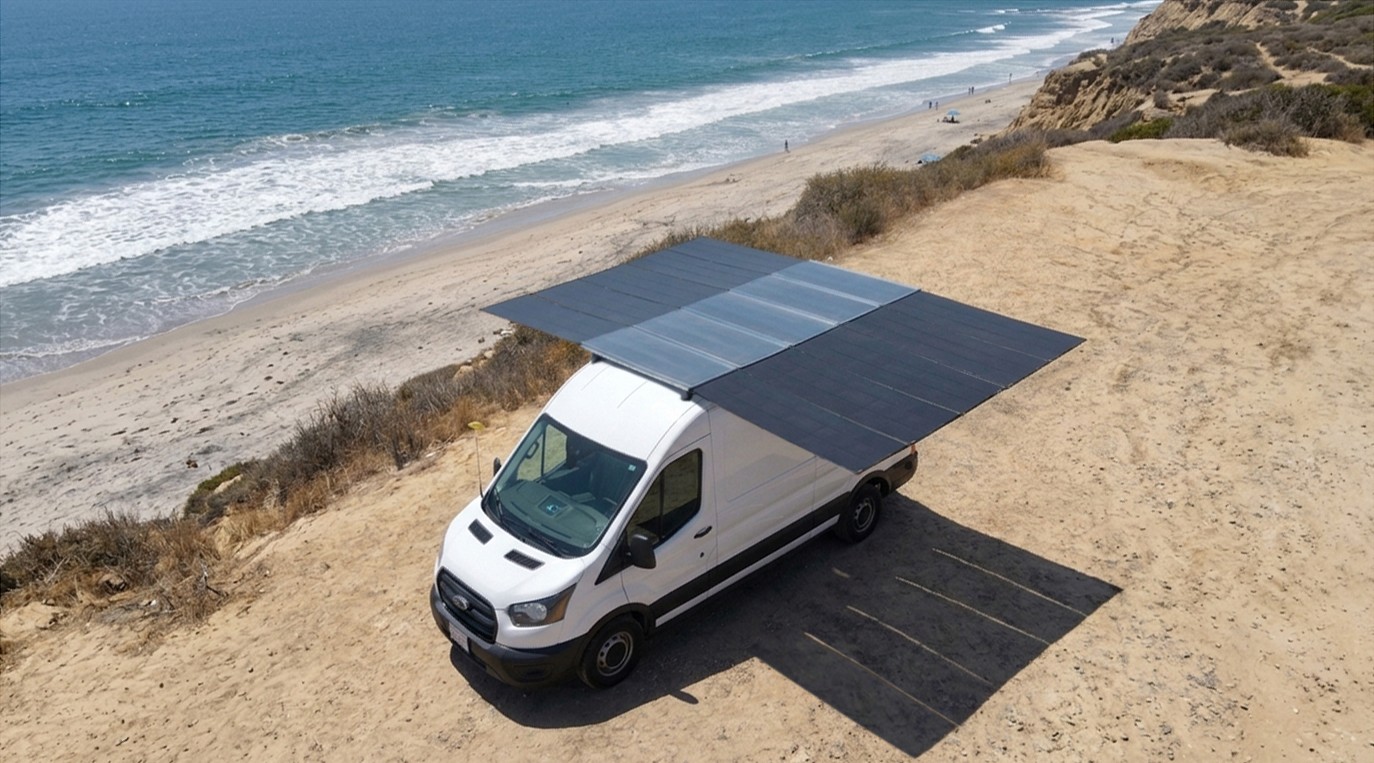
Each 500-watt DartSolar unit holds three 170-watt solar panels: one fixed top panel and two stowed panels that slide out in about 10 seconds using two fingers. Depending on how you mount the frame, the panels can expand either front-to-back or side-to-side. When closed for driving, a single rack measures 58 by 24 by 3 inches, with a 1.5-inch (3.8 cm) front edge facing the wind. Fully extended while parked, the three panels span roughly 14 feet (170.5 inches or 433 cm).
Unlike lightweight peel-and-stick flexible solar panels designed for permanent building rooftops, a vehicle rack has to survive highway winds, flying gravel, and constant vibration. As detailed on the DartSolar technical overview, the company built the frame for repairability and rough road conditions:
- Panel construction: Three 170-watt, 30-volt panels per unit, each measuring 54 by 23 inches and about 0.1 inches thick, built with half-cut 182 mm cells, fiberglass backing, and an ETFE coating.
- Frame and housing: A 3 mm aluminum frame paired with a 4 mm polycarbonate shell and extruded 6061-T6 aluminum telescope tubes, rated as water, hail, and rock proof.
- Serviceable components: UV-protected nylon, ASA, and TPU plastic parts, with open 3D-printable files available so owners can print replacement pieces at home.
- Electrical output: Terminates in a single standard XT60 solar plug, configurable via adapters for 30-volt parallel wiring (which keeps producing in partial shade) or 90-volt series wiring (for maximum output in full sun).
One critical detail for buyers is that the solar roof rack for EV charging does not plug directly into your vehicle’s charging port, and the required portable power station is not included in the $1,350 price. The panels feed DC power through the XT60 cable into a separate battery inside your trunk or cabin, such as an EcoFlow, Jackery, Bluetti, Anker, or Pecron unit. DartSolar states it has reviewed 169 portable power stations for compatibility. You then plug your EV’s standard charging cord into the power station’s AC outlet to transfer the stored energy into the car.
Real Math: Parked vs. Driving Energy Yield
Before buying a roof rack solar EV charger, you need to separate raw panel wattage from actual miles added to your dashboard. Every solar-to-EV setup loses energy at two bottlenecks: first when DC power moves from the roof panels into the portable power station, and second when the power station inverts that energy to AC power for the car’s onboard charger.
DartSolar’s own sunny summer tests in Los Angeles show exactly how that loss chain plays out in practice. On a bright August day in Los Angeles, a single 500-watt unit expanded while parked generates about 3,000 watt-hours (3 kWh) of raw solar electricity. Two units (1,000 watts) generate roughly 6,000 watt-hours. Out of those 6,000 watt-hours made on the roof, about 5,000 watt-hours reach the portable power unit, and roughly 3,500 watt-hours actually land in the EV traction battery.
A similar July test in Los Angeles with a two-unit, 1,000-watt setup produced roughly 6.2 kWh at the panels, stored about 5.1 kWh in the power unit, and delivered around 3.6 kWh into the EV battery. At an assumed vehicle efficiency of 250 watt-hours per mile (4 miles per kWh, typical for an aerodynamic sedan like a Tesla Model 3 in mild weather), 3.6 kWh translates to about 14 miles of driving range.
Then comes the one-third driving rule. Because the slide-out panels must be retracted before the car moves, only the single top panel remains exposed to the sun on the road. Charging while driving cuts output to roughly one-third of the expanded total, and clouds, winter sun angles, or tree shade reduce daily yields further.
How Many Units Do You Need?
Scaling from a single 500-watt rack to a four-unit, 2,000-watt array multiplies both your daily range and your hardware cost. The table below outlines DartSolar’s reported daily yield on a sunny summer day in Los Angeles with all panels fully expanded while parked.
| Solar Power | Units | Hardware Cost (Rack Only) | Energy Made per Day | Energy Stored in Power Unit | Estimated EV Range per Day |
|---|---|---|---|---|---|
| 500W | 1 | $1,350 | ~3,000 Wh | ~2,500 Wh | 6 to 7 miles |
| 1,000W | 2 | $2,700 | ~6,000 Wh | ~5,000 Wh | 12 to 15 miles |
| 1,500W | 3 | $4,050 | ~9,000 Wh | ~7,500 Wh | 18 to 22 miles |
| 2,000W | 4 | $5,400 | ~12,000 Wh | ~10,000 Wh | 24 to 30 miles |
Note that all range figures in the company’s testing assume 250 watt-hours per mile after conversion losses between the separate power station and the vehicle. Winter days, overcast skies, or keeping the panels closed while driving will lower these totals significantly, and buyers must still budget for a portable power station large enough to hold 2.5 to 10 kWh of daily charge.
DartSolar vs. GoSun vs. Aptera
Drivers shopping for solar-assisted mobility generally compare three very different paths: DartSolar’s modular 500-watt rack, the unfolding GoSun EV Solar Charger, or a purpose-built solar electric car like the Aptera. Each solves a different problem at a vastly different price point.
Based in Cincinnati, Ohio, GoSun builds a single folding array rated at roughly 1,200 watts when unfolded while parked and 200 watts when closed. As detailed in a Mark Green World technical review of the GoSun charger and a Core77 design profile, GoSun’s 70-pound box measures 46.75 by 48 by 5 inches closed and unfolds to roughly 245 inches long, packing an integrated 1,500-watt-hour lithium iron phosphate (LFP) buffer battery with 110V AC, 12V DC, and USB outputs for an early-bird price of around $2,999 (with a $100 refundable deposit, and widely reported between $3,000 and $4,000 at full retail).
Aptera approaches solar driving from the opposite angle in Carlsbad, California. Rather than strapping panels onto a heavy conventional car, Aptera integrates roughly 700 watts of solar cells directly into a three-wheeled aerodynamic body designed to use just 100 watt-hours per mile. Following an Aptera customer build announcement on November 19, 2026, and independent Electrek test coverage noting that TUV Rheinland measured 4.23 to 4.75 kWh per day delivered to the battery in August 2026 Carlsbad sun, our recent look at how Aptera built its first customer solar EV shows why hitting up to 40 solar miles a day requires ultra-low vehicle energy consumption.
| System | Solar Output | Claimed Solar Range per Day | System Price | Roof Weight | What You Need |
|---|---|---|---|---|---|
| DartSolar (1 to 4 Units) | 500W per unit (up to 2,000W with 4 units) | 6 to 7 miles per unit (24 to 30 miles with 4 units) | $1,350 per 500W unit ($5,400 for 4 units; power station extra) | 45 lb (20 kg) per unit | Any EV with crossbars + separate portable power station |
| GoSun EV Solar Charger | ~1,200W open (200W closed) | 10 to 20 miles (up to 30 miles peak) | ~2,999 early-bird (widely reported ~3,000 to $4,000 full) | ~70 lb (32 kg) | Any vehicle with roof rack (1,500 Wh LFP buffer battery included) |
| Aptera Solar EV | ~700W body-integrated | Up to ~40 miles (at ~100 Wh/mile vehicle efficiency) | ~40,000 targeted (400-mile Launch Edition vehicle) | Integrated into vehicle body | Full three-wheeled vehicle purchase (deliveries targeted early 2027 subject to financing) |
Weight, Drag, and Practical Caveats
Strapping hardware to the roof of an electric vehicle always introduces trade-offs. Even though DartSolar kept the leading edge down to 1.5 inches (3.8 cm) and tested the rack at 100 mph (160 km/h) alongside road-track abuse and 10,000-cycle fatigue tests, any roof attachment adds mass and alters airflow.
- Added weight: Each 500-watt unit weighs 45 pounds (20 kg). A single rack is easy for standard crossbars to handle, but linking four units for a 2,000-watt truck or van setup puts 180 pounds on the roof before counting your portable power station inside the cabin.
- Efficiency baseline: DartSolar’s 6 to 7 miles per unit range estimate assumes your EV uses 250 watt-hours per mile. Heavier electric pickups, boxy vans, or cars driving at fast highway speeds often consume 350 to 500 watt-hours per mile, which cuts the actual miles gained per kilowatt-hour by a third to a half.
- Highway aerodynamic drag: While independent wind-tunnel drag figures have not been published for the rack, external gear inevitably creates some wind resistance at highway speeds. As seen in off-grid solar EV camper towing tests, keeping rooftop and trailer profiles as low and narrow as possible is critical so highway drag does not eat up the solar energy you collect while parked.
- Weather and parking limits: You only get peak wattage when you park in direct, unobstructed sun and slide the panels out. Garage parkers, winter commuters in northern latitudes, and drivers in cloudy climates will collect far less than the Los Angeles summer benchmark.
- Cabin shade bonus: On the upside, the company notes that shading the glass roof and metal cabin with an overhead solar array can keep interior temperatures up to 15 degrees cooler while parked in the summer sun, reducing initial air-conditioning draw when you start driving.
Who Should Buy a Solar Panel Roof Rack for an EV?
A solar panel roof rack for EV charging is not a replacement for a home Level 2 wall box or public fast chargers on road trips. However, it solves real problems for three specific groups of drivers:
- Open-lot commuters without home charging: Apartment renters who park in an uncovered workplace lot for eight hours a day in sunny states can use a single 500-watt ($1,350) or dual 1,000-watt ($2,700) setup to cover a 6-to-15-mile daily commute while simultaneously owning a backup power system for home outages.
- Overlanders and weekend campers: If you already carry a 2 kWh to 5 kWh EcoFlow, Jackery, or Bluetti power station to run induction cooktops, fridges, and tools off-grid, a 500-watt detachable roof rack feeds that battery far faster than small folding ground blankets and adds a few bonus miles back into your EV when camp packs up.
- Electric truck, van, and RV owners: Larger rooflines can accommodate three or four linked units (1,500 to 2,000 watts), turning a parked work van or camper into a self-contained 10 kWh daily microgrid in sunny weather.
Frequently Asked Questions
How many miles can a solar roof rack add per day?
On a sunny summer day in Los Angeles with the panels fully extended while parked, a single 500-watt DartSolar unit stores about 2,500 watt-hours in a power station and adds roughly 6 to 7 miles of range to an EV rated at 250 watt-hours per mile. Linking four units for 2,000 watts can store up to 10,000 watt-hours and add 24 to 30 miles per day under the same sunny conditions.
Can you charge your EV with the solar rack while driving?
Yes, the rack continues generating electricity while you drive, which feeds into your portable power station inside the vehicle. However, because the two slide-out panels must be closed before driving, the rack operates on its single top panel and produces roughly one-third of its expanded parked output.
Does the DartSolar rack fit any electric vehicle?
Yes. It mounts to standard rooftop crossbars on cars, trucks, vans, and RVs without drilling, and up to four units can be joined depending on your roof size and weight capacity.
Do you need a separate portable power station?
Yes. The station is required, sold separately, and compatible with brands including EcoFlow, Jackery, Bluetti, Anker, and Pecron.


