
An Artificial Intelligence (AI) factory can rise from a cleared desert or pasture lot in 12 to 36 months, yet the high-voltage transmission lines needed to feed its servers routinely take five to 15 years to plan, permit, and build. That structural timeline mismatch has turned electrical grid interconnection into the single tightest bottleneck in digital infrastructure. Rather than waiting up to seven years for a utility upgrade, developers are increasingly routing power directly behind the meter, pairing a solar powered data center architecture with multi-layered battery storage to shave daytime peaks, buffer violent server load swings, and bridge the queue gap.
Collocated solar and storage does not turn a hyperscale compute campus into a self-sufficient 24/7 energy island on its own. Instead, engineering teams treat on-site photovoltaics and high-rate batteries as a front-line shock absorber and capacity multiplier. By generating zero-fuel electricity during peak sun hours and smoothing millisecond GPU power spikes locally, behind the meter solar shrinks the maximum incoming utility feed a facility requires by 20% to 40%, opening access to constrained grid nodes that would otherwise reject a full-load application.
Why AI Factories Are Looking Behind the Meter
The appetite for compute power is scaling far faster than regional transmission operators can string new conductors. According to the International Energy Agency (IEA) 2025 Energy and AI report, global data center electricity consumption reached roughly 415 terawatt-hours (TWh) in 2024, accounting for about 1.5% of worldwide power demand. That figure climbed to an estimated 485 TWh in 2025 and is projected to more than double to approximately 945 TWh by 2030, adding unprecedented strain to data center energy and water grids across every major market.
When a developer applies for a new 100-megawatt (MW) or gigawatt-scale grid connection today, the request enters a heavily congested utility study process. An IEA Electricity 2026 grid analysis found that more than 2,500 gigawatts (GW) of renewable generation, storage, and large load projects are currently stalled in interconnection queues worldwide. At least 180 GW of advanced data center projects sat waiting in queues as of May 2026, putting roughly 20% of planned global data center buildout at serious risk of delay.
Across major US computing corridors, routine interconnection waits now stretch three to seven years, with Northern Virginia averaging closer to seven years for large service requests. In space-constrained international hubs such as Amsterdam and Tokyo, securing a 50 MW utility feed can take up to a decade. This bottleneck has pushed operators to explore unconventional siting, including offshore floating data centers and on-site generation.
In the United States, the Congressional Research Service (CRS) now categorizes behind the meter self-supply as a formal third power procurement path alongside standard retail utility connections and collocation at existing utility-scale power plants. Because utility-scale solar and battery assets can be permitted and constructed in one to five years, building on-site solar for AI data centers matches the one-to-three-year construction cadence of the server halls themselves.
What On-Site Solar Actually Does for an AI Load
Traditional cloud servers run relatively steady workloads, allowing facility engineers to size transformers and backup generators around predictable flat demand curves. Modern AI factories behave very differently. Training clusters pack thousands of high-density accelerators into tightly synchronized loops that ramp from idle to full draw and back down in fractions of a second.
According to the Nvidia and Open Compute Project (OCP) hardware roadmap, a single high-density AI server rack is projected to hit a 1 MW peak power draw by the Feynman architecture generation around 2028 to 2029, while swinging down to 300 kilowatts (kW) within milliseconds during communication pauses. Multiplied across hundreds of racks, those violent load transients send shockwaves backward into utility substations, threatening transformer longevity and grid voltage stability.
Deploying a behind the meter solar data center microgrid changes how the facility interacts with the local utility in three distinct ways:
- Incoming feed reduction: Placing dedicated energy storage directly alongside the load can cut the required incoming utility feed by 20% to 40%, according to power engineering data from Jabil. A campus that peaks at 100 MW of internal compute demand might only need a 60 MW to 80 MW continuous grid interconnection if on-site solar and batteries handle the upper peak envelope.
- Millisecond swing smoothing: High-rate local batteries absorb and inject power almost instantaneously, flattening out 300 kW to 1 MW rack-level oscillations before the local utility substation ever registers the disturbance.
- Daytime peak shaving and curtailment bridging: On-site solar panels carry the bulk of cooling and compute loads during high-tariff afternoon sun hours, while charged battery banks carry the facility through one-hour utility curtailment windows when regional grids face afternoon heatwaves.
What collocated solar does not do on its own is eliminate the grid connection or run an AI factory 24/7 without backup. Because solar output drops to zero overnight and falls sharply during winter cloud cover, a solar powered data center functions as a peak-shaving and queue-bridging machine rather than a disconnected island.
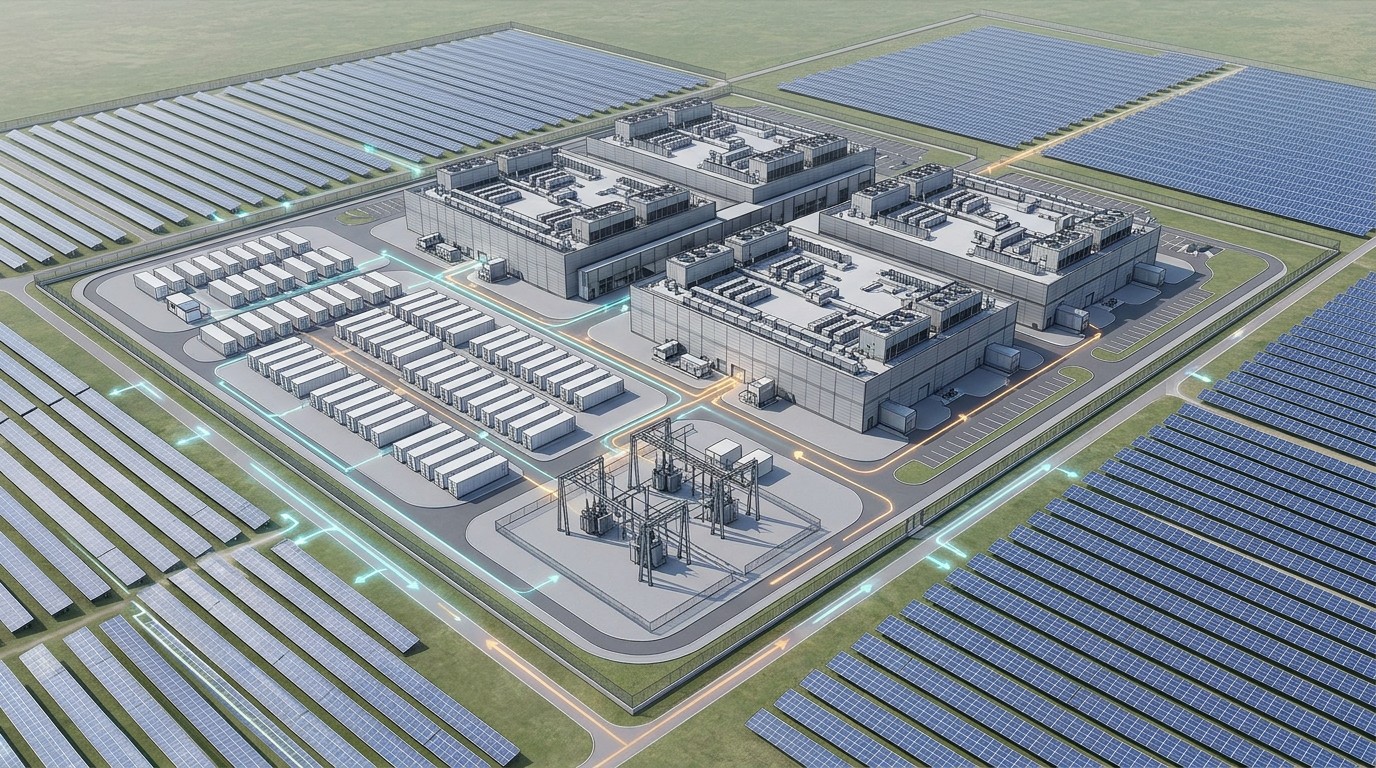
How Many Solar Panels Would It Take to Run a Data Center?
The physical constraint that governs every solar powered data center is land density. Server racks compress megawatts of demand into a few thousand square feet of floor space, whereas sunlight arrives thinly spread across the ground. Answering how many solar panels it takes to run a data center requires stepping through real utility-scale land math.
According to a National Renewable Energy Laboratory (NREL) land-use benchmark, utility-scale photovoltaic systems require between 5 and 10 acres of land per megawatt of alternating-current (AC) capacity, with single-axis tracking arrays averaging roughly 7 acres per MW. Using a benchmark 100 MW AI data center as a baseline reveals the footprint trade-offs:
- Direct 100 MW daytime peak match: Generating 100 MW of peak midday solar power on-site requires 500 to 1,000 acres of contiguous land (roughly 700 acres in a standard single-axis tracker layout). Depending on specific commercial module wattages (typically 500 to 650 watts per panel), a 100 MW array spans roughly 150,000 to 200,000 individual solar panels, though exact panel counts vary by module efficiency, row spacing, and local solar irradiance.
- Overbuilding for afternoon storage charging: If the facility aims to run at 100 MW during the day while simultaneously charging behind the meter battery banks to cover evening peak hours, the solar field must be overbuilt to two or three times the data center’s base load, expanding the land footprint to between 1,500 and 3,000 acres.
- Real-world desert proof at Moro Hub: Where bright sunlight and open land converge, full-scale deployment is already operating. In Dubai, Digital DEWA’s 100 MW Moro Hub facility operates inside the Mohammed bin Rashid Al Maktoum Solar Park. Recognized by Guinness World Records as the largest solar-powered data center at 33,311.11 square meters of facility space, Moro Hub draws 100% solar power by co-locating directly inside a sprawling desert solar complex.
The Storage Stack That Makes It Work
Connecting an intermittent solar array to an unforgiving AI server load works only if electrical energy can be buffered at multiple timescales simultaneously. US utility-scale battery energy storage systems (BESS) have scaled rapidly enough to make this architecture practical, reaching roughly 52 GW of installed capacity by mid-2026 after averaging 70% annual growth over the prior three years, according to US Energy Information Administration (EIA) figures.
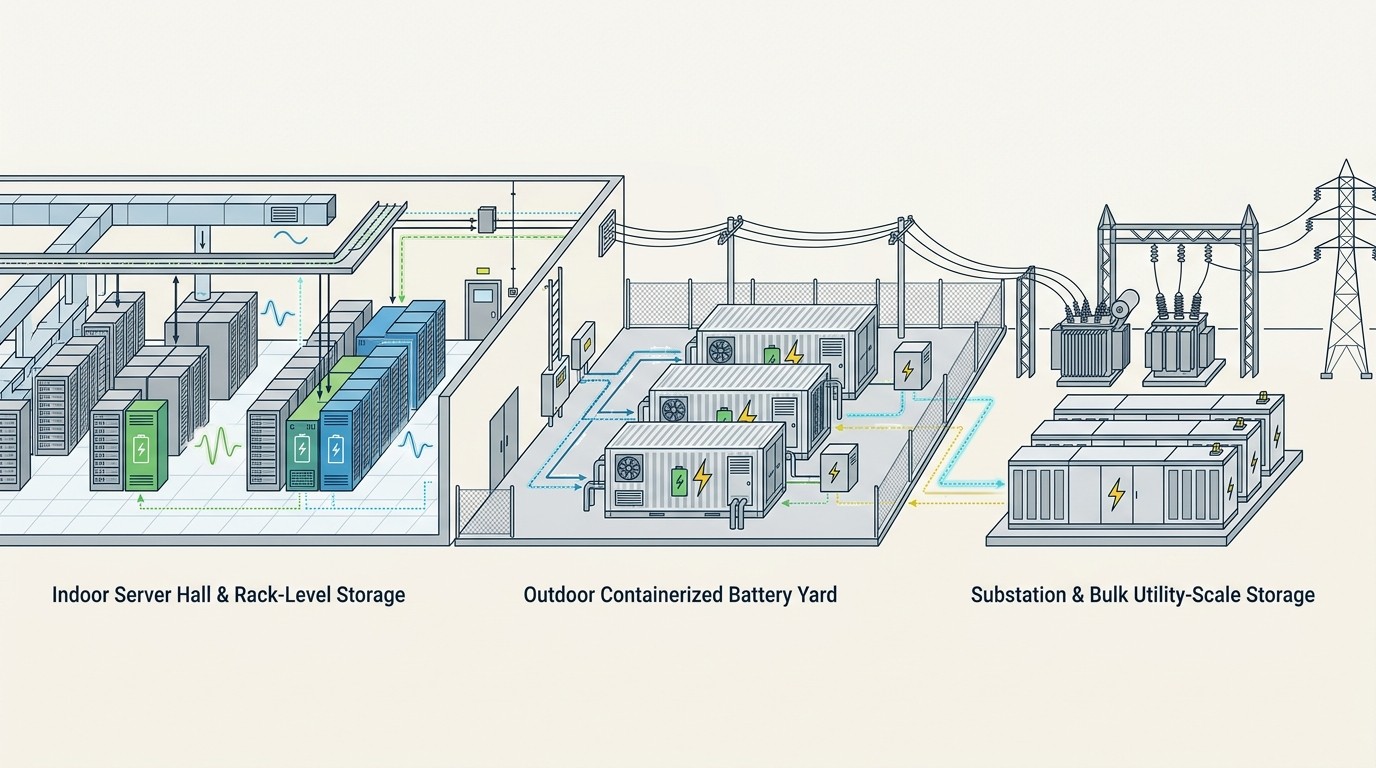
Rather than relying on a single monolithic battery yard, modern AI power engineering divides energy storage into a three-layer hierarchy, each tuned to a specific discharge speed and duration:
- Layer 1, rack-level millisecond buffering: Installed directly inside or adjacent to the server rows, this tier uses high-rate lithium iron phosphate (LFP) cells, sometimes paired with lithium titanate, sodium-ion batteries, or supercapacitors. Its sole job is absorbing violent millisecond power swings as GPU clusters jump between 300 kW and 1 MW, protecting upstream electrical switchgear.
- Layer 2, behind the meter curtailment bridging: Positioned in containerized yards on the data center campus, this layer typically provides around one hour of full-load duration using lithium-ion or sodium-ion chemistries. It absorbs midday solar surges and carries the data center through short utility curtailment events when the regional grid demands load shedding, while existing diesel gensets usually remain on-site as a final mechanical safety net.
- Layer 3, front of the meter multi-hour shifting: Located at the utility substation interface or within adjacent solar parks, this bulk tier uses eight-hour-plus lithium-ion banks or long-duration flow batteries to shift daytime solar generation into overnight compute hours.
Where Sodium-Ion Fits Against Lithium
Sodium-ion battery technology is attracting intense engineering interest for layers one and two of the data center stack. In fast-cycling pulse applications, sodium-ion cells can match the charge and discharge C-rates of high-rate LFP batteries while using abundant salt-derived feedstocks that may be cheaper to manufacture at scale. More importantly for hot climates and dense compute yards, certain sodium-ion chemistries can operate safely at ambient temperatures between 45 degrees C and 55 degrees C (113F to 131F) without requiring active parasitic liquid cooling systems.
However, sodium-ion faces a major financial hurdle before it can dominate data center microgrids: bankability. Aside from legacy lead-acid systems, lithium-ion remains the only rechargeable battery chemistry with a multi-year field record deep enough for project lenders to finance at hundreds-of-megawatts scale. Until multi-megawatt sodium-ion installations accumulate several years of audited cycling data, developers primarily deploy LFP for main behind the meter buffers while piloting sodium-ion in modular fast-response racks.
Head-to-Head: Solar and Storage vs. Gas Turbines vs. Fuel Cells vs. the Grid
When a developer cannot wait seven years for a transmission upgrade, behind the meter solar is not the only self-supply option on the table. Operators weigh solar-plus-storage directly against natural gas turbines and solid-oxide or hydrogen fuel cells. Each pathway enforces strict engineering trade-offs between deployment speed, continuous 24/7 availability, land footprint, and emissions permitting.
Behind the meter natural gas has captured the largest share of early headlines, with more than 130 GW of behind the meter power capacity announced in the US pipeline, over 80% of which relies on natural gas. Yet actual steel in the ground tells a much tighter story. Because of turbine supply backlogs, pipeline limits, and strict air-quality permits, on-site gas turbines at AI factories face a steep reality gap: only about 2 GW (roughly 2.2% of announcements) was actually operating by mid-2026, with realistic projections placing total operating behind the meter gas at 22 to 32 GW by 2030.
Stationary fuel cells offer a quieter, low-emission chemical alternative that requires far less land than solar arrays. Hydrogen and solid-oxide fuel cells for data centers deliver continuous 24/7 power without combustion turbines. According to Rystad Energy data, Bloom Energy has already deployed more than 400 MW of fuel cells to data centers and built an order book of roughly 9 GW across major operators including Oracle, AEP, Equinix, and Brookfield. Solid-oxide fuel cells (SOFC) convert fuel to electricity at roughly 54% electrical efficiency, climbing up to 90% when waste heat is captured for cooling chillers, and can run on natural gas, biogas, or hydrogen, whereas proton exchange membrane (PEM) cells operate at 50% to 60% efficiency and require pure hydrogen.
| Power Option | 24/7 Power Alone? | Deployment Speed | Key Engineering Advantage | Main System Limit |
|---|---|---|---|---|
| Solar + Short-Duration Storage | No (daytime peak shaver and queue bridge) | Fast (1 to 3 years) | Zero fuel cost, zero on-site emissions, cuts required grid feed 20% to 40% | Requires 5 to 10 acres per MW and long-duration storage or grid tie for night draw |
| Behind-the-Meter Gas Turbines | Yes (dispatchable baseload) | Moderate (months to install once delivered, but multi-year turbine and permit queues) | Compact footprint with familiar spinning-reserve reliability | Direct carbon and NOx air emissions, pipeline constraints, only about 2.2% of announced US pipeline operating |
| Fuel Cells (SOFC / PEM) | Yes (continuous modular power) | Fast (modular skid delivery) | Up to 54% electric efficiency (90% with heat capture), quiet, urban-permit friendly | Requires continuous gas, biogas, or hydrogen fuel supply and higher capital outlay |
| Standard Utility Grid Connection | Yes (regional generation mix) | Slow (3 to 7+ year interconnection queues; 5 to 15 year transmission builds) | Simplest facility operations with no on-site generation maintenance | Multi-year queue delays, rising peak demand charges, and curtailment risk |
Where Solar Fits and Where It Does Not
Because every power architecture carries physical trade-offs, a solar powered data center works exceptionally well in specific geographies and workload profiles while failing the math in others.
Collocated solar and storage fits best in high-irradiance, land-rich corridors, such as the US Southwest, Texas, Spain, Australia, and the Middle East, where 500 to 1,000 acres of low-cost flat land sits adjacent to existing fiber-optic trunk lines and constrained regional substations. In these environments, an AI training campus can use on-site solar and one-to-four-hour battery banks to trim its peak daytime grid draw by up to 40%, securing a fast-track partial interconnection permit years before a full transmission upgrade finishes. It also excels when paired with flexible batch workloads, such as non-urgent foundation model training runs or data indexing, which can throttle compute intensity slightly during multi-day winter storms.
Conversely, on-site solar cannot solve the power crunch for dense urban inference centers in northern latitudes or land-locked metro corridors like Northern Virginia, Frankfurt, Tokyo, or Dublin. Where industrial land costs millions of dollars per acre, devoting 700 acres to photovoltaic rows is economically impossible. Furthermore, low winter sun angles and multi-day cloud decks mean that a standalone solar array without a massive grid tie, fuel cell bank, or gas backup would leave multibillion-dollar GPU clusters sitting dark overnight.
Rooftop-only solar illustrates the scale limit: industry reporting notes Digital Realty hosts behind the meter solar at 19 sites totaling about 9.8 MW, with most individual deployments in the 100 kW range covering less than 1% of a facility load. Rooftop trims bills, but campus-scale peak shaving needs ground-mounted acres plus storage.
What to Watch Next
Separating substantive behind the meter engineering from speculative press releases over the next three years comes down to three verifiable metrics:
- Operating megawatts versus announced pipelines: Just as behind the meter gas announcements topped 130 GW while only 2 GW reached active service by mid-2026, observers should track actual substation meter data and commercial operation certificates rather than memorandum headlines.
- Flexible curtailment interconnection tariffs: Watch how regional transmission organizations rewrite queue rules for loads that bring their own behind the meter storage. Utilities are increasingly offering expedited connections to data centers that contractually guarantee a 20% to 40% grid draw reduction during regional peak alerts.
- Sodium-ion bankability milestones: Watch for the first 50 MW to 100 MW data center microgrids to secure commercial project debt using sodium-ion battery racks for high-temperature millisecond pulse smoothing alongside bulk LFP storage.
Frequently Asked Questions
Can solar power data centers alone?
No, solar panels cannot run a 24/7 hyperscale data center alone without massive long-duration energy storage or a backup generation source. Because solar arrays produce zero electricity at night and drop sharply during overcast winter weather, facilities use on-site solar paired with batteries primarily to shave daytime peak loads, buffer millisecond AI server power swings, and reduce the size of the required incoming utility grid connection by 20% to 40%.
How many solar panels for a data center?
According to NREL benchmarks, utility-scale solar requires 5 to 10 acres of land per megawatt (averaging about 7 acres per MW with trackers). Meeting the 100 MW daytime peak of a large data center requires roughly 500 to 1,000 acres of land and approximately 150,000 to 200,000 commercial solar panels, depending on module wattage, sunlight levels, and how much extra capacity is built to charge batteries.
What is behind the meter solar?
Behind the meter solar is a photovoltaic power system and battery bank connected directly to a facility’s internal electrical distribution system on the customer’s side of the utility service meter. Instead of feeding electricity out into the public transmission grid first, the system supplies servers and cooling equipment directly on-site, trimming peak utility demand charges and bypassing multi-year grid interconnection queues.
Solar and sodium-ion vs. lithium for data centers?
Lithium iron phosphate (LFP) currently dominates data center battery projects because it is the only modern chemistry alongside lead-acid with the multi-year field record required for large-scale bank financing. However, sodium-ion batteries can match LFP charge rates for fast millisecond rack smoothing, cost potentially less in raw materials, and run at 45C to 55C without active cooling, making them a strong emerging option for behind the meter pulse layers.


