
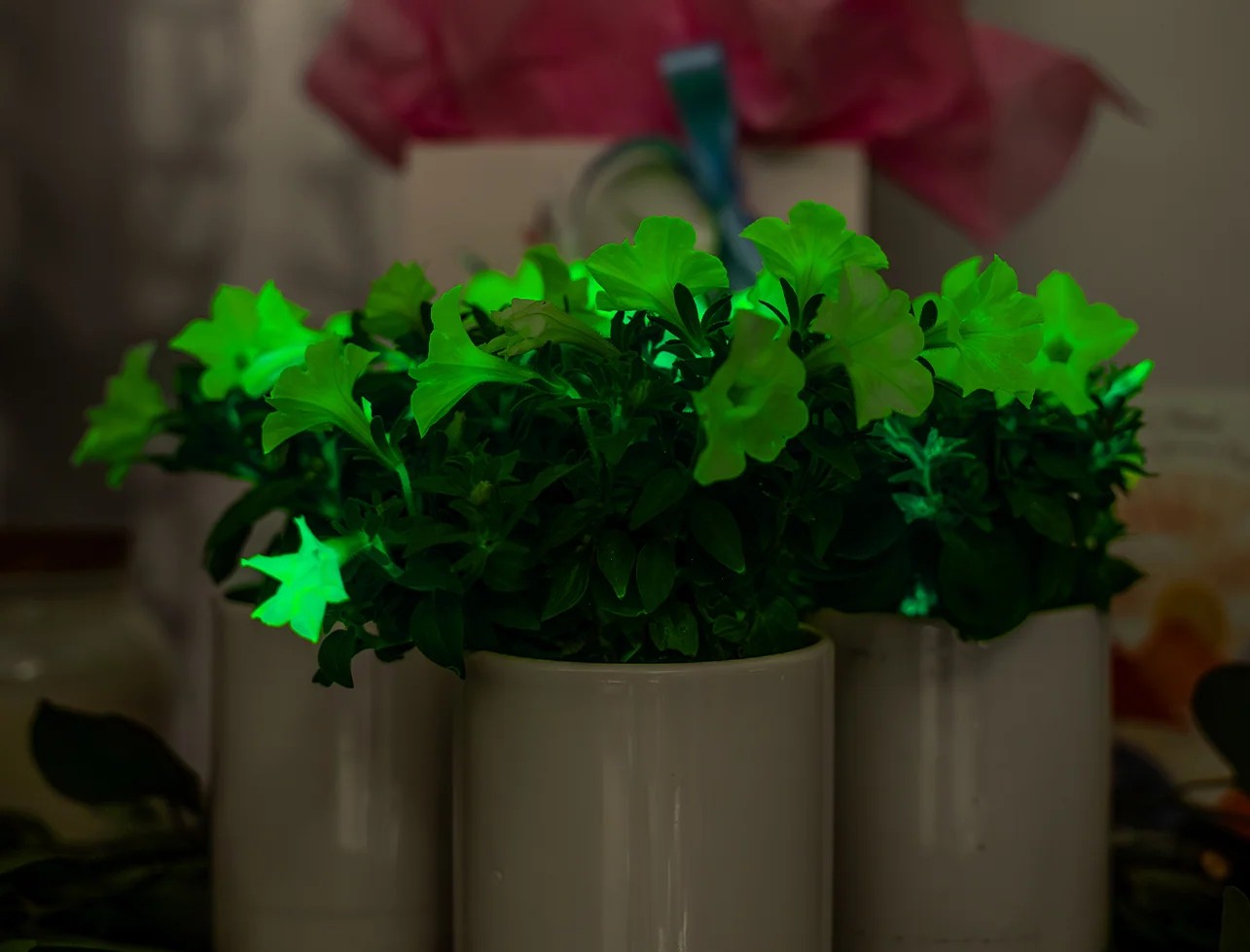
In daylight, the Firefly Petunia looks like an ordinary basket of crisp white petunias. Carry that same pot into a pitch-black room at night, wait a few minutes for your eyes to adjust, and the leaves, stems, and flower buds emit a soft green glow.
Cleared by federal regulators for sale in the United States, it is the first glowing houseplant you can buy for a sunny windowsill or patio pot. Details on where it ships are in the buying section below. Before you join the waitlist, though, it pays to understand how bright that glow really is, why you cannot buy it as seed, and what it takes to keep the plant shining.
What the Firefly Petunia Actually Is
The Firefly Petunia is a genetically engineered variety of Petunia hybrida developed by Light Bio, a biotechnology company based in Ketchum and Sun Valley, Idaho. The company was co-founded by CEO Keith Wood, a scientist who helped create the world’s first glowing tobacco plant at the University of California, San Diego, back in 1986.
During the day, the plant produces standard white blooms that blend right in with conventional garden petunias. In the dark, the entire plant is bioluminescent, from its roots and stems to its leaves and petals. The newest growth and youngest flower buds glow the brightest, while older blossoms gradually dim as they mature.
“That’s why we call it the Firefly Petunia. Because these bright buds resemble fireflies sitting on top of the plant,” Wood told Wisconsin Public Radio.
Light Bio has since expanded the lineup beyond the original white. The Trial Pink Petunia offers saturated pink blooms by day with what the company describes as 2 to 3 times the growing power of the original, while the Trial Pink and White Petunia produces pink, white, and starry bicolor patterns that shift with temperature and sunlight. Both carry the same familiar Firefly glow at night and, like the original, are sold as live plants only.
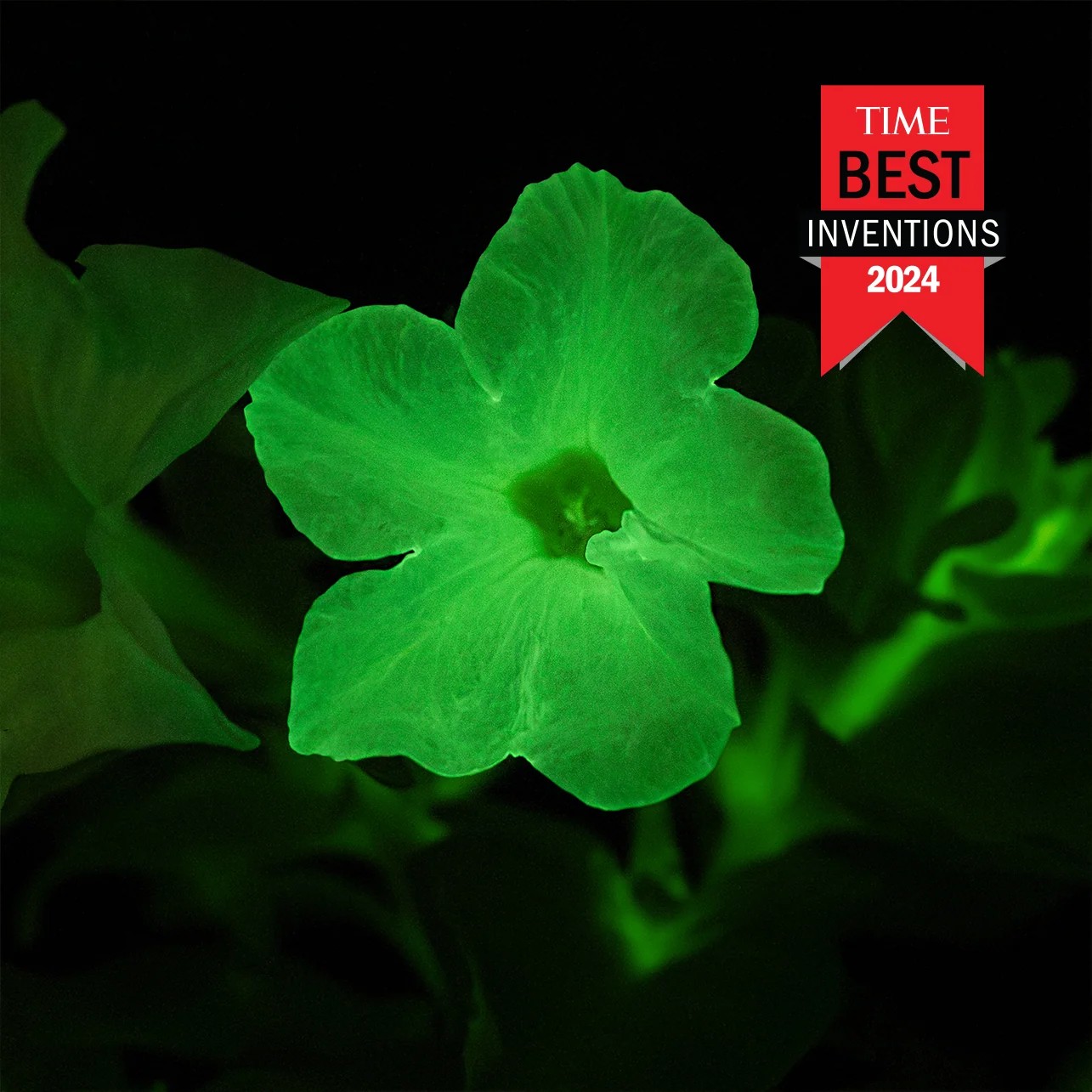
In nature, bioluminescence is common in the ocean and appears on land in fireflies, certain bacteria, and glowing mushrooms, yet no naturally bioluminescent plants exist. Recognizing the landmark transition from lab specimen to living room flowerpot, TIME named the Firefly Petunia one of its Best Inventions of 2024.
How Mushroom Genes Make It Glow
For nearly four decades, scientists struggled to make plants glow brightly on their own. Early experiments in 1986 inserted firefly luciferase genes into tobacco, but the glow was faint and required feeding the plant special chemical substrates. In 2017, researchers at MIT created nanobionic watercress by embedding nanoparticles and firefly enzymes into the leaves, producing a dim, temporary glow that could not pass to new growth.
The breakthrough came in 2020, when a team of researchers discovered that the bioluminescent mushroom Neonothopanus nambi makes light using caffeic acid, an organic compound already present in the cell walls of all terrestrial plants as a building block of lignin. When Intelligent Living covered that earlier work on mushroom-DNA glowing plants, Light Bio and its research partners had just demonstrated the pathway in tobacco, producing a continuous glow at least 10 times brighter than previous bacterial or firefly-gene attempts.
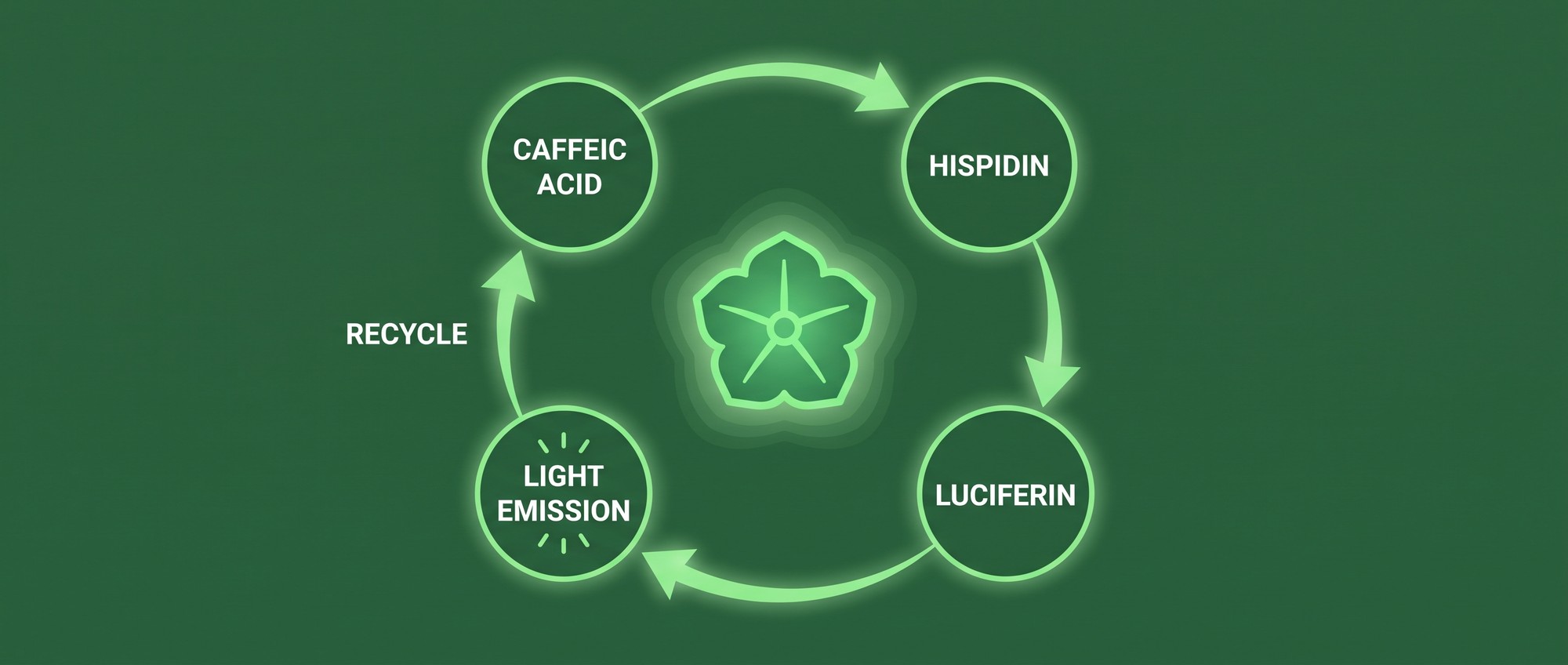
While wild botanical oddities such as plants that rely entirely on underground fungi show how closely plants and mushrooms interact in nature, the 2020 fungal bioluminescence study in Nature Biotechnology moved a complete four-enzyme fungal circuit directly into plant DNA:
- Hispidin synthase and hispidin-3-hydroxylase: These first two fungal enzymes convert the plant’s own caffeic acid into a luciferin light-emitting precursor.
- Fungal luciferase: This enzyme oxidizes the precursor, releasing energy as a steady green photon of light.
- Caffeoyl pyruvate hydrolase (CPH): The fourth enzyme recycles the spent molecule back into caffeic acid, allowing the cycle to run 24 hours a day without batteries, sprays, or ultraviolet charging.
Comparing true metabolic bioluminescence with novelty glow products highlights why the fungal cycle is fundamentally different from past approaches.
| Plant or Product Type | How It Glows | Needs Charging or Special Light? | How Long the Glow Lasts |
|---|---|---|---|
| Firefly Petunia (true bioluminescence) | Internal caffeic-acid cycle driven by fungal genes in every cell | No blacklight, spray, or chemical food; powered by daytime photosynthesis | Continuous day and night for the life of the plant (visible only in darkness) |
| Glow-paint or sprayed plants | Surface coating of phosphorescent pigment applied to leaves or petals | Yes, must absorb bright light before glowing in the dark | Fades within minutes to a few hours after lights go out |
| UV fluorescent plants | Pigments or dyes that reflect ultraviolet wavelengths | Yes, requires an active blacklight shining on the plant | Stops the instant the ultraviolet lamp is switched off |
| 2017 nanobionic watercress (research only) | Infused nanoparticles carrying firefly enzymes inside leaves | Requires high-pressure nanoparticle infusion in a laboratory | Dim, temporary glow lasting only hours; never sold commercially |
How Bright Is It Really?
If you are hoping to swap your bedside reading lamp or hallway night-light for a potted petunia, you will be disappointed. The Firefly Petunia emits a soft, gentle radiance often compared to moonlight. Even though the chemical reaction runs 24 hours a day, the light is completely washed out by daylight or normal room lighting.
To actually see the glow at night, you need to follow specific viewing steps recommended by Light Bio:
- Find a pitch-black space: Carry the potted plant into a windowless bathroom, closet, or darkened room at night where no streetlights or ambient glare can leak in.
- Turn off all screens and indicators: Even a dim smartphone screen, television standby LED, or distant hallway lamp will constrict your pupils and wash out the plant’s soft glow.
- Give your eyes 5 to 10 minutes to adjust: Human night vision takes several minutes to adapt to total darkness. What looks barely visible in the first 15 seconds becomes clearly defined once your eyes adjust.
- Look closely at fresh buds: The newest flower buds and actively growing shoots shine brightest, creating clusters of bright pinpoints above the softer glow of the older leaves.
You should also keep camera physics in mind when browsing promotional photos or social media posts. Professional photos of the Firefly Petunia are taken using long exposures, where the camera sensor gathers light over several seconds. In the original 2020 research preprint documenting the fungal pathway, scientists captured clear color images on consumer cameras and smartphones using exposure times of 5 to 30 seconds. A multi-second camera exposure makes the plant look neon bright on screen, whereas to the naked eye it remains a subtle, soothing glow.
Buying One in the US and Avoiding Seed Scams
Light Bio opened preorders in February 2024 for an initial batch of 50,000 plants, priced at $29 per plant plus $24 shipping, with multi-plant discounts on orders of three or more and free shipping on orders of 10. The first deliveries shipped in April 2024 according to each buyer’s USDA Hardiness Zone.
“This milestone, and the magical experience we are bringing to people across the country, has been decades in the making,” Wood stated in a launch announcement reported by Freethink. “We can’t wait to see their reactions and to discover the bright future ahead for this incredible technology.”
According to Light Bio’s official storefront, the 2026 shipping season is closed and customers can join the waitlist for Spring 2027 deliveries. Light Bio sells direct through light.bio and through its authorized grower and retail partner network, with seasonal listings also appearing via partner garden centers and online storefronts. Start at light.bio to confirm authorized sellers (full shipping region and seed policy are in the table below), current return-season pricing, and shipping windows.
| Buying Detail | Verified Status |
|---|---|
| Official Seller | Light Bio, Inc. (Ketchum / Sun Valley, Idaho) via light.bio |
| Plant Species and Appearance | Petunia hybrida; white flowers by day, soft green glow in total darkness |
| US Regulatory Status | Cleared by USDA APHIS (Sept 6, 2023, RSR 22-161-01rsr); not regulated under 7 CFR part 340 |
| Shipping Region | 48 contiguous US states only; delivery timing aligned to USDA Hardiness Zone |
| Launch Pricing Benchmark | $29 per plant plus $24 shipping at 2024 launch (50,000 initial batch); check light.bio for upcoming season pricing |
| 2026 / 2027 Season Status | 2026 season closed; waitlist open on light.bio for Spring 2027 |
| Seeds and Cuttings Policy | Never sold as seeds; Light Bio sells and authorizes live plants only |
One of the biggest pitfalls for shoppers searching online is fake seed listings. Light Bio explicitly states in its authenticity notice that it does not sell or authorize the sale of Firefly Petunia seeds, and that the technology is available in live plant form only. Any third-party marketplace seller offering “glowing petunia seeds” or “bioluminescent flower seeds” is selling mislabeled or fraudulent packets.
Caring for a Firefly Petunia as a Houseplant
Because the plant’s nighttime glow is fueled directly by its daytime metabolism, a healthier, more vigorous petunia glows noticeably brighter. You do not need special fertilizers or laboratory equipment; standard attentive container care keeps the caffeic-acid cycle running at peak output.
- Give it plenty of direct sunlight: Daytime photosynthesis charges the plant’s metabolic energy reserves. Place your pot where it receives several hours of direct sunlight each day, or keep it under a bright indoor grow light.
- Water and feed regularly: Like all vigorous container petunias, it needs consistent watering whenever the top layer of potting mix begins to dry, paired with regular feeding using a standard flower fertilizer.
- Keep it in a portable container: Growing the petunia in a pot or hanging basket makes it easy to sun the plant on a porch, balcony, or sunny sill during the day and bring it into a dark room for viewing at night.
- Expect slower winter growth indoors: Technically, Petunia hybrida is a tender perennial that most gardeners treat as an annual outdoors. You can keep it year-round indoors as a houseplant near a sunny window or under a grow light, though growth and blooming naturally slow down during colder months with shorter daylight hours.
Is It Legal and Safe?
Before any genetically engineered plant can be sold to US consumers, it must undergo federal scrutiny. On September 6, 2023, the USDA Animal and Plant Health Inspection Service issued its official Regulatory Status Review determination (RSR number 22-161-01rsr) for Light Bio’s glowing petunia.
APHIS concluded that the modified petunia is unlikely to pose an increased plant pest risk compared to other cultivated petunias. As a result, it is not subject to regulation under 7 CFR part 340, and from a plant pest risk perspective, it may be safely grown and bred in the United States. The agency’s technical review letter confirmed the inserted fungal enzyme genes and marker gene posed no elevated pest threat.
Researchers chose the common garden petunia specifically for its strong environmental safety record. Ornamental petunias are not native to North America, have no wild relatives in the United States with which they could cross-pollinate, and are not considered invasive. Independent scientists consulted during the launch told Nature and Scientific American that they saw no environmental safety risks from putting the glowing ornamental in home gardens and pots.
Outside the 48 contiguous US states, however, the rules are entirely different. The Firefly Petunia is not approved for sale or cultivation in the United Kingdom, the European Union, Canada, or Australia. As the UK’s Royal Horticultural Society notes, strict genetic modification rules and mandatory public consultations mean British and European gardeners must admire the plant from afar for now. Even within the EU, only a single genetically modified crop line is cleared for cultivation across member states, making approval for an ornamental houseplant highly unlikely in the near term. Travelers and international buyers should never attempt to carry or mail live plants across international borders.
Why a Glowing Houseplant Matters
For decades, most public encounters with agricultural biotechnology revolved around industrial field crops engineered for herbicide tolerance or pest resistance. Those traits mattered to commercial farmers, but they offered nothing visible or joyful to an ordinary person watering a plant on an apartment balcony.
Stanford University bioengineering associate professor Drew Endy, who was not involved with Light Bio, summed up the cultural shift when speaking about the petunia: “[The plants] invite people to experience biotechnology from a position of wonder.”
A flower that quietly turns afternoon sunlight into a soft midnight glow will not replace your porch light, and it asks for a dark room and a few minutes of patience to reveal its trick. For home growers willing to meet those terms, it turns an everyday flowerpot into a living demonstration of synthetic biology.
Frequently Asked Questions
Do firefly petunias come back every year?
Like standard garden petunias, the Firefly Petunia is a tender perennial usually grown as an annual outdoors because it cannot survive frost. You can keep it year-round indoors as a houseplant (see the care section above).
Where can I buy a Firefly petunia?
In the United States, genuine plants originate with Light Bio and are sold through light.bio and its authorized grower and retail partners (see the buying table above for region and season details). They are not sold as seeds anywhere.
Why can’t I buy Firefly petunia seeds?
Light Bio sells and authorizes its bioluminescent petunia as a live plant only and never distributes seeds (see the buying section above for the full warning).
Do petunias like sun or shade?
Firefly Petunias love sunlight. Daytime photosynthesis powers the nighttime glow, so give them direct sun, a bright sill, or a grow light (see the care section above).
Is the glow bright enough to read by?
No. The glow is a gentle radiance similar to faint moonlight, not a reading lamp. It needs a pitch-black room and several minutes of dark-adapted vision (see the brightness section above).


