The legend of Atlantis was invented by Plato around 360 B.C. (more than 2,300 years ago). He claimed that this utopian civilization, founded by half God and half-human, was punished by the gods for becoming greedy, selfish, and amoral and thus sunk into the seas. Exactly which sea is unknown.
Plato said Atlantis existed 9,000 years before even his time and that its story had been passed down by priests, poets, and others. However, Plato’s Atlantis writings are the only known records of its existence.
There are several theories about where Atlantis actually was— off the coast of Spain, in the Mediterranean, even under Antarctica. “Pick a spot on the map, and someone has said that Atlantis was there. Every place you can imagine,” said Charles Orser, curator of history at the New York State Museum in Albany.
While Atlantis is an entirely fictional sunken city, there are many real ones worldwide that, through some misfortunate natural disaster, or ‘the wrath of gods,’ can now only be found at the bottom of a lake or the sea. However, there is also a recently-opened, man-made underwater city in Dubai.

Whether naturally formed or artificially created, any underwater city is astounding, and if you experience it, you can’t help but share it with others. The perfect way to share your favorite photos is by customizing the quirky landscapes you encounter on your travels into unique pins. Custom enamel pins can also be used as decorations and are great for decorating jackets or hats. And if you’re a leader of a travel organization or club, why not create a one-of-a-kind travel souvenir for your next traveling? Pins definitely are the perfect great gift for your club members.
Listed below are eleven of the world’s real-life versions of Atlantis, both man-made and naturally formed.
Deep Dive Dubai And The Sunken City
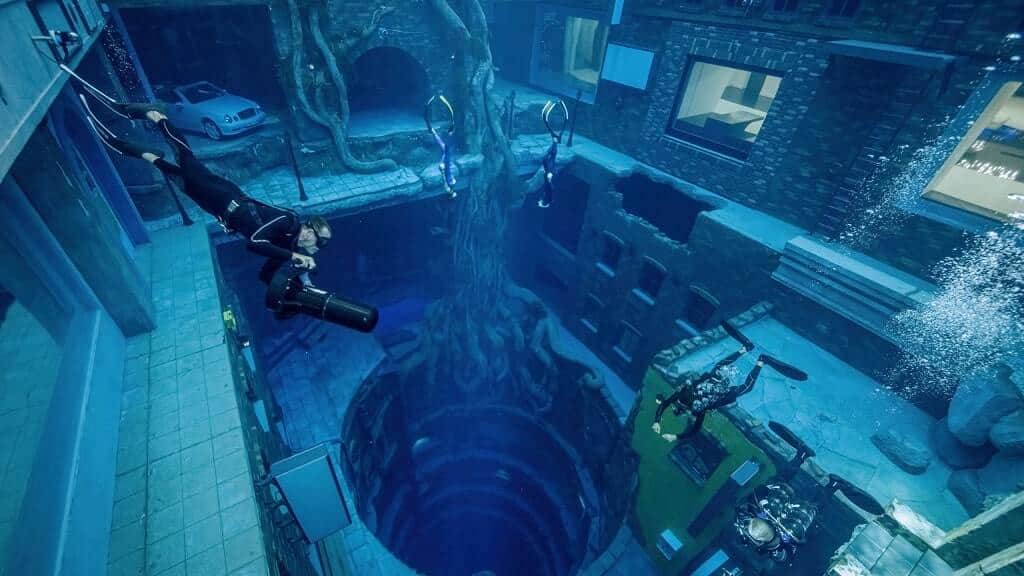
Dubai has recently opened the world’s deepest pool – called the Deep Dive Dubai – that holds an “abandoned” underwater city that divers can explore. It also features an underwater film studio – the largest in the region, with a media editing room available nearby in the facility. In addition, state-of-the-art sound systems and lighting are fitted inside the pool to create different atmospheres. There’s even an underwater arcade, where divers can play underwater pool.


With a record-breaking depth of 196 ft, the massive pool is housed in a 16,000-sq-ft oyster-shaped structure, “a nod to the United Arab Emirates’ history as a pearl diving nation,” as CNN reports. Deep Dive Dubai will offer courses for diving beginners and certified divers. Divers will get to explore the pool and the underwater city by themselves after a site tour with one of the dive guides. Divers can choose between swimsuits and thin wetsuits, as the pool’s 14 million liters of fresh water are kept at 86°F (30°C).
Some fifty-six cameras have been installed around the pool at every corner to ensure the safety of divers and that nobody gets lost in the underwater city. In addition, it also has a highly advanced hyperbaric chamber that can hold a dozen divers in case of emergencies. The chamber allows divers to gradually acclimatize to surface pressure, avoiding the risk of decompression sickness.


Deep Dive Dubai has posted a warning notice on its website FAQ advising divers against traveling to the top of the famed Burj Khalifa, the tallest tower in the world, due to the staggering pressure differential. “Don’t visit the top of the skyscraper after diving. After any dive, it’s recommended to wait 18-24 hours before ascending higher than 300 meters (1,000 feet). However, there is no risk in diving after having visited the tallest building in the world,” the notice reads.
The facility is now open by invitation only but will open its doors to the public later this year.

Dwarka
In 1988, the city of Dwarka, or “Gateway to Heaven,” was discovered submerged roughly 100-ft below the Gulf of Cambay, a bay on the Arabian Sea coast of India. Divers found ancient structures, artifacts, pillars, and grids of a city.

Port Royal
On June 7, 1692, an enormous earthquake followed by a tsunami killed some 2,000 people and dragged the city of Port Royal under the Jamaican sea. Once called the “wickedest on earth,” this city was home to Caribbean pirates (like Blackbeard).

The sinking of Port Royal was deemed an act of God, but that didn’t stop the pirates, who just traveled farther up the coast, raiding ships for treasure along the way. Today it’s considered one of the world’s best-preserved underwater cites. Visitors can scuba dive to the underwater city but require special permission from the authorities.
Phanagoria
Phanagoria, founded in the 6th century B.C., was reportedly the largest city of ancient Greece and the capital of the Bosphoran Kingdom. Today, it’s part of Russia, with a third of the old town submerged in the Black Sea, earning its nickname the Russian Atlantis. However, two-thirds of the city is on land, making for an enormous archaeological site, dry and wet, with discoveries still being made.


The Lost Villages
The Lost Villages comprise ten sunken Canadian towns, former municipalities of Cornwall and Osnabruck in Ontario, Canada. In 1958, both of these regions were submerged after the construction of a waterway. Today, there are still buildings and sidewalks visible from some areas above the water’s surface.
Pavlopetri
Pavlopetri, located on the southern coast of Lakonia in Greece, is considered the oldest underwater city in history. The flooding of the city is believed to have taken place some 5,000 years ago. Since its discovery in the late 60s, it has been an archaeological site of great value. “It is a unique discovery in the sense that we have found on the seabed an almost complete city, with streets, buildings, gardens, tombs, and what looks like a religious complex,” explained Jon Henderson from the University of Nottingham, according to the BBC.

Shicheng
Beneath Lake Qiandao, China, lies the sunken city of Shicheng which used to be part of two regions called Chun’an and Sui’an. According to National Geographic, the city was submerged in 1957, when the government constructed a hydroelectric power station in the area.
Sant Romà de Sau
In the Osona region of Catalonia in north-eastern Spain, a 1,000-year-old village called San Romà de Sau is entirely submerged by water. The San Romà de Sau church’s bell tower stays emerged from the water when the reservoir isn’t full. However, people can visit the ruins during droughts, as they’re entirely exposed when there’s no water present.
Titicaca’s Pre-Incan Ruins
Beneath the waters of Lake Titicaca, the world’s highest navigable lake, in the Andes between Bolivia and Peru, there are ruins of what is thought to be an ancient temple complex. The site, estimated to be 1,000 to 1,500 years old, contains a 660-foot long, 160-foot-wide temple, a terrace for crops, a 2,600-foot wall, and a pre-Incan road.
The City Of Thonis-Heracleion
This 2,000-years-old sunken city, recognized as one of the most important port cities of the Mediterranean, now sits at the bottom of the sea on the northern coast of Egypt.
China’s Lion City
China’s Lion City, believed to be over 1400 years old, was built during the Han dynasty. It spans a massive area of 62 football fields.

The waters around the globe are rising. Unfortunately, that means, one day, some of our ports could become underwater ruins too!
Will We Ever Live In Underwater Cities?
According to Ian Koblick, the Marine Resources Development Foundation president, the technology already exists to create underwater colonies that can support as many as one hundred people. The few bunker-like habitats currently in operation offer a blueprint. “There are no technological hurdles. If you had the money and the need, you could do it today,” Koblick explained. However, technological advances would be needed to manage emergency evacuation systems and environmental controls of air supply and humidity beyond one hundred residents.
Koblick is a pioneer in developing advanced undersea programs for ocean science and education. He is the co-author of a book called “Living and Working in the Sea” and is considered one of the leading authorities on undersea habitation.
In the 70s Koblick designed and operated a sophisticated undersea lab called La Chalupa. Later, he and partner Dr. Neil Monney converted it into Jules’ Undersea Lodge, the world’s only undersea hotel, in operation since 1986 at the Marine Resources Development Foundation environmental education facility in Key Largo, Florida.
Creating larger-scale underwater habitation wouldn’t only benefit research. Advocates claim it could alleviate over-population problems and guard against the possibility of man-made or natural disasters rendering land-based human life impossible. The question is, how feasible is this?