
There’s no way to stop global warming from intensifying over the next three decades because we’ve delayed curbing fossil-fuel emissions for far too long. However, we still have a little time left to prevent the worst-case scenario.
Ko Barrett, a vice-chair of the panel and a senior adviser for climate at the National Oceanic and Atmospheric Administration, said:
There’s no going back from some changes in the climate system. [But immediate and sustained emissions cuts] could make a difference in the climate future we have ahead of us.
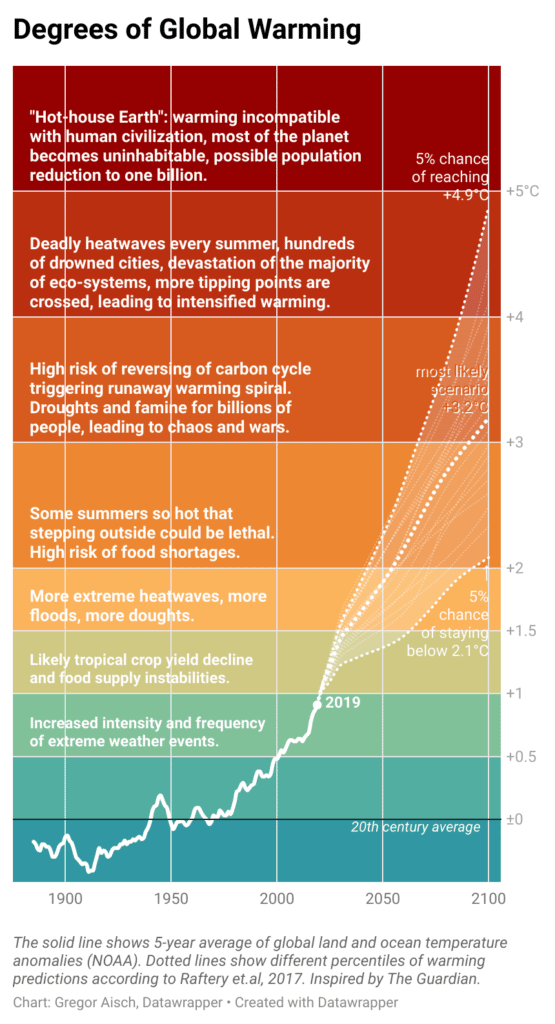
A new United Nations scientific report based on over 14,000 studies approved by 195 governments shows how climate change is our fault. It says we’ve already warmed the planet by approximately 1.1 degrees Celsius (2 degrees Fahrenheit) since the 19th century by burning oil, coal, and gas for energy.

The report is the most comprehensive summary to date of the physical science of climate change. It warns that the dangers of warming grow considerably at only 1.5 degrees Celsius, and every additional degree brings far greater perils. For example, it says that a mere 0.4 degrees Celsius rise from the current average temperature would result in nearly one billion people experiencing more frequent life-threatening heatwaves and hundreds of millions more struggling for water due to severe droughts.

Meanwhile, some plant and animal species will become extinct, and large swaths of coral reefs will suffer more frequent mass die-offs. Moreover, every additional degree will result in more vicious heat waves, droughts, floods, and accelerating sea-level rise, which threatens the existence of several island nations. For example, the Maldives exists barely above sea level and will likely disappear if average temperatures surpass 2 degrees Celsius.

Rising sea levels are one of the consequences of crossing irreversible “tipping points.” As the planet gets hotter, things can happen to the Earth that we can’t undo. For example, if the immense ice sheets in Greenland and West Antarctica collapse, they can’t grow back. The consequences are disastrous. In addition to the Maldives disappearing, some of Seychelle’s island and large swaths of the Bermuda archipelago could be underwater. Also, much of the US Gulf Coast, Thailand’s capital Bangkok, the Netherland’s Amsterdam, Rotterdam cities, and the Hague could be submerged in two feet of water on average by the end of the century. Such places will require defenses constructed to counter rising water levels to survive.
Robert Kopp, a climate scientist at Rutgers University who helped write the UN report, said:
It’s not like we can draw a sharp line where, if we stay at 1.5 degrees, we’re safe, and at 2 degrees or 3 degrees, it’s game over. But every extra bit of warming increases the risks.


The starting point for measuring future warming is the late 1800s. That’s when reliable global temperature records started becoming available. Since then, the planet has warmed a little more than 1 degree Celsius (1.8 degrees Fahrenheit) on average, with some regions warming much more. The accumulation of fossil fuel pollutants in the atmosphere, like carbon dioxide and methane, is responsible. The UN report leaves no doubt that humans are responsible for global warming. Atmospheric carbon dioxide levels haven’t been this high in at least 2 million years.

Adding 2 degrees Celsius would make our world unimaginably hotter and disproportionately hotter on land. Two degrees doesn’t seem like much, but about 70% of the planet is covered in water, which warms more slowly than land. Meaning, if the average global temperature rise is 3 degrees Celsius, the land area is much warmer than that.

Furthermore, strange things can happen as global temperatures rise. For example, Kevin Trenberth and John Fasullo of the National Center for Atmospheric Research in Boulder, Colorado, published a study showing how rising temperatures could increase cloud coverage due to higher humidity levels. Clouds can both cause temperatures to drop and grow simultaneously because they block heat from reaching the ground, but they also trap the heat below them.
Every time the amount of carbon dioxide in the atmosphere doubles, the Earthy will likely warm between 2.5 degrees and 4 degrees Celsius. In addition, scientists are concerned that a 3-degrees-warmer world could negatively impact the planet’s natural carbon sinks (plants, trees, soil, and ocean), which consistently pull carbon dioxide out of the air. If any of these systems stopped absorbing as much carbon dioxide as it currently does, the greenhouse gas would linger in the atmosphere and fuel global warming further.
Climate scientist Cobb of Georgia Tech said:
Half of our emissions right now are pulled back into the ground by natural carbon sinks that have been functioning decade in, decade out at the same service levels. So going forward, as a climate scientist, it is very concerning that we are beginning to understand that there’s a real risk that these natural carbon sinks could stop functioning as well at higher warming levels.

This could lead to a much warmer world, perhaps 4 to 6 degrees Celsius warmer. This version of Earth is much different than the one we live in today. Many of the places we live in now would be uninhabitable deserts, while others that are uninhabitable now, like Antarctica, would be green and colonized by climate refugees. The regions abandoned to desertification could be used for solar and wind farming, while areas covered in snow today could become thriving agricultural lands.

But, if the world’s temperature increases by 6 degrees Celsius, habitable land could become so scarce that racial conflict and civil war could become commonplace. Even Canada and Siberia may be too hot to grow food. In addition, if the oceans heat up enough, massive stores of methane hydrate will begin to escape. More methane in the atmosphere is very dangerous because it’s a flammable gas, and the slightest spark, like a lighting strike, could become fireballs tearing through the sky that explode on land and destroy life on Earth entirely.

Mark Lynas, author of a book called “Six Degrees: Our Future on a Hotter Planet,” told CNN columnist John D. Sutter in an interview:
[A six-degrees-warmer world is] a scenario which is so extreme it’s almost unimaginable. Not many studies have addressed this because it’s so far off the scale of what can be envisaged. I found myself looking back at the severe traumatic events in the Earth’s geological history, which have led to mass extinctions, such as the one at the end of the Permian period, 250 million years ago, which wiped out nearly 90% of life on Earth. A lot of the mass extinctions seem to have been associated with very rapid global warming events. Humans are releasing carbon more rapidly, even than it took place during mass extinctions. We haven’t gotten there in terms of the overall amount, but we’re certainly moving in that direction. So, it’s not a planet that I think any of us would want to live on, and it doesn’t have to happen. So, while I think it’s important to try to visualize what a 6-degree world would look like, it’s also important to remember that we don’t have to go there.
Most of the planetary surface would be functionally uninhabitable. Agriculture would cease to exist everywhere, apart from the polar and subpolar regions and perhaps the mid-latitudes for extremely heat-tolerant crops. It isn’t easy to see how crops could be grown elsewhere. There’s a certain level above which plants can’t survive. There’s a certain level where humans biologically can’t survive outside, as well. We get close enough already in the Arabian Peninsula and some other parts of the world. Remember, 6 degrees is a global average. It would be probably twice that over land and somewhat less than that over the oceans. The oceans would probably stratify, so the oceans would become oxygen-deficient, which would cause a mass extinction and a die-off in the oceans, which would release gases and affect land. So, it’s pretty much equivalent of a meteorite striking the planet, in terms of the overall impacts.
Lynas goes on to explain how we humans are in charge of the planet. He said:
We are now inhabiting a human-dominated planet. We are in a new epoch known as the Anthropocene. The Holocene is now considered to be over. And I don’t think there have been another species that has had that effect on the planet before — maybe the first bacteria that emitted oxygen or photosynthesizing microorganisms. But we are into terra incognita looking forward. That gives our species a serious level of responsibility for planetary management that people don’t really appreciate at any kind of fundamental physiological or political level. We are in charge. It’s up to us. We actually do have an overall effect on the Earth’s temp. It’s not up to Mother Nature anymore to run the show.
Bottom line: The hotter it gets, the closer we are to a real-life apocalypse. And while that sounds like science fiction, it’s our reality based on scientific facts and evidence. So, start doing whatever you can, like switching to an electric vehicle and eliminating meat from your diet, to help us avoid the doom and gloom that lies ahead if we all do nothing!


