
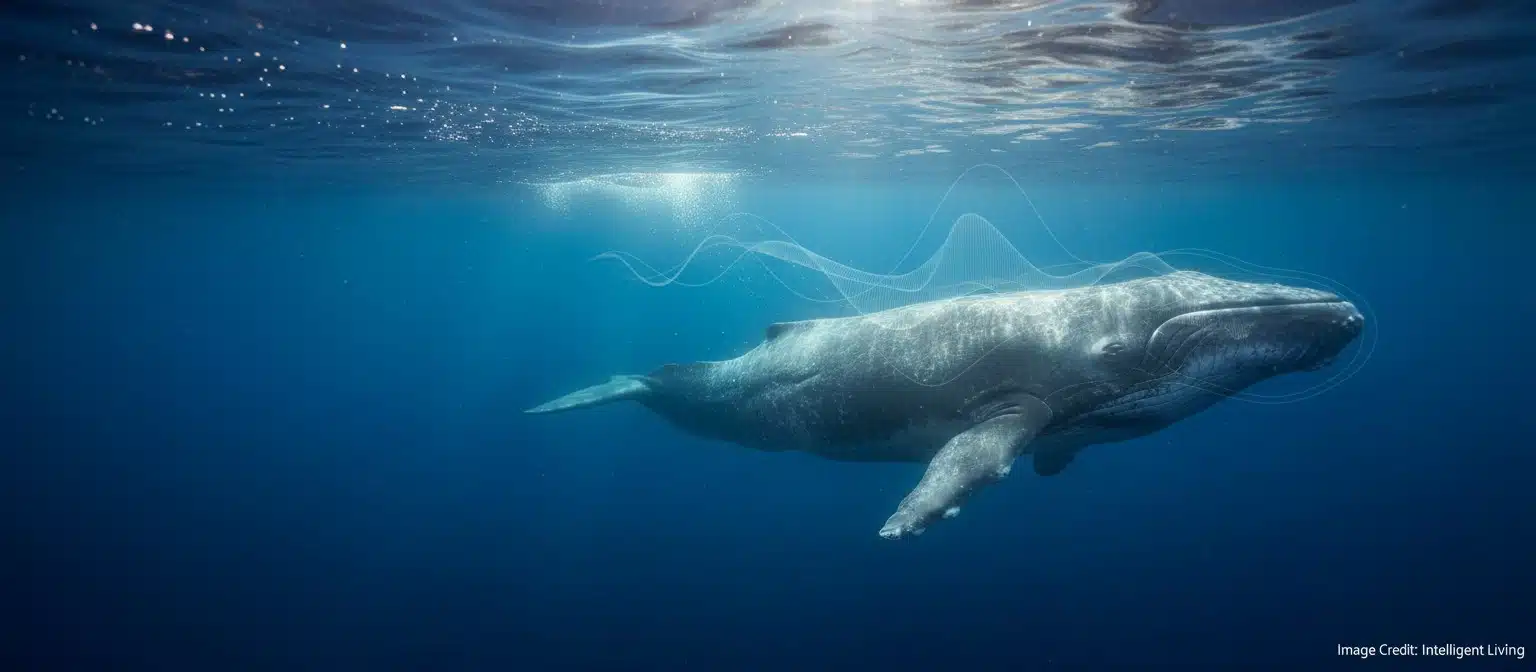
Meaning travels through the deep ocean without a single spoken word, yet recent marine bioacoustics breakthroughs reveal a highly structured reality hidden in the silence. Recently, a peer-reviewed Proceedings of the Royal Society B study highlighted a concept that shifts our understanding of aquatic life: sperm whale click patterns may follow sound rules that resemble human vowels. Scientific mapping suggests that underwater communication is not just a series of random noises but a structured sound system designed for long-distance social coordination.
Working with recordings from long-running research off Dominica, teams connected to the CETI whale-communication research program analyzed thousands of sperm whale codas. Recurring sound-quality categories found within these click sequences mirror the specific patterns linguists use to distinguish organized communication from random noise. Methods-first breakdowns of the analysis explain the core logic behind these tests, focusing on measurable data rather than speculative claims about interspecies conversation.
Whales are not speaking English underwater; instead, researchers are identifying repeatable sound categories that allow for long-term testing and comparison. Vowel-like spectral patterns allow scientists to uncover how sperm whales use codas in social exchanges to maintain group cohesion. Sophisticated research provides a new lens for viewing whale research in Dominica and beyond, proving that these animals utilize a sophisticated combinatorial structure to navigate their social worlds.

Whale Vowels in the News: What Researchers Found in Sperm Whale Clicks
Key Facts Regarding Vowel-Like Click Patterns and Acoustic Signaling Rules
Underwater acoustic rules become visible once researchers look past the ocean’s ambient volume to analyze the specific mechanics of whale communication. Researchers are now measuring patterns inside sperm whale click sequences and asking whether those patterns behave like a structured sound system rather than random noise. This analytical shift allows scientists to treat each pulse as a potential unit of meaning within a larger social exchange.
- The dataset builds on decades of observation from the Dominica Sperm Whale Project’s long-term field program, which has followed families across years.
- Researchers report two recurring click-quality categories that appear across different coda types, suggesting the whales are not limited to just click counts and timing.
- Evidence of combinatorial structure in codas already exists, and this new work adds a fresh layer that looks more like ‘sound quality’ than ‘rhythm.’
- Scientists emphasize the same reality check people keep asking out loud to their phones: structure is not the same as a translated dictionary of meanings.
Sperm whale clicks function as a sophisticated system of reusable building blocks rather than simple rhythmic pulses. Marine biologists utilize these findings to decode cultural signatures unique to specific whale clans. These discoveries help us understand how massive sea mammals manage their social lives and stay together across hundreds of miles.

Research Findings on Frequency Peaks and Formant-Like Click Categories
Two Click Qualities that Keep Reappearing
Scientists measured both the timing and the physical shape of every click to see if the sounds stayed consistent throughout the study. Findings suggest that codas use two specific sound categories that act like stable building blocks, known to experts as a-class and i-class patterns.
Vowel- and diphthong-like spectral patterns appear in a comprehensive open-access analysis, revealing frequency peaks that cluster into stable categories across various social units. Think of it as the difference between hearing ‘just clicks’ and realizing certain sounds have their own predictable flavors that appear in specific spots.
A Speech Tool Applied Underwater
Tools built to study human speech are now helping experts prove that whale sound categories stay consistent even in different parts of the ocean. By using linear predictive coding, researchers can pick out specific frequency peaks that would normally be too subtle for the human ear to catch.
The goal is not to claim that whales have human mouths or speak human vowels. Instead, researchers want to see if acoustic patterns behave in measurable ways rather than blurring into background noise. Imagine hearing two different doorbells in an apartment building—one is high and one is low—even if a stranger thinks they both just sound like a ‘ding.’
Why Scale Matters
Large datasets exceed the capacity for human listening alone, necessitating the use of sophisticated automated methods for accurate processing. Work on automatic detection and annotation of eastern Caribbean sperm whale codas shows how algorithms can scale up coda identification and labeling, making it more realistic to study patterns across many hours and many groups.
Algorithmic scaling tracks how sound systems evolve over decades and across diverse social groups, ensuring researchers build an accurate model of complex marine communication. Patterns that persist under that kind of pressure are harder to dismiss as coincidence.

How Codas Work and Why Scientists Hear Vowels in Click Patterns
Defining Sperm Whale Codas: Social Signal Sequences and Clan Signatures
Social Click Phrases, Not Hunting Clicks
A coda is a short patterned sequence of clicks that sperm whales use in social contexts. These are not the rapid echolocation clicks whales use to hunt squid at depth. Instead, codas function more like social signals exchanged between members of a group, often in back-and-forth sequences that resemble turn-taking.
Building Blocks and Clan Signatures
Sperm whale codas operate as modular building blocks, allowing for a vast inventory of distinguishable social signals within the deep-sea environment. Research in Nature Communications on contextual and combinatorial structure describe how multiple features can combine into a larger inventory of distinguishable coda types.
Families of sperm whales living near Dominica repeat distinct coda patterns unique to their clan. Acoustic signatures act as social markers, working much like a regional accent that tells you exactly where a person was raised. Such repetition hints at learned cultural patterns rather than simple instinct.
Why this Matters for a Global Species
Basic biology matters here too, because these are not rare animals in one tiny corner of the sea. The NOAA sperm whale species profile describes sperm whales as globally distributed, which makes a flexible, resilient communication system useful across many ocean environments.
Acoustic Characteristics: Frequency Peaks and Click Coarticulation Patterns
Frequency Peaks and Click “Formants”
The term “vowel-like” comes from how the clicks cluster into acoustic categories with consistent frequency-peak characteristics. In human speech, vowels are distinguished by formants, broad peaks in the sound spectrum shaped by the vocal tract. In sperm whales, the research describes formant-like peaks that separate clicks into categories that behave in discrete, repeatable ways.
Vowel-like terminology serves as scientific shorthand for stable sound categories, emphasizing measurable frequency peaks rather than implying that whales share human vocal anatomy.
Patterns that Resemble Coarticulation
Beyond the categories themselves, a preprint version that summarizes the study’s main tests describes five vowel-pattern checks in sperm whale codas, including a coarticulation-like effect where an edge click can align more closely with an adjacent coda. In everyday terms, nearby sounds can tug on each other, like the way a syllable can subtly change depending on what comes next.
Anyone who has tried to hear a friend’s voice in a crowded restaurant knows the feeling: the signal is there, but context matters. With whale clicks, context includes the coda before and after, the social scene at the surface, and the acoustic clutter of the ocean itself.

Applying Interspecies Communication Data: Conservation Impacts of Mapping Whale Coda Structure
Scientific Boundaries: Structural Analysis Versus Semantic Translation
Structure is Not Translation
It is important to draw a clear boundary between structure and translation. A mainstream summary that emphasizes the study’s limits stresses that scientists have not decoded specific meanings attached to these click categories.
That matters because “animal language” gets misunderstood fast. Detecting sound categories and sound rules is closer to mapping an alphabet than it is to reading a message.
What Scientists Still Need
Spotting these steady patterns is a major win for science, as it proves that whale communication has a measurable order we can finally track. However, identifying vocabulary, syntax, or semantic meaning is a far more complex challenge.
To get closer to meaning, researchers need more than audio. Mapping meaning requires more than just sound; it takes watching how whales behave in the same situations over and over to see if their clicks predict what they do next.
Why Caution Protects the Science
Recognizing that letters form consistent patterns in an unfamiliar alphabet does not mean you can read the language. The same caution applies to whale research. Researchers are currently mapping structure rather than translating conversations.
Maintaining this distinction prevents a common mistake where people treat a clever pattern as proof of intent. Scientific progress thrives when claims stay tied strictly to what is measurable.

Strategic Conservation Applications for Mapping Whale Communication Systems
Understanding that sperm whale clicks contain vowel-like sound categories opens several practical possibilities.
- Improved Passive Acoustic Monitoring: Long-duration monitoring gear like sound-wave-powered, battery-free underwater cameras hints at how ocean observations could become quieter, smaller, and easier to deploy, which matters when the goal is to listen without adding new noise.
- Smarter Ship Collision Prevention: Hydrophone-based early warning has already been tested using whale-song shifts that signal migration timing, and sharper definitions of “social communication” could make those alerts more precise.
- Stronger Ocean Noise Policy: If whales rely on delicate sound contrasts, the problem of human-caused ocean noise pollution becomes less abstract and more like information loss, where critical social signals get masked. Conservation experiments using underwater speakers that restore lost reef soundscapes underline the same point: sound can shape survival.
- Better Population Tracking: Coda patterns can act like identity cues, and research on identity cues in sperm whale codas shows how repertoires can differ across individuals and social units, which can support population mapping when sightings are rare.
- Ethical and Legal Debates: As evidence of communication complexity grows, policy conversations about how whales should be treated can shift, including bans such as Canada’s law restricting captivity and breeding of cetaceans.
- AI Model Development for Animal Communication: Learning to track emotions in other species proves that we can use smart technology to check on the well-being of all kinds of animals.
Local communities depending on marine health often detect shifts in whale presence through acoustic changes long before official survey data becomes available. When sound patterns shift or grow quieter, that absence is felt economically and culturally, and better listening tools can make those changes visible sooner.

Why the Ocean’s “Vowels” Moment Matters for Conservation and AI-Driven Wildlife Science
Deciphering the evolution of complex animal communication takes a meaningful leap forward as researchers map these structured click patterns across the Caribbean. Artificial intelligence clarifies why technology remains essential by uncovering patterns hidden within messy, real-world data, allowing us to see the ‘alphabet’ of the deep. Sophisticated whale signal pattern-finding technology allows machine learning to identify structures that human observers often overlook in chaotic datasets.
Life beneath the surface organizes information without words, and every structured click pulls us closer to solving the ocean’s remaining mysteries. New models for whale signals move us past simply hearing sounds and toward understanding the unique cultural voices of different whale families. Conservation requires preserving the acoustic integrity of their environment so their social stories can continue to be told.
Frequently Asked Questions About Sperm Whale Coda Patterns
What are sperm whale codas, and how do they work?
Sperm whale codas are short, patterned sequences of clicks used primarily for social signaling and group identity rather than hunting.
Does Project CETI believe whales have a language?
Project CETI identified structured, vowel-like acoustic categories, though a full translation of specific meanings remains a future challenge.
Why do scientists call these click patterns ‘vowel-like’?
Frequency peaks called ‘formants’ refer to the building blocks of human speech found within the clicks, allowing for measurable sound categorization.
How does ocean noise pollution affect whale communication?
Human-caused noise masks these subtle acoustic contrasts, potentially disrupting the social bonds and coordination within whale families.
Can AI actually translate what whales are saying?
AI mapping shows us how whale sounds are built, which helps experts spot the patterns needed to eventually decode their communication.


