
Scientists have developed an underwater camera that is powered solely by sound waves and is around one hundred thousand times more efficient than other undersea camera systems.
While seafloor cameras are helpful for purposes such as wildlife monitoring, powering them and getting their images might be challenging. A new camera created by MIT can help with that because it has no batteries and wirelessly sends images through the water.
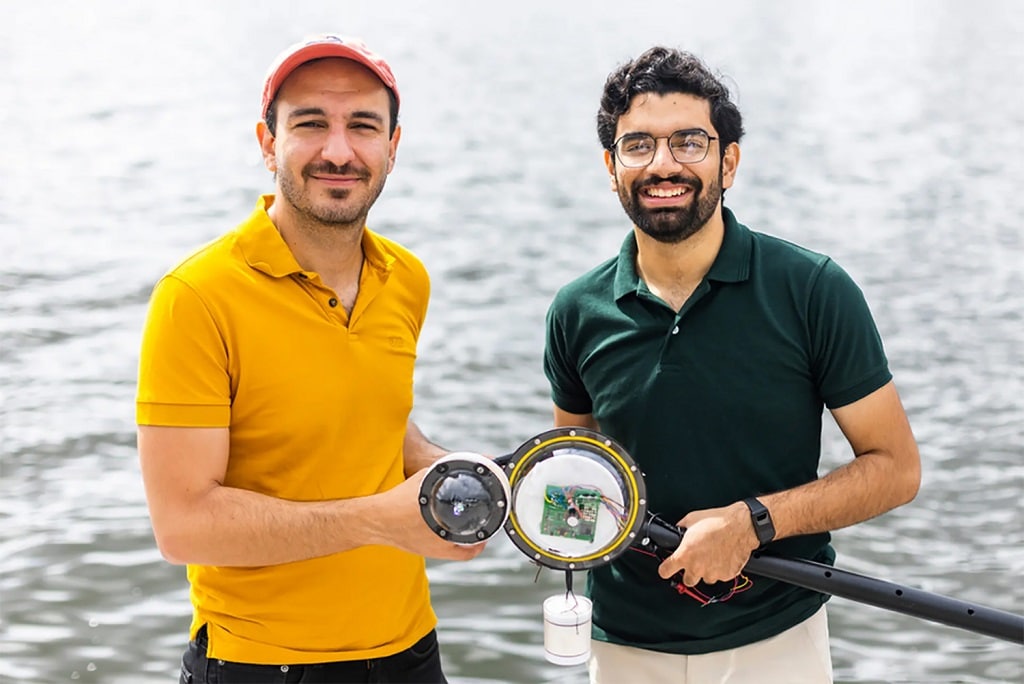
Instead of a battery or a long power cord, the camera has a set of piezoelectric transducers strategically placed around its exterior.
How Does it Work?
Unique materials inside the transducers vibrate in response to the pressure produced by sound waves from sources like animals or watercraft. Since those materials are piezoelectric, they generate an electrical current when shaken. Once sufficient electrical energy has been developed in this way and stored in a super-capacitor, it is used to capture a photo.
Engineers used off-the-shelf, ultra-low-power imaging sensors to minimize power consumption. It is, however, only possible to capture grayscale images with these sensors. Moreover, due to the lack of light in most underwater environments, they also needed to develop a low-power flash.
“We were trying to minimize the hardware as much as possible, and that creates new constraints on how to build the system, send information, and perform image reconstruction. It took a fair amount of creativity to figure out how to do this,” said Associate Professor Fadel Adib.
Tackling Limitations
To overcome this limitation, each color photo is composed of three basic color exposures: one with red LEDs, one with green LEDs, and another with blue LEDs. Although each exposure seems black and white, it demonstrates how the subject reflects light in red, green, or blue wavelengths. As a result, when all three photos are examined and integrated, they can generate a single composite color image.
A surface-based transceiver sends rapid sound-wave signals through the water to the camera so it can wirelessly receive the digital photo, coded as a series of 1s and 0s. In response, a module in the camera either reflects the signal to the transceiver, signaling a 1, or absorbs the signal, indicating a 0. Therefore, a topside computer may store a pattern of 1s and 0s that depicts the color image by noting which signals are reflected to the transceiver and which are not.
Future Plans
So far, the device has a maximum underwater range of 40 meters (131 feet) and has been utilized successfully for activities such as documenting an aquatic plant’s growth in a dark environment over a week. The MIT team is currently working to increase the battery-free camera’s memory and range to feed real-time images, stream images, and even record full-motion underwater video.
The technology could help researchers explore unknown regions of the ocean, track pollutants, and monitor the effects of climate change. It could also monitor the growth of fish raised in aquaculture farms. “This technology could help us build more accurate climate models and better understand how climate change impacts the underwater world,” said Adib.
Haitham Al-Hassanieh, an electrical and computer engineering assistant professor at the University of Illinois Urbana-Champaign, who was not involved in the study, added:
“This will open up great opportunities for research both in low-power IoT devices and underwater monitoring and research.”
The study’s findings were released on September 26, 2022, in the journal Nature Communications. The following video contains images captured in an experimental trial using the camera.


