
Training a frontier AI model is no longer just a compute problem. It is a networking problem. As recent breakthroughs in distributed training techniques have shown, the industry is searching for every possible efficiency gain, and the network has emerged as a critical constraint. When thousands of GPUs synchronize gradients across all-reduce and all-to-all operations, the slowest transfer sets the pace for the entire job. Even small amounts of network friction can strand significant compute capacity, turning expensive GPU hours into wasted cycles.
On August 24, 2026, Meta introduced MetaRoCE, a clean-sheet RDMA transport protocol purpose-built for AI workloads on commodity Ethernet. Unlike incremental improvements to existing protocols, MetaRoCE rethinks the fundamental assumptions that have governed data center networking for decades. It treats the fabric as lossy, pushes intelligence to the NIC, and sprays packets across multiple paths without caring what order they arrive in.
Meta is releasing the full specification, a reference software implementation, and a compliance test suite through the Open Compute Project (OCP), making this more than an internal optimization. It is a bid to reshape how the entire industry builds AI networking infrastructure.
Why Networking Has Become the AI Bottleneck
The AI industry has spent the last few years in an arms race for compute. NVIDIA, AMD, and a growing roster of custom silicon designers have pushed GPU performance to extraordinary levels. But a less visible constraint has emerged alongside this compute explosion: the network connecting those GPUs.
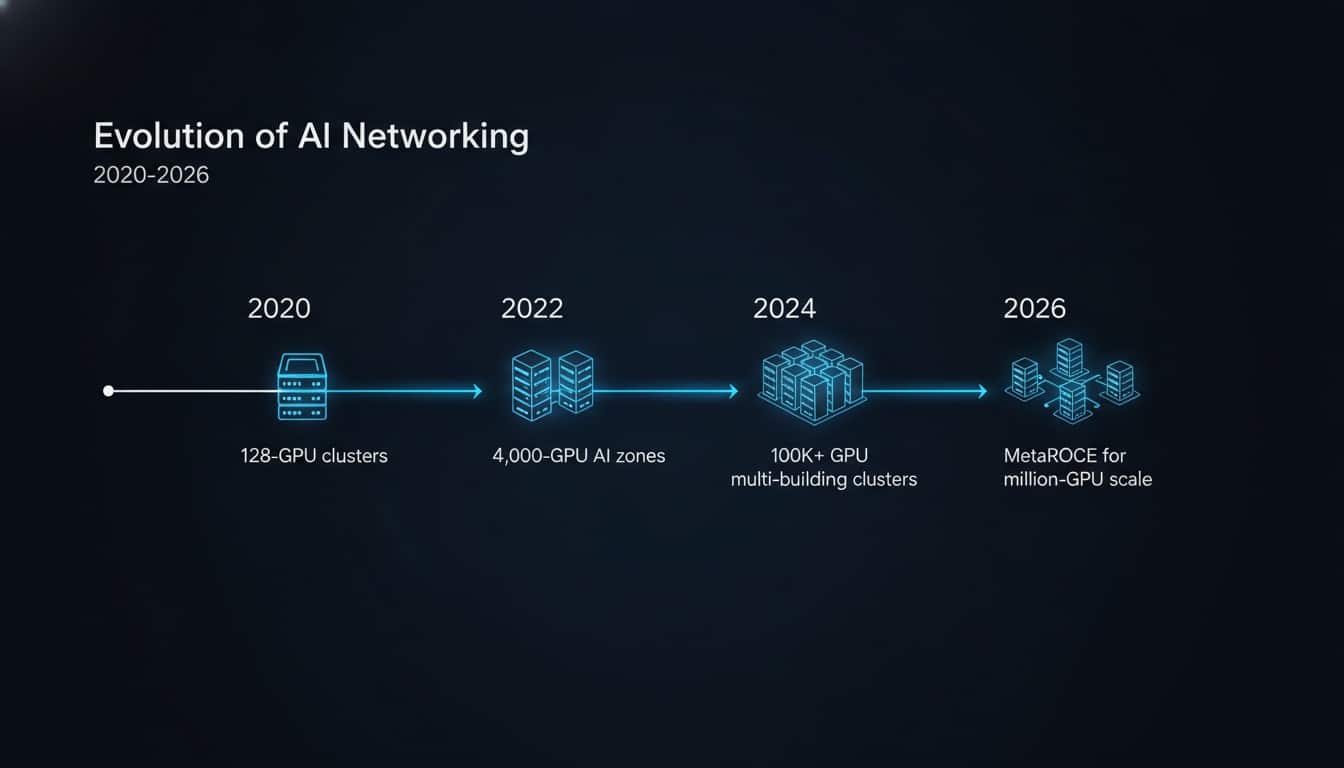
Modern AI training clusters span hundreds of thousands of accelerators spread across multiple data centers and regions. Meta itself has scaled clusters to this magnitude, with plans to reach over one million GPUs, following a trajectory similar to other hyperscale AI infrastructure buildouts happening globally. At this scale, collective operations like all-reduce and all-to-all become the critical path. Every GPU must synchronize with every other GPU, and a single slow transfer delays the entire training step.
This phenomenon is known as the tail-at-scale effect.
What appears as a rare packet loss at the single-node level becomes frequent when observed across thousands of GPU nodes synchronizing in parallel. As researchers from a recent academic paper on reimagining RDMA for machine learning noted, these losses accumulate at synchronization points, turning infrequent delays into persistent tail latency that degrades the entire cluster.
The networking challenge extends beyond training. As the industry pushes toward more powerful and densely packed compute architectures, the interconnect between those chips becomes proportionally more critical. Inference workloads now require low-latency communication between distributed model shards, directly impacting response times for hundreds of millions of users. As Meta has observed, the requirements for distributed inference are beginning to resemble those of training, demanding high-speed backend networks that were historically associated only with training jobs.
What Is RoCE and Where Does It Break Down?
To understand why MetaRoCE matters, it helps to understand the technology it aims to replace. RDMA (Remote Direct Memory Access) is a mechanism that allows one computer to directly access the memory of another without involving the CPU or operating system kernel. This direct memory-to-memory transfer eliminates the copying and context-switching overhead that makes traditional networking slow.
RoCE (RDMA over Converged Ethernet) is the protocol that brings RDMA semantics to standard Ethernet networks. The current version, RoCEv2, encapsulates RDMA transport packets inside UDP/IP datagrams, allowing them to traverse regular IP-routed Ethernet infrastructure. This made RDMA accessible beyond the specialized InfiniBand fabrics that originally dominated high-performance computing.
RoCEv2 has served the industry well for clusters of hundreds to a few thousand GPUs. But it carries fundamental assumptions that break at the scales AI training now demands:
- Lossless operation: RoCEv2 expects the network to deliver every frame without loss. It relies on Priority Flow Control (PFC) and pause frames to prevent packet drops, which requires careful tuning and creates operational complexity.
- In-order delivery: The protocol assumes packets arrive in the order they were sent. A single out-of-order packet can trigger head-of-line blocking, stalling the entire connection until the missing packet arrives.
- Single-path routing: Standard RoCEv2 uses Equal-Cost Multi-Path (ECMP) hashing to select a single path per flow. This means one congested or failed link can bottleneck an entire connection, even when alternative paths are available.
- Queue pair explosion: To get more bandwidth or ordering, traditional RDMA opens more queue pairs, often dozens per node pair. Each queue pair maintains its own congestion window, blind to the others, creating state that grows with workload parallelism.
At the scale of hundreds of thousands of GPUs, these limitations become acute. A 0.001% packet loss rate can reduce training throughput by 10 to 30 percent because a single stalled GPU stalls the entire cluster at the synchronization barrier. PFC misconfiguration can cause cascading pauses that ripple across the fabric. The operational burden of maintaining lossless Ethernet at this scale is substantial.
Inside MetaRoCE: Six Design Principles That Change Everything
MetaRoCE inverts the traditional approach. Instead of making the fabric smarter and more reliable, it makes the endpoints smarter and accepts that the fabric will lose packets. The core insight, as Meta describes it, is that “the fabric sees packets, but the NIC sees intent.”
Here are the six design decisions that define the protocol:
1. Out-of-Order Delivery Is the Default
MetaRoCE sprays packets across many paths, so they arrive out of order by design. Every packet carries its own destination address, allowing data to be written straight to its final memory location as it lands. There is no reorder buffer and no head-of-line blocking. If one packet is delayed on one path, the others continue unimpeded.
2. Native Multipathing
Each connection gets first-class paths, and the NIC sprays across them packet by packet. Each path carries a distinct UDP source port as its ECMP entropy, which the NIC can change at any time to move traffic off a bad route. Because each path maintains its own window and round-trip time estimate, the transport can distinguish congestion from failure and rebalance explicitly.
3. Loss Tolerance by Design
This is the philosophical core of MetaRoCE. The protocol treats the Ethernet fabric as lossy and does not ask it to be otherwise. No PFC. No pause frames. Each path carries its own ordered sequence, so a gap in its 256-bit selective acknowledgment bitvector is evidence of loss rather than reordering. That gap triggers retransmission of exactly the missing packet on the path that lost it the moment the gap appears.
4. Congestion Control From Both Ends
MetaRoCE combines sender-driven ECN-based Additive Increase Multiplicative Decrease (AIMD) with receiver-driven fair-share rate hints. In every acknowledgment, the receiver returns the share of its inbound bandwidth it has allocated to that sender. This means senders approach the right speed directly rather than searching for it. Incast, a common pattern in AI training where many GPUs respond to one simultaneously, resolves in one or two round trips.
5. Topology Independence
MetaRoCE asks the fabric for only two things every switch already has: ECN marking and ECMP. It does not require packet trimming, in-network telemetry, credit-based flow control, or switch-side spraying. The same transport runs over fat-tree, multiplane, deep-buffer, and shallow-buffer fabrics, including vendor clouds whose configuration you do not control.
6. Unified Connections at Scale
Traditional RDMA scales ordering and bandwidth by opening more queue pairs, each with its own congestion window and NIC state. MetaRoCE separates the two concerns. A single connection carries many independent ordered streams above (one per communicator or collective) and many paths below, under one congestion controller. Connection state stops growing with the parallelism of the workload.
The application layer remains mostly untouched. Existing RDMA Verbs APIs and software stacks work without modification, with enhanced features like multiplane support available through extension APIs.

MetaRoCE vs. RoCEv2: What the Benchmarks Actually Show
Meta implemented MetaRoCE on AMD Pensando programmable NICs and tested it on a 64-node AMD GPU cluster running RCCL (ROCm Communication Collectives Library) collectives. The direct comparison against RoCEv2 across all-reduce and all-to-all operations produced consistent results:
- Higher throughput across all tested configurations
- Lower flow completion times than RoCEv2
- ~86% throughput maintained at 1% packet loss, a condition that would severely degrade standard RoCEv2
- Useful bandwidth even at 10% loss rates, converging gracefully rather than collapsing
The resilience result is the headline number. Standard RoCEv2, which depends on lossless operation, experiences catastrophic performance degradation when packets are dropped. MetaRoCE, designed from day one to expect and recover from loss, maintains the majority of its throughput under the same conditions.
Multiplane validation across 4-plane and 8-plane topologies with up to 4,000 concurrent connections confirmed that throughput scales linearly with plane count. During simulated plane failures, the protocol demonstrated graceful autonomous recovery: traffic redistributed without application involvement or operator intervention.

MetaRoCE vs. InfiniBand: Ethernet’s Case for AI Networking
No discussion of AI networking is complete without addressing InfiniBand, the purpose-built fabric that has long been the gold standard for high-performance computing. Understanding where MetaRoCE fits requires understanding the broader Ethernet versus InfiniBand debate.
InfiniBand delivers hardware-enforced lossless transport with sub-microsecond switch hop latency (roughly 200 to 300 nanoseconds per hop). For 8xH100 all-reduce operations, InfiniBand NDR achieves approximately 350 GB/s effective bus bandwidth. Well-tuned RoCEv2 on 400GbE reaches approximately 270 to 290 GB/s, or about 77 to 83 percent of InfiniBand performance.
But performance is only part of the equation. The cost difference is dramatic:
| Component | InfiniBand NDR | RoCEv2 (Commodity) | MetaRoCE (Projected) |
|---|---|---|---|
| 64x NICs | ~400,000 | ~140,000 | ~140,000 |
| Switch | ~65,000 | ~20,000 | ~20,000 |
| Cables/Optics | ~25,000 | ~15,000 | ~15,000 |
| 64-GPU Fabric Total | ~490,000 | ~175,000 | ~175,000 |
| Per-GPU/Hour (Amortized) | ~0.29 | ~0.10 | ~0.10 |
At 1,024 GPUs, an InfiniBand fabric can cost approximately $7.7 million, while a comparable RoCEv2 fabric runs closer to $6 million. MetaRoCE uses the same commodity Ethernet hardware as RoCEv2, so the hardware cost advantage carries over directly.
Where MetaRoCE changes the equation is in closing the performance gap. Standard RoCEv2 requires extensive PFC and DCQCN tuning to approach lossless operation, and it has no equivalent of InfiniBand’s SHARP in-switch collective offload. MetaRoCE eliminates the need for lossless configuration entirely while delivering higher throughput than standard RoCEv2. It does not match InfiniBand’s raw latency, but it narrows the effective performance gap by being more resilient under real-world conditions where packet loss is inevitable at scale.
The practical guidance, according to industry analysis, is that InfiniBand remains the strongest choice for the largest dedicated training clusters (10,000+ GPUs) where absolute peak performance justifies the cost premium. For most AI deployments in the 256 to 10,000 GPU range, Ethernet-based solutions deliver 85 to 95 percent of InfiniBand’s training throughput at significantly lower cost. MetaRoCE strengthens Ethernet’s position by addressing the protocol-level weaknesses that previously made RoCEv2 fragile at scale.
The “Design for Loss” Paradigm Shift
The most significant aspect of MetaRoCE is not any single technical feature. It is the philosophical shift it represents: designing for loss rather than fighting it.
For decades, the networking industry has treated packet loss as a failure condition to be eliminated. Priority Flow Control, pause frames, Data Center Bridging, and elaborate Quality of Service configurations all exist to create the illusion of a lossless network on top of inherently lossy hardware. This approach works at a small scale, but it introduces operational complexity, configuration fragility, and cascading failure modes that grow worse as the network grows larger.
MetaRoCE takes the opposite approach. It accepts that Ethernet will lose packets, especially at the scale of hundreds of thousands of endpoints generating synchronized traffic bursts. Rather than preventing loss, it makes loss recovery fast, precise, and localized. A lost packet on one path triggers retransmission on that specific path without affecting any other path or connection.
This approach draws on a growing body of academic research. The Celeris project, which reimagines RDMA through the lens of machine learning workloads, reached similar conclusions: strict reliability and in-order delivery mechanisms designed for general-purpose workloads introduce complexity and latency that scale poorly in ML environments. By aligning transport semantics with ML workload characteristics, these researchers found that you can avoid the systemic buildup of tail latency from cluster-wide delays.
Meta’s own experience validates this. In their SIGCOMM 2024 paper on RoCE at scale, the company documented the challenges of tuning DCQCN congestion control for AI training workloads, noting that distributed training produces unique traffic patterns that create different modes of congestion. MetaRoCE is the culmination of those lessons: a protocol that works with the physics of Ethernet rather than against them.
Open by Design: The OCP Strategy and What Comes Next
MetaRoCE extends the multi-vendor philosophy that OCP’s Ethernet Scalable Unified Network (ESUN) initiative established for the fabric into the transport layer. Three artifacts will ship at the 2026 OCP Global Summit in October:
- Full protocol specification via OCP: Available for any vendor to implement and build interoperable hardware.
- Production compliance suite: Tools that let hardware vendors prove their implementations match the protocol specification.
- libsoftmetaroce: A complete, functional transport stack that runs on commodity Linux over standard UDP sockets without specialized hardware. It serves as the authoritative behavioral model for silicon development.
Meta has proven MetaRoCE on AMD Pensando programmable NICs, with additional implementations underway from other vendors.

The protocol is designed to run across diverse NIC architectures, both programmable and fixed-function.
Looking ahead, Meta has identified three areas of continued development:
- Scale-up (within a rack): Optimizing the fast signaling path for short memory operations between accelerators where every nanosecond matters.
- Scale-across (multi-building): Enabling a single training job to span buildings thousands of kilometers apart, where round trips stretch into milliseconds.
- Storage and KV-cache: Applying receiver-driven rate hints to distributed storage workloads that invite incast patterns, including the KV-cache transfers between prefill and decode pools that are becoming critical for large-scale inference.
What MetaRoCE Means for Enterprise AI Deployments
MetaRoCE is not yet deployable. The specification, reference implementation, and compliance framework are expected at the OCP Global Summit in October 2026. Hardware support is early: Meta has proven the protocol on AMD Pensando NICs, with other vendors working on implementations. For now, this is a fabric-architecture decision, not a procurement one.
But the implications for enterprise AI are significant. As the AMD comparative analysis of RoCE network traffic highlights, hyperscale deployments like xAI’s 200,000-GPU Colossus cluster generate network loads orders of magnitude higher than smaller-scale efforts. The congestion control, adaptive routing, and telemetry challenges that Meta solved with MetaRoCE will eventually trickle down to enterprise-scale deployments as AI clusters grow.
For organizations building AI infrastructure today, MetaRoCE signals the direction the industry is heading, alongside efforts like multi-vendor AI factory strategies that are reshaping how organizations build AI infrastructure. The Ultra Ethernet Consortium and OCP’s ESUN initiative are both working to standardize next-generation Ethernet for AI, and MetaRoCE’s transport-layer innovations complement these physical and link-layer efforts.
The practical takeaway: if you are designing an AI fabric today, RoCEv2 on commodity Ethernet with proper PFC and ECN configuration remains the production-ready choice for clusters up to several thousand GPUs. But MetaRoCE points to a near future where the operational complexity of lossless Ethernet configuration is no longer necessary and where Ethernet can match or exceed its current performance while being fundamentally simpler to operate.
Frequently Asked Questions
What is RoCE in networking?
RoCE stands for RDMA over Converged Ethernet. It is a protocol that enables Remote Direct Memory Access (RDMA) over standard Ethernet networks, allowing direct memory-to-memory transfers between computers without CPU involvement. The current version, RoCEv2, encapsulates RDMA packets in UDP/IP datagrams for routing across regular IP networks.
What is the difference between RoCE and InfiniBand?
InfiniBand is a purpose-built networking fabric with hardware-enforced lossless transport and sub-microsecond latency. RoCE delivers RDMA semantics over commodity Ethernet, which is cheaper and uses existing infrastructure but requires careful configuration to achieve lossless operation. InfiniBand typically delivers 15 to 25 percent higher throughput for AI collectives but at 2 to 3 times the hardware cost. MetaRoCE narrows this gap by eliminating the need for lossless configuration while maintaining higher throughput than standard RoCEv2.
When can I deploy MetaRoCE?
Not yet. Meta plans to release the specification, a DPDK-optimized software reference implementation, and the production compliance framework at the 2026 OCP Global Summit in October. Hardware implementations are in progress from multiple vendors beyond AMD. Widespread vendor availability will likely follow in 2027.
Does MetaRoCE replace InfiniBand?
Not directly. MetaRoCE strengthens Ethernet’s position for AI networking, particularly for clusters in the hundreds to tens of thousands of GPUs range. InfiniBand retains advantages in raw latency and in-switch collective offload (SHARP) for the very largest dedicated training clusters. The two technologies will likely coexist, with the choice depending on cluster size, budget, and operational requirements.
What hardware do I need for MetaRoCE?
MetaRoCE requires programmable NICs that can implement the protocol’s transport logic. Meta has validated it on AMD Pensando programmable NICs. The protocol asks the network fabric for only ECN marking and ECMP, which are standard features on virtually all modern data center switches. No proprietary switch features or special fabric configurations are required.
How does MetaRoCE handle packet loss?
MetaRoCE treats packet loss as normal rather than exceptional. Each path maintains its own ordered sequence with a 256-bit selective acknowledgment bitvector. When a gap appears in the bitvector, the protocol retransmits exactly the missing packet on the specific path that lost it. This targeted retransmission avoids the cascading stalls that packet loss causes in traditional RoCEv2.


