
NASA continues outdoing itself with the magnificent photographs of space that it releases. However, despite the organization’s high standards, a 12-year timelapse of the entire sky is an astonishing feat.
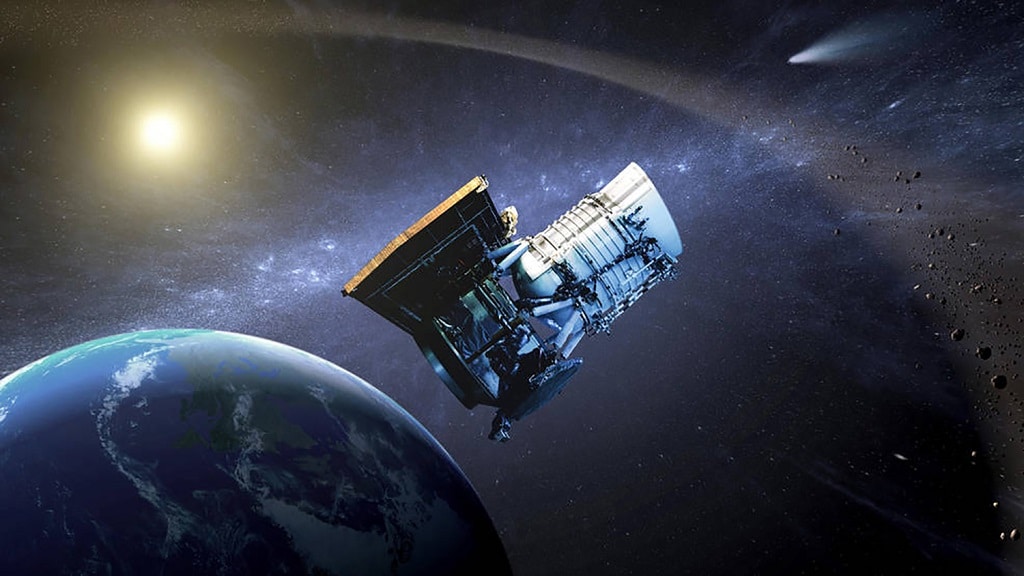
The NEOWISE space telescope, launched in 2009 under the former name “WISE” to investigate the Universe outside of our Solar System, has collected images throughout those years.
Since then, it has been renamed and repurposed to track near-Earth objects like comets and asteroids.
NEOWISE Data
Data acquired by NEOWISE (Near-Earth Object Wide Field Infrared Survey Explorer) provides scientists with crucial insight into how celestial objects move and change over time (time-domain astronomy), whether stars are exploding or roaming across the night sky or black holes are sucking up gas.
NEOWISE’s principal investigator, astronomer Amy Mainzer of the University of Arizona, stated:
“If you go outside and look at the night sky, it might seem like nothing ever changes, but that’s not the case.”
The readings obtained by NEOWISE reveal the position and amount of infrared light emitted by hundreds of millions of objects. After that, this data can be examined to determine what an object is doing.
Every six months, when the telescope goes halfway around the Sun, it collects data on the whole sky. Astronomers have now put together 18 maps to make the time-lapse.
Brown Dwarfs
The maps have proved particularly valuable for analyzing brown dwarfs – objects that do not have the mass to ignite the fusion required to become a brightly burning star but have comparable origins. In addition, those closer to Earth objects appear to move across the sky more quickly than farther away ones, making it easier for NEOWISE to identify them.
So far, the telescope has found roughly 260 brown dwarfs. As a result of its research, we now know nearly twice as many Y-dwarfs, which are the coldest brown dwarfs, and of great interest to astronomers because they can shed light on the effectiveness of star formation and its timing in the evolution of our galaxy.
Peter Eisenhardt, an astronomer with the NASA Jet Propulsion Laboratory in California, stated:
“We never anticipated that the spacecraft would be operating this long, and I don’t think we could have anticipated the science we’d be able to do with this much data.”
Through the telescope’s sky scanning, we also learn more about how stars are formed. Protostars, objects that briefly flash before becoming stars, stand out in the night sky, and scientists are currently following around 1,000 of them to observe their growth.
Black Holes and Unseen Objects
Then there is the black hole, arguably the most fascinating celestial phenomenon. NEOWISE data can be used to spot bursts of infrared light from clouds of matter swirling around black holes, allowing us to observe these objects from a greater distance.
The project still needs to be completed, and NEOWISE will continue its mapping mission with plans to release two more sky maps in March 2023. However, you can expect the project to reveal a lot more soon—things you can not see when you look at the stars in the night sky. “Stars are flaring and exploding. Asteroids are whizzing by. Black holes are tearing stars apart. The Universe is a really busy, active place,” said Mainzer.
You can get more information by visiting the NEOWISE Project website.


