The human eyeballs encompass substances that are difficult to penetrate. These obstacles make successful ocular drug delivery challenging. The current method of topical administration to treat diseases in the anterior of the eye works, but is not good enough. It is difficult for therapeutic agents to breach the substances making the method inefficient, slow, and sometimes unsuccessful. That is why researchers in the field of ophthalmology strive to find a better way. The searching has led to a completely futuristic approach – a swarm of robotic medicine delivering nanoparticles.
These robotic nanoparticles are slippery micropropellers that can penetrate the vitreous body of the eye. They would be filled with a medication to be delivered directly where needed by injection to the eyeball. Soon they could be used to treat diseases ranging from diabetic retinopathy, glaucoma, to diabetic macular edema by transporting medicine to the back of a patient’s eye.

While traditional delivery methods rely on the random, passive diffusion of molecules (that do not allow for the rapid delivery of a concentrated cargo to a defined region at the posterior pole of the eye) these nanobots are quick (10x faster) and direct. To top it off, clinical optical coherence tomography is used to monitor the movement of the propellers and confirm their arrival.
How is this possible?
Challenge One
If the size of the micropropellers (robots) is much smaller than the mesh size of the complex network (human eyeball) it has to penetrate, then the propulsion of the nanopropellers is possible in the nanoporous medium (the eyes dense tissue, also known as, the lacrimal fluid-eye barrier and the retina–blood barrier). And these microscopic nanobots are definitely small enough. At about 500 nanometers wide, they’re around 200 times smaller than the diameter of a human hair, just the right size for sliding around in the complex molecular matrix of the eyeball.
The new robots were developed (and created using a 3D printer) at the Max Planck Institute for Intelligent Systems in Stuttgart, Germany, with input from researchers in Denmark and China. Details on the emerging technology are published in the journal Science Advances. The project is part of a larger initiative to design extremely small robots that can achieve targeted drug delivery inside dense biological tissue.
“We want to be able to use our nanopropellers as tools in the minimally-invasive treatment of all kinds of diseases,” said co-author Tian Qiu, “where the problematic area is hard to reach and surrounded by dense tissue.”
While similar nanobots have been developed for moving through other parts of the body, (the bloodstream and the gastrointestinal tract for example) the Planck bots are the first to be designed specifically to swim through a human eyeball.
Challenge Two
The first challenge was size. The second was to find a way to keep the robots (which move like a corkscrew) from getting entangled in the eyeball’s mesh of biological molecules. The robot itself is a device called a micropropellor. It uses a spiral tail to spin through the vitreous humor – a clear, jelly-like substance behind the white of your eye which makes up 80 percent of the organ. But the device itself wasn’t flowing through the “jelly” smoothly or as directed.
To solve this dilemma the scientists used a perfluorocarbon liquid to coat the micropropellors and make them slippery.
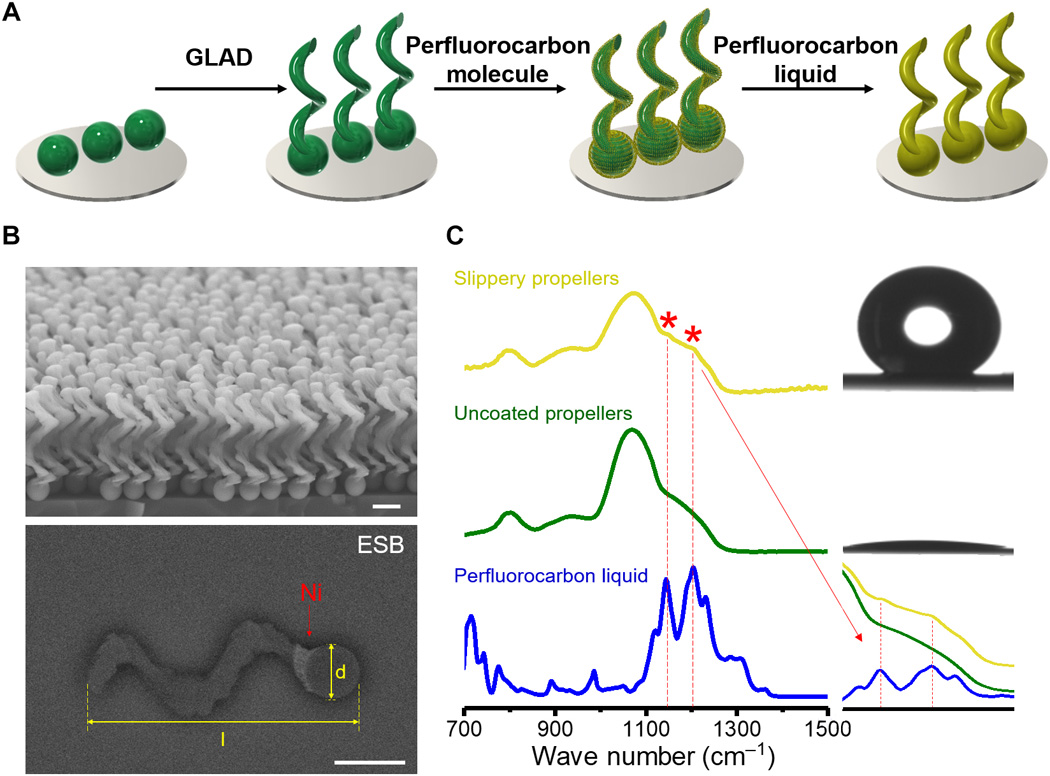
This synthetic non-stick layer is similar to the Teflon coating of a frying pan, Wu explains. It was inspired by a liquid layer found on the carnivorous Nepenthes pitcher plant. The plant uses the slippery layer to catch insects.
Challenge Three
The third challenge was guided maneuverability, in other words, how to navigate the robots to the desired location through the eyeball. For this, a standard system (used by other kinds of medical nanobots) was appointed – magnets. The tails of the robots were seeded with tiny metal particles (made of nickel) that respond to an external magnetic field.
The external magnetic field is the control board where the doctor can guide the robot(s) to the desired location within the eye. The medics have full control and can drive them in any direction (forwards, backward, left or right, up, down) while watching them on a live scan to see where they’re going.
Testing The Resolution
A series of experiments were conducted using dissected (dead) pig eyeballs to test the new technology. The Planck team injected tens of thousands of the bots into the eyeball’s vitreous humor. They were able to guide all of them simultaneously to the retina in just half an hour. The team concluded that the use of nanobots is more effective and faster than using eye drops or injections. The scientists believe that one day they could be used to prevent or reverse blindness.