As technology rapidly progresses, there’s an emerging understanding that nature may be the key to solving numerous environmental problems. This understanding has led to the rise of biomimicry, a pioneering approach where nature’s innovative designs and processes inspire human solutions. Biomimicry involves observing and adapting natural models to address human challenges effectively and sustainably. This approach has birthed a captivating branch of robotics dedicated to replicating the intelligence inherent in the natural world. These bio-inspired robotics aim to deliver practical solutions that harness nature’s time-tested ingenuity, enabling societies to tackle ecological issues with heightened efficiency and sustainability.
Among these innovations is Plantolin, a remarkable robot fashioned after the pangolin, renowned for its peculiar yet effective seed planting method and its origins in a young student’s imagination. This robot, and others like it, represent a shift toward sustainable technologies that utilize biology as a blueprint. As these nature-inspired robots gain momentum, they promise ecological benefits and highlight the importance of fostering creativity and innovation in the next generation. Join us as we explore what makes Plantolin extraordinary and explore other fascinating nature-inspired robots making waves in today’s tech landscape.
Meet Plantolin: A Pangolin-Inspired Robotic Marvel
Design and Inspiration
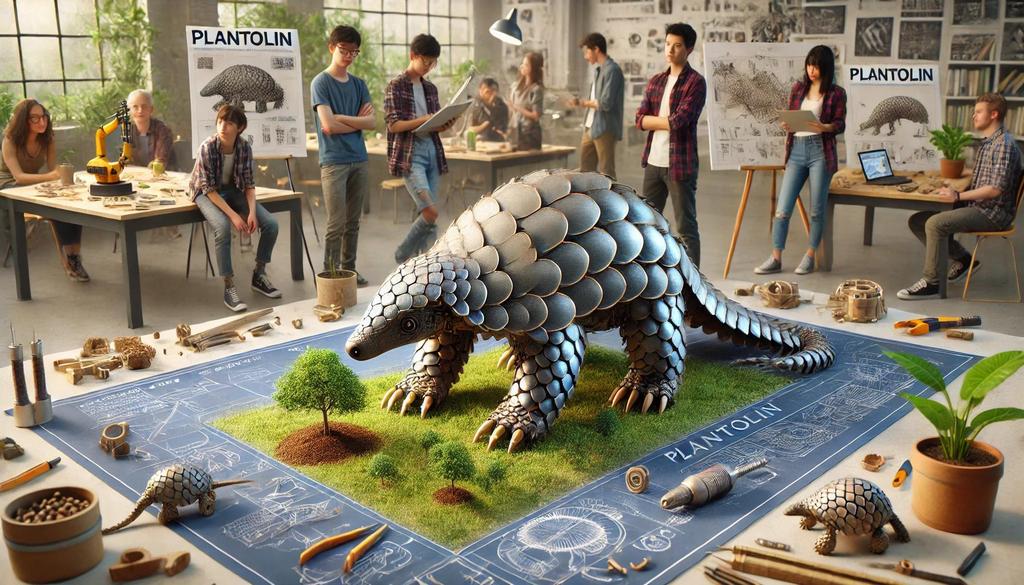
In the world of robotics, sometimes the most captivating ideas come from those with the freshest perspectives. Meet Plantolin, a revolutionary tree-planting robot inspired by the natural world, specifically the pangolin, an animal celebrated for its unique armored exterior and adept digging skills. This ingenious creation is the brainchild of Dorothy, a high school student from California, who submitted her concept to the Natural Robotics Contest.
Out of 184 entries, Dorothy’s design captured judges’ attention not just because of its charming resemblance to a “walking pine cone” but due to its thoughtful integration of nature’s mechanisms to address a critical ecological issue: deforestation. Researchers at the University of Surrey were able to take this concept a step further and develop Dorothy’s vision!
Dorothy envisioned a robot that would mimic the pangolin’s natural behaviors to plant trees efficiently. Her goal was to create a device capable of assisting in forest restoration, an effort crucial in combating climate change and enhancing biodiversity both in urban and rural settings. Using the animal’s natural propensity for digging, Plantolin promises a sustainable solution for seed planting, thus helping replenish and protect our fragile ecosystems.

Functionality and Environmental Impact
Plantolin’s design is a testament to the blend of simplicity and innovation. This robot traverses different terrains with the grace of a Segway, balancing effortlessly on two wheels with the support of a movable tail for stability. Equipped with motorized claws, Plantolin digs precise holes to deposit “seed bombs”—nuggets packed with seeds and nutrients, ready to grow into mature plants. This ingenious mechanism is a beacon of technological ingenuity, reflecting how large animals naturally contribute to seed dispersion but with a consistency and reach that’s challenging to achieve in urban environments.
The potential impact of Plantolin extends beyond its immediate function. As forests are fundamental in sequestering carbon dioxide and providing habitats for countless species, enhancing reforestation efforts is pivotal in combating climate change. Plantolin, by mimicking natural processes, offers scalable and eco-friendly solutions to this global challenge. Furthermore, its design demonstrates how engineering can effectively borrow from natural models to solve modern problems.
The Importance of Supporting Young Innovators
Plantolin is not merely a testament to robotic advancement; it underscores the significance of nurturing young minds and transforming their ideas into reality. Encouraging children to engage in STEM (Science, Technology, Engineering, and Mathematics) activities and contests cultivates a generation of innovators who approach problems with fresh perspectives and imaginative solutions. Initiatives like the Natural Robotics Contest highlight the necessity of providing platforms for young people to express their creativity and insights, fostering skills crucial in today’s innovation-driven society.
By acknowledging and supporting the potential in children’s ideas, we inspire them to pursue careers in STEM fields, driving future discoveries and technological advancements. When educational institutions, industry leaders, and communities collectively invest in these young talents, they not only empower individual growth but also contribute to a brighter, more sustainable future for everyone. As the story of Plantolin demonstrates, even the smallest spark of imagination has the power to ignite significant change, proving that the future of robotics and environmental conservation may well rest in the hands of today’s youth.
Plantolin’s journey from concept to reality exemplifies how engaging with natural inspirations and supporting young creators can lead to sustainable technological solutions. As we look to the future, stories like Plantolin encourage us to continue exploring nature-inspired innovations, ensuring a brighter, more interconnected world.

The Evolution of Bio-Inspired Robotics
In recent years, a remarkable shift has occurred in the world of robotics, where inventors and engineers are increasingly looking to nature for inspiration. This field, known as bio-inspired robotics, leverages designs and behaviors observed in the natural world to drive innovation in robotic technology. Let’s explore some of these fascinating creations and how they’re paving the way for the future.
Communication Through Dance: Robots Inspired by Honeybees
Nature often has elegant solutions to complex problems, and one such example is the communication method of honeybees. Honeybees use a “waggle dance” to convey detailed information about the location of food sources. Drawing from this, scientists have developed robots that mimic the waggle dance to communicate in environments where wireless networks are unavailable, such as disaster-stricken areas.
These robotic systems, inspired by the honeybee’s dance, highlight how animals can effectively communicate vital information without words. In practical terms, robots equipped with this communication style could help locate packages in a building by interpreting gestures from a user and translating these into clear directions for other robots. Projects like RoboBee and Hiveopolis further demonstrate the potential of this technology, with Hiveopolis using robotic bees to gather data on healthy bee colonies, potentially alleviating the devastating effects of colony collapse disorder.

The Untethered Frontier: Flying Fish Robot
The concept of taking unexpected forms from nature, like flying fish, and turning them into functional robots is an exciting frontier. Engineers at Imperial College London have developed a flying fish robot capable of taking off from water and soaring through the air. This robot can travel up to 85 feet after take-off, resembling how some fish escape predators.
This robot is intended for use in environmental monitoring and is capable of collecting water samples in the aftermath of floods, oil spills, or nuclear disasters. It operates using a simple combustion system, harnessing the reaction between water and specific chemicals to generate the propulsion needed for its flight. The flying fish robot showcases a creative solution to tackling real-world issues, highlighting the integration of natural mechanics into advanced technology.

Collective Power: Swarm Robotics
Swarm robotics borrows inspiration from the collective behaviors of animals like ants and bees, where a group of simple units work together to perform complex tasks without centralized control. Imagine tiny robots working collectively like a swarm of bees or army ants, capable of tackling tasks that a single robot could not handle independently.
These robots can link together to navigate difficult terrains, carry out search and rescue missions, or even support construction tasks. The strength of swarm robotics lies in numbers and coordination, effectively mimicking nature’s practicality. This technology extends beyond physical robots—Swarm AI explores how collective human decision-making processes can be enhanced by understanding swarm behaviors, promising to improve decision-making in numerous fields, from medicine to finance.
Advancements in Autonomous Environmental Exploration
Autonomous environmental exploration is one of the most exciting and impactful areas in exploring bio-inspired robotics. These advancements have led to the development of robots that can navigate challenging terrains and gather vital ecological data, bringing us closer to understanding and conserving our planet’s biodiversity. Here, we delve into some remarkable robotic innovations changing how we interact with the environment.
AVOCADO: Discovering the Rainforest Canopies
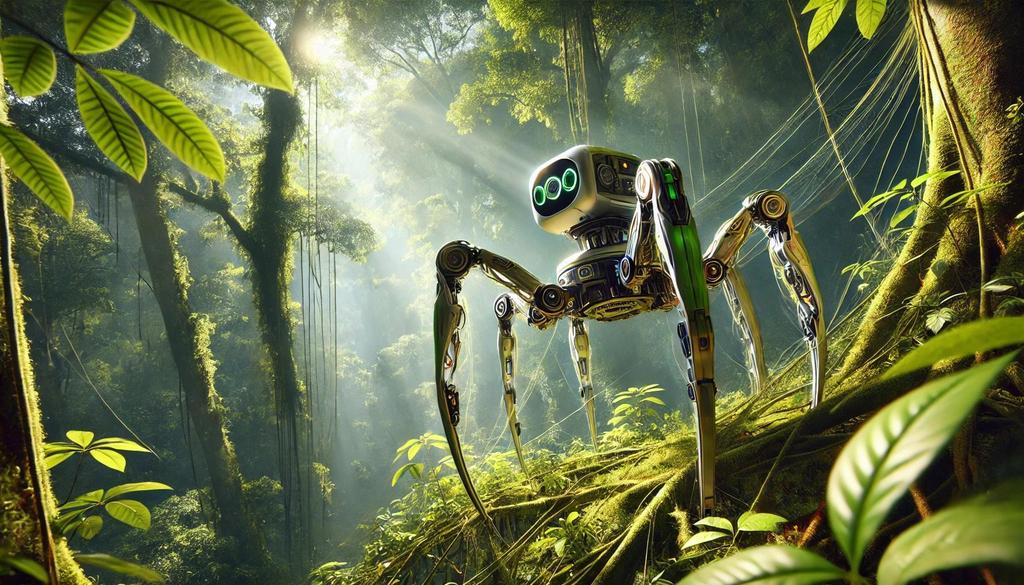
The jungles and rainforests of our world are teeming with life, playing a crucial role in supporting our planet’s biodiversity. However, exploring these dense canopies has always been a daunting task for researchers. Enter AVOCADO, a cutting-edge robot designed to traverse these challenging environments autonomously.
AVOCADO employs state-of-the-art biomimicry techniques, allowing it to navigate rainforest canopies with agility reminiscent of a spider. Its robust design helps it withstand the harsh conditions of the treetops, enabling it to collect critical ecological data that researchers can use to study forest dynamics, species interdependence, and climatic interactions. This makes AVOCADO not just a tool for data collection but a critical contributor to unlocking the secrets hidden in these towering green fortresses.
AVOCADO’s ability to cover areas that were previously inaccessible to humans presents an unprecedented opportunity to monitor these ecosystems more comprehensively. By advancing our understanding of the rainforest’s complex ecosystems, AVOCADO is helping us to protect and preserve these vital natural resources for future generations.

Biohybrid Robotics: Fungal Mycelium Integration
The fusion of biology and technology is giving rise to innovative solutions for environmental exploration, with fungal mycelium at the forefront of this development. Mycelium, the network of fine threads from fungi, is being integrated into robots, resulting in biohybrid systems that blend living organisms with mechanical components.
These biohybrid robots harness the natural sensory abilities of mycelium, which can react to environmental changes by emitting electrical signals. Researchers have embedded these sensitive networks into robots, enabling them to sense and respond organically to their surroundings. This creates robots that can adapt to various environmental conditions more naturally than traditional machines.
Applications for such robots extend into agriculture, where they could autonomously monitor soil health, potentially enhancing crop yields by determining when and where to irrigate or fertilize. Furthermore, in environmental monitoring, these biohybrids could be deployed to measure pollution levels, track ecosystem changes, or even assist in detecting signs of life in search and rescue missions after natural disasters.
Biohybrid robots exemplify the potential of merging living systems with technology to create responsive and sustainable machines. As research continues, these robots could transform sectors such as environmental conservation, agriculture, and even space exploration, showcasing the incredible possibilities of integrating biology into mechanical systems.

The Future of Nature-Inspired Robotics
As we stand at the intersection of technology and nature, the future of robotics is being reshaped by innovations that draw inspiration from the natural world. These advancements promise to enhance existing technologies and redefine how we approach some of the world’s most pressing ecological and societal challenges.
Harnessing Nature’s Ingenuity for Real-World Solutions
Nature-inspired robots, like Plantolin and its counterparts, show immense potential for solving real-world problems. They can improve environmental restoration efforts, tackle agricultural inefficiencies, and even assist in disaster recovery processes. The idea is simple yet profound: leveraging the ingenious designs found in nature to create robots that can perform tasks more efficiently and sustainably than ever before.
Navigating Challenges in Biohybrid Robotics Integration
However, with great potential comes significant challenges. As we integrate living systems into robotic designs—such as using fungal mycelium in biohybrid robots—we must navigate ethical and environmental concerns. For example, introducing biohybrid robots into natural ecosystems could inadvertently disrupt delicate ecological balances. Researchers and policymakers need to ensure that these technologies are developed and deployed responsibly, keeping in mind the broader impacts on biodiversity and natural systems.
Enhancing Practicality in Robotics for Real-World Application
Refining these technologies to be practical for real-world applications is also challenging. For instance, improving battery efficiency and sensor capabilities is crucial for the long-term viability of such robots. Fortunately, ongoing research and interdisciplinary collaboration are helping overcome these hurdles, paving the way for more versatile and autonomous robotic systems.

The Future of Bio-Inspired Robotics: Bridging Technology and Nature for Sustainable Innovation
While nature-inspired robotics is in its nascent stages, the potential it holds to revolutionize industries and environmental management is substantial. As they evolve, these technologies will foster harmonious connections between humans, robots, and the natural environment. This harmony reflects a seamless integration, where robotics emulates the precise mechanisms found in nature to provide sustainable and efficient solutions addressing significant global challenges. The path forward is driven by innovations such as the bee’s intricate dance or the coordinated efforts of ants, demonstrating how bio-inspired robotics continually amazes and motivates progress.
Utilizing the innate intelligence and systems in nature, these advancements in autonomous environmental exploration pave the way for sustainable interactions with ecosystems. The technological wonders, ranging from the AVOCADO project navigating rainforest canopies to biohybrid robots analyzing soil health, demonstrate a future where the synergy between technology and nature is being realized today.
Bio-inspired robotics embodies a captivating union of ancient ecological wisdom and futuristic ingenuity. This union, informed by the extensive tapestry of life that spans millions of years, allows the design of technologies that effectively address modern-day problems while ensuring long-term sustainability.
As this domain expands, it unlocks opportunities to deepen our understanding and cooperation with the world, affirming a future where technology and nature collaborate to improve the life quality of all living beings. Plantolin and its fellow robotics innovations illustrate the possibilities achievable through nature’s guidance—pioneering creations that honor and protect the earth’s sensitive equilibrium, marking the path toward a sustainable tomorrow.