
Biomimicry
Nature engineers everything to the highest standards on the planet. That’s why it has inspired many inventions and designs, a procedure known as biomimicry. Some of these creations are used often, and you may not even realize they are nature-inspired technologies, such as Velcro.
A natural history writer named Janine Benyus coined the term “biomimicry” in 1998. In her book “Biomimicry: Innovation Inspired by Nature,” she writes:
“It is important to look at nature – after all, it has had 3.8 billion years to come up with ideas…And it’s always a lot less energy, a lot less material, no toxins – a lot better.”
Benyus goes on to explain how there are three types of biomimicry. She continues:
“There are three types of biomimicry – one is copying form and shape, another is copying a process, like photosynthesis in a leaf, and the third is mimicking at an ecosystem’s level, like building a nature-inspired city.”
This emulation has extended into the field of robotics in recent years, with researchers and engineers copying a form or shape, or process to develop more efficient robots. From this pursuit rose a subfield called swarm robotics in which a collective of robots maneuvers in a coordinated manner to achieve goals autonomously and without centralized control.
Swarm Intelligence
Swarm robotics was inspired by swarm intelligence– collective behaviors of animals that enable them to achieve goals by working together without the direction of a leader. For example, army ants build bridges out of their bodies so some of them can cross rugged terrain and forage for food, and fish form schools to monitor for predators with thousands of eyes instead of only two.
There’s strength and efficiency in numbers when the individuals behave purposefully as a group. Humans want to harness this power in autonomous artificial swarms of robots for search and rescue missions, environmental remediation, construction efforts, space exploration, and medical applications.
Among such people is a group of engineers at the Wyss Institute. They were inspired by the foraging army ants and built simple mobile robots that can perform tasks by collaborating, like building human-scale structures transporting large objects or even providing instant emergency WiFi. Such robots would be used when a single robot alone couldn’t accomplish the task at hand, but together, they can. And flexibility is a significant selling point here. It may seem that a swarm of robots would be unnecessarily expensive, but together, they can do things that a single robot can’t do.
The researchers wrote:
“When the task is relatively simple (e.g., object transport on flat ground) or the task inherently requires a small single unit (e.g., object transport in a narrow tunnel), it is more cost-effective to use single robots. However, to solve high-level tasks, such as obstacle traversal and object transport in rough terrain, the units establish physical connections with each other. Thus, they can organize into a larger multilegged system.”
Although, they’re not necessarily as expensive as they seem. Swarm robots aren’t as expensive individually because they don’t need to be highly sophisticated to perform complex tasks. The algorithms that run them assign simple rules for all the individual robots to follow, and then complex behaviors can emerge through interactions among the robots. Instructions can be something as simple as “move toward the light source.”
Terrestrial Swarm Robotics
Multilegged robots can overcome unpredictable environments presented by terrain, like stepping over debris. That’s why the University of Notre Dame’s Assistant Professor Yasemin Ozkan-Aydin chose to focus on land robots over air or water. She wanted to improve their mobility and hypothesized that a terrestrial-legged collective system could be the way.
She speculated that, perhaps, for situations where a single-legged robot is incapable, multiple units could connect to form a more extensive multilegged system. (Think transformers.) Then, collaborative swarms of terrestrial robots could do things like search for survivors at disaster sites, collect and transfer objects, and explore Mars.
Prof. Ozkan-Aydin used 3D printers to build a batch of quadruped robots. Using this technology is cost-effective and efficient since swarms can be mass-made rapidly. Each unit is 6 to 8 inches long (15 to 20 centimeters) and equipped with a microprocessor, a lithium-polymer battery, a front-mounted light sensor for direction, and a magnetic touch sensor on both ends for connection. They also have four legs and a flexible tail for stability. When they connect, they look like a giant centipede.
This correlation between robotics and machine building will not cease anytime soon. The development of tiny robots is still in its early stages, and we can expect to see more advancements in the near future.
In the study, she programmed all the robots to move toward a light source using their light sensors, but one unit (the searcher robot) was programmed to have a stronger attraction to light than the others. Also, if the searcher robot got stuck or confronted with an obstacle (like crossing a gap or climbing stairs), it would wirelessly send a signal to the swarm (the helper robots). In experiments, the helper robots came to the rescue of the searcher robot by finding it and attaching themselves to it so the swarm could resume working toward its goal.


Prof. Ozkan-Aydin said there’s much more work to do to improve the technology. She’s currently focused on improving the system’s control, sensing, and power capabilities, requirements for real-world problem-solving, and locomotion. Furthermore, today’s battery technology is a limitation; so is the need for more powerful motors and sensors while keeping the robot size as tiny as possible.
She said:
“For functional swarm systems, the battery technology needs to be improved. We need small batteries that can provide more power, ideally lasting more than 10 hours. Otherwise, using this type of system in the real world isn’t sustainable. You need to think about how the robots would function in the real world, so you need to think about how much power is required, the size of the battery you use. Everything is limited, so you need to make decisions with every part of the machine.”
Swarm AI
Swarm robotics is a budding field with so much potential. At the moment, they’re only in use in a few applications, for example, monitoring crop health and water quality. The technology isn’t yet at the level where swarms can work in the tangible world without centralized human control. However, applications aren’t limited to the physical world; for example, swarm artificial intelligence.
Swarm AI is another subfield emerging to help humans generate better group decisions in fields like medical diagnoses, finance, and famine forecasting. The founder of Unanimous AI, Louis Rosenberg, explained the technology in a recent article he wrote for Big Think. He pointed out how animals like birds, bees, and fish make fantastic group decisions, but humans are pretty terrible at it.
Swarm AI harnesses these creatures’ real-time systems, which blend diverse perspectives efficiently into unified decisions. It applies Mother Nature’s successful decision-making methods to improve human forecasting and group decisions, such as diagnosing disease better or predicting stock prices.

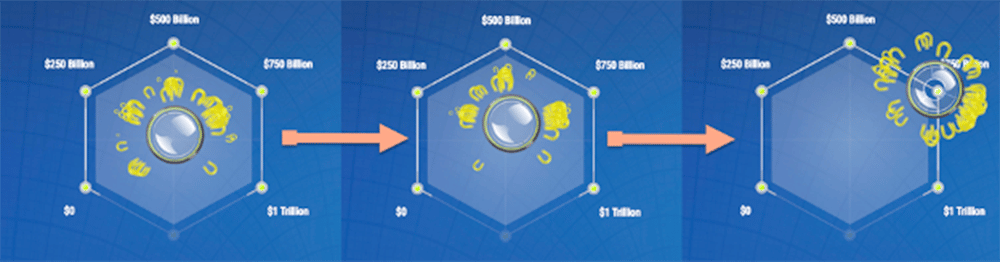
These days, humans struggle to find the best path forward because decisions are in the hands of large and complex organizations, like governments and massive corporations. Citizens vote and pass opinion data up a hierarchy to a group of deciders who claim to represent the whole population. Nature doesn’t do this, and it reaches far better societal decisions.
Rosenberg’s curiosity about how nature does this led to the founding of his company. He said:
“That’s what I wanted to know, so seven years ago, I founded Unanimous AI intending to explore this idea. Unlike most AI researchers who aim to replace people with algorithms, our goal has been to connect people with AI, enabling networked human groups to form ‘artificial swarms’ that can efficiently converge on optimized decisions. And it works, enabling teams of all sizes to make significantly more accurate decisions and predictions.”
The technology (Swarm AI) enables groups of any size to connect over the internet and deliberate as a unified system. People push and pull decisions while swarming algorithms monitor their reactions and actions. The company trains the algorithms on human behaviors. They determine each person’s level of conviction to guide the swarm toward solutions that most fittingly reflect their collective sentiments.
He continued:
“We humans need to make better decisions. Fortunately, the problem may simply be the methods we have been using to harness our collective wisdom. For most of human history, groups were small, and decisions only had a local impact. But that has dramatically changed in recent years, so our decision-making methods may need to change as well. I believe the biological principle of swarm intelligence can point us in the right direction, enabling us to make group decisions, big and small, that more accurately reflect our collective insights and aspirations.”
While some people may be turned off and frightened by this idea, it would be far more effective and fairer to apply swarm intelligence to the systems of modern society, especially as the population grows. The more humans there are, the more essential Swarm AI may become.


