
Innovative breakthroughs in bioelectronics are currently bridging the gap between synthetic hardware and organic neural pathways. Northwestern engineers recently printed flexible artificial neurons capable of generating brain-like electrical spikes to trigger responses in living mouse brain tissue. Reaching this milestone, recently documented as a significant step for bioelectronic printing, serves as a foundational step toward neuroprosthetics that communicate using authentic biological signals.
While the technical results mimic science fiction, the data remains anchored in materials science and neurobiology. Researchers produced these devices to mirror spiking neuron behavior rather than biological cells, creating a measurable bridge between printed electronics and living tissue under precise laboratory conditions.
In controlled lab tests, the printed device produced electrical signals that closely matched the timing and shape of real neuron spikes, and those signals stimulated neurons inside slices of mouse cerebellum.
Clarifying the printing process reveals that engineers produced a device mimicking spiking neuron behavior rather than a biological cell and then used it to drive measurable responses in living brain tissue under lab conditions.

Breakthrough Study Details: Printed Neurons and Neural Communication
Laboratory Testing: Stimulating Purkinje Cells in Mouse Cerebellum Slices
Advancements in flexible electronics depend on the successful integration of novel materials into stable hardware configurations. Engineers at Northwestern University recently developed a sophisticated device using a specific stack of high-performance inks. Selecting graphene for these components ensures that the electrical signals remain consistent even when the device is subjected to mechanical stress. The team focused on achieving biological compatibility by selecting materials known for their electrical versatility:
- Graphene electrodes for high-conductivity and flexibility.
- Molybdenum disulfide (MoS2) nanosheets for memristive switching.
- Aerosol-jet-printed substrates that adapt to soft tissue.
Validated results from recent bioelectronic neural stimulation trials demonstrated that these materials can generate spike patterns matching the brain’s timing range. This successful test confirms that printed hardware can effectively trigger living neural activity through precisely tuned protocols.
Teams focused on responses within Purkinje neurons, which are known for their distinctive firing patterns and central role in cerebellar motor control. A reference overview of Purkinje cells in cerebellar circuits explains why these neurons are a useful window into how timing and pulse shape can change downstream activity.

Technical Performance Data: Spiking Frequencies and Durability Metrics
In-depth technical details appear in a peer-reviewed report of aerosol-jet-printed MoS2 nanosheet memristive networks featuring a graphene–MoS2–graphene stack. The study reports tunable spiking frequencies up to 20 kilohertz and stable operation over more than one million switching cycles, a durability marker that matters because spiking electronics are only useful if the switching behavior stays consistent over time.
Establishing clear boundaries remains critical for understanding the scope of the study. Recognizing that the work was not a human trial or a chronic implant study helps manage expectations regarding long-term internal operation. Evidence instead points to a credible, measurable bridge between printed spiking electronics and living neural tissue.
Key Takeaways: Artificial Neuron Performance and Bioelectronic Testing
If the search query is “what did the study actually do,” verifiable data points capture the who, what, where, and the key technical claim without sliding into futuristic assumptions.
- Institution: Northwestern University
- Publication: Nature Nanotechnology, April 2026
- Materials: Printed graphene and molybdenum disulfide inks
- Mechanism: Current-constricted filament formation driven by resistance turning current into heat inside a conductor
- Performance: Spiking up to 20 kHz with over one million cycles
- Biological Test: Stimulated Purkinje neurons in mouse cerebellum slices
Such findings clarify why the work is classified as a significant step for neuromorphic hardware and bioelectronic interfaces. Beyond being a novelty print job, the research establishes a baseline for how future systems might be built.

The Printed Neuron Blueprint: What it is and How it Fires Brain-Like Spikes
Defining Artificial Neurons in Spiking Bioelectronics
Decoding Neural Spikes: How Brain Cells Communicate
Biological neurons communicate via short bursts of electrical activity called spikes, which travel through neural circuits to coordinate functions ranging from movement to speech. An artificial neuron in electronics aims to reproduce that spike behavior using materials and circuits instead of living cells.
Printed Hardware Design: Graphene and Flexible Substrates
Specific hardware configurations allow this printed electronic device to produce spike-like voltage signals without being a biological cell. These systems lack the ability to grow, heal, or metabolize, functioning instead as a physical stack of conductive materials.
Selecting graphene for these components ensures that the electrical signals remain consistent even when the device is subjected to mechanical stress. Flexible substrates are equally critical for the success of these bioelectronic tools. The mechanical mismatch between hard silicon electronics and soft neural tissue often creates long-term stability problems, making flexible printing techniques a necessity for real-world medical applications.
Role of Memristors in Brain-Inspired Computing Models
The key ingredient is a memristive element. A memristor changes its electrical resistance based on the history of current that has passed through it, which is why researchers treat it as a promising building block for brain-inspired electronics.
Observing a faulty light switch flicker before stabilizing provides a glimpse into nonlinear electrical behavior in everyday life. Historical roots trace back to Leon Chua’s 1971 memristor proposal, yet modern researchers continue pushing materials toward switching behavior that remains predictable under stress. Work on memristors that survive lava-level heat hints at why reliability is the entire game, because the same device that spikes beautifully on day one is useless if it drifts or degrades on day ten.
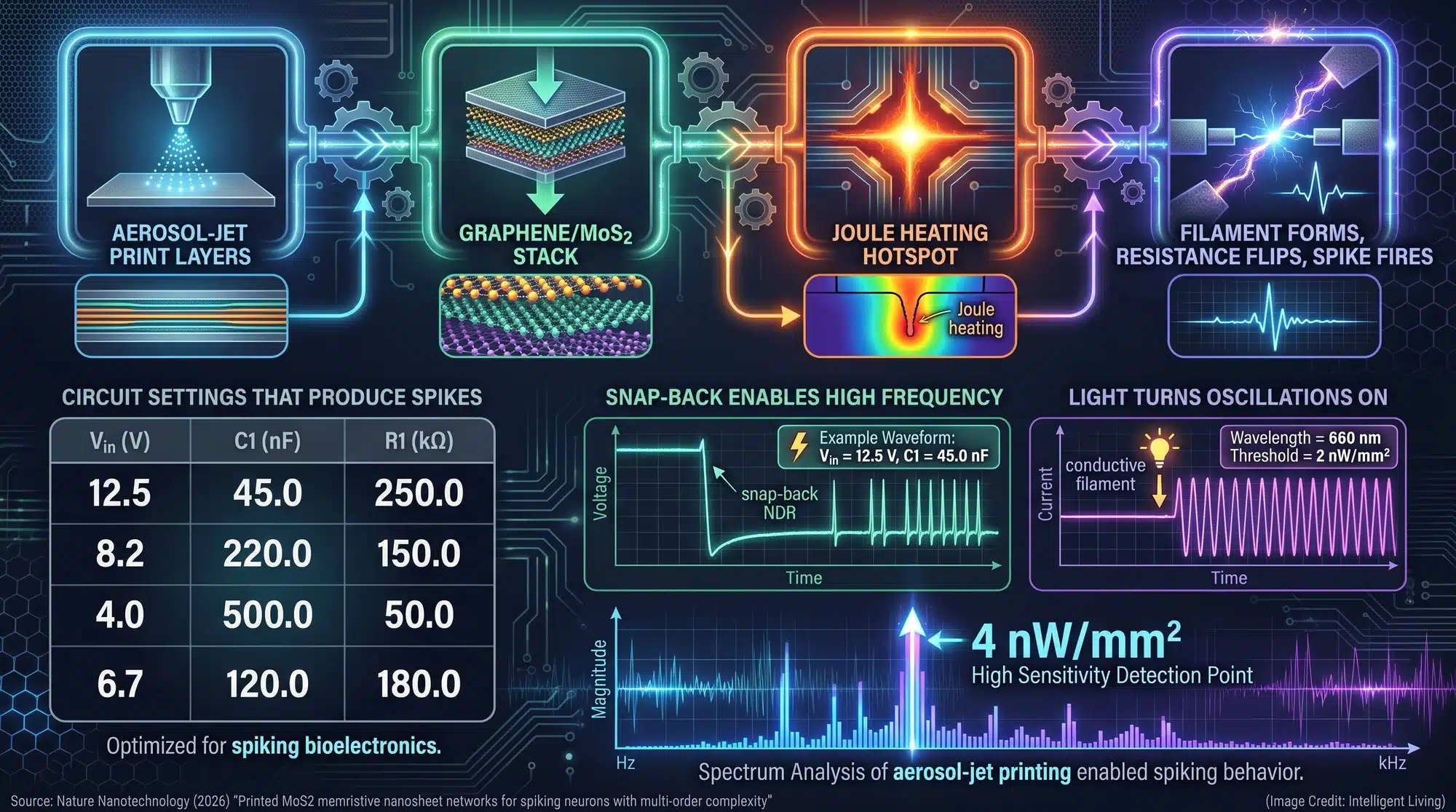
Operational Process: From Printed Ink to Filament-Driven Spikes
Precision Manufacturing: Aerosol Jet Printing for Flexible Electronics
The device begins as layers of printable electronic ink deposited using aerosol jet printing, a technique known for placing fine features on flexible surfaces.
Recent industrial shifts toward additive manufacturing for functional bioelectronics confirm that aerosol jetting achieves the micron-level control necessary for these neural stacks.
Material Architecture: The Graphene and MoS2 Nanosheet Stack
Inside the printed stack, molybdenum disulfide, where low-power flexible MoS2 circuit prototypes are a well-studied direction in materials research, is printed as nanosheets and sandwiched between graphene electrodes. That layered layout is not decorative. It sets the stage for current to concentrate, heat to build locally, and switching behavior to emerge.
Signal Generation: Joule Heating and Filament Spike Mechanisms
When current flows, localized heating occurs. The study describes how Joule heating helps form a narrow conductive filament within the material. As current gets squeezed through this microscopic path, the device flips into a spike-like mode, with sudden changes in resistance that resemble a neuron firing.
A simple way to picture it is a choke point forming inside the material. Electricity builds up, then releases in a burst. That burst becomes the spike, and the ability to tune how those spikes appear is what makes the device more than a one-trick pulse generator.
Importance of Spiking Burst Patterns in Neural Signal Encoding
A phone buzzing once feels different than a short cluster of pulses, even before anyone checks the screen. Timing carries meaning for people, and timing carries meaning for neurons too, which is why lifelike firing patterns are a serious technical target rather than a cosmetic detail.

Strategic Importance: Intersection of Neurotechnology and AI Infrastructure
Scaling BCI Tech: Addressing Signal Drift and Daily Calibration Needs
Immediate clinical significance revolves around brain-computer interface research. Scaling real-world assistive neurotechnology often fails due to practical friction rather than a lack of innovation. Engineers must constantly adapt decoding systems to the unique biological signals of each user on a daily basis.
Utilizing a printed spiking source that matches physiological timing does not solve decoding independently. Instead, it advances the objective of reducing the mismatch between electronics, neural tissue, and supporting algorithms. Such pressure is evident in the development of universal brain-to-text decoders and sophisticated neuroprosthetic typing systems, where the primary challenge involves translating signals without exhaustive daily calibration.
AI Infrastructure Challenges: Managing Energy and Water Consumption
At the same time, computing infrastructure is running into physical limits. The International Energy Agency notes that global data center electricity use surged in 2025, and it warns that demand could climb sharply by 2030 as AI workloads expand.
Expanding energy growth does not stay confined to the cloud. Local impacts manifest as transformer queues, grid upgrades, and increased utility rates for everyday consumers. Water has become part of the same story. A World Resources Institute analysis of data center cooling water demand describes how the biggest facilities can consume millions of gallons per day in certain configurations, which raises real questions in regions already wrestling with drought and competing water claims. Cooling design choices in water-smart data center cooling strategies often decide whether a facility leans on evaporation-heavy systems or closed-loop approaches that trade water savings for other engineering costs.
Efficiency Gains: Event-Driven Processing in Neuromorphic Systems
Neuromorphic computing is often described as hardware that works more like the brain, using bursts of activity instead of constant, clock-driven churn. Establishing a baseline for event-driven hardware architecture helps clarify how these systems avoid the constant power drain of traditional processors. Earlier projects focused on hardware architectures modeled on mammalian brain scales demonstrate exactly how long this efficiency goal has remained at the center of the conversation for engineers.
A homeowner watching a local substation get upgraded to support new industrial loads, and hearing neighbors argue about who should pay for those upgrades, is already living inside the same story that a recent AI power-cost pledge aimed at ratepayers tries to address. In that context, the appeal of event-driven hardware is not abstract. It is the difference between compute that idles expensively and compute that wakes up only when a signal actually matters.

Future Roadmap: Potential Applications for Printed Spiking Electronics
Clinical and Computing Applications: Proven and Plausible Use Cases
These use cases work best when they stay honest about what is demonstrated versus what is still a roadmap. The proven items come directly from what the device did in lab testing, while the plausible items describe where similar spiking hardware is being pushed across neurotech and energy-efficient computing.
- Proven: Laboratory stimulation of living neurons in tissue slices using printed spiking signals.
- Proven: Stable high-frequency spiking behavior in flexible memristive networks under controlled conditions.
- Plausible: Improved hardware foundations for future brain-machine interfaces that require realistic neural signaling patterns, including directions explored in miniature implant sensors for brain-computer interfaces where size, stability, and signal quality drive real-world performance.
- Plausible: Energy-efficient neuromorphic chips that process information in event-driven bursts rather than continuous clock cycles.
- Plausible: Flexible bioelectronic testbeds for studying how electronic pulses interact with neural tissue in controlled experiments.
- Plausible: Additive manufacturing pathways that reduce material waste compared to some traditional semiconductor fabrication steps.
Realizing these plausible applications requires extensive engineering, independent replication, and rigorous safety validation.
Experiments with 3D aerosol-jet-printed perovskites onto graphene show how fine-feature printing can build precise stacks for very different devices, which is the same scaling intuition behind printed spiking electronics.

Ongoing Development: Key Milestones for Printed Neurotech Validation
Verifying independent replication remains a priority because device physics can appear stable in one lab while proving fragile in another due to minor printing variations. Progress in this field depends on several key milestones:
- Standardizing printing environments to ensure repeatability.
- Testing material response across diverse biological environments.
- Validating durability markers over extended operational cycles.
Durability Beyond Tissue Slices
Tissue slices differ from living organisms in immune response, long-term chemical exposure, and mechanical stress, so the next questions are about drift, stability, and how the materials behave over weeks instead of minutes.
Systems Integration Across the Neurotech Stack
Developing a functional bionic stack for robotic prosthetics requires that sensing, decoding, and material durability work in total synchronization.
Efficiency Proof Under Real Workloads
If neuromorphic hardware is to ease AI growth pressures, researchers must show measurable reductions in energy per computation under real workloads, not only elegant spikes in a lab bench setup. That question increasingly overlaps with AI infrastructure and grid capacity constraints that cities and utilities are now treating as planning issues, not abstract technology debates.
Governance and Mental Privacy Guardrails
Governance and privacy guardrails will matter more as neural data pipelines grow. Discussions of neurorights and mental privacy risks underline why the technical leap needs an equally serious conversation about how neural signals are stored, protected, and used.
Technological leaps frequently occur without fanfare. While a printed layer of ink and a tiny heat-formed filament may appear subtle on a lab bench, these spikes represent the moments where synthetic and biological systems finally converge.

Brain-Inspired Hardware, AI Energy Reality, and the Next Wave of Printed Neurotech
The successful integration of printed spiking devices highlights a significant shift toward harmonious technological alignment. Rather than requiring biological systems to adapt to rigid, power-hungry electronics, engineers are now developing hardware that reflects the natural efficiency of the brain. Such devices represent a materials science advance that narrows the gap between electronic pulse timing and biological signaling. This progress indicates a future where brain-computer interfaces remain stable, energy-efficient, and capable of long-term synergy with human tissue.
As global AI infrastructure demands continue to rise, the necessity for event-driven hardware will become a primary constraint rather than a luxury. These aerosol-jet-printed networks offer a sustainable pathway forward, ensuring that next-generation neurotechnology provides high-value performance without the excessive electrical overhead of traditional computing architectures.
Essential Insights into Spiking Neuromorphic Hardware
What is the primary benefit of printed artificial neurons?
These devices allow electronics to communicate with brain cells using realistic timing and pulse shapes, improving the stability of neural interfaces.
How does aerosol jet printing help neurotech?
Aerosol jet printing allows engineers to place precise, flexible electronic features onto soft surfaces that better match the mechanical properties of living tissue.
Can these artificial neurons replace biological cells?
No, they are electronic devices designed to mimic the signaling behavior of neurons, not to replace the biological cells themselves.
Why is neuromorphic hardware considered energy efficient?
Neuromorphic systems only activate when a signal is present, whereas traditional processors often consume power continuously regardless of activity.
What materials were used in the Northwestern breakthrough?
The engineers utilized a combination of graphene electrodes and molybdenum disulfide (MoS2) nanosheets to create the spiking memristive networks.


