
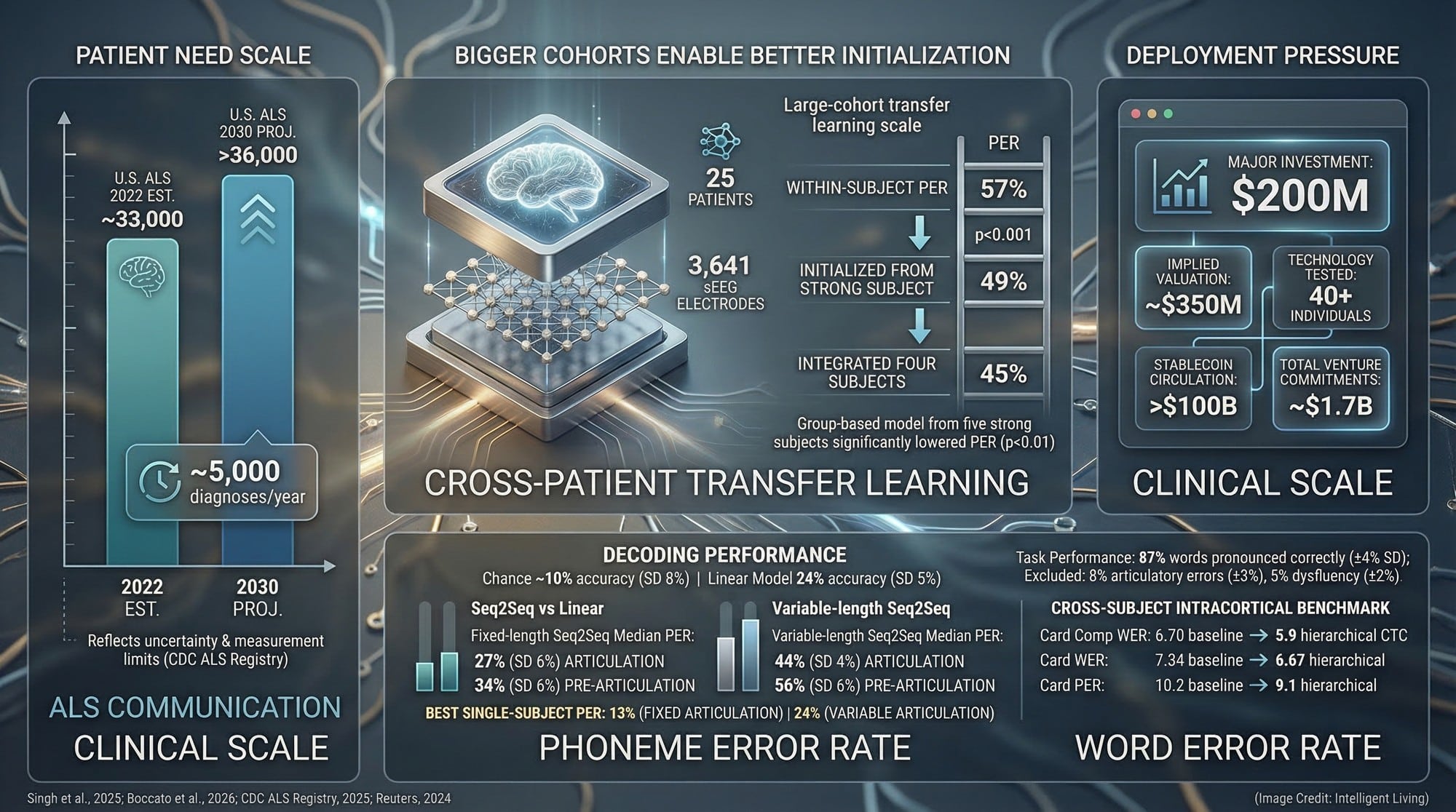
Neuralink often captures the public imagination, but a quieter technical obstacle has mattered more for patients and clinicians: until recently, each person who used a speech brain-computer interface needed a decoder trained on their own neural recordings—a requirement that rendered deployment slow, labor-intensive, and expensive. New cross-subject work reports a shared model that reached a 5.9% competition word error rate, beating a 6.70% single-patient baseline on the same benchmark. The result suggests that training on more patients can improve accuracy rather than dilute it.
Advancing toward shared decoders matters because communication loss is rarely an abstract engineering problem. In real clinics, every extra calibration session can mean more fatigue for a patient, more staff time, and more delay before the system becomes useful. A shared decoder does not solve every problem, but the recent cross-subject BCI research changes the scale question in a way the field has struggled with for years.

Critical Advancements in Cross-Subject Speech BCI Performance
- The cross-patient speech decoder model reports 5.9% competition WER against a 6.70% benchmark on the same Card test set, while the study currently undergoes peer review.
- The approach trains on multiple large intracortical speech datasets and uses small per-day or per-subject alignment transforms to place recordings in a shared representation space.
- Word error rate (WER) gauges decoding accuracy; within this tightly contested benchmark, dropping from 6.70 to 5.9 represents a significant leap.
- Prior best-in-class systems typically relied on patient-specific calibration data and supervised recordings, and the 2024 speech neuroprosthesis trial shows how much individual training still shapes performance even when day-one accuracy is strong.
- Independent labs are also testing cross-patient transfer learning, and a Nature Communications study across 25 patients suggests the field is moving toward shared decoding strategies rather than isolated one-user systems.

Why Speech BCIs Still Don’t Scale from One Patient to The Next
Why Can’t Today’s Speech BCIs Just Reuse the Same Decoder?
Contemporary speech BCIs face three kinds of variability that make a one-size-fits-all decoder difficult to build.
Each of these barriers represents a unique challenge for clinical scaling.
Neural recordings change over time. The exact signal captured from the same electrode can drift between sessions because of small shifts in contact, tissue response, or device placement, and even high-resolution miniature neural implants still need decoding that stays stable across days. Such inherent variability implies that a decoder calibrated to previous data may fail to perform reliably as signal conditions shift.
While manageable in controlled research labs, maintaining consistency becomes significantly harder when clinics must support dozens of patients across repeated visits.
These logistical hurdles often define the success of a BCI outside of specialized research settings.
Managing Biological Heterogeneity and Cortical Mapping
Restoring speech requires navigating a complex biological landscape. The relationship between intended speech and local neural activity depends on several critical factors:
- Exact electrode placement and cortical folding
- The presence of scar tissue
- Specific disease progression
- Individual performance of attempted speech tasks
Analyzing these unique traits helps researchers refine how signals are captured and translated.
Integrating Neural Feature Extraction with Language Modeling
Decoders combine neural feature extraction with language modeling. The neural-to-phoneme mapping depends on individual signal patterns, while the language model helps resolve ambiguous sounds into words.
Consequently, if the neural mapping is patient-specific, even the large-vocabulary language modeling used in a 2023 speech neuroprosthesis study cannot solve the problem on its own.
That works well in studies, but direct brain-to-text communication has already shown how much custom training still separates laboratory success from broader clinical rollout.

Benchmarking the Breakthrough: Achieving 5.9% Word Error Rate
Interpreting Word Error Rate (WER) as a Success Metric
Word error rate is a standard speech-recognition metric. It counts insertions, deletions, and substitutions in decoded text relative to the correct transcript and divides by the total number of words. Lower WER means cleaner decoding.
A drop from 6.70 to 5.9 is not a flashy hundred-fold jump. Its importance is more subtle and more interesting. Within this benchmark, adding patient diversity to training did not weaken performance. It improved it. This shift represents a fundamental break with the long-standing assumption that neural patterns are too individual for shared decoding.
For a caregiver or speech therapist, even a small error reduction can matter. The difference between correcting every few words and holding a smoother exchange can decide whether a system feels frustrating or genuinely useful.
How Cross-Subject Decoding Works and Why Calibration Matters
Core Technical Innovations in Shared Decoder Training
The underlying concept is straightforward. The team layered two practical steps on top of an already familiar speech-decoding pipeline.
Session-Specific Alignment and Neural Normalization
Each recording session and each participant can look slightly different to the model. The system learns a small linear translation for each session or subject. This ensures those differences are normalized before decoding. It works like a compact adaptor that helps recordings from different people land in the same internal space.
Neural normalization proves vital because the model no longer needs to assume uniform biological wiring across every participant.
Hierarchical CTC Layers for Phonetic Accuracy
After alignment, the system predicts intermediate speech units such as phonemes. It uses a hierarchical form of Connectionist Temporal Classification before converting them into full words. That extra layer gives the model a chance to organize speech more cleanly before final text is produced.
In plain language, it is easier to build reliable words when the model first gets the sound structure right. That is part of why the decoder can benefit from shared training rather than collapsing under additional variability.
Computational Efficiency and Model Portability
Both pieces are computationally compact. The alignment layers are small, so they can be updated with relatively little per-user data. The decoder change makes better use of the neural evidence once signals are aligned. Combined, these technical innovations establish a viable path toward shared foundation models paired with lightweight personal adaptors, bypassing the need for exhaustive patient-specific retraining.
The cross-subject evaluation table lays out the alignment layers, hierarchical CTC design, and cross-subject evaluation behind these claims.
Mitigating the Calibration Burden Through Shared Models
Calibration remains the hidden cost of current deployments. For many speech BCI systems, clinicians must gather supervised recordings while the user attempts to speak or silently imagines speaking. This labor-intensive requirement leads to several critical resource drains that impact both the facility and the patient:
- Dedicated staff time and scheduling
- Patient physical energy
- Emotional patience and endurance
Shrinking this per-patient time investment allows clinics to focus on rehabilitation rather than technical setup.
Evidence For Reduced Calibration Burden
Representative work from Card and colleagues documents practical calibration timing for constrained-vocabulary tasks, and the full 2024 clinical report shows how per-user fine-tuning still contributes to final performance.
That nuance matters. The strongest modern systems already calibrate faster than many older ones, so this is not a story about the field doing nothing right until now. It is a story about shifting from faster custom training toward genuinely reusable training.

Bridging the Gap Between Laboratory Success and Clinical Deployment
Infrastructure Constraints: Edge Computing and Latency
Beyond signal stability, the physical location of decoding operations creates a secondary bottleneck. High-performing pipelines often depend on heavy server-side computation and large language-model support. These requirements introduce several clinical obstacles:
- Unwelcome processing latency
- Complex data privacy concerns
- Substantial infrastructure costs
In everyday terms, a system that pauses too long before speaking back can feel unnatural even when its accuracy is strong. Conversation depends on timing as much as content.
Future Capabilities of Leaner BCI Architectures
Because the alignment layers are small and the decoder changes are relatively efficient, the cross-subject approach moves toward leaner models that could run on edge devices or local clinic servers rather than always depending on remote heavyweight computing.
Heavier server-dependent pipelines introduce unwelcome latency, complex privacy concerns, and substantial infrastructure costs. The preprint explicitly notes weighted finite-state transducer decoding as computationally expensive and memory-intensive, which is why the leaner approach matters for real clinics, and NIH coverage of a faster brain-to-speech system shows how strongly reduced delay affects real conversation.
Critical Hurdles for Multi-Site Clinical Validation
Verification Through Peer Review and Independent Replication
The work is posted as a preprint and remains under review. Peer review can clarify methodology, expose edge cases, and test how robust the claimed gains really are.
Moreover, independent reproduction across labs will be essential to verify these results across broader populations.
Hardware Agnostic Performance and Cross-Site Testing
These experiments come from specific implant types, datasets, and lab protocols. Several variables can affect how well a shared decoder generalizes across new settings:
- Differences in electrode arrays and surgical placement
- Variation in recording quality and task design
- Specific device architectures, such as the stentrode implant
Ensuring performance remains consistent across these factors is the next significant milestone for the field.
Sustaining Signal Stability Over Extended Durations
Signals change over months and years. A model that adapts well in a short study still has to prove its long-term stability. It must remain functional over extended timescales or be refreshed without burdensome retraining.
Navigating FDA Standards and Neural Data Policy
Translation to routine clinical use is not only technical. Trials, safety standards, reimbursement, and clinical workflow determine what can actually be adopted. The regulatory timeline varies by jurisdiction and device class, and Colorado’s neural-data privacy law shows how policy is starting to catch up with brain-signal collection as broader debates about neurorights and neural data protection accelerate.
What this Could Mean for Patients and The Neurotech Ecosystem
Market Dynamics and Commercial Scalability
Cross-institutional success is crucial because the neurotech ecosystem rarely advances through isolated benchmarks alone. It can also accelerate several key areas:
- Unified technical standards
- Specialized clinical tooling
- Global deployment strategies
Cross-Institutional Trends in Population-Level Training
Multiple groups are exploring cross-subject and transfer learning strategies, and a UTHealth Houston report on decoding speech across different patients shows that population-level training is already moving beyond a single lab.
That matters because the field does not advance through one impressive benchmark alone. It advances when different teams keep arriving at compatible solutions from different datasets, hardware setups, and clinical constraints.
Funding and Commercial Incentives
Commercial pressure can distort a story, but it can also accelerate standards, tooling, and deployment. While capital alone doesn’t validate the science, increased investment ties technical progress directly to the urgent commercial need for scalable, workable BCI systems. That commercial push became harder to ignore when news broke of substantial venture capital funding for neural chips, tying decoder research more directly to deployment incentives and product timelines.
Human Impact for ALS and Locked-In Syndrome Patients
For people living with ALS or locked-in syndrome, every clinic visit, every hour of calibration, and every moment of communication effort counts.
Restoring Dignity Through Natural Conversation
A decoder that works out of the box with only a short per-user adaptor could extend restored communication for individuals with locked-in syndrome into something more clinics can realistically offer.
Beyond simple speed, the true significance lies in restoring patient dignity through fluid, natural interaction. Families living with severe paralysis do not experience communication as a benchmark table. They experience it as the difference between a slow, exhausting interaction and a faster exchange that feels more like a real conversation.
Ensuring Equitable Access to Neuroprosthetic Technology
Even if shared decoders lower the onboarding burden, equitable access is still not guaranteed. Devices, surgery, follow-up care, software support, and insurance coverage will shape who benefits first. Without attention to cost and access, a scalable decoder could still remain available to only a narrow group of patients.

What this Breakthrough Means for Patients and Clinics
The result points toward a different model for the whole field: shared foundation training plus lightweight personalization rather than a fully bespoke decoder for every new user. That does not eliminate adaptation, but it can shrink one of the most stubborn barriers to broader clinical use.
That broader shift fits with the way advanced AI-driven neural links are increasingly framed as assistive systems that must balance three core pillars:
- Decoding accuracy
- Personal adaptation
- Human usability
The remaining work is still substantial. Shared decoders need multi-site replication, longer-term performance data, stronger privacy standards, and clinical workflows that ordinary hospitals can sustain. But the core assumption has changed. More brains in the training set may not be a problem to work around. They may be part of the solution.
Common Queries Regarding Cross-Patient BCI Decoders
How does a brain-to-text decoder work?
A brain-to-text decoder uses machine learning to map neural activity into phonetic units, which are then translated into written words by a language model.
What does word error rate mean?
Word error rate (WER) is the standard metric for accuracy, calculating the percentage of insertions, deletions, or substitutions in decoded text compared with the correct transcript.
Can BCI decoders be shared between patients?
Yes, new research demonstrates that a single “foundation” decoder can be trained on multiple patients and then lightly adapted for new individuals.
Why is BCI calibration so slow?
Traditional calibration requires hours of supervised recordings to map a specific patient’s unique neural signals to their intended speech.
How soon will scalable BCIs be in clinics?
While preprints show 5.9% accuracy, broader clinical use depends on ongoing multi-site trials, peer review, and regulatory approval.
Who owns neural data, and what about privacy?
Data ownership and privacy rules are evolving. Legislators and regulators are beginning to address neural data specifically, and consumer-focused neural data security is now part of the wider BCI conversation far beyond medical wearables.


