
Rapid advancements in neurotechnology are shifting from experimental laboratories into real-world clinical applications at an unprecedented pace. While global headlines often center on private ventures, a coordinated surge in China BCI research is redefining the boundaries between biological thought and digital command. High-stakes competition between state-backed Chinese institutes and commercial pioneers like Neuralink signals a new era for brain-computer interface development.
Establishing a bridge between the human mind and external machines promises to restore independence for patients while simultaneously igniting a global debate over mental privacy and cognitive liberty. Recent breakthroughs occur alongside other wireless human brain-to-computer connections achieved in clinical trials with paralyzed patients, but with a major distinction: China’s progress is being driven by national policy rather than market competition.
Hospitals such as Huashan Hospital at Fudan University and research institutes like the Center for Excellence in Brain Science and Intelligence Technology (CEBSIT) are testing wireless invasive implants known as WRS01, enabling users to control external devices through calibrated neural signals.

Quick Facts: China’s Brain-Computer Interface Surge
- Human Implants Underway: CEBSIT and Huashan Hospital report successful wireless implant operations allowing real-world device control.
- Government Targets: Beijing’s roadmap aims for BCI breakthroughs by 2027 and a globally competitive ecosystem by 2030, based on translated national policy documents.
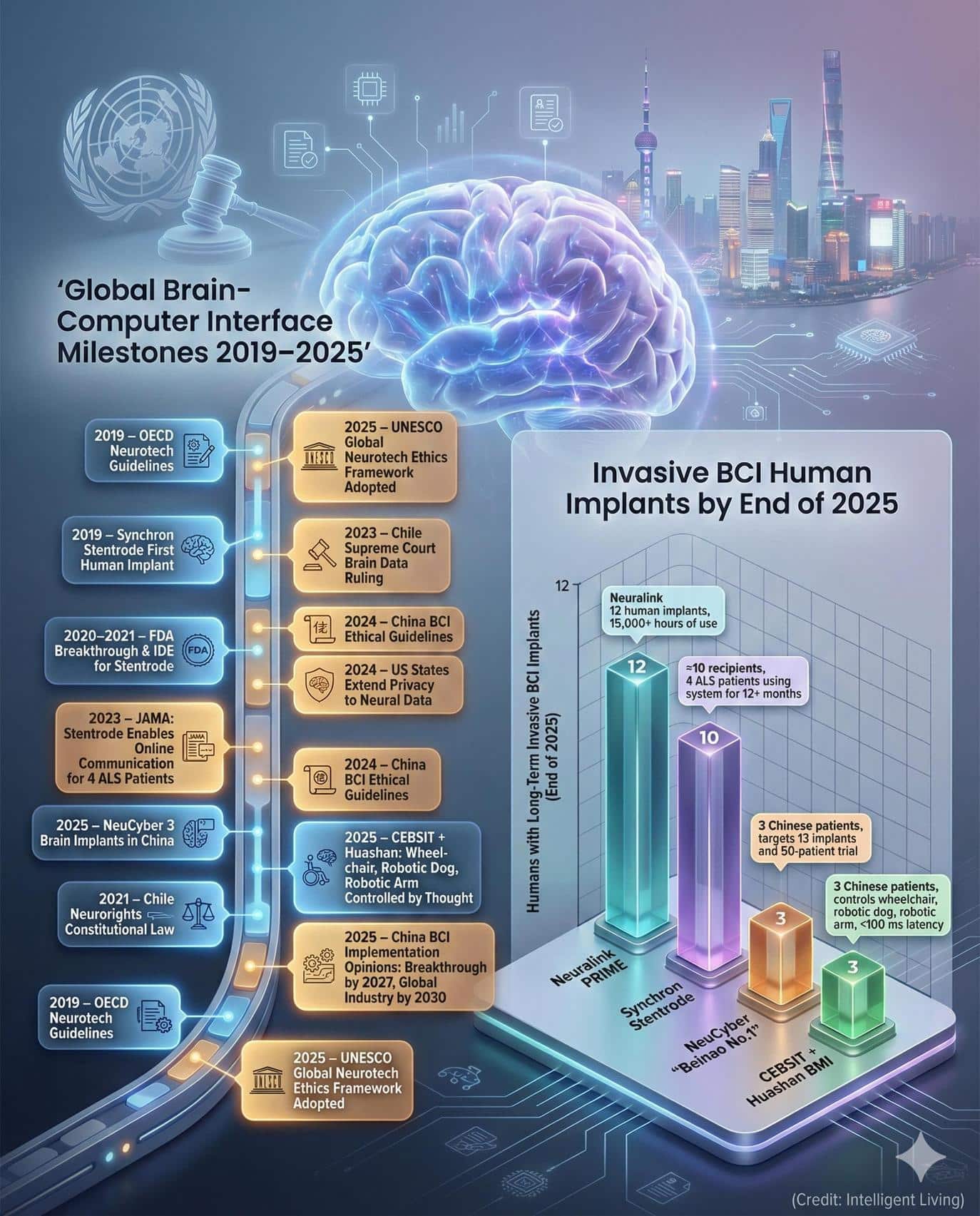
- Neuralink Benchmark: Reuters reporting indicates that Elon Musk’s Neuralink has implanted chips in 12 people as of September 2025.
- Ethical Debate Expands: The UNESCO Neurotechnology Ethics Framework emphasizes mental privacy and human dignity as neurotech scales worldwide.
- Global Context: Other initiatives show that assistive neurotechnology is moving rapidly from theory into practice.
Defining Brain-Computer Interface Mechanics in 2026 and Beyond
Despite sensational headlines, modern mind control technology is not about reading or manipulating thoughts. The correct term is “brain-computer interface,” a system that detects neural activity and converts it into digital instructions for computers or machines. Neural interfaces typically rely on electrodes that monitor electrical signals produced when neurons fire in specific brain regions. Over time, artificial intelligence algorithms learn to translate these patterns into commands.
Mastering a neural connection requires training, patience, and precise calibration. Patients must engage in repetitive mental exercises to generate consistent neural signals that the interface can interpret with high accuracy.
Differentiating Invasive and Non-Invasive Neural Implants
Specific phases of BCI training include:
- Practicing focused visualization to trigger specific electrical activity.
- Calibrating AI algorithms to recognize individual neural patterns.
- Engaging in mutual learning where both user and machine adapt to signals.
- Achieving real-time control over external assistive devices.
Refining these skills allows a person to move a wheelchair, type text, or control robotic limbs purely through intent. This collaborative learning process bridges the gap between biological desire and mechanical execution.
China’s research teams are focusing on invasive BCIs, which are surgically implanted under the skull for higher accuracy and signal clarity. These differ from non-invasive BCIs, like EEG headsets used in gaming or focus-enhancing wearables, including AI-enhanced headphones designed to track cognitive fatigue and attention through brainwave patterns, which detect weaker signals through the scalp. Invasive systems can restore lost motor function but also raise complex ethical and medical questions related to surgery, data privacy, and long-term maintenance.
BCIs are already transforming assistive care. Recent breakthroughs where a brain-computer interface restored communication for a locked-in patient with amyotrophic lateral sclerosis show that decoding brain signals can give a voice back to those who cannot speak. As China accelerates clinical trials, the line between assistive rehabilitation and broader human enhancement continues to blur, demanding careful oversight and transparent governance.
Scaling China BCI Systems: From Clinical Trials to National Infrastructure
National coordination in 2025 allowed China to shift beyond one-off experiments into a unified framework for brain-computer interface development. Reports from the Center for Excellence in Brain Science and Intelligence Technology confirm that several patients now operate external devices through wireless implants. Meanwhile, startups such as NeuCyber NeuroTech are collaborating with medical institutions to commercialize implantable BCIs known as Beinao No. 1, which have already been tested in three human subjects, with plans for larger trials.
This scaling phase distinguishes China from Western competitors. Instead of relying solely on private venture funding, China integrates its BCI initiatives into five-year innovation plans supported by multiple ministries. The government not only finances research but also aligns universities, hospitals, and industry players under unified targets. Such top-down coordination allows rapid mobilization of resources—but also heightens the importance of ethical regulation. China is pursuing a parallel circuit-level approach beyond BCIs, with chemogenetic DREADDs therapies now entering human trials for epilepsy and Parkinson’s, highlighting how state-coordinated neurotechnology is expanding on multiple fronts.
Integrating AI Algorithms with Neural Decoding Systems
Parallel developments show that AI-integrated neural decoding systems are maturing into practical tools. Chinese researchers have demonstrated mind-controlled robotic arms, drones, and exoskeletons, each iteration designed for rehabilitation and industrial applications.
Foundational experiments involving a mind-controlled robotic arm operating without surgical implants proved that these control schemes can succeed even when all signals are captured non-invasively. As pilot programs expand, observers note that China’s approach mirrors how it built leadership in solar, battery, and AI sectors: identify a frontier, align policy, and accelerate. The same playbook is now reaching clinical research, where Beijing has paired an “AI + drug regulation” framework with new data-governance rules that are reshaping how AI is used in clinical trials.
Strategic Neurotech Policy and the Path to Global Leadership
Strategic policy frameworks underpin every scientific breakthrough achieved by Chinese researchers. Beijing released specific guidelines in August 2025 to establish clear milestones for the coming years. The plan envisions cultivating two to three globally influential BCI enterprises while fostering domestic supply chains for sensors, microchips, and neural data software.
Later that year, a landmark Implementation Opinions document jointly issued by seven ministries outlined the scope of BCI development. Provisions within the Brain-Computer Interface Implementation Opinions explicitly mention applications in healthcare, education, and surveillance. International concern has grown regarding the inclusion of surveillance, yet analysts view this as a clear sign of China’s intent. The nation plans to integrate BCI technology into both civilian and security domains simultaneously.
China’s industrial-policy-first model mirrors the strategic path the nation used to dominate electric vehicles and artificial intelligence. Centralized planning, state-backed investment, and long-term procurement strategies combine to create entire technology ecosystems. While this approach delivers speed, it also underscores the necessity for transparency and global ethical dialogue. UNESCO’s neurotechnology framework warns that without universal standards, breakthroughs in one nation could outpace the world’s ability to regulate them.

Comparing Neuralink Capabilities with China’s Industrial BCI Model
The comparison between China’s BCI progress and Elon Musk’s Neuralink is tempting but simplistic. Neuralink confirmed during its recent PRIME human brain-implant trial that the company implanted its coin-sized brain chips in twelve patients by September 2025, marking an important milestone in Western neurotechnology. However, China’s progress must be measured differently—not by patient count alone, but by system-level coordination and national momentum.
While Neuralink focuses on refining its surgical robot and wireless implant for consumer-level adoption, China’s approach focuses on building a full industrial chain. Comprehensive industrial planning covers every component from core hardware to software protocols.
Primary components of the BCI industrial chain include:
- Developing advanced electrode materials for signal clarity.
- Manufacturing high-performance microchips for neural processing.
- Refining AI algorithms for real-time neural decoding.
- Creating standardized software for neural data management.
Government funding ensures that multiple institutions pursue simultaneous research tracks, accelerating innovation but also diffusing accountability. This structure creates a dense, state-driven ecosystem where startups, hospitals, and public agencies collaborate under the same strategic banner.
Defining “faster” therefore depends on context. If the metric is the number of implants, the race remains close. If it is the establishment of manufacturing standards and long-term policy support, China appears to be moving ahead. For readers, the takeaway is clear: BCIs are transitioning from experiments to infrastructure, and whichever nation balances speed with safety will define the ethical boundaries of this emerging technology.

The Value of Neural Data and the Risks to Mental Privacy
Beyond the captivating visuals of mind-controlled machines lies a more profound and valuable asset—neural data. Every signal captured by a brain-computer interface represents not just movement or intent but fragments of human cognition. As BCIs become more sophisticated, they generate datasets that reveal how the brain encodes choice, emotion, and perception. These signals can help diagnose neurological disorders, optimize therapies, and even improve mental health treatments. Yet, they also open a new frontier of privacy risk.
In China, the industrial push toward BCIs means vast volumes of neural information may soon move through cloud systems, AI platforms, and data centers. Accelerated medical discovery is a primary benefit of localized data collection, yet the absence of strict safeguards poses a severe risk. Global observers remain concerned that such intimate information might be repurposed for surveillance or behavioral prediction. Could unauthorized access to your thought patterns redefine personal safety?
Securing Cognitive Information Against Cybersecurity Threats
Algorithms that enable a patient to control a wheelchair could theoretically map concentration levels or detect stress. These same systems might infer personal preferences without the user’s explicit awareness. Protecting this information is therefore as crucial as developing the technology itself.
As neurodata becomes the next digital commodity, countries are racing to define ownership. Will it belong to the individual, the hospital, or the corporation that processes it? The answer will determine whether BCIs become tools of empowerment or instruments of control. Readers concerned with digital security should note that protecting neural data will require advanced cybersecurity architectures capable of defending sensitive cognitive recordings against sophisticated attacks.
UNESCO’s Warning Shot: Mental Privacy Is a Human-Rights Issue
In December 2025, the adoption of UNESCO’s global ethical framework for neurotechnology made history as the first international agreement to address neurotechnology at a human-rights level. The framework calls mental privacy a universal right and warns that thought-level data must never be exploited without explicit consent. It emphasizes that neurotechnology should preserve dignity, autonomy, and mental integrity—the core of what makes individuals human.
UNESCO’s recommendations also encourage governments to create ethical oversight boards to review BCI projects, similar to institutional review boards in medical research. It suggests that nations invest in public education so citizens understand what BCIs can and cannot do. Transparency, the framework argues, is the first safeguard against misuse.
For China, these global standards present both opportunity and challenge. Aligning domestic neurotech policy with UNESCO’s principles could enhance global trust and foster international collaboration. However, the inclusion of surveillance as a potential application in national planning documents raises questions about how privacy will be maintained. The global community is watching whether China can balance rapid progress with respect for mental autonomy.

Neurorights and the Governance Gap
As BCIs advance, legal systems worldwide are struggling to keep pace. The term “neurorights” has emerged to describe a proposed set of protections for individuals in the age of neurotechnology. These rights typically include mental privacy, cognitive liberty, psychological continuity, and equal access to enhancement technologies. Chile became the first nation to enshrine such protections in its constitution, adopting a neurorights constitutional amendment to safeguard mental integrity, signaling a wave of policy experimentation that could soon spread.
The challenge lies in translating ethical ideals into enforceable law. Who oversees compliance when neural data crosses borders? How should informed consent be documented when algorithms continuously interpret brain signals? These questions expose what many analysts call the governance gap—the lag between technological capability and legal accountability.
Bridging the International Neurotechnology Governance Gap
Rapid expansion of the BCI sector in China creates a particularly wide governance gap that requires immediate attention. Western nations, conversely, navigate slow-moving regulatory systems that might hinder innovation while encouraging necessary public debate. Bridging this divide requires global coordination. Whether through UNESCO, the World Health Organization, or emerging coalitions of neuroethics researchers, the race to protect the human mind must accelerate alongside the race to decode it.
What Happens Next (12–36 Months)
The next three years will determine whether brain-computer interfaces remain medical miracles or evolve into everyday infrastructure. In China, clinical trials are expected to expand to dozens of new hospitals, with a focus on rehabilitation robotics, speech restoration, and neuroprosthetics. Commercial partners may begin producing home-use systems for physical therapy and cognitive assessment. The Center for Excellence in Brain Science and Intelligence Technology is expected to continue leading research, while private firms like NeuCyber NeuroTech scale manufacturing.
Internationally, collaboration and competition will intensify. The United States and the European Union are developing frameworks for neural data protection, while UNESCO will likely monitor compliance with its ethics guidelines. Tech companies are investing in AI-powered brain-computer interfaces that blend machine learning with neural decoding, pushing BCIs closer to consumer applications.
Experts anticipate that the defining breakthrough will focus on standardized neural data protocols rather than hardware miniaturization. Establishing formats for secure transfer and analysis remains the top priority for the next phase of development.
Key milestones expected within the next 36 months include:
- Implementing standardized protocols for secure neural data transfer.
- Merging BCI capabilities with existing AI ecosystems.
- Transforming educational tools through neural feedback loops.
- Expanding therapeutic applications into mainstream communication.
The next 36 months will reveal whether this integration occurs under transparent international standards. Alternatively, the technology may develop within fragmented national silos, limiting global cooperation and safety.

Balancing Human Autonomy with Neurotechnology Breakthroughs
Upcoming shifts in neurotechnology depend heavily on how nations manage the sensitive flow of neural data across digital borders. Prioritizing patient welfare over state surveillance remains the most critical challenge for the global community. Will our legal systems evolve in time to protect the sanctity of the human mind? Responsible development requires a shared commitment to mental privacy, ensuring that the technology used to heal the human mind also respects its fundamental dignity.
Essential Guide to Neural Interface Capabilities
1. What defines a modern brain-computer interface?
Neural systems record brain signals and translate those electrical patterns into specific digital commands for external devices.
2. Is modern mind control technology reading private thoughts?
Current interfaces detect intent for physical movement or action rather than decoding abstract language or personal memories.
3. How does China’s BCI progress compare to Neuralink?
National policy drives China’s industrial chain, while Neuralink focuses on refining private consumer-level devices for broader adoption.
4. Why is neural data protection a high priority?
Cognitive information captured by devices reveals intimate processes, requiring strict mental privacy safeguards to ensure user safety.
5. When will assistive neurotechnology become widely available?
Clinical trials are expanding rapidly, with broader rehabilitation center integration expected within the next thirty-six months.


