
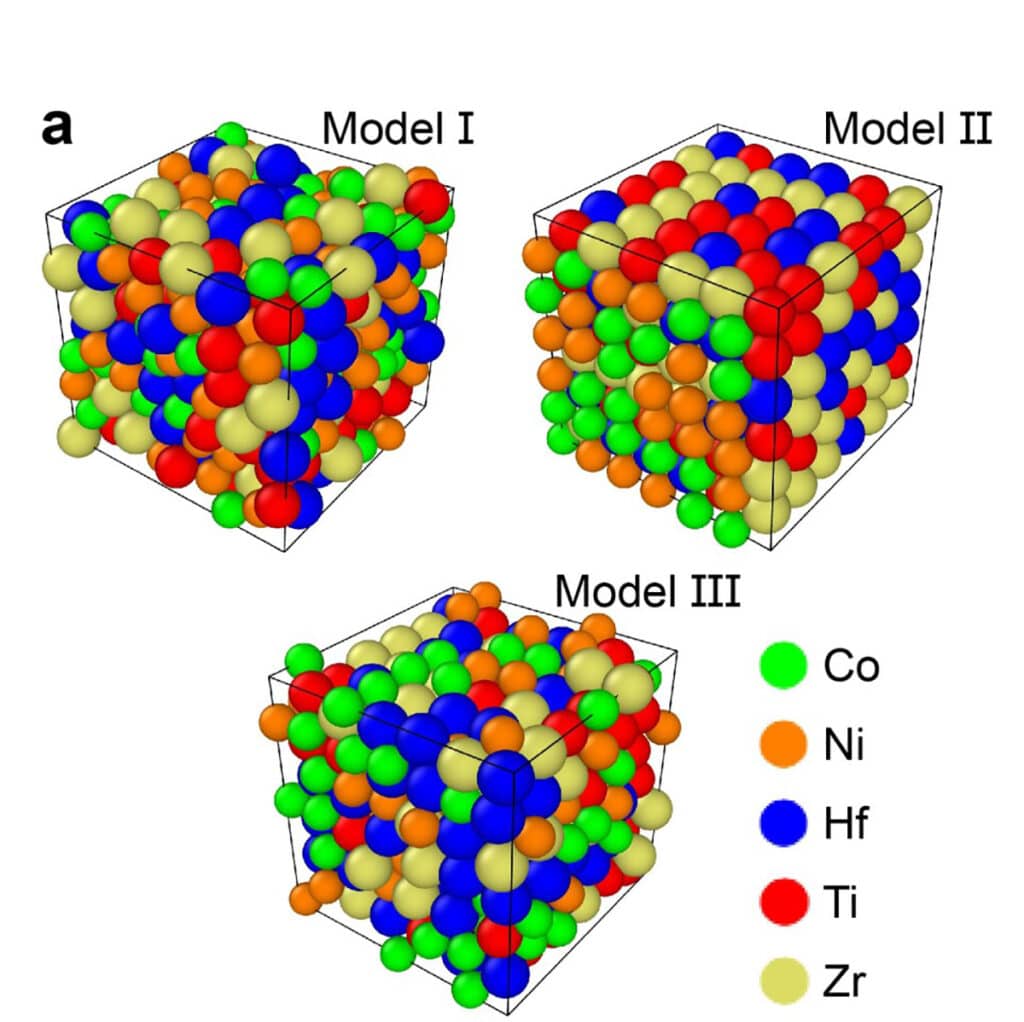
Scientists in Hong Kong have accidentally discovered a first-of-its-kind alloy – called the high-entropy Elinvar, or Co25Ni25(HfTiZr)50 – that retains its stiffness instead of softening as the temperature rises. This is the first metal known to behave this way.
A material’s resistance to elastic or non-permanent deformation under stress is quantified by its elastic modulus. The higher the elastic modulus, the harder it is to deform the material and the stiffer it will become. Until this new alloy was discovered, it was believed that thermal expansion caused all metals to soften as their temperatures increased.
However, the high-entropy Elinvar alloy, arranged into a unique, extremely-distorted lattice structure, does not follow that rule, as its elastic modulus appears to increase as temperatures rise. Where other metals soften, this chemically complex new alloy gets springier and stiffer as temperatures reach 1,000 K (1,341°F, 727°C). The team has called this “the Elinvar Effect.”

Professor Yang Yong from the Department of Mechanical Engineering at the City University of Hong Kong explained:
When this alloy is heated to 1,000K, i.e., 726.85 °C, or even above, it is as stiff as, or even slightly stiffer than, it is at room temperature, and it expands without any notable phase transition. This changes our textbook knowledge, as metals usually soften when they expand under heating.
In addition, this metal also has an elastic limit of approximately 2% at room temperature, meaning it is very springy and capable of storing a massive amount of elastic energy. So while you will require a lot of energy to deform it, it warps about twice as much like a crystalline alloy before any permanent distortion occurs. The research was published on February 9, 2022, in Nature’s journal.
The Professor said:
Since elasticity does not dissipate energy and therefore will not generate heat, which can cause devices to malfunction, this super-elastic alloy will be useful in high-precision devices, such as watches and chronometers.
The team also envisions the new alloy being particularly useful in aerospace engineering, in which machinery and devices endure drastic temperature changes.

Professor Yang added:
We know that the temperature ranges from 122°C to -232°C on the surface of the moon, for example. This alloy will remain strong and intact in an extreme environment, and so it would fit very well with future mechanical chronometers operating within a wide range of temperatures during space missions.
The video below shows the incredible (now patented) high-entropy Elinvar alloy demonstrating its spring-back power in a room-temperature ball-bearing drop test.


