
Moonshot AI has quietly changed the model that powers its default coding route. Inside Kimi Code, the kimi-for-coding alias that developers and third-party tools have depended on throughout 2026 now resolves to a new checkpoint: Kimi K2.8 Preview. There was no renamed endpoint, no configuration update, and no launch banner. The change arrived in the September 11, 2026 entry of the official Kimi Code changelog, which describes the model as performing close to the flagship Kimi K3, with coding and agent capability improved across the board and significantly more efficient thinking than K2.7 Code.
For most users, the practical story is compact: near-flagship coding behavior, a one-million-token context window on every membership tier, and zero migration friction under the same model ID. For teams that pin kimi-for-coding in continuous integration pipelines or shared development environments, the operational detail matters more than the marketing, because the weights behind the alias changed while the configuration their tooling displays did not.
What follows covers what the rollout actually delivers, how the routing rules changed underneath an unchanged identifier, and what Moonshot has deliberately left unconfirmed.
What Is Kimi K2.8 Preview?
K2.8 Preview is Moonshot’s newest checkpoint in the Kimi K2 family, positioned between the previous coding model, Kimi K2.7 Code, and the open-source flagship, Kimi K3. It went live inside Kimi Code on September 11, 2026, and secondary reports indicate the same weights reached Kimi Work the same day. The company frames overall performance as approaching K3 while reasoning more efficiently than the generation it replaces.
What the official release notes confirm:
- Official name: Kimi K2.8 Preview. The word “Preview” carries real weight here. In software terms it marks a pre-release build: live and usable today, but provisional, with defaults, routing behavior, and pricing still subject to change. Moonshot has not announced a stable-release date, so nothing about this checkpoint should be treated as final.
- Model ID: still kimi-for-coding. Integrators address that string, not the version name; typing “K2.8 Preview” into a model field fails outright.
- Context window: up to 1,048,576 tokens, available on every membership tier.
- Thinking effort: adjustable at low, high, or max, with max as the default.
- Speed class: regular. The dedicated HighSpeed tier still runs on older K2.7 weights.
- Input modalities: images and video, matching the K3 one-million-token path.
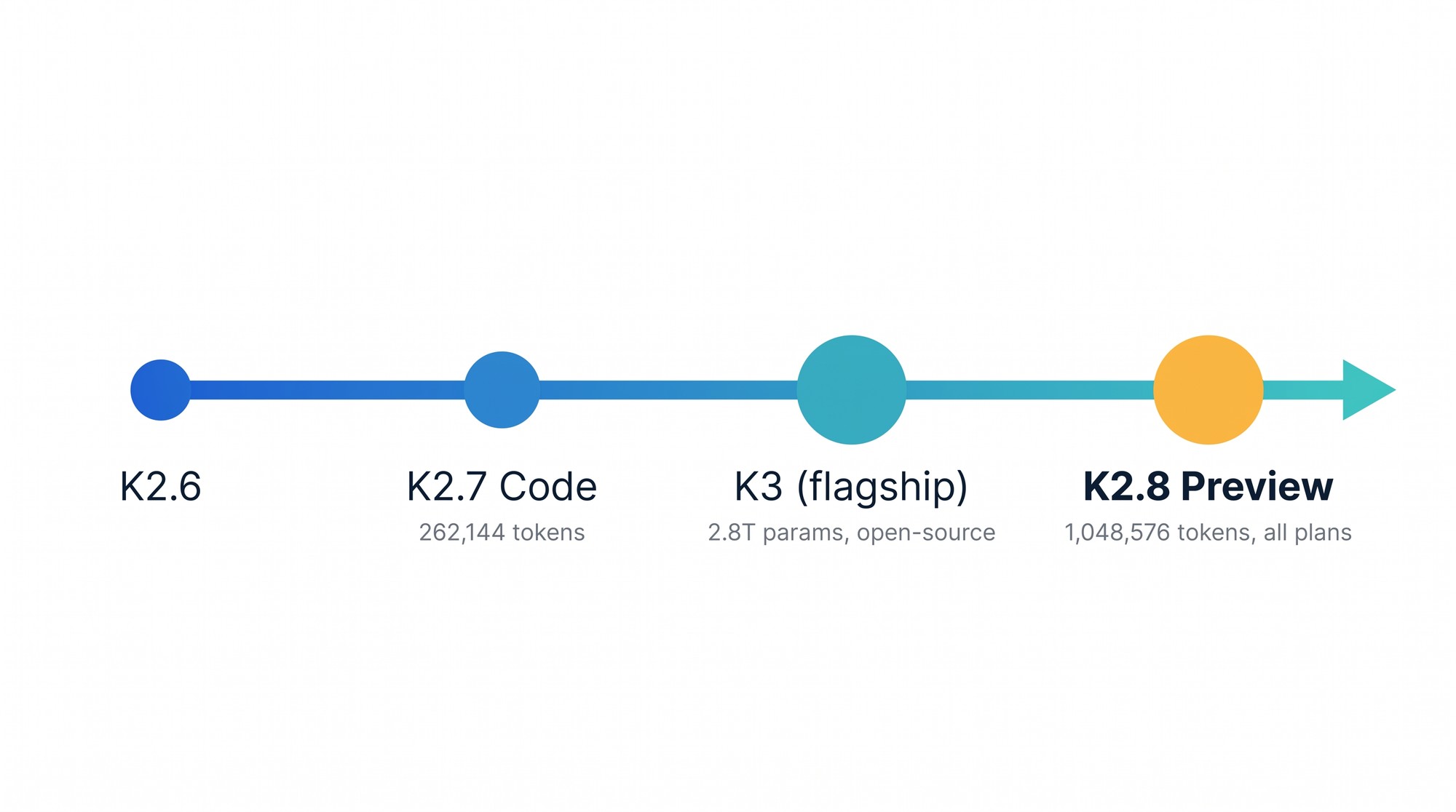
What Moonshot has not published is equally material to anyone evaluating the checkpoint: a parameter count, an architecture write-up, open weights, a public benchmark table, or a per-token price. Claims circulating online that K2.8 is a 2.8 trillion-parameter model simply borrow K3’s figure, and assumptions that it reuses K2.7 Code’s one-trillion-parameter recipe with 32 billion active parameters are speculation. As of the rollout, K2.8 Preview exists only on the Kimi Code membership surface, not on the open platform API model list.
The Model ID That Did Not Change
The most consequential detail of this release is also the easiest to overlook: the model ID stayed the same. The Kimi Code client, Claude Code, OpenCode, Codex, and other tools wired to the alias keep calling kimi-for-coding, and those requests now land on the preview weights with no configuration diff. For integrators, that continuity is the headline. The swap happened behind the identifier they already ship.
Continuity this seamless is convenient for tooling and treacherous for runbooks. Any documentation, onboarding guide, or internal wiki written earlier in the year that equates kimi-for-coding with K2.7 Code is now factually stale, even though nothing in the toolchain reports an error. The HighSpeed route is the exception that proves the rule: kimi-for-coding-highspeed still resolves to K2.7 Code HighSpeed and did not change in this rollout.
A sharper configuration trap hides in the same surface. A mistyped HighSpeed identifier can fall back to the regular route silently, with no error message and no speed penalty. Before September 11 that fallback meant regular K2.7 Code; today it means K2.8 Preview serving requests that a team believes are running on the fast tier. Verifying identifiers character by character has become part of due diligence.
One Million Tokens for Every Plan
Context length is the release’s most visible capability gain. A window of up to one million tokens is available across all Kimi Code membership tiers, extending ultra-long context well beyond the higher-plan gates that applied when K3 first opened its one-million-token window to upper memberships.
The generation-over-generation jump is stark. K2.7 Code offered 262,144 tokens of context; K2.8 Preview more than quadruples that to 1,048,576 tokens, and it does so without reserving the window for a premium plan. K3’s own one-million-token path, by contrast, still requires an Allegretto-or-higher membership.
In practice, a one-million-token window lets a single request hold an entire repository, extended build logs, or a complete technical specification in context at once, which is what makes long-horizon agent runs tractable rather than piecemeal. The economic caveat deserves emphasis: a larger window is not free capacity. Stuffing a million tokens into a one-file fix is the fastest route to exhausting weekly quota, and switching models or thinking effort invalidates the prompt cache, so consumption spikes after a swap until a fresh prefix settles. Long-context agentic coding is also an industry-wide theme rather than a Moonshot-only initiative; Zhipu AI’s GLM-5, for instance, similarly targets long-context agentic code engineering, which places this rollout inside a broader competitive pattern.
Adjustable Thinking and the Routing Trap
K2.8 Preview inherits the thinking controls introduced with the K3 series. Reasoning effort is adjustable at low, high, or max, with max as the out-of-the-box default. The dial carries direct cost implications: max spends reasoning tokens that are invisible in the editor but plainly visible in quota consumption, while low or high comfortably handles routine diffs.
The routing rule is where operators get caught. When thinking is disabled, requests aimed at either the K3 series or K2.8 Preview are both served by K2.8 Preview without thinking. A K3 selection with thinking turned off is therefore not a quieter K3; it is a different model executing the request on preview weights.
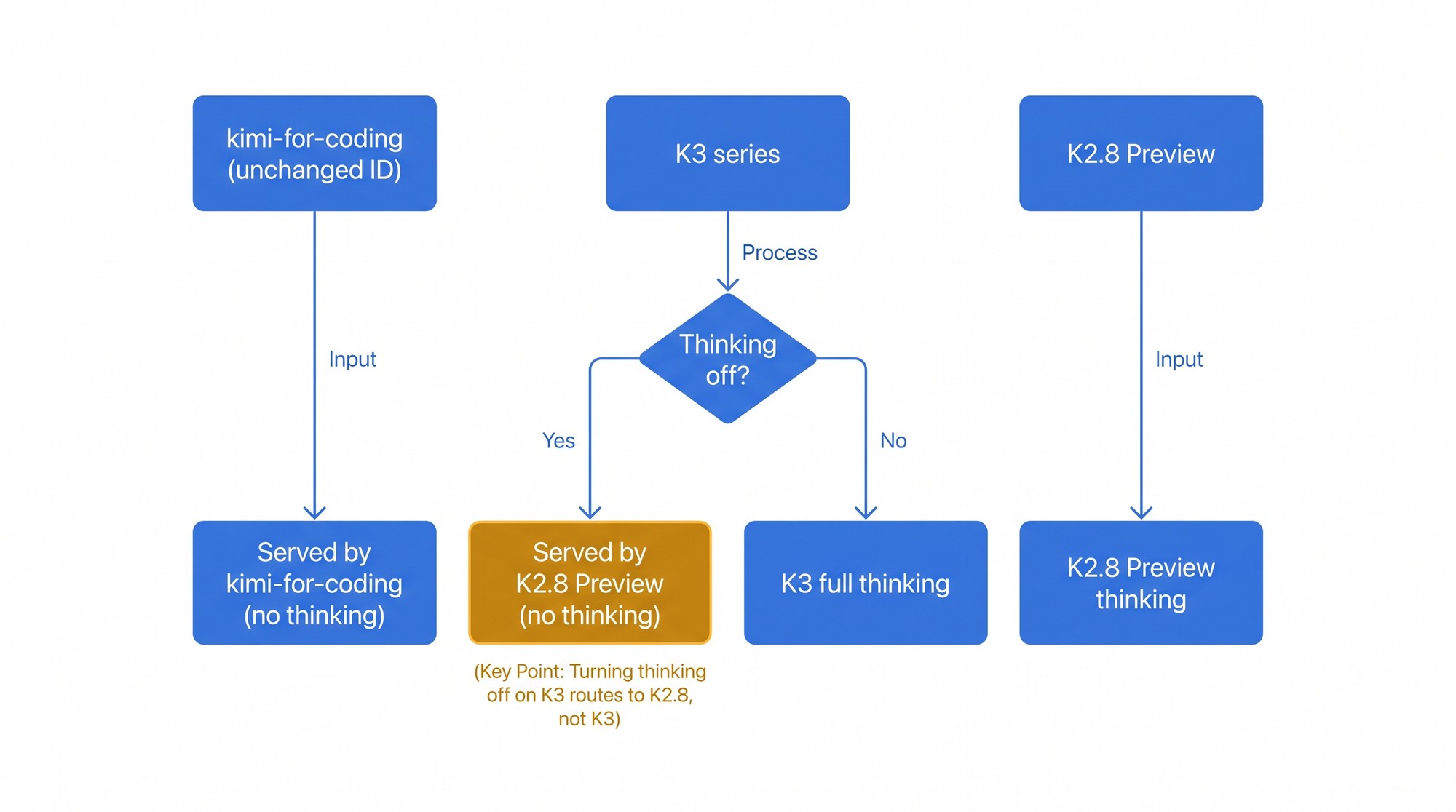
The implication for benchmarking is concrete. Any A/B comparison or regression suite that toggles thinking off cannot attribute its results to K3, because those requests never reached K3’s reasoning stack. Logging the resolved model alongside outputs is the only reliable way to know which checkpoint actually served a given run.
K2.8 Preview vs K3 vs K2.7 Code HighSpeed
Three models in the current lineup are routinely confused, partly because two of them share a base identifier and partly because the changelog places them in adjacent sentences. Their roles, however, are distinct.
| Feature | K2.8 Preview | K3 | K2.7 Code HighSpeed |
|---|---|---|---|
| Model ID | kimi-for-coding | k3 / k3-256k | kimi-for-coding-highspeed |
| Positioning | Default coding model for everyday development | Flagship for demanding, long-horizon work | Speed tier on K2.7 weights |
| Context window | 1,048,576 tokens | 1,048,576 for k3; 262,144 for k3-256k | 262,144 tokens |
| Membership access | All tiers, including the 1M window | Moderato and above; 1M window requires Allegretto | Allegretto and above |
| Reasoning effort | low / high / max; default max | low / high / max | Thinking stays on; cannot be disabled |
| Visual input | Images and video | Images and video on k3 | Images |
| Speed class | Regular | Regular | Roughly 5 to 6 times faster output |
The useful framing is that K2.8 Preview replaces K2.7 Code as the everyday default, not K3 as the performance ceiling. If a team split work last month between K2.7 Code for shipping and K3 for demanding tickets, that division of labor still holds; only the default’s name changed. Long-horizon engineering work, kernel-level optimization, and multi-module refactors remain K3 territory, while latency-sensitive workflows remain on HighSpeed, which this rollout left untouched.
What It Means for Developers and Automation
For teams pinning kimi-for-coding in CI pipelines, automation scripts, or shared coding environments, the silent backend swap warrants deliberate precaution. The same identifier now serves different weights, so output style, latency characteristics, and token consumption can all shift without any change in code. A short regression suite executed against kimi-for-coding before and after the swap is the only dependable way to establish whether the new default preserves a project’s baseline behavior.
Practical habits that keep the upgrade clean:
- Confirm the resolved label. In the CLI, run the model command and verify the picker shows K2.8 Preview on kimi-for-coding. If the label looks stale, log out and back in, or restart the editor extension.
- Start a fresh session after switching. Model and effort changes invalidate the prompt cache, so token consumption spikes until a new context settles.
- Log resolved models, not nicknames. Automated pipelines should record which checkpoint served each request, because routing can move beneath a stable identifier.
- Verify the HighSpeed suffix. Workflows expecting the fast tier should confirm the identifier ends in -highspeed, since typos fall back silently to the regular route.
- Re-baseline token budgets. Because thinking now defaults to max, routine tasks can consume more reasoning tokens than the previous generation did.
Client-side updates shipping in the same window are separate from the model swap but relevant to operators upgrading both at once. Experimental Tower multi-agent collaboration on the web, text-selection annotations, and revised CLI permission modes all alter the harness without altering which model answers; the changelog logs them as distinct entries, and tracking them separately is the clearest way to attribute behavioral changes. Latency-sensitive agentic workflows are also under industry-wide design pressure, as Mercury 2’s diffusion-based approach to reasoning speed illustrates, which makes the untouched HighSpeed tier worth revisiting rather than assuming.
What Is Still Not Confirmed
Since this release is still in preview, key questions remain unresolved, and treating unverified speculation as operational fact risks costly missteps:
- No stable-release date. The notes do not say when, or whether, K2.8 Preview becomes a stable release.
- No benchmark table. Moonshot published no comparison table for this rollout, unlike the K2.7 Code release, which cited specific gains over K2.6 on Program-Bench, MCP Mark Verified, and SWE Marathon alongside a 30 percent reduction in reasoning-token usage.
- No published size or price. No parameter count, no architecture details, no per-token rate on the open platform.
- No open weights. K2.8 Preview does not appear on the open platform model list, and no Hugging Face release exists.
- Pricing and quota treatment. It remains unconfirmed whether quotas or pricing change when the preview promotes to a stable release.
The contrast with the previous release is worth visualizing rather than asserting. The last coding checkpoint Moonshot quantified arrived with concrete double-digit benchmark gains, as the chart above shows; K2.8 Preview arrived with qualitative claims of performance “close to K3” and little else. Until quantitative evidence lands, the model is best understood as a Kimi Code membership release, and building production backends on an identifier absent from the open platform list amounts to betting on a roadmap rather than a specification.
Frequently Asked Questions
Is Kimi K2 Being Discontinued?
No. K2.8 Preview does not retire the K2 line; it becomes the new default checkpoint behind kimi-for-coding while K2.7 Code HighSpeed remains available as the dedicated speed tier. The naming suggests a clean generational handoff that has not actually occurred, since both generations remain addressable.
Is Kimi K2.8 More Powerful Than K2.7 Code?
Moonshot reports coding and agent capability improved across the board relative to K2.7 Code, with more efficient thinking, and positions overall performance as close to the flagship K3. Independent benchmark evidence has not been published, so the magnitude of the gap remains company-reported for now.
What Is Special About K2.8 Preview’s Context Window?
The window reaches 1,048,576 tokens, and unusually, that full capacity is available on every membership tier. K2.7 Code capped at 262,144 tokens, and K3’s one-million-token path requires a higher-tier membership, so this release effectively democratizes ultra-long context within Kimi Code.
Do I Need to Change My Configuration to Get K2.8?
No. The model ID remains kimi-for-coding, so existing clients and third-party tools pick up the preview weights without configuration changes. The meaningful actions are confirming the resolved model label in your client and starting a fresh session so the prompt cache resets.
Can I Use K2.8 in Kimi Work or the Consumer Chat App?
Secondary reports place the same model in Kimi Work, while the verified rollout lives in Kimi Code. The consumer chat app and mobile interfaces have not been confirmed to surface K2.8 Preview; their silence on the matter reflects separate product surfaces rather than a contradiction of the coding rollout.
The Bottom Line
Kimi K2.8 Preview is a real September 11 rollout inside Kimi Code that hides in the identifier developers already use. It delivers near-flagship coding behavior, a one-million-token context window on every plan, and zero migration friction under kimi-for-coding. The details that separate a smooth upgrade from a silent regression are the routing rules: thinking-off requests aimed at K3 are actually served by K2.8, and a mistyped HighSpeed identifier quietly lands on the regular route.
Moonshot’s own model configuration documentation remains the primary reference for effort levels, routing behavior, and the unchanged model ID. For context on where Kimi sits among fast-moving coding and agentic models, it pays to track the open-weights competition pursuing similar themes, starting with how Qwen3.8 Max positions itself at the top of China’s frontier models.

