
In 2018, the California Institute of Technology (Caltech) lab of electrical engineer Lihong Wang developed a camera that can take 10 trillion frames per second. The device, called phase-sensitive compressed ultrafast photography (pCUP), is so fast that it can even capture light traveling in slow motion.
They then evolved the technology so it could also capture transparent objects (such as water cells) and other phenomena (such as shockwaves) invisible to the naked eye. They called the new camera lossless encoding compressed ultrafast technology (LLE-CUP). These sorts of devices are called streak cameras – which are machines that can capture an entire event in one shot and record lightwaves in real-time.
The researchers were able to capture the movement of a shockwave through water with the camera, as well as a laser pulse through a crystalline material. Wang sees it ultimately being used in fields such as chemistry, biology, or physics. For example, it could someday be used to record the signals that travel through neurons at a microscopic scale.
Wang said:
As signals travel through neurons, there is a minute dilation of nerve fibers that we hope to see. If we have a network of neurons, maybe we can see their communication in real-time. In addition, because the temperature is known to change phase contrast, the system may be able to image how a flame front spreads in a combustion chamber.
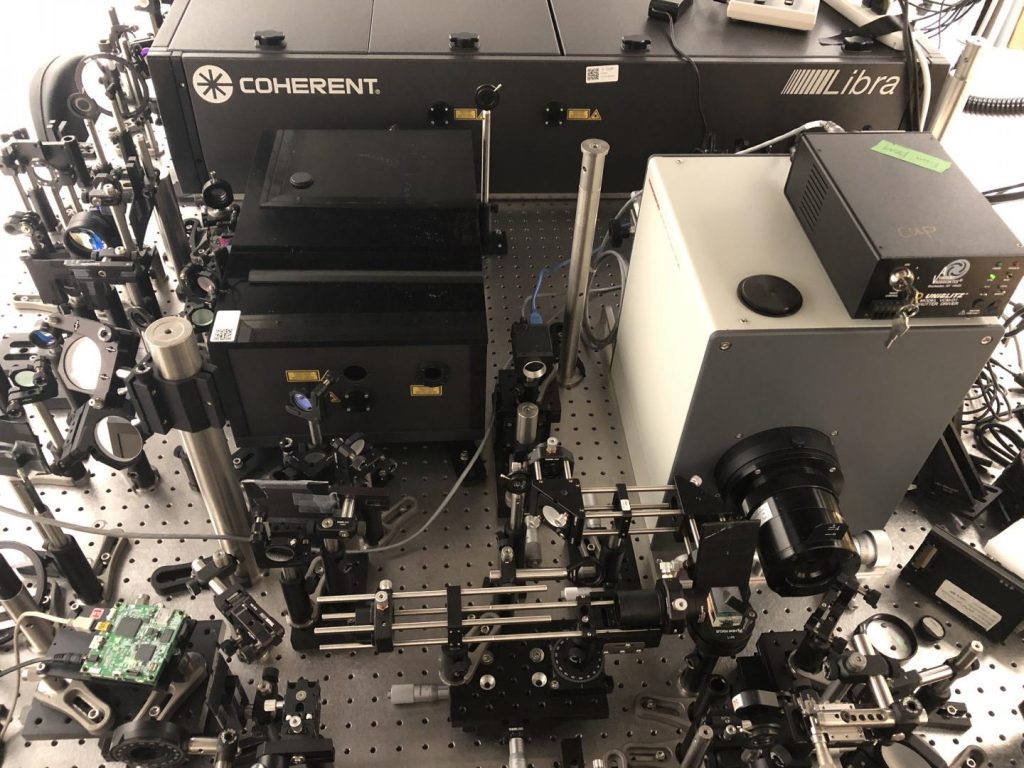
This year, Wang’s team has developed an even more impressive device – a camera that can take as many as 70 trillion frames per second! That’s fast enough to see fluorescent decay of molecules and light waves in motion. This newest camera technology is called compressed ultrafast spectral photography (CUSP).
The researchers envision the CUSP technology being used to help create smaller and more sensitive electronics (next-generation semiconductor miniaturization), as well as explore life sciences and probe the ultrafast world of fundamental physics.
Wang said:
We envision applications in a rich variety of extremely fast phenomena, such as ultrashort light propagation, wave propagation, nuclear fusion, photon transport in clouds and biological tissues, and fluorescent decay of biomolecules, among other things.
These cameras are not the same as the camera’s you are familiar with. They use extremely short pulses of laser light – ones that last only one femtosecond, which is one quadrillionth of a second. These pulses are then split up by a system of optics to even shorter flashes that then strike a specialized sensor in the camera to produce an image. With the CUSP camera, this process happens 70 trillion times in one second! That’s mind-boggling speed.


