
Scientists around the globe are making major strides in the science of biodegradable plastics. Michigan State University researchers announced their successful development of a compostable plastic alternative, which is set to significantly cut down on plastic waste. The team combined a bio-based polymer blend that can be composted in both domestic and industrial environments.
This polymer blend, known as polylactic acid (PLA), was chosen due to its promising properties. Derived from plant sugars rather than petroleum, PLA’s waste products are entirely natural and include water, carbon dioxide, and lactic acid. Professor Rafael Auras, a leading scientist on the project, said the innovative use of plant sugars has all the right ingredients to potentially reduce plastic waste that typically ends up in landfills.

However, a major drawback with PLA is that it only decomposes in the heating conditions found in industrial composters. To bypass this problem, researchers introduced a carbohydrate-derived material called thermoplastic starch into PLA. This modification allows microbes to break down the bioplastic quicker and more efficiently. Despite this modification, the product retains PLA’s original desirable features, such as clarity and strength. The final bioplastic composition is safe to be composted alongside food, making it free from the step that usually necessitates cleaning food out of containers before they can be disposed of.
In a parallel development, University of Washington researchers created bioplastic from a rather unconventional source: powdered blue-green cyanobacteria cells, also known as spirulina. Cyanobacteria are an attractive choice because they absorb carbon dioxide as they grow, further reducing greenhouse gas emissions. Manufacturing the bioplastic is carbon-neutral, and improvements to the process could potentially make the process carbon-negative. Their unique fire-resistant properties also distinguish spirulina-based plastics from traditional solutions, making them suitable for high-temperature environments such as server racks.
Considering their superior mechanical properties, these spirulina bioplastics have at least one other big potential. They can decompose at the same rate as a banana peel in a backyard compost bin, breaking barriers previously faced by other bio-based plastics. Despite these advances, the rapid biodegradability of these materials should not be mistaken for a license to litter. Biodegradable materials need specific conditions to decompose in a timely fashion. Outside of these active composting conditions, such waste can be just as problematic as regular litter.
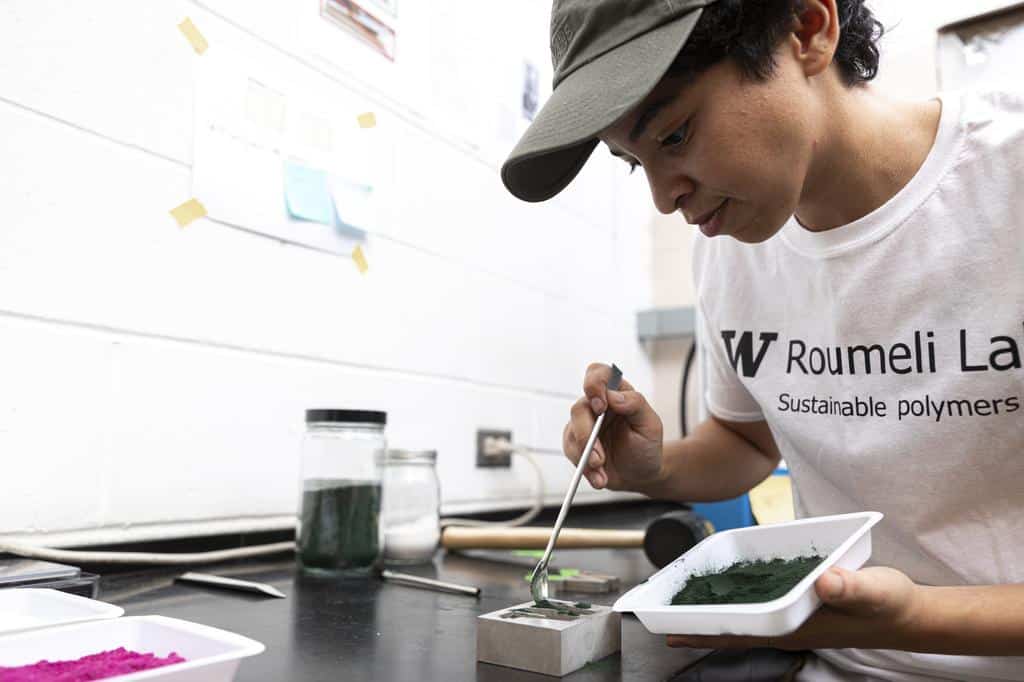
“Biodegradation is not our preferred end-of-life scenario. Our spirulina bioplastics are recyclable through mechanical recycling, which is very accessible. People don’t often recycle plastics, so it’s a bonus that our bioplastics degrade quickly in the environment,” says Eleftheria Roumeli, the study’s senior author and University of Washington Assistant Professor of Materials Science and Engineering.
“The bioplastics we have developed have a degradation profile similar to organic waste and are, on average, ten times stronger and stiffer than previously reported spirulina bioplastics. These properties open up new possibilities for applying spirulina-based plastics in various industries, including disposable food packaging or household plastics like bottles or trays.”
These studies highlight both the progress and challenges in the bioplastics sector. Completely compostable bio-based plastic packaging fabricated using PLA and thermoplastic starch demonstrates the important part scientific innovation can play in managing plastic waste. Similarly, spirulina-based plastic introduces a new potential solution formulated from readily available natural resources. However, public misconceptions about biodegradable materials and industrial discomfort with novel plastics are social and behavioral obstacles that need to be overcome to have these inventions introduced into active waste-management scenarios.
The fight against plastic waste is a vast wraparound issue. It requires not only scientific advancements but also public education and systemic changes in waste management. Converting these scientific breakthroughs into commercial successes requires a collective responsibility to correctly manage waste, a shift in behavioral patterns, and a greater appetite to embrace sustainable options. Scientific innovation is certainly leading the way, but societal commitment must ensure that these new materials are implemented successfully, helping us transition to a more sustainable future.
The study Breaking It Down: How Thermoplastic Starch Enhances Poly(lactic acid) Biodegradation in Compost─A Comparative Analysis of Reactive Blends was published in the journal ACS Sustainable Chemistry & Engineering.
The study Fabricating Strong and Stiff Bioplastics from Whole Spirulina Cells was published in Advanced Functional Materials.


