
Over the last year, insurance brokers have fundamentally changed their approach to renewals. What was once a simple formality has been replaced by exhaustive questionnaires—pages of detailed questions scrutinizing cybersecurity setups, from multi-factor authentication and endpoint detection to incident response plans and email security. For business leaders, this intense scrutiny has quickly become the new normal, shifting cyber insurance from a simple line item to a major operational hurdle.
This shift is causing a scramble as CFOs and IT leaders are now forced to find verifiable answers to questions they may have never considered. The primary driver is not a sudden internal focus on security best practices but a harsh external reality: the ability to get—or even afford—a cyber insurance policy now depends entirely on proving these advanced security controls are in place and functioning correctly.

When Insurance Companies Started Paying Attention
For years, cyber insurance was relatively easy to get. Carriers looked at revenue, industry, and data sensitivity, then issued a policy.
A significant shift occurred around 2021 and 2022. Ransomware attacks exploded, and the insurance industry started losing massive amounts of money on cyber claims.
Carriers stopped focusing on industry and started focusing on proof of specific security controls. The market flipped from “easy to buy” to “hard to qualify for.”
Premiums Made CFOs Start Caring
The financial impact is what truly got everyone’s attention. Premiums didn’t just increase; they doubled, tripled, or quadrupled, especially for companies that couldn’t prove they had modern security controls.
Atlanta-based companies with no claims history, for example, received renewal quotes that were 300% higher than the prior year. The message from the carriers was clear: “If you are high-risk, you will pay for it.”
The financial math also started to make sense. In one instance, a mid-sized logistics company was facing a $120,000 premium increase. They worked with cybersecurity services Atlanta providers to implement a new, integrated security stack (including EDR and managed SOC) for an annual cost of about $80,000. Their premium increase was then reduced to just $15,000.
The company essentially got better security for less money than the cost of the increased premiums alone.
The New Requirements Changing Everything
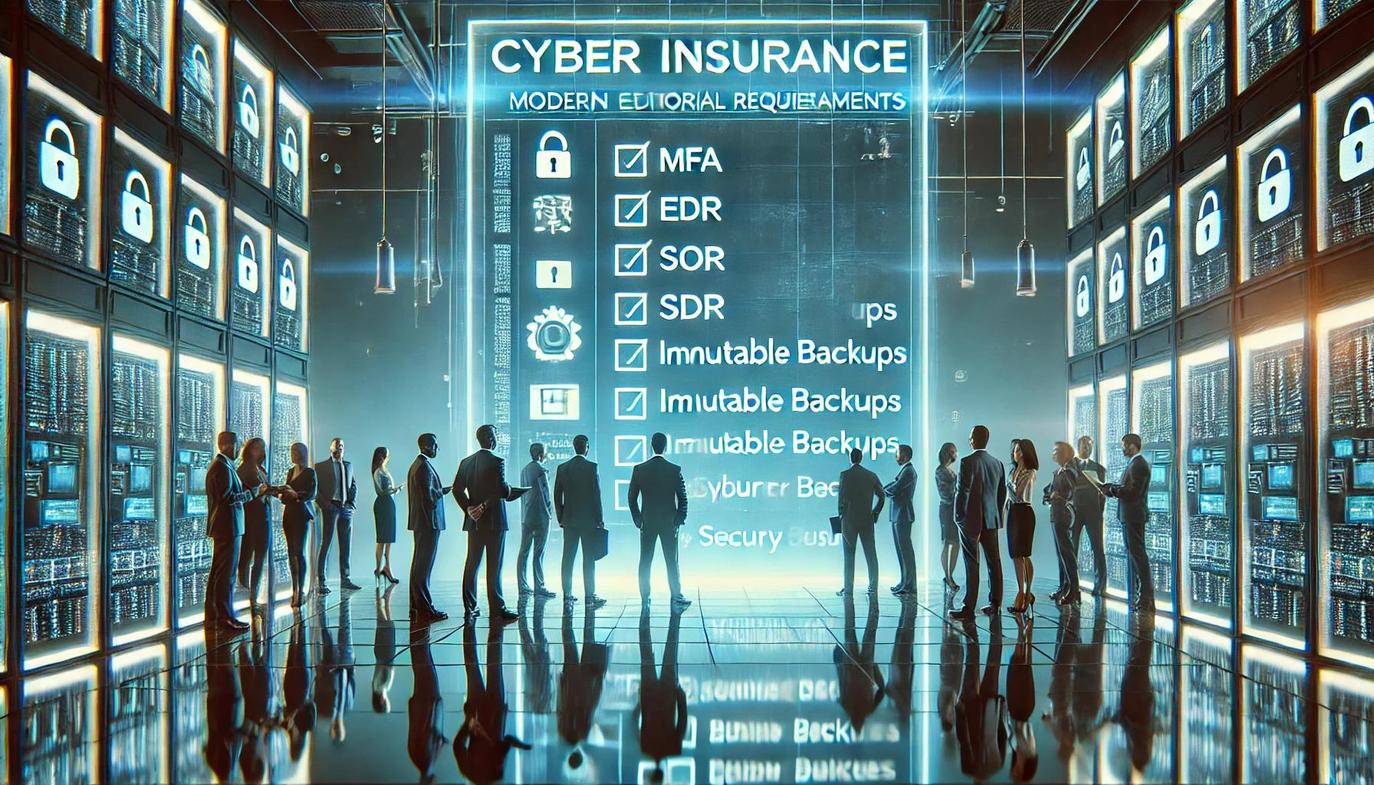
A review of a modern cyber insurance application reveals what is now considered baseline. Ten years ago, a firewall and antivirus software were enough. Today, the checklist is extensive.
Key Controls Insurers Now Mandate
- Multi-Factor Authentication (MFA): Enforced for all users, on all systems, especially for remote access (VPN) and cloud email.
- Endpoint Detection and Response (EDR): Traditional antivirus is no longer enough. Carriers want EDR (like CrowdStrike or SentinelOne) that can detect and respond to threats, not just block known viruses.
- Managed SOC: A 24/7 Security Operations Center (SOC) monitoring your EDR.
- Immutable Backups: Backups that cannot be altered or deleted by ransomware, stored off-site, and tested regularly.
- Privileged Access Management (PAM): Strict controls over who has “admin” rights.
- Incident Response (IR) Plan: A written, tested plan for what to do during an attack.
- Security Awareness Training: Regular, mandatory training for all employees on phishing and social engineering.
- Email Authentication: Validated DMARC, SPF, and DKIM records to prevent email spoofing.
This comprehensive list presents a major challenge, as many Atlanta companies are not meeting half of these requirements, creating a significant problem at renewal time.
Why This Is Actually Harder Than It Sounds
Understanding the requirements is not the challenge; they are quite clear. The difficulty lies in the fact that most companies built their security infrastructure backwards.
The “Patchwork” Problem
Tools were added reactively: a laptop theft led to implementing encryption, and the need for remote access during COVID led to setting up a VPN. There was no strategy, only reaction.
The result is a patchwork of solutions that function partially but lack integration, which is difficult to document for an insurance application. This “patchwork” is expensive to manage, full of holes, and impossible to prove to an underwriter.
Businesses in the area are consequently finding they need to hire cybersecurity services in Atlanta. The goal is not just to add another tool but to rationalize the entire security stack and build a central, provable security strategy.

What Happens if You Don’t Meet Requirements
Some companies are tempted to just “check the box” and hope for the best. This is a risky play for one primary reason:
The “Failure to Maintain Controls” Clause
Upon filing a claim, the carrier investigates. A finding that the required controls were not in place as stated can lead to a denial of the claim. Premiums would have been paid for coverage that was void from the start.
In one documented case, a logistics company was hit with ransomware. The carrier denied the $2 million claim, citing “failure to maintain controls.” The company technically had MFA turned on, but it was not enforced for all users and had undisclosed exceptions. That technicality voided their entire policy.
The Unexpected Benefit Nobody Talks About
An interesting, unprompted benefit has emerged. Companies that invested in a modern, integrated security stack to satisfy their insurance carrier also reported better business operations.
How Better Security Drives Better Business
- It Drives Modernization: The “patchwork” of old tools is replaced by a clean, integrated platform.
- It Reduces “Alert Fatigue”: IT teams aren’t chasing thousands of false positives.
- It Improves Uptime: A properly secured network has less downtime.
- It Becomes a Business Enabler: When security is built-in, you can adopt new cloud tools or remote work policies confidently.

The Strategic Next Steps for Your Cyber Insurance Renewal
For companies with an upcoming renewal, starting the process now is critical if confidence in meeting these requirements is low.
The first step is a gap analysis against your specific carrier’s requirements. This isn’t just an IT problem; it’s a financial risk problem. The CFO and the IT team need to be in the same conversation.
The choice is whether to get there before the next renewal or after an uncomfortable conversation with a broker about why the premium has tripled.
Cyber Insurance Requirements: Common Questions
What Security Controls Do Insurers Mandate?
Insurers now mandate a baseline of advanced controls, including Multi-Factor Authentication (MFA) for all access, Endpoint Detection and Response (EDR), 24/7 Managed SOC, immutable backups, and a formal Incident Response (IR) plan.
Why Did My Cyber Insurance Premium Triple?
Premiums are tripling due to the massive financial losses carriers experienced from ransomware. If a business cannot prove it has modern controls like EDR and MFA, insurers now consider it “high-risk” and are increasing premiums to cover their potential losses.
What Happens If I Fail a Cyber Insurance Questionnaire?
Failing to meet requirements can lead to a massive premium increase, a reduction in coverage limits, or an outright refusal to renew the policy. More dangerously, “checking the box” for a control you don’t have can lead to a cyber insurance claim being denied entirely.


