
A new study on Stony coral by a group of scientists from New York, California, Israel, England, and Germany is very concerning for all life on this planet.
According to the study published in Scientific Reports, Stony coral is exhibiting similar behavior traits as during the last mass extinction some 66 million years ago. How is that even possible to test, you ask?
Coral skeletons leave behind excellent fossil records for scientists, which also include behavioral traits. The dynamic survival modes the coral resort to include; “increased prevalence of deep-water residing, cosmopolitan distributions, non-symbiotic relationship to algae, solitary or small colonies, and bleaching resistance.” These are the traits present-day coral is showing.
The information from the fossil records comes from the modern International Union for Conservation of Nature (IUCN) Red List data. This is the world’s most comprehensive information source on the global conservation status of plant, animal, and fungi species.
David Gruber, a marine biologist from The Graduate Center, CUNY and Baruch College, commented on the teams’ findings:
When we finally put all this together and saw the result, for me it was that moment when the hair on the back of your neck stands up. It was incredibly spooky to witness how corals are now exhibiting the same traits as they did at the last major extinction event. Corals seem to be preparing to jump across an extinction boundary, while we are putting our foot further on the pedal.
Highlighted in the study was the fact that primates do not show survival characteristics, or have a record of mass extinction, in the way that some coral does. The team was actually able to look at fossil coral data from 250 million years ago and compared that to the extinction event 66 million years ago and compared those with the behavior being exhibited today.
The data revealed an 18% decrease in photosymbiosis, an 18% decrease in coloniality, and a 12% decrease in the occupation of shallow habitats. They also noted the evolutionary selection toward slower-growing coral, which they said may improve their chances of survival.
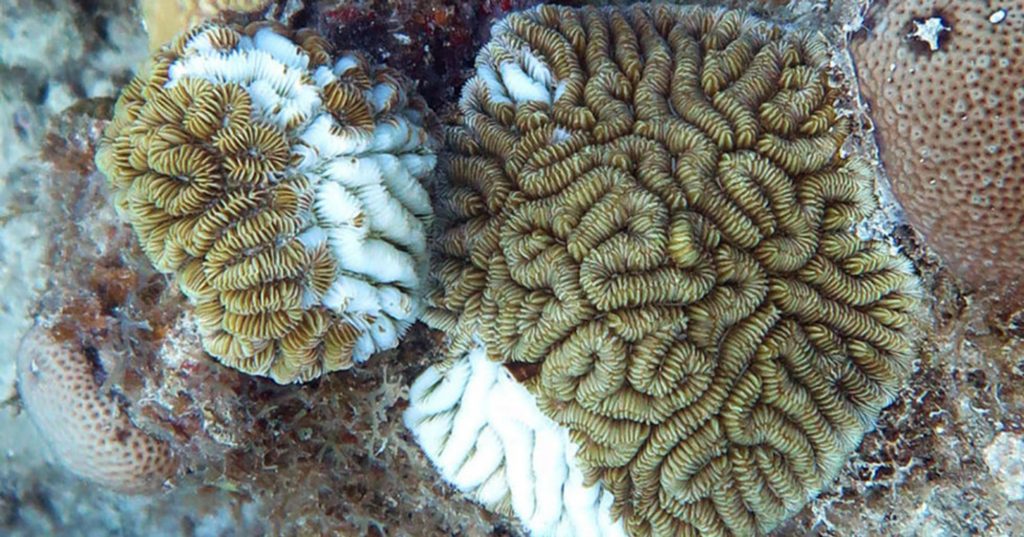
Unfortunately, coral reefs around the world are dying off. Last year a mysterious disease killed off more than half of the stony coral reef in the Caribbean, within just four months. Australia’s Great Barrier Reef has been in decline for years and a marine heatwave further threatens life there, and Red Sea corals are having a difficult time spawning, leading to a decline in their population.
A mass extinction does not mean that all life will die, but it does signify that a large percentage of the current life forms on this planet will perish. As humans, we have no idea whether or not we will be able to survive. As Gruber said to Newsweek: “Even though we think we’re so strong and resilient, we’re actually very delicate compared to other species.”
It’s obviously noted that other extinctions have taken place and humans have played no part. However, it’s also very clear that humans are playing a big part in causing the acceleration of climate change, which presents us an opportunity to correct our mistakes. But, we must act now! Gruber closed out his comments by saying:
We can put a person on the moon, we can come up with all these amazing technologies. We can reverse this in due time if we have the motivation. But what the data is showing is that we’re not doing that. We’re putting our foot further on the pedal, whereas the corals are reacting and changing.


