
Sustainable journalism today relies on a fragile economic equation. Independent reporting, sustainability coverage, investigative features, and practical solution journalism often depend on advertising revenue to stay accessible to readers. Independent solutions-focused media platforms covering climate, health, and technology often operate within ad-supported ecosystems even as they experiment with memberships, grants, and other revenue models.
Despite this journalistic necessity, the infrastructure supporting every banner impression relies on a dense web of manual workflows. Revenue operations typically involve sales teams negotiating contracts, ad ops reconciling inventory, and finance departments validating complex billing data as information flows across disconnected systems. That hidden labor, sometimes called “human middleware,” is rarely visible to readers but heavily impacts whether media businesses remain viable, much like the rising costs of managing everyday AI across residential and professional sectors.
Industry research underscores how significant that burden is. A Boston Consulting Group analysis of digital advertising operations found that only about 20 percent of campaign processing time is spent on activities that directly improve campaign performance, while the majority is absorbed by manual coordination, reporting, and system handoffs. This structural inefficiency helps explain why automation and agentic systems are now moving from experimental pilots into core revenue infrastructure.
Simultaneously, the Interactive Advertising Bureau’s 2026 outlook forecasts 9.5 percent growth in U.S. advertising spend and highlights a shift from isolated AI experiments toward scaled execution powered by agentic AI. The digital advertising market continues to expand rapidly. However, the pressure to maintain operational efficiency is intensifying as publishers move away from legacy manual workflows.
Against this backdrop, ADvendio’s newly announced “Revenue OS for Agentic Advertising” is less about a single product launch and more about a broader question. Can agentic advertising systems meaningfully reduce operational drag and strengthen the revenue engines that fund independent media?

Agentic Advertising Market Snapshot: Key Data, Growth Signals, and Infrastructure Trends
Accelerating Growth Signals
- Global ad spend is on track to surpass US$1 trillion in 2026, with digital channels capturing most of that growth according to major industry forecasters.
- The Interactive Advertising Bureau’s 2026 outlook study, which forecasts 9.5 percent U.S. ad spend growth in 2026, identifies agentic AI as a driver of scaled execution.
- Boston Consulting Group research found that only about 20 percent of campaign processing time directly improves performance, while the majority is consumed by manual workflows.
- Standards initiatives such as the Ad Context Protocol are emerging to enable interoperability between AI agents and advertising systems.
- Vendors like ADvendio are positioning “Revenue OS” platforms as unified layers that connect sales, operations, inventory, and finance.
These indicators suggest that the next competitive edge in publishing relies on operational intelligence, similar to the way intent-based search and inbound marketing redefine content structure.

The Human Middleware Tax: Why Advertising Ops Still Eats the Workday
Modern advertising operations require the seamless integration of several mission-critical platforms to maintain profitability.
- Customer relationship management (CRM) tools
- Global ad servers and inventory hubs
- Automated order management systems
- Specialized billing and reconciliation software
- Real-time reporting dashboards
This interconnected stack ensures that data flows naturally between departments without requiring manual intervention. When these systems do not natively communicate, people fill the gaps.
Quantifying Operational Friction
Manual tasks absorb roughly 80 percent of campaign processing time, according to Boston Consulting Group’s research on digital advertising efficiency. That imbalance limits how quickly teams can launch, optimize, and close campaigns, especially for those who lack integrated browser extensions to unify workflows.
Operational friction compounds rapidly across an industry where margins are often thin. These inefficiencies act as more than minor annoyances; they actively slow proposal turnaround times and increase billing disputes while reducing the overall capacity of revenue teams.
This environment necessitates the rise of agentic advertising systems. The promise is not just faster dashboards but also software agents capable of coordinating tasks across systems that previously required human intervention.

Defining Agentic Advertising and the Future of Workflows
Differentiating Reasoning from Generation
Market leaders now employ the term ‘agentic’ to describe sophisticated AI systems that move beyond text generation to coordinate complex actions.
The Salesforce Agentforce framework illustrates this by framing agents as systems that harmonize structured data with reasoning. In plain language, these systems allow an AI to retrieve relevant data and evaluate options based on predefined rules. This capability enables the software to trigger tasks like updating records or generating documents, similar to how GPU-accelerated agentic AI orchestrates engineering tasks with high precision.
The Human-in-the-Loop Safeguard
Agentic advertising does not mean removing humans from the process. Most current standards proposals, including the Ad Context Protocol, emphasize human-in-the-loop controls, schema validation, and clear boundaries for what agents are permitted to execute. The model is closer to supervised automation than autonomous decision-making without oversight.
For publishers and advertisers, the difference matters. An agent that drafts proposals, checks inventory availability, or validates billing entries can reduce repetitive work, just as automated testing frameworks now orchestrate software validation from end to end. However, final approvals, strategic decisions, and relationship management remain human responsibilities.

The Case Study: What ADvendio Says its Revenue OS Does
Startup reporting on ADvendio’s Revenue OS launch describes the system as a unified platform built to embed agentic capabilities into advertising workflows. According to the company’s launch materials, the system centers on AdOne, a hub that connects sales, inventory, operations, and finance.
The company has publicly framed the product as a way to reclaim up to 28 percent of the workday lost to manual tasks. That figure should be understood as a vendor claim. Independent research, such as Boston Consulting Group’s 20 percent value-creating benchmark, provides the broader context for why such efficiency gains are plausible in theory.
ADvendio’s suite features several core components engineered to eliminate operational drag:
- AdGateway: Operates as a universal translation layer to connect disparate systems and align with evolving industry standards.
- AdPortal: Focuses on activating long-tail and self-service advertising revenue for smaller, underserved markets.
- AdFinance: Streamlines billing validation, revenue recognition, and complex reconciliation processes to ensure audit-ready autonomy.
This orchestration implies that advertising revenue operations can function more like a coordinated operating system than a chain of disconnected manual processes.
Why Standards are Suddenly the Center of Gravity (AdCP, Tech Lab, and Interop)
Agentic systems cannot scale if every vendor builds proprietary connections. Interoperability is becoming the central question.
The Ad Context Protocol positions itself as an open framework for enabling AI agents to transact and coordinate within advertising ecosystems. It emphasizes shared schemas, structured communication, and built-in human oversight, a pattern mirrored in enterprise agentic AI platforms that combine Model Context Protocol with governed workflows.
Parallel to these efforts, the IAB Tech Lab has charted a roadmap for embedding agentic logic into established standards. Industry reporting highlights a debate between extending legacy frameworks and adopting new protocol-driven models.
Prebid, an open-source project widely used by publishers, has also signaled movement toward sell-side AI agents. That momentum suggests the conversation is not theoretical. Infrastructure layers are actively forming.
For publishers evaluating Revenue OS platforms, standards alignment may prove as important as feature lists. Systems built around emerging interoperability models are more likely to remain adaptable as the ecosystem evolves.
Monetizing the Omnichannel Long Tail through Automation
Capturing Underserved Ad Revenue
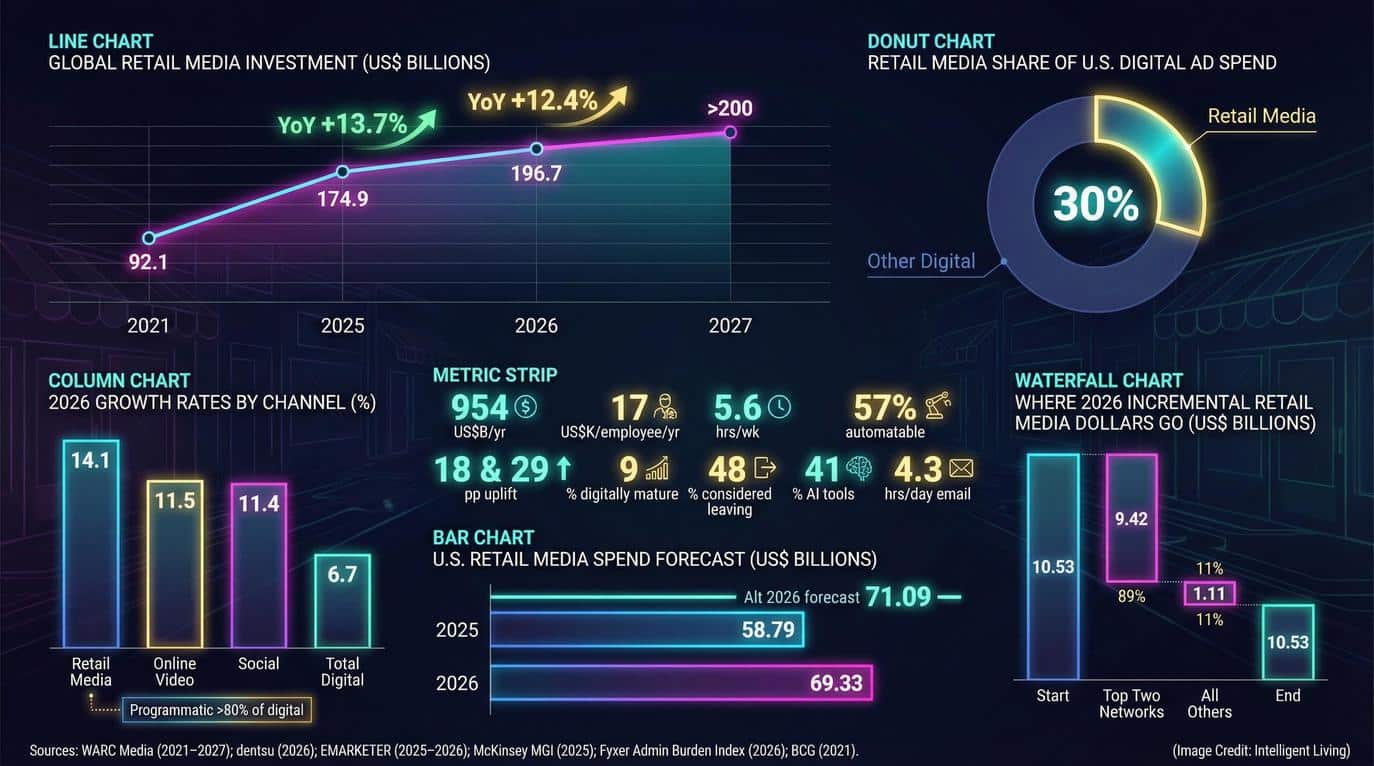
Retail media networks and streaming platforms have significantly expanded the number of monetizable touchpoints available to publishers. This includes everything from AI-powered product recommendations in e-commerce to sustainable outdoor channels for eco-brands.
Each new channel introduces additional rate cards, targeting rules, creative formats, and billing logic. This rising complexity creates an opportunity cost for manual processing, especially in sectors where retail profitability is increasingly tied to sustainable, data-driven practices.
Consequently, long-tail advertisers who do not justify heavy human involvement often remain underserved. ADvendio positions its AdPortal component as a way to activate these smaller advertisers through structured, automated workflows. Whether any given implementation succeeds depends on integration depth and data quality, but the strategic logic is clear. Automation can make previously inefficient revenue segments economically viable.
Omnichannel growth therefore intensifies the need for unified revenue orchestration rather than isolated automation scripts.
Financial Integrity and Audit-Ready Autonomy in AI Systems
Advertising revenue eventually translates into invoices, financial statements, and audited accounts. If agentic systems accelerate proposals and trafficking but introduce billing errors, trust erodes quickly.
ADvendio’s AdFinance component is presented as a safeguard layer, focusing on validation checks, reconciliation workflows, and revenue recognition logic. Those features align with a broader enterprise requirement. Automation that affects money must be transparent, logged, and reviewable, echoing how enterprise deployments of agentic AI in regulated sectors are pairing automation with strict ethical controls.
Successful adoption typically begins with limited workflows and clearly defined approval gates. Monitoring exception rates and expanding scope only occurs after accuracy benchmarks are consistently met. Agentic advertising that lacks this phased discipline risks creating new forms of operational risk.
Strict control mechanisms serve as the essential foundation for establishing trust and making autonomy viable in financial contexts.

Building Financial Resilience for Sustainable Independent Media
Transitioning to agentic advertising represents a fundamental structural necessity rather than a passing industry trend. As digital ad spend grows and workflows become more complex, publishers face mounting pressure to convert operational intelligence into financial resilience, reflecting the intense competition for datacenter control among AI empires as they secure long-term economic stability.
Data confirms that manual tasks still dominate large portions of advertising work, even as industry bodies forecast continued growth and scaled AI adoption, aligning with the scaled AI investment trends currently seen across American enterprises prioritizing productivity. Standards groups are racing to define how agents interact safely and interoperably.
ADvendio’s Revenue OS is one example of how vendors are attempting to operationalize that shift. The real test will not be launch announcements, but measurable reductions in reconciliation time, proposal turnaround, billing disputes, and manual error rates.
If agentic systems can demonstrably reduce friction while preserving accountability, they may help stabilize the economic foundations that sustain high-quality journalism and mission-driven media.
Agentic Advertising and Revenue OS FAQ
What exactly is a Revenue OS in digital publishing?
A Revenue OS is a unified platform that connects disparate advertising systems—such as CRM, billing, and ad servers—into a single intelligent layer to streamline operations.
How does the Ad Context Protocol (AdCP) benefit publishers?
The Ad Context Protocol provides the shared schema and standards needed for AI agents to interact securely and interoperably across different advertising platforms.
Can agentic systems help with billing reconciliation?
Yes, agentic advertising tools like AdFinance automate the validation and reconciliation of invoices, significantly reducing manual errors and billing disputes.
Is human oversight maintained in agentic advertising?
Modern workflows prioritize human augmentation, enabling agents to manage repetitive tasks while experts retain oversight of strategy and relationships, ensuring final approval and strategic control.
What is the primary impact of reducing human middleware?
Reducing human middleware reclaims up to 28% of the workday, allowing revenue teams to focus on high-value sales and relationship management instead of manual data entry.


